


Shibuya Corporation FY2026 Earnings In-Depth Report: Record-High Revenue and Net Income, and the Growth Roadmap Toward the Final Year of the Mid-Term Management Plan 2027

StockClub
Published: Aug 18, 2026, 09:53 AM
Sentiment Analysis

Shibuya Corporation FY2026 Earnings In-Depth Report
Shibuya Corporation’s financial results for the fiscal year ended June 2026 saw the company achieve record-high net sales and profit attributable to owners of the parent , supported by robust demand in the packaging plant business—centered on bottling systems—and a recovery in semiconductor-related sectors. While rising raw material costs, labor expenses, and depreciation charges weighed on profit margins, resulting in a slight year-on-year decline in operating profit, the figures still exceeded initial forecasts. At the midpoint of the current Mid-Term Management Plan 2027 ("Shibuya Rising Tide Strategy"), the company is steadily building a foundation for medium- to long-term growth through the development of next-generation platforms and the expansion of production capacity.
1. FY2026 Consolidated Financial Highlights
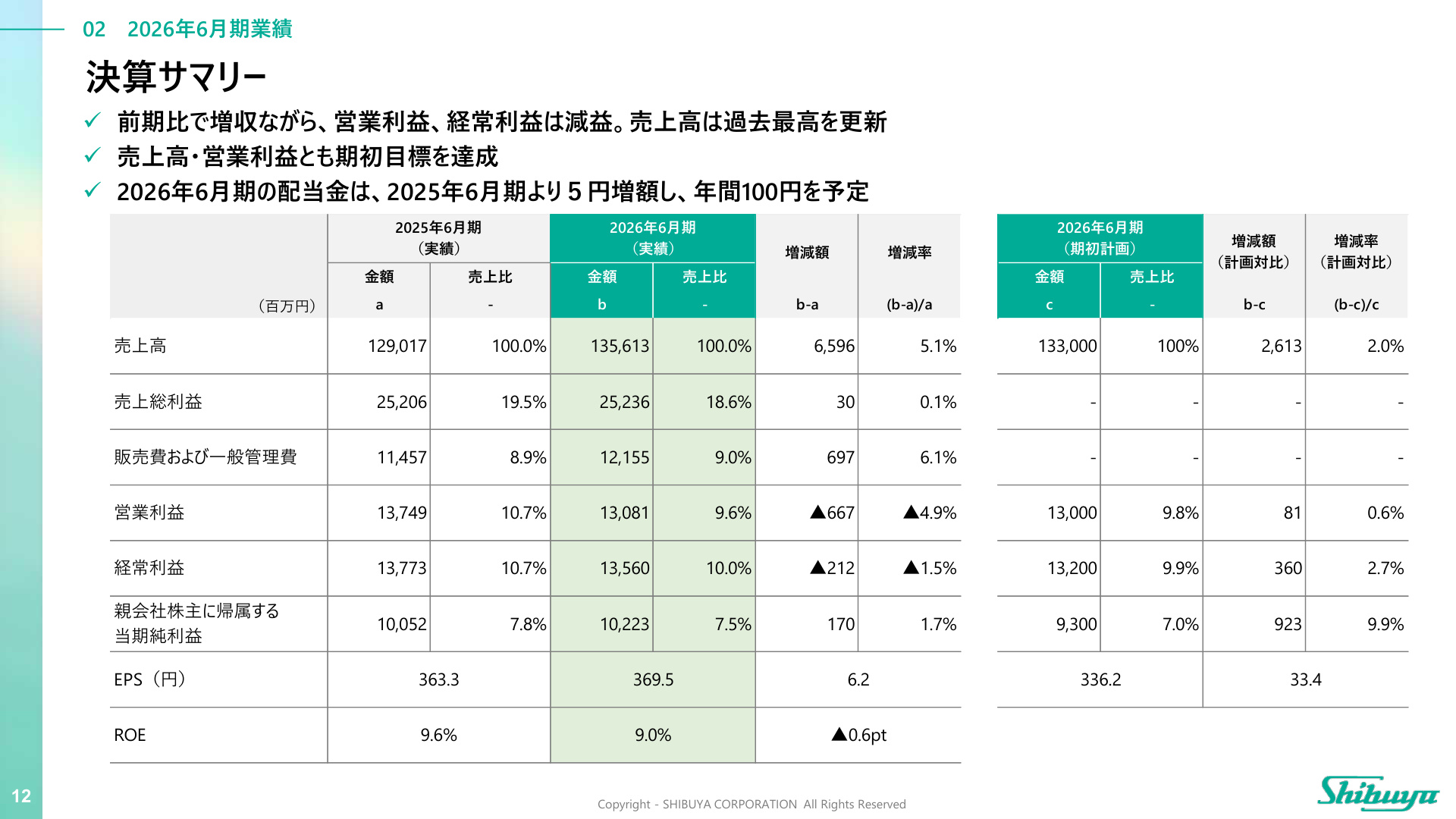
For the fiscal year ended June 2026, consolidated net sales reached 135.613 billion yen (+5.1% YoY) , operating profit was 13.081 billion yen (-4.9% YoY) , ordinary profit was 13.560 billion yen (-1.5% YoY) , and profit attributable to owners of the parent was 10.223 billion yen (+1.7% YoY) .
Background and Factor Analysis of Performance Data
As shown in the earnings summary slide above, net sales and net income reached record highs, and all items surpassed the initial full-year forecasts (net sales of 133 billion yen, operating profit of 13 billion yen, and net income of 9.3 billion yen). Earnings per share (EPS) reached 369.5 yen , and the Return on Equity (ROE) was maintained at 9.0% . Regarding dividends, the company plans an annual dividend of 100 yen , an increase of 5 yen from the previous fiscal year, further strengthening shareholder returns.
The 667 million yen year-on-year decline in operating profit was primarily due to the following factors, despite a 1.325 billion yen increase in gross profit driven by higher sales:
- Decline in Gross Profit Margin (-1.320 billion yen) : Driven by soaring raw material prices and changes in product mix.
- Increase in SG&A Expenses (-697 million yen) : Driven by higher labor costs and increased depreciation associated with the operation of new factories.
- Quarterly Performance Trends : Profitability improved sharply from the first quarter (operating margin of 4.9%) toward the end of the fiscal year. In the fourth quarter alone, the company posted net sales of 39.091 billion yen and an operating profit of 4.866 billion yen (operating margin of 12.4%), demonstrating a strong recovery.
2. Segment Performance and Profitability Analysis
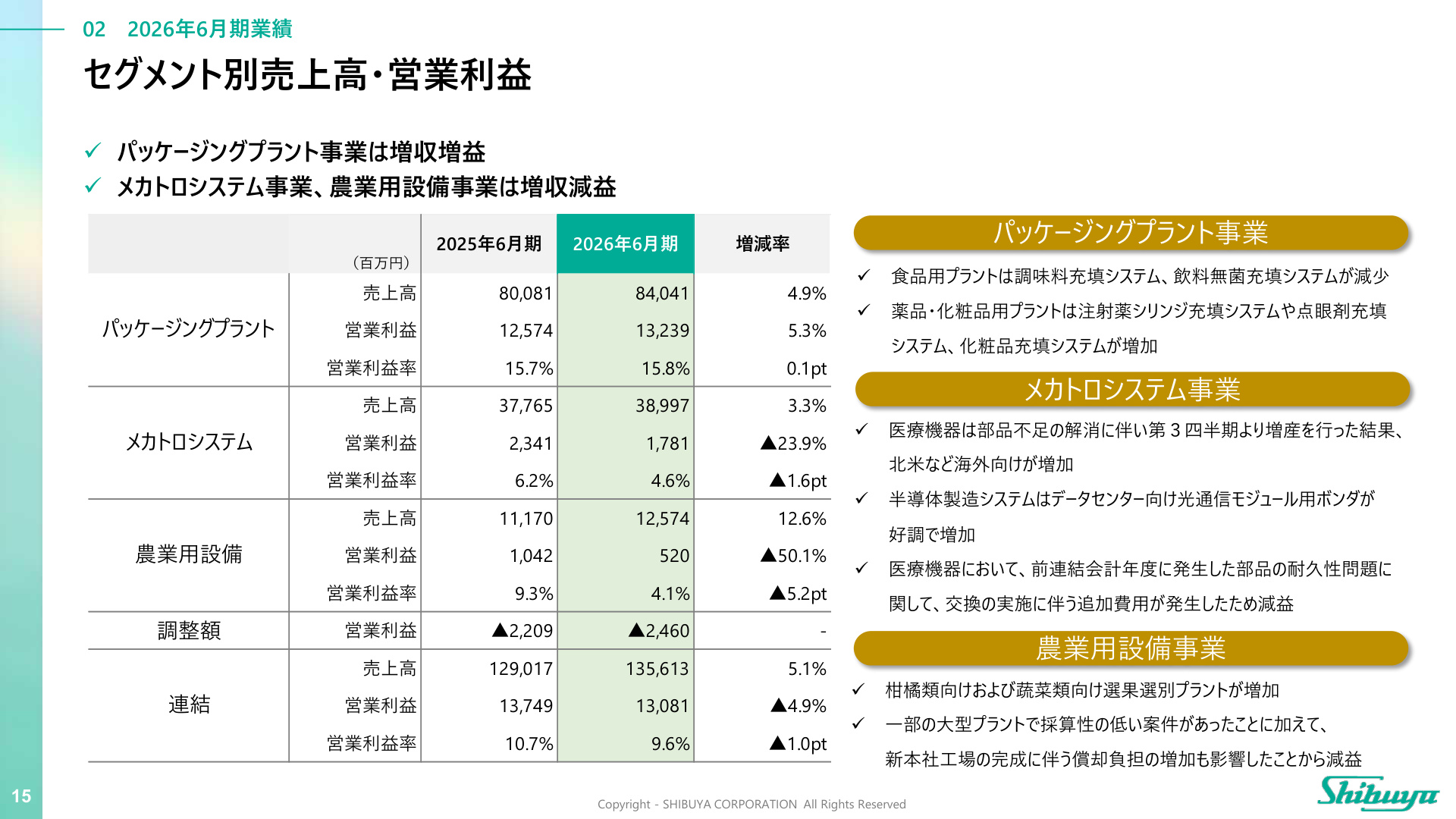
While the core Packaging Plant business drove growth in both sales and profit, the Mechatronics System and Agricultural Equipment businesses saw increased sales but decreased profits.
① Packaging Plant Business (62.0% of total sales)
- Net Sales : 84.041 billion yen ( +4.9% YoY )
- Operating Profit : 13.239 billion yen ( +5.3% YoY , operating margin 15.8% )
- Business Overview : Despite a partial decline in food plants (such as seasoning filling systems) and beverage aseptic filling systems, the business saw significant growth in high-value-added pharmaceutical and cosmetic plants (syringe filling systems for injectables, eye drop filling systems, and cosmetic filling systems) . Maintaining a high operating margin of 15.8%, this segment remains a solid pillar of the company's earnings.
② Mechatronics System Business (28.8% of total sales)
- Net Sales : 38.997 billion yen ( +3.3% YoY )
- Operating Profit : 1.781 billion yen ( -23.9% YoY , operating margin 4.6% )
- Business Overview : In semiconductor manufacturing systems, bonders for optical communication modules performed exceptionally well, driven by demand for AI servers and data centers. In the medical equipment field, while sales to North America increased due to the resolution of parts shortages, profits were pressured by additional costs incurred for free replacements related to durability issues with certain parts identified in the previous fiscal year.
③ Agricultural Equipment Business (9.3% of total sales)
- Net Sales : 12.574 billion yen ( +12.6% YoY )
- Operating Profit : 520 million yen ( -50.1% YoY , operating margin 4.1% )
- Business Overview : The segment achieved double-digit sales growth by capturing demand for fruit and vegetable sorting plants. However, profitability was significantly impacted by lower margins on certain large-scale plant projects and an increase in depreciation expenses following the completion of the new headquarters factory.
3. Regional Trends, Order Environment, and Financial Foundation
Net Sales by Region
- Domestic Sales : 80.271 billion yen ( +6.1% YoY , 59.2% of total)
- Overseas Sales : 55.342 billion yen ( +3.7% YoY , 40.8% of total) Overseas, sales to China expanded rapidly by 21.0% YoY (15.506 billion yen) , centered on aseptic beverage filling systems. Sales to North America declined by 13.8% due to a transition period in beverage plant projects, despite growth in medical equipment; however, long-term overseas expansion is progressing steadily.
Trends in Orders Received and Order Backlog
- Orders Received : 132.888 billion yen (+10.4% YoY) , with growth across all segments (Packaging +5.2%, Mechatronics +12.5%, Agricultural +38.9%).
- Order Backlog : 90.454 billion yen (-2.9% YoY) , maintaining a robust backlog that provides a solid foundation for future sales.
Financial Position and Cash Flow
- Total Assets : 173.280 billion yen (+13.854 billion yen from the end of the previous fiscal year), driven by increases in trade receivables, tangible fixed assets, and the market valuation of investment securities.
- Net Assets : 119.091 billion yen (Equity ratio of 68.7% ), maintaining an extremely sound financial position.
- Cash Flow : Operating CF secured +5.280 billion yen. Capital investment reached 8.002 billion yen (including 4.2 billion yen in acquisitions of tangible fixed assets) due to the completion of the Morimoto No. 3 Machinery Factory and down payments for three factories currently under construction, reflecting an active investment phase for future production capacity expansion.
4. Progress of Mid-Term Management Plan 2027 and Future Outlook
The company is advancing its "Mid-Term Management Plan 2027" as an intermediate step toward its long-term vision for its 100th anniversary (fiscal year ending March 2031), which targets 200 billion yen in sales by 2030.
Summary of the Second Year and Targets for the Final Year (FY2027)
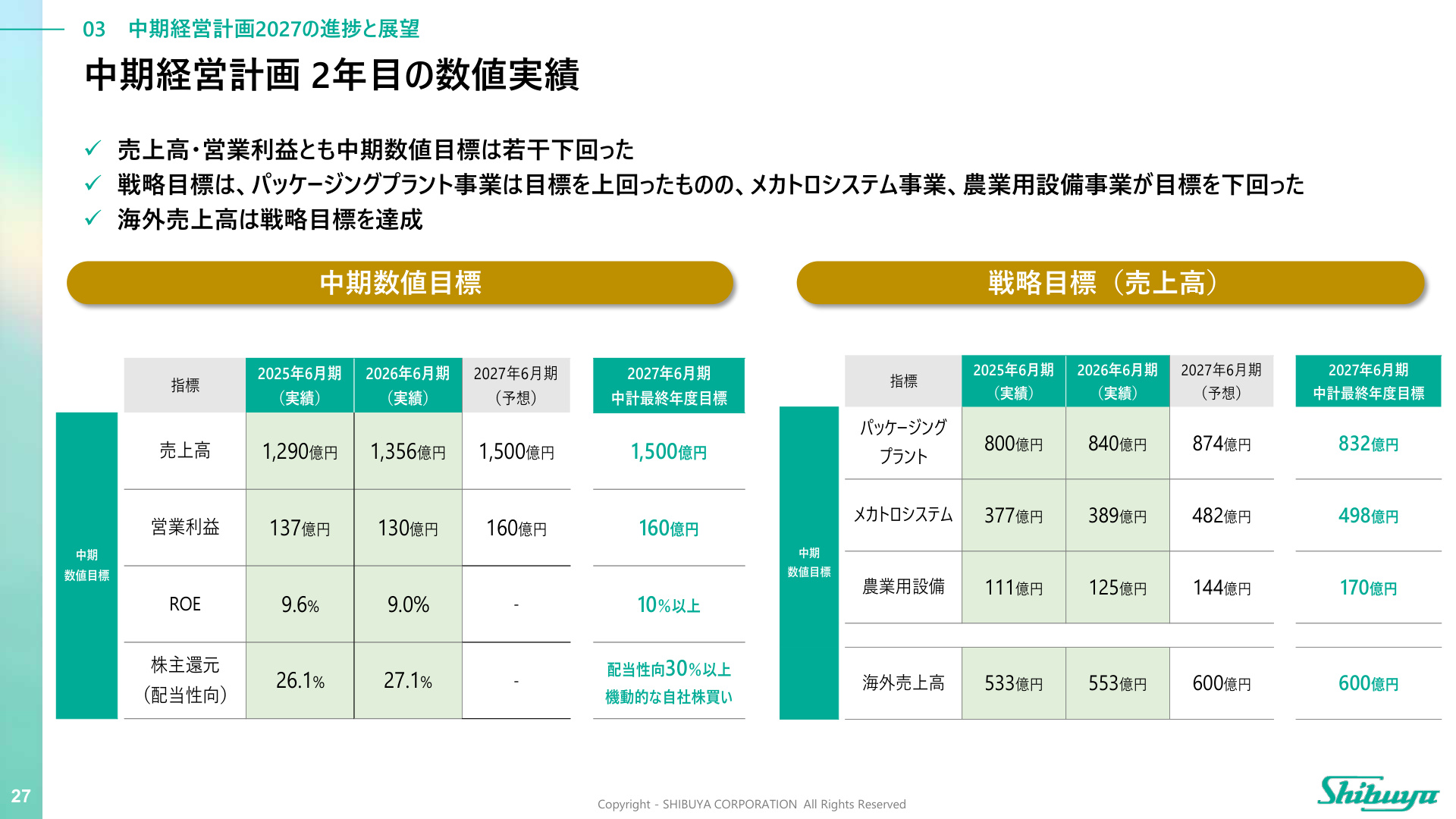
As shown in the slide above, in the second year of the plan (FY2026), the company largely maintained its trajectory with net sales of 135.6 billion yen (against a target of 138 billion yen) and operating profit of 13 billion yen (against a target of 14 billion yen). Notably, the strategic target for overseas sales reached 55.3 billion yen , achieving the second-year goal (55 billion yen) ahead of schedule.
Targets for the final year, FY2027 , are set as follows:
- Consolidated Net Sales : 150 billion yen
- Consolidated Operating Profit : 16 billion yen (Operating margin 10.7% )
- ROE : 10% or higher
- Overseas Sales : 60 billion yen (40% overseas ratio)
- Shareholder Returns : Dividend payout ratio of 30% or higher , with flexible share buybacks.
5. Strategic Initiatives to Accelerate Growth
- Innovation in Aseptic Business (ZHA Project)
- Promoting "Cost Destruction" (CD) through cross-functional collaboration among design, production, sales, and service departments. Strengthening proposals for short lead times, space-saving, and low costs through the expansion of new two-stage sterilization systems and modular standardization.
- Next-Generation Platform "SHoPS" and "MIRAI Tech Lab"
- Deployment of "SHoPS," a smart factory foundation that vertically and horizontally integrates IT, OT, and physical domains.
- Establishment of "MIRAI Tech Lab," an in-house R&D facility for next-generation advanced technologies, aiming to realize unmanned production lines by 2030 utilizing physical AI, humanoid robots, and collaborative robots.
- Creation of New Markets and Businesses
- Expanding business domains into regenerative medicine and biotechnology, such as securing orders for solid-liquid mixing/dispersion systems and automated cell culture systems for autologous cell banks.
6. Conclusion
Shibuya Corporation’s FY2026 results were resilient, achieving record-high sales and net income while absorbing high costs and temporary additional expenses. For the next fiscal year (FY2027), the company is well-positioned to achieve its mid-term targets of 150 billion yen in sales and 16 billion yen in operating profit , supported by a strong order backlog, tailwinds in semiconductor and pharmaceutical demand, and the full-scale operation of new factories. Future developments, including the move toward unmanned smart factories and expansion into the biomedical field, remain key areas to watch.
This content is not intended as investment advice or a recommendation. Any opinions expressed are solely the personal views of each article.