

RS Technologies H1 FY2026 Earnings & Mid-Term Plan Deep Dive: Capacity Expansion and Profitability Roadmap Across Wafer Reclamation and Prime Wafer Segments

StockClub
Published: Aug 17, 2026, 09:51 AM
Sentiment Analysis
1. H1 FY2026 Earnings Highlights
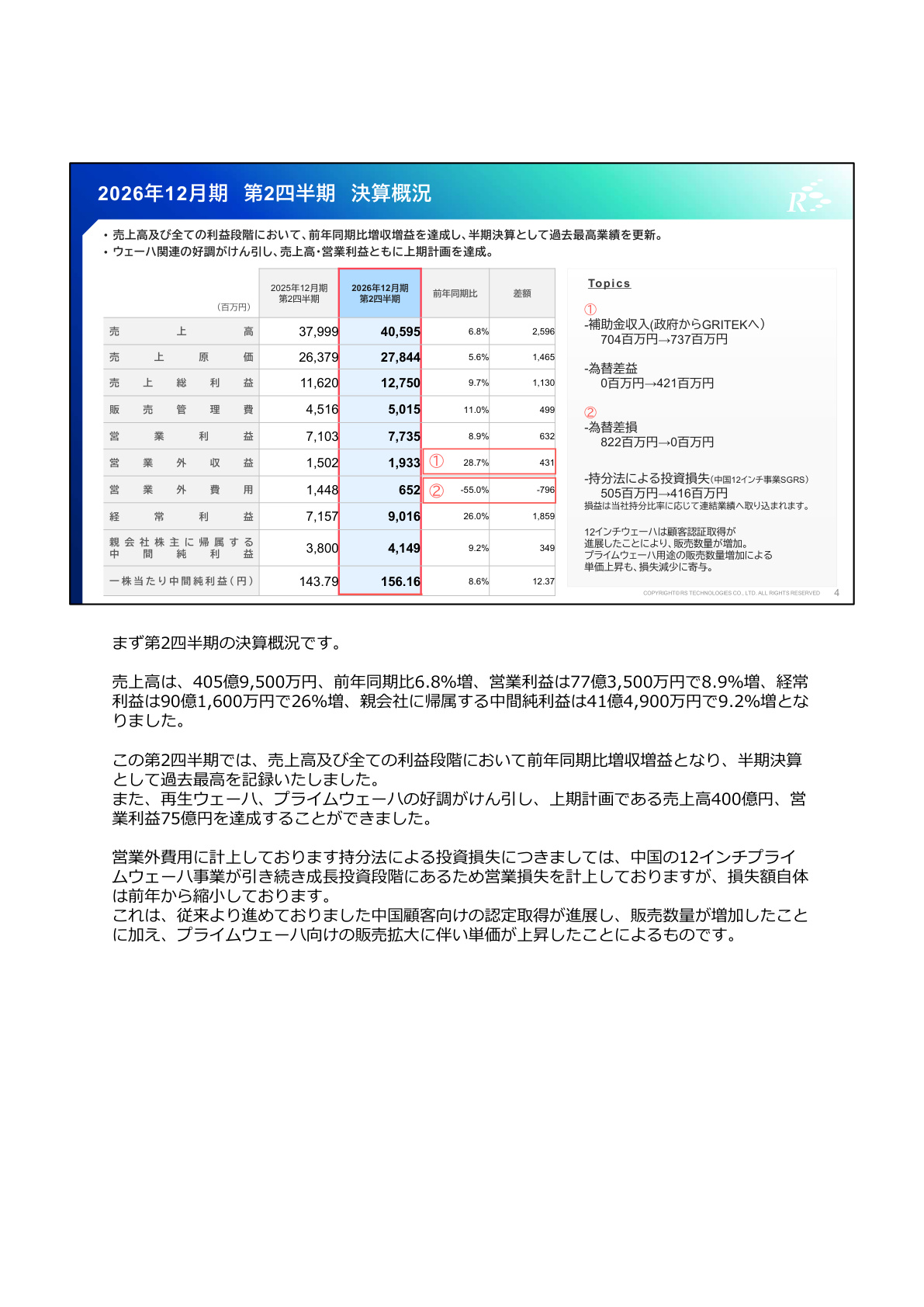
RS Technologies Co., Ltd. reported record-breaking results for the first half of the fiscal year ending December 2026. Consolidated net sales reached 40.595 billion yen (up 6.8% YoY) , operating profit 7.735 billion yen (up 8.9% YoY) , ordinary profit 9.016 billion yen (up 26.0% YoY) , and net profit attributable to owners of the parent 4.149 billion yen (up 9.2% YoY) .
The company exceeded its initial H1 targets (net sales of 40 billion yen, operating profit of 7.5 billion yen), driven by strong performance in its core wafer reclamation and prime wafer manufacturing and sales businesses.
Key Performance Drivers and Profit Structure Analysis
As shown in the earnings summary slide above, the company achieved year-on-year growth in both revenue and profit across all stages. Notably, non-operating income saw significant improvement.
- Increase in Non-Operating Income : Non-operating income reached 1.933 billion yen (up 28.7% YoY). This was supported by 737 million yen in government subsidies for the Chinese subsidiary GRITEK (compared to 704 million yen in the same period last year) and a foreign exchange gain of 421 million yen (compared to an 822 million yen loss in the previous year).
- Reduction in Equity-Method Losses : Equity-method investment losses related to the 12-inch prime wafer business in China (SGRS) narrowed to 416 million yen from 505 million yen in the same period last year. This improvement was driven by increased sales volume following successful customer certifications in China and higher unit prices due to the expansion of prime wafer applications.
2. Segment Performance and Factor Analysis
① Wafer Reclamation Business
- Net Sales : 14.284 billion yen (up 6.8% YoY)
- Operating Profit : 5.069 billion yen (up 6.9% YoY)
- Operating Margin : 35.5% (on par with the previous year)
Increased production capacity from capital investment contributed to steady growth in both revenue and profit. While the operating margin for Q2 (3 months) temporarily dipped to 32.6% (from 38.5% in Q1), this was due to temporary cost factors , including the accelerated expansion of the Tainan plant, upfront maintenance costs for the upcoming launch of the Sanbongi No. 7 plant, and concentrated periodic maintenance during the Golden Week holidays. Customer demand remains extremely robust, and further sales volume growth is expected as production capacity increases in the second half.
② Prime Wafer Manufacturing and Sales Business
- Net Sales : 13.902 billion yen (up 39.0% YoY)
- Operating Profit : 3.240 billion yen (up 39.1% YoY)
- Operating Margin : 23.3% (on par with the previous year)
For 8-inch prime wafers, the company successfully leveraged its investment to reach a record-high monthly production capacity of 270,000 units , effectively capturing moderate demand growth in the Chinese market. Additionally, the expansion in demand for silicon components —consumable parts for etching equipment—and successful new customer acquisition led to a higher proportion of high-margin products, directly contributing to significant revenue and profit growth.
③ Semiconductor-Related Equipment and Materials Business
- Net Sales : 13.642 billion yen (down 12.1% YoY)
- Operating Profit : 413 million yen (down 54.6% YoY)
- Operating Margin : 3.0%
Revenue and profit declined due to planned production cuts for optical pickup modules at RSPDH. Conversely, the next-generation energy business (including VRFB electrolyte sales and consulting) recorded sales exceeding 1 billion yen, and despite upfront investments for future growth, operating losses are on a narrowing trend compared to the previous year.
3. Mid-Term Management Plan (2026-2028) Roadmap and Growth Investment
The company has designated the three-year period from 2026 to 2028 as a "phase of intensive investment for growth acceleration," aiming for 115 billion yen in net sales, 19 billion yen in operating profit, and 13 billion yen in net profit by the fiscal year ending December 2028. It has also set capital efficiency targets of ROIC of 11% or higher and ROE of 13% or higher .
Wafer Reclamation: A Global Three-Hub Strategy for 1.19 Million Units/Month
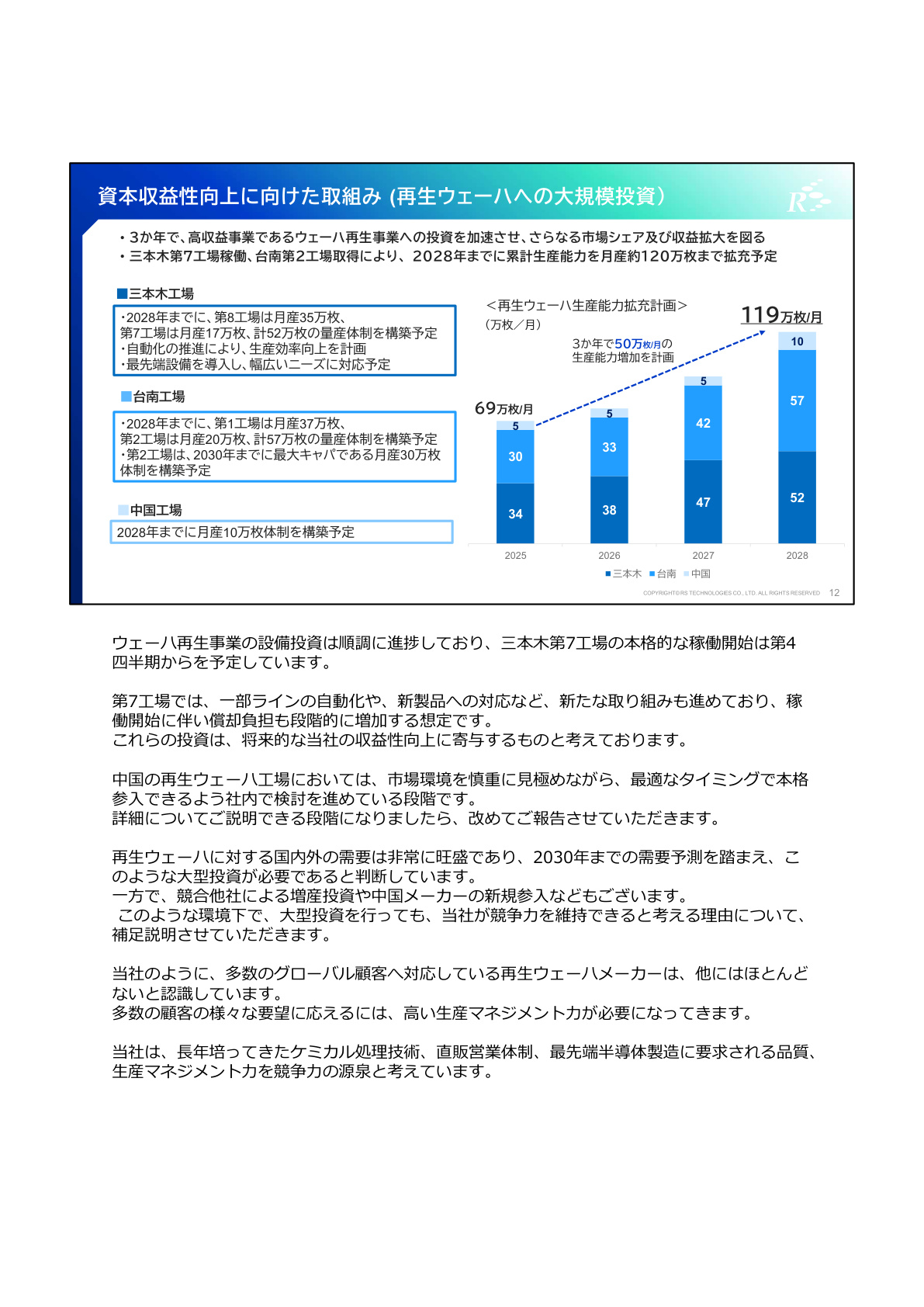
This slide outlines the global production capacity expansion plan for the core wafer reclamation business. As demand for test wafers surges due to semiconductor miniaturization and advanced packaging, the company is executing capital investments across three hubs:
- Japan (Sanbongi Plant) : Total investment exceeding 17.3 billion yen. With the full-scale operation of the No. 7 plant (170k units/month) and the expansion of the No. 8 plant (350k units/month), the company will establish a 520k units/month capacity by 2028 . Automated lines will be introduced to improve production efficiency.
- Taiwan (Tainan Plant) : Total investment of 24.7 billion yen. In addition to the No. 1 plant (370k units/month), the company is acquiring and expanding the No. 2 plant (200k units/month, expandable to 300k), establishing a 570k units/month capacity by 2028 .
- China Plant : Planned investment of 10 billion yen. The company aims to build a 100k units/month capacity by 2028 , depending on market conditions.
By increasing capacity by 500,000 units/month over three years from the 690,000 units/month at the end of 2025, the company plans to reach 1.19 million units/month by 2028 , solidifying its position as the global market leader.
4. Prime Wafer Strategy and Vertical Integration
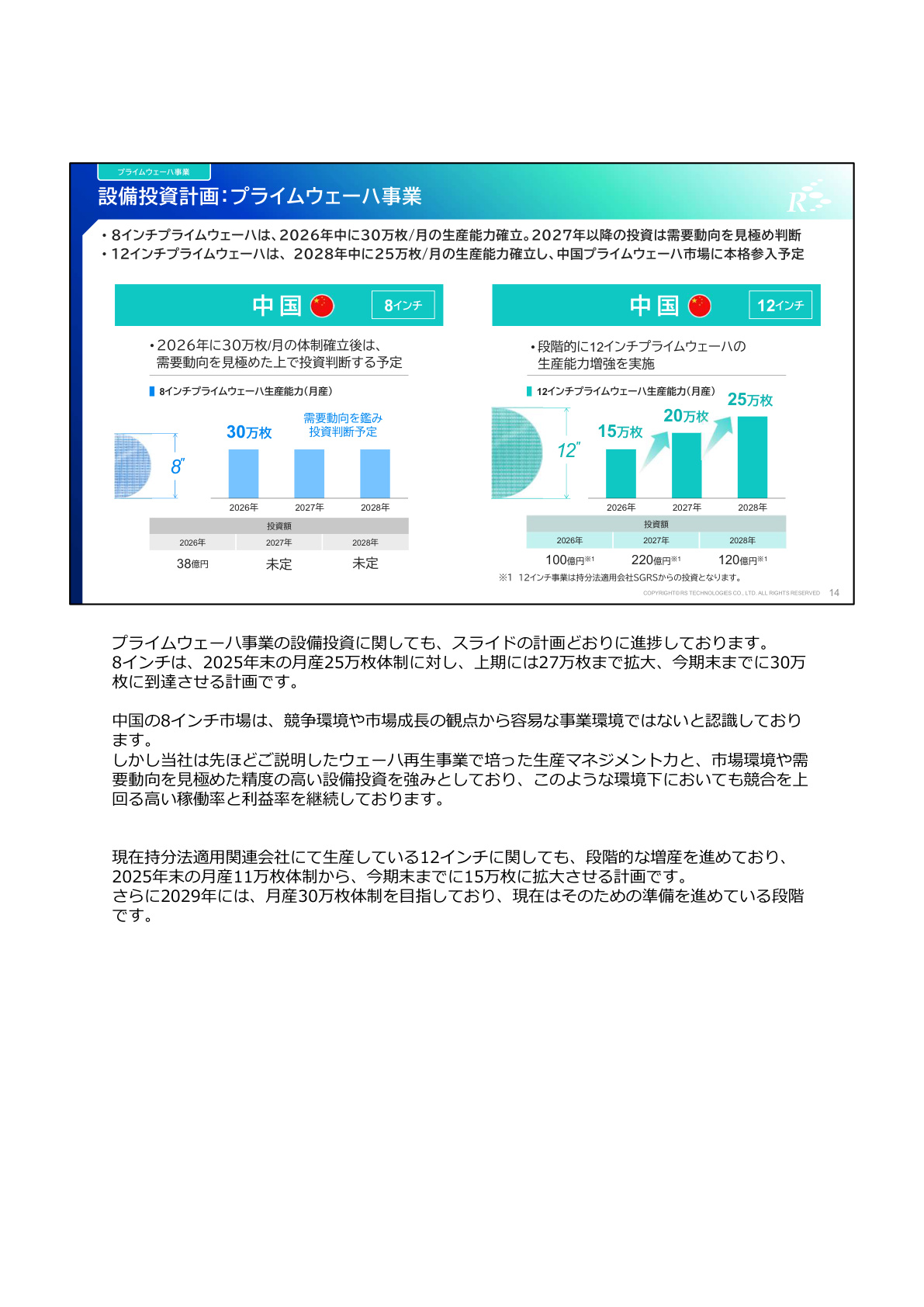
In the prime wafer business, the company is promoting phased expansion for both 8-inch and 12-inch wafers to meet local demand in China and the growing power semiconductor market.
- 8-inch Prime Wafers : A 300k units/month capacity is scheduled for 2026. High utilization rates are being maintained by capturing demand for high-voltage power semiconductors for automotive and industrial equipment.
- 12-inch Prime Wafers (Equity-method affiliate SGRS) : Capacity will expand from 110k units/month at the end of 2025 to 150k in 2026, 200k in 2027, and 250k units/month in 2028 , with 300k in sight for 2029. While focusing on power semiconductors, the company is also expanding into memory-related products to capture AI-driven demand.
- Upstream/Downstream Expansion (from Q&A) :
- Inner Mongolia Single Crystal Ingot Plant : Construction starts in July 2026, with operations scheduled for 2028. By leveraging low electricity costs and subsidies, the company will consolidate ingot production to achieve significant cost competitiveness.
- M&A of Anhui Epitaxial Plant : By internalizing 8-inch epitaxial processing capabilities, the company is preparing to sell higher value-added epi-wafers directly to device manufacturers.
5. Cash Allocation and Shareholder Return Policy
Over the three-year mid-term plan, the company has formulated an allocation policy using approximately 53 billion yen in operating cash flow and existing liquidity: approximately 57 billion yen for growth investment in existing businesses (approx. 40.5 billion yen for reclaimed wafers, approx. 3.8 billion yen for 8-inch prime wafers, etc.) and approximately 36.5 billion yen for strategic investments (M&A) .
Simultaneously, the company is strengthening shareholder returns. Compared to the annual dividend of 45 yen for FY2025 (payout ratio 12.8%), it plans a dividend of 55 yen per share for FY2026 (a 10 yen increase, with a projected total return ratio of 14.6%) . The company aims to balance growth investment with shareholder returns while improving capital profitability to exceed the cost of capital (WACC 9.0%, cost of equity 10.5%).
This content is not intended as investment advice or a recommendation. Any opinions expressed are solely the personal views of each article.