


Atlas Technologies (9563) Q2 FY2026 Earnings Deep Dive: Structural Profitability Shift and Growth Strategy Highlighted by Upward Revisions and Inaugural Shareholder Returns

StockClub
Published: Aug 14, 2026, 12:59 PM
Sentiment Analysis

Atlas Technologies (Securities Code: 9563) disclosed its Q2 FY2026 earnings presentation materials on August 14, 2026. The company announced a series of pivotal developments, including an upward revision to its full-year earnings forecast following an over-performance in the first half, the announcement of its first-ever dividend (an inaugural payment of 7 yen) , and a resolution to execute a share buyback and cancellation equivalent to 5.0% of its total outstanding shares .
This report extracts 10 key topics from the financial data and qualitative information provided, offering a comprehensive analysis of the company's performance, financial structure, client base, growth strategy, and shareholder return policies.
1. Earnings Highlights: Exceeding H1 Targets and Significantly Raising Full-Year Guidance
For the first half of the fiscal year ending December 2026, the company reported consolidated net sales of 1,187 million yen (up 112.7% YoY) , operating profit of 86 million yen (a turnaround from a 95 million yen loss in the same period last year, representing an improvement of 181 million yen) , ordinary profit of 94 million yen (up 185 million yen YoY) , and net profit attributable to owners of the parent of 68 million yen (up 157 million yen YoY) , achieving significant growth in both revenue and profit.
In response, the company revised its full-year earnings forecast:
- Full-year Net Sales: 2,400 million yen (unchanged, 49.5% progress)
- Full-year Operating Profit: 100 million yen ( 167% upward revision from the previous 60 million yen, 86.0% progress)
- Full-year Ordinary Profit: 100 million yen ( 167% upward revision from the previous 60 million yen, 94.6% progress)
- Full-year Net Profit: 70 million yen ( 175% upward revision from the previous 40 million yen, 98.6% progress)
Having already achieved the majority of its full-year plan by the end of the first half, the company is now pursuing business strategies aimed at exceeding these revised forecasts in the second half.
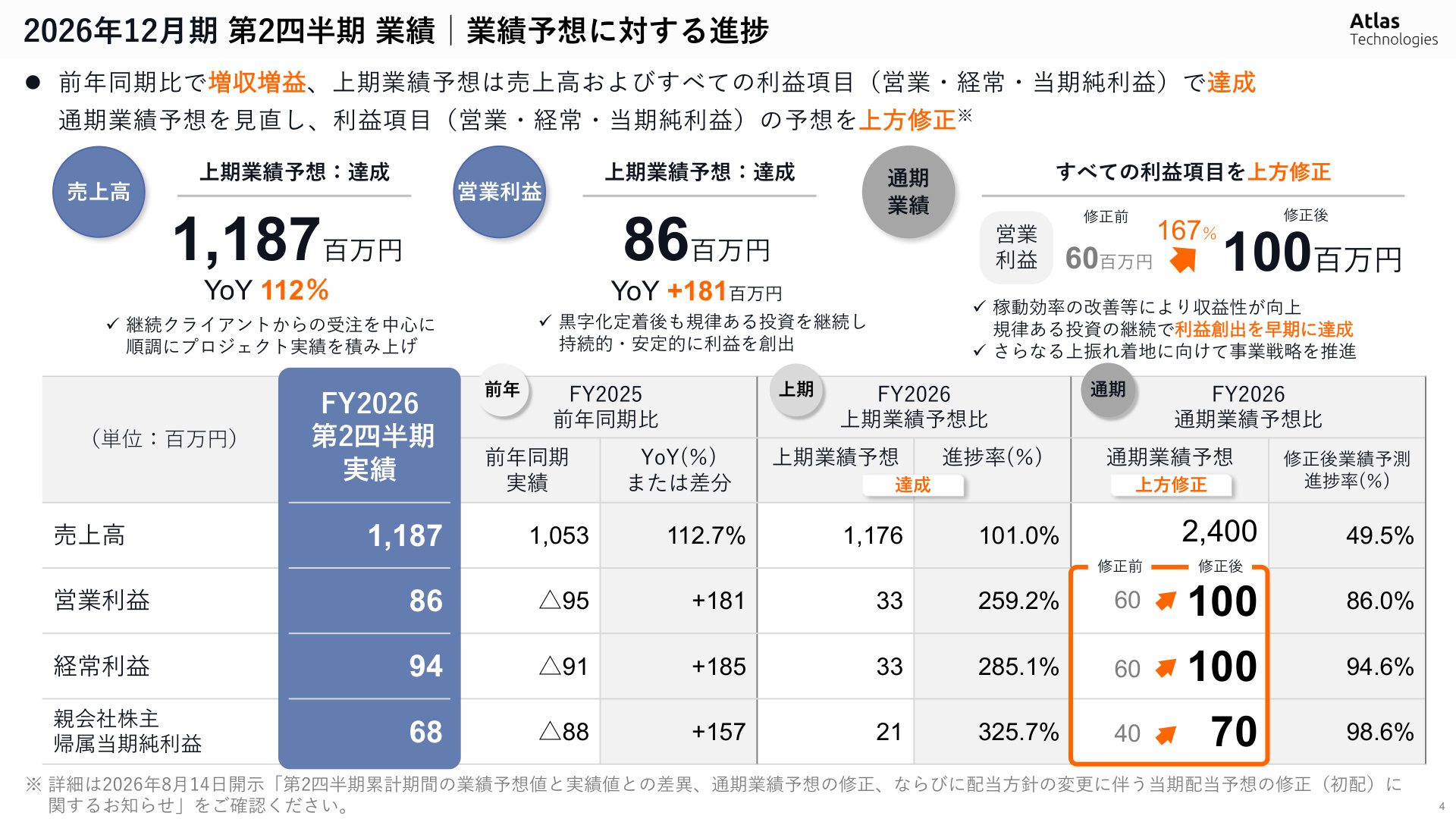
[Slide Analysis: Significance and Importance of PAGE_4]
This slide is the most critical performance indicator, clearly summarizing the over-achievement of H1 results and the magnitude of the upward revision to full-year profit forecasts . Notably, the full-year operating profit target is set at 100 million yen against an H1 result of 86 million yen. With a progress rate of 86.0%, it is evident that the forecast is set conservatively, leaving room for further upside . This result clearly reflects improved gross margins due to enhanced consultant utilization and disciplined SG&A execution following the completion of upfront investments.
2. Quarterly Performance Trends: Transitioning to a "Stable Profit Generation Phase"
Quarterly performance trends highlight a significant shift in the company's revenue structure. From Q4 2023 to Q2 2025, the company consistently reported operating losses due to aggressive hiring and organizational investments. However, since turning profitable in Q3 2025 with an operating profit of 14 million yen , the company has achieved four consecutive quarters of operating profit , with 90 million yen in Q4 2025, 34 million yen in Q1 2026, and 51 million yen in Q2 2026.
Net sales also maintained a steady growth trajectory, reaching 595 million yen in Q2 2026 (up 121% YoY) . This proves that the company has successfully transitioned to a sustainable and stable profit generation phase , driven not merely by cost-cutting, but by a combination of revenue growth, the acquisition of high-margin projects, and the maintenance of high utilization rates.
3. Client Base and Retention: High Recurring Revenue Ratio and Maximizing LTV
In the company's core consulting business, maintaining and expanding the client base is the lifeline of growth. As of Q2 FY2026, the track record is as follows:
- Number of Contracted Clients: 26 (16 recurring, 10 new)
- Recurring Client Revenue Ratio: 94.8% ( +11.4 points from 83.4% in FY2025)
- Recurring Revenue Ratio by Project: 83.4% ( +7.1 points from 76.3% in FY2025)
Backed by strong relationships with clients, the company is successfully maximizing Lifetime Value (LTV) through repeat orders and horizontal expansion (upselling/cross-selling) into other departments.
4. Optimization of Major Client Dependency: Steady Progress in Risk Diversification
A past challenge for the company was its high revenue dependency on a specific major client (NTT DOCOMO, INC.). However, this structural reform is yielding steady results:
- NTT DOCOMO Revenue Ratio: 46.4% ( down 5.2 points from 51.6% in FY2025)
While maintaining and expanding its relationship and transaction volume with NTT DOCOMO, the company has successfully reduced the specific company's share of the total portfolio through new client acquisition and expansion into other financial institutions. This has simultaneously achieved reduced client concentration risk and diversification and stabilization of the revenue base .
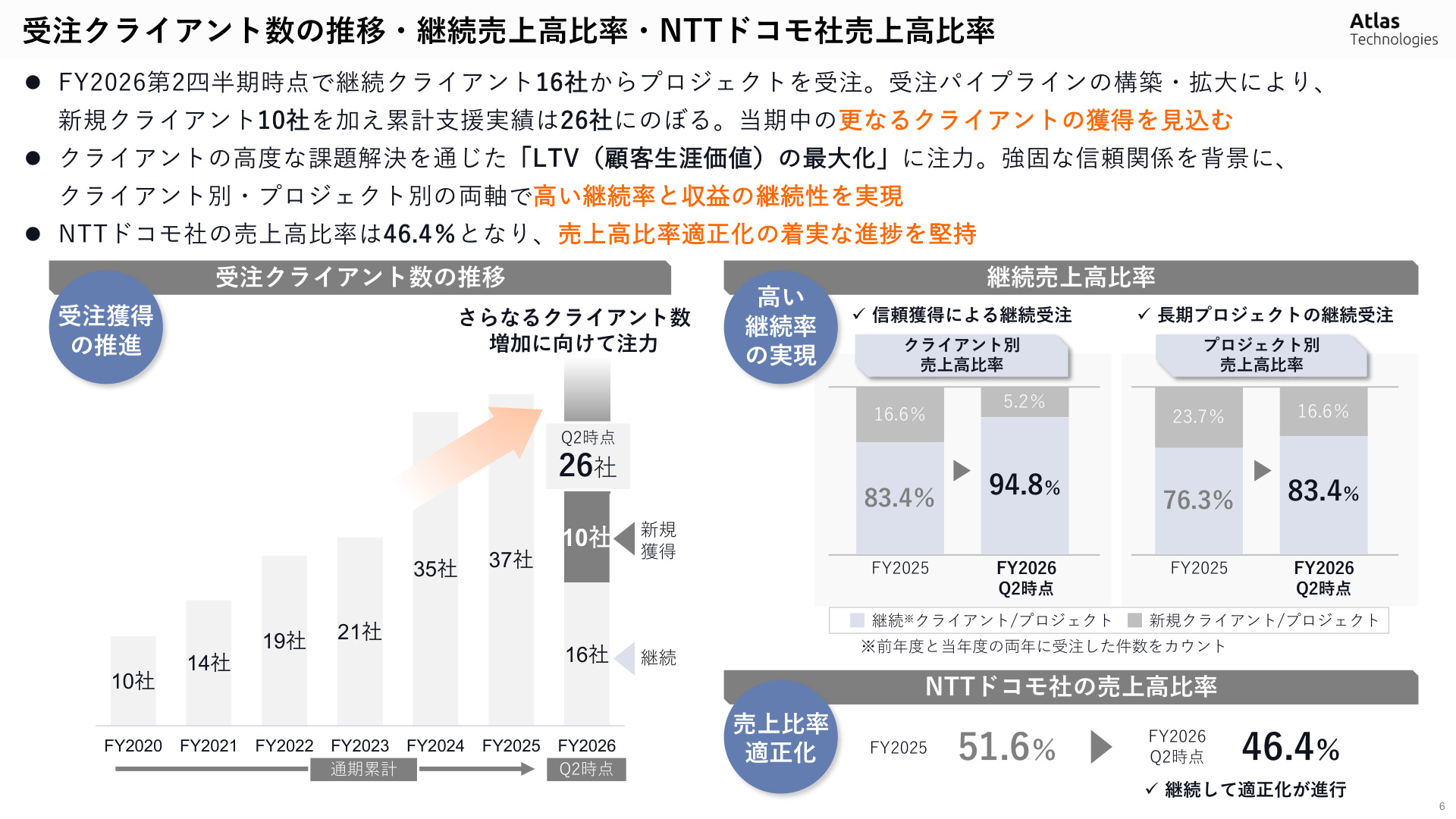
[Slide Analysis: Significance and Importance of PAGE_6]
This slide provides objective data proving the soundness and improved stability of the company's business model . It addresses the two biggest risks in the consulting business—"churn risk" and "client concentration risk"—with an overwhelming client satisfaction level evidenced by a 94.8% recurring revenue ratio and a downward trend in specific client dependency to 46.4% . Because the client base is firmly established, the company can efficiently allocate sales resources to new business development.
5. Significant Expansion of Shareholder Return Policy: Inaugural Dividend, Progressive Dividend Policy, and Share Buybacks
Based on the V-shaped recovery in performance and the transition to a stable profit generation phase, the company has moved away from its previous "no dividend" policy and introduced highly proactive shareholder return measures.
① Decision on First-Ever Year-End Dividend (Inaugural Dividend)
- FY2026 Year-End Dividend Forecast: 7 yen per share
- Forecast Dividend Yield: 2.2% (based on the August 14, 2026 closing price of 321 yen, significantly higher than the TSE Growth market average of 0.6%)
- Basic Dividend Policy: Calculated based on a "progressive dividend" (a policy of maintaining or increasing dividends without reducing them in principle) and a "DOE (Dividend on Equity) of 3% or higher."
② Large-Scale Share Buyback and Cancellation
- Maximum Number of Shares to be Acquired: 370,000 shares ( 5.0% of total outstanding shares)
- Maximum Total Acquisition Amount: 130 million yen (321 yen per share)
- Method: Executed via ToSTNeT-3 on August 17, 2026
- Scheduled Cancellation Date: August 31, 2026 (all acquired shares to be cancelled)
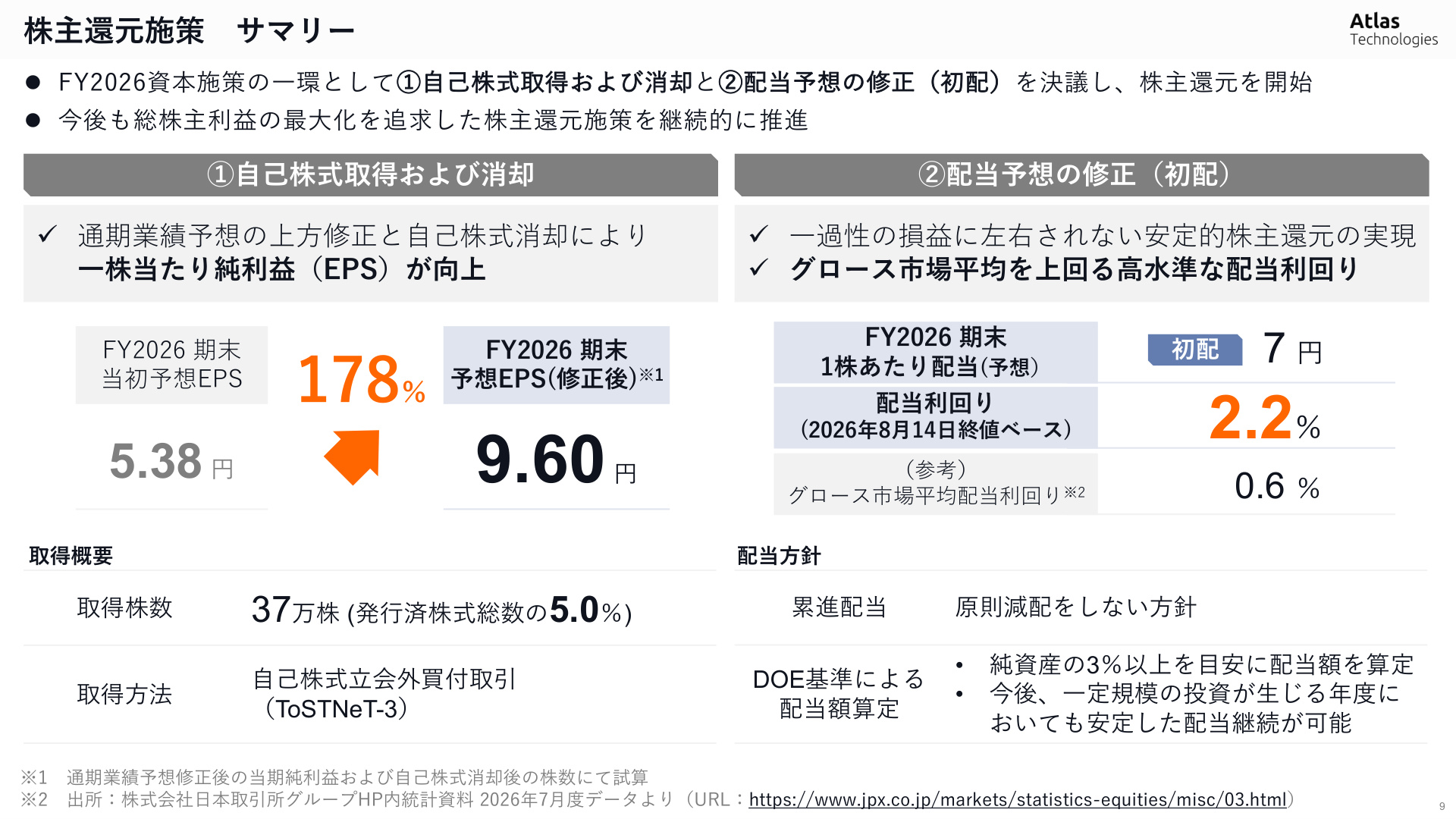
[Slide Analysis: Significance and Importance of PAGE_9]
This slide is a definitive piece that allows investors to understand management's stance on capital efficiency at a glance. In addition to the upward revision of full-year earnings, the cancellation of treasury shares will compress the total number of outstanding shares, resulting in a 178% significant increase in Earnings Per Share (EPS) from the initial forecast of 5.38 yen to 9.60 yen . By explicitly committing to long-term goals such as a "DOE of 3% or higher" and a "progressive dividend," the company has demonstrated its commitment to the sustainable maximization of shareholder value.
6. Strengthening the Financial Base: Accumulation of Retained Earnings and High Liquidity
The company's robust balance sheet supports both aggressive growth investment and shareholder returns.
- Total Assets: 2,011 million yen (+67 million yen from the end of the previous fiscal year)
- Net Assets: 1,743 million yen (+66 million yen from the end of the previous fiscal year)
- Retained Earnings: 375 million yen ( +69 million yen / 122% increase from the end of the previous fiscal year)
- Special Overdraft Facility: 1,000 million yen (unused, ensuring liquidity on hand)
By utilizing accumulated retained earnings (375 million yen) as a source for flexible shareholder returns while maintaining a 1 billion yen credit line, the company retains the financial flexibility to respond immediately to sudden M&A opportunities or the launch of large-scale projects.
7. Business and Service Strategy: Deepening the Payment Domain and Expanding into Peripheral Finance
The company's strength lies in its deep expertise in the "payment domain," which has extremely high barriers to entry. It has established a unique position ("a big whale in a small pond") in this field, which requires complex legal regulations and advanced security knowledge, and is now deploying a strategy to expand its services into peripheral areas.
- Payment Domain (Focused Investment/Deepening): Established an overwhelming position in international brand compliance, external system connectivity for credit card businesses, and regulatory compliance.
- Financial Domain (Strategic Investment/Development): Provides practical support for IT risk management, cybersecurity, DX, and PMO to banks, insurance companies, and securities firms. Current achievements include IT internal audit support for 13 regional banks and modernization support for a major foreign insurance company .
- Overseas Market (Strategic Investment/Development): Promoting a "cross-border support model" centered on the Singapore office to assist Japanese companies expanding overseas and foreign companies entering the Japanese market.
8. Evolution of Client Acquisition Strategy: Structuring the Project Acquisition Process
In its project acquisition model, the company is building a sustainable pipeline that does not rely solely on direct sales.
- Uncovering Needs: Approaching different departments of existing clients and entering the public sector by obtaining qualifications for government projects.
- Horizontal Expansion to Related Companies: Spreading projects to group companies through strong referrals backed by high client satisfaction.
- Alliance Collaboration: Establishing a low-cost, high-efficiency acquisition model through partnerships with solution companies and system integrators (leveraging a network of over 100 companies).
9. Human Capital Strategy and Evolution into an AI-Native Enterprise
The company is also strengthening its human resources, the driving force behind the growth of a consulting firm, in both quality and quantity.
- Number of Consultants: 57 (as of Q2 FY2026)
- Average Annual Consultant Salary: 11.03 million yen ( +7.5% UP from 10.26 million yen at the end of the previous fiscal year)
Adopting a virtuous cycle model of "high value-added, high return," the company organizes and shares know-how gained from high-difficulty projects as proprietary knowledge to enhance service quality, and appropriately returns the resulting profits to its consultants. Furthermore, it aims for overwhelming productivity improvements by incorporating AI into its management foundation, aiming to "evolve into an AI-native enterprise."
10. External Tailwinds: Expansion of Cashless Payments, Financial DX, and the Consulting Market
The market environment in which the company operates continues to provide long-term tailwinds.
- Cashless Payment Market: The Ministry of Economy, Trade and Industry has set a future target of an 80% cashless ratio (51.7% as of 2024), and the credit card market is expected to expand to 184 trillion yen by 2030.
- Domestic Consulting Market: Projected to grow from 798.7 billion yen in 2024 to 1.2832 trillion yen in 2029 ( CAGR 9.9% ).
- Domestic DX Market: Expected to grow dramatically from 5.2759 trillion yen in 2024 to 9.2666 trillion yen by 2030.
As payment and financial IT become increasingly complex as social infrastructure, the demand for the highly specialized consulting provided by the company is expected to remain robust.
Conclusion
Atlas Technologies' Q2 FY2026 earnings results prove that the company has exited its past upfront investment phase and entered a solid profit generation phase . The comprehensive announcement of shareholder return measures, including an upward revision of earnings, an inaugural dividend, a progressive dividend policy, and share buybacks, can be interpreted as a sign of management's confidence in the company's profitability and cash-generating ability. All eyes will be on the company's growth story as it leverages its expertise in the payment sector to expand into financial DX and overseas markets.
This content is not intended as investment advice or a recommendation. Any opinions expressed are solely the personal views of each article.