


Project Holdings FY2026 Q2 Earnings Analysis: 20.7% YoY Revenue Growth and the Strategic Roadmap for the 'AI Co-Creation' Era

StockClub
Published: Aug 14, 2026, 12:50 PM
Sentiment Analysis

Project Holdings (TSE Growth: 9246) FY2026 Q2 Earnings Analysis
Project Holdings (TSE Growth: 9246) reported its FY2026 Q2 earnings , demonstrating solid consolidated revenue growth across all business segments, despite seasonal factors impacting its core Digital Transformation business. The company has clearly articulated an evolving business structure and growth strategy designed to navigate the "AI Co-Creation" era.
This report extracts 10 key topics from the earnings presentation—including performance highlights, segment trends, cost structure, progress against full-year targets, mid-to-long-term growth strategies involving AI product utilization, and shareholder return policies—to provide a detailed analysis of their underlying structure.
1. Consolidated Performance Highlights: Revenue Growth Remains Strong at +20.7% YoY
For the first half of FY2026, consolidated revenue reached 1,544 million JPY (+20.7% YoY) . While Q2 alone saw a 5.6% QoQ decline due to seasonal factors such as lower utilization rates, the company achieved a robust YoY growth exceeding 20%, with all three business segments reporting revenue increases compared to the same period last year.
In terms of profitability, the company recorded an EBITDA of 36 million JPY , marking its fourth consecutive quarter of profitability . This represents a significant improvement of 58 million JPY compared to the same period last year (a loss of 22 million JPY). Although operating profit landed at a loss of 7 million JPY , this is a 57 million JPY improvement over the previous year's loss of 64 million JPY, signaling a strengthening of the company's structural profitability.
A review of the quarterly revenue trends clearly illustrates the company's growth trajectory and the shifting contributions of each business segment.
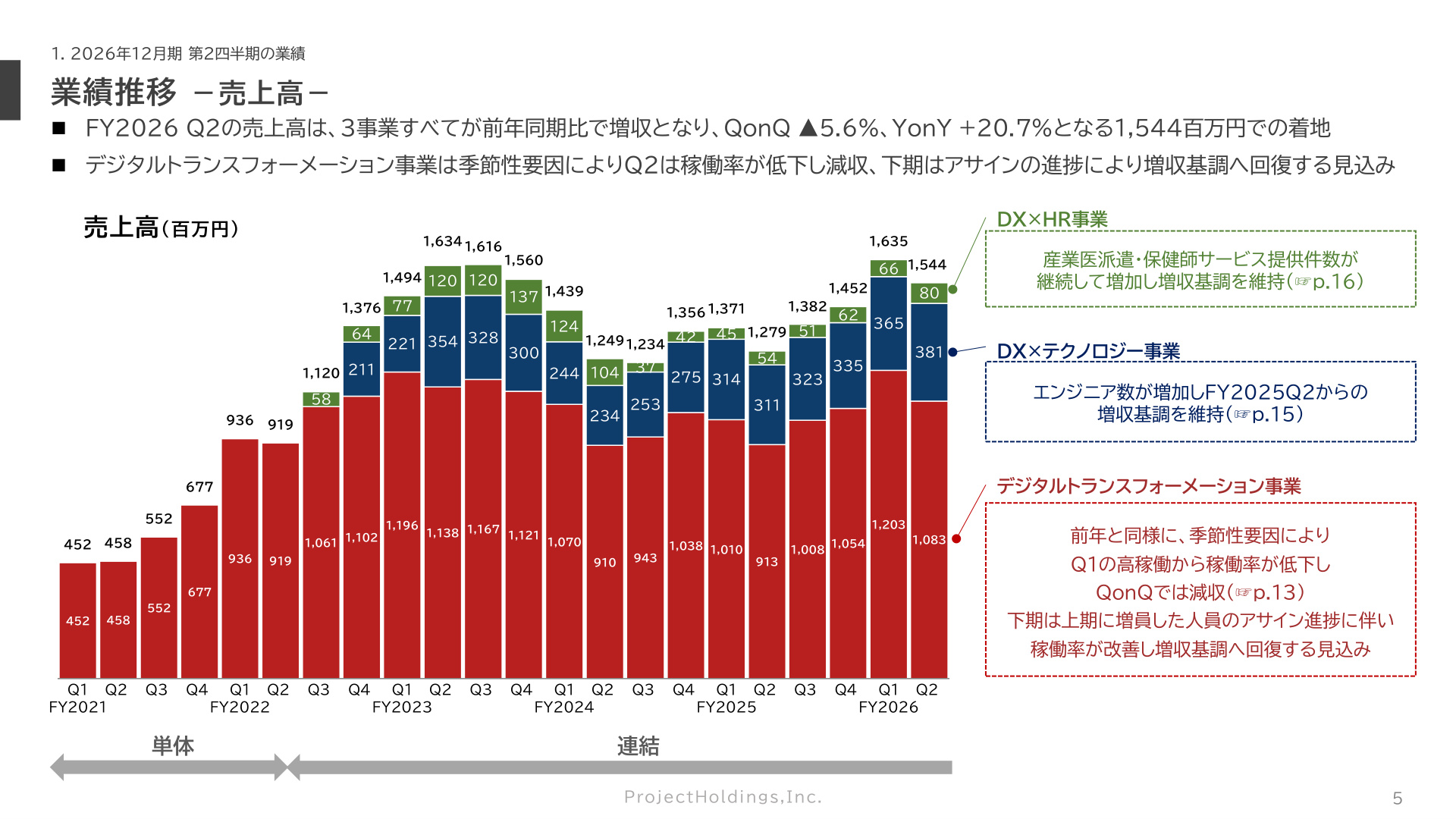
[Slide Commentary: The Importance of Revenue Trends]
This slide is the most critical data point for understanding the company's growth potential and portfolio effects. The core Digital Transformation business (red) exhibits a clear seasonal pattern where utilization and revenue temporarily dip in Q2 due to new graduate hiring and training. However, the rapid growth of the DX x Technology business (blue) and the DX x HR business (green) ensures that the group's overall revenue base continues to rise steadily. The graph demonstrates a sustainable upward revenue trend that persists despite seasonal fluctuations.
2. Segment Performance and KPI Analysis
The company operates through three segments: "Digital Transformation," "DX x Technology," and "DX x HR." Quarterly performance for each is as follows:
(1) Digital Transformation Business
- Revenue: 1,083 million JPY (+7.2% YoY, -10.0% QoQ)
- Gross Profit: 514 million JPY (+46.9% YoY), Gross Margin: 47.5%
- Consultant Unit Price: 1,657k JPY/month (+5.6% YoY)
- **Billable Man-Months: 193 man-months (up from 180 in the previous quarter)
As in previous years, Q2 saw a seasonal decline in utilization from 95% to 87% due to new graduate onboarding. However, the consultant unit price improved by 5.6% YoY under the company's optimal pricing policy. Furthermore, by reducing reliance on external partners (subcontractors) through internalizing operations, the ** subcontracting cost ratio improved significantly from 44.5% to 17.3%**. This helped maintain a high gross margin of 47.5% (compared to 38.3% in the same period last year).
(2) DX x Technology Business (artwize)
- Revenue: 381 million JPY (+22.5% YoY, +4.4% QoQ)
- Gross Profit: 103 million JPY (+43.1% YoY), Gross Margin: 27.0%
The number of engineers has increased for nine consecutive quarters since FY2024 Q1 (138 permanent engineers) , creating a virtuous cycle where expanding headcount drives stock-like revenue growth. Unit prices are also recovering, reaching 679k JPY/month (+2.9% QoQ).
(3) DX x HR Business (Dr. Kenko Keiei)
- Revenue: 144 million JPY (+41.2% YoY, +19.0% QoQ)
- Gross Profit: 69 million JPY (+38.0% YoY), Gross Margin: 47.9%
New contracts for industrial physician and public health nurse dispatch services reached a record high, with service provision expanding to 623 cases/month . The acquisition of enterprise clients has driven the average transaction price up to 76k JPY/month (from 69k JPY/month in the previous quarter), fueling high revenue and profit growth.
3. SG&A Structure and Trends in Personnel and Organization
SG&A expenses for the quarter totaled 696 million JPY (45.1% of revenue) . The 201 million JPY in personnel expenses (+18.9% QoQ) was primarily driven by the inclusion of new graduate training costs in SG&A and an increase in mid-career hires.
Regarding organizational structure, the company is expanding its management layer to handle more sophisticated and larger-scale projects, with the number of managers growing from 35 to 42 . This reduced the number of members per manager from 4.5 to 4.1, optimizing management load. To address turnover exceeding plans, the company plans to introduce a new compensation system starting in FY2027, including base pay increases and revised evaluation systems, to strengthen retention.
Meanwhile, effective office space utilization reduced rent expenses to 120 million JPY (down from 166 million JPY in the previous quarter) , which is expected to contribute to fixed cost containment in the second half.
4. Progress Against Full-Year Forecasts and the H2-Weighted Structure
The progress of the first half (H1) against the full-year consolidated earnings forecast for FY2026 is as follows:
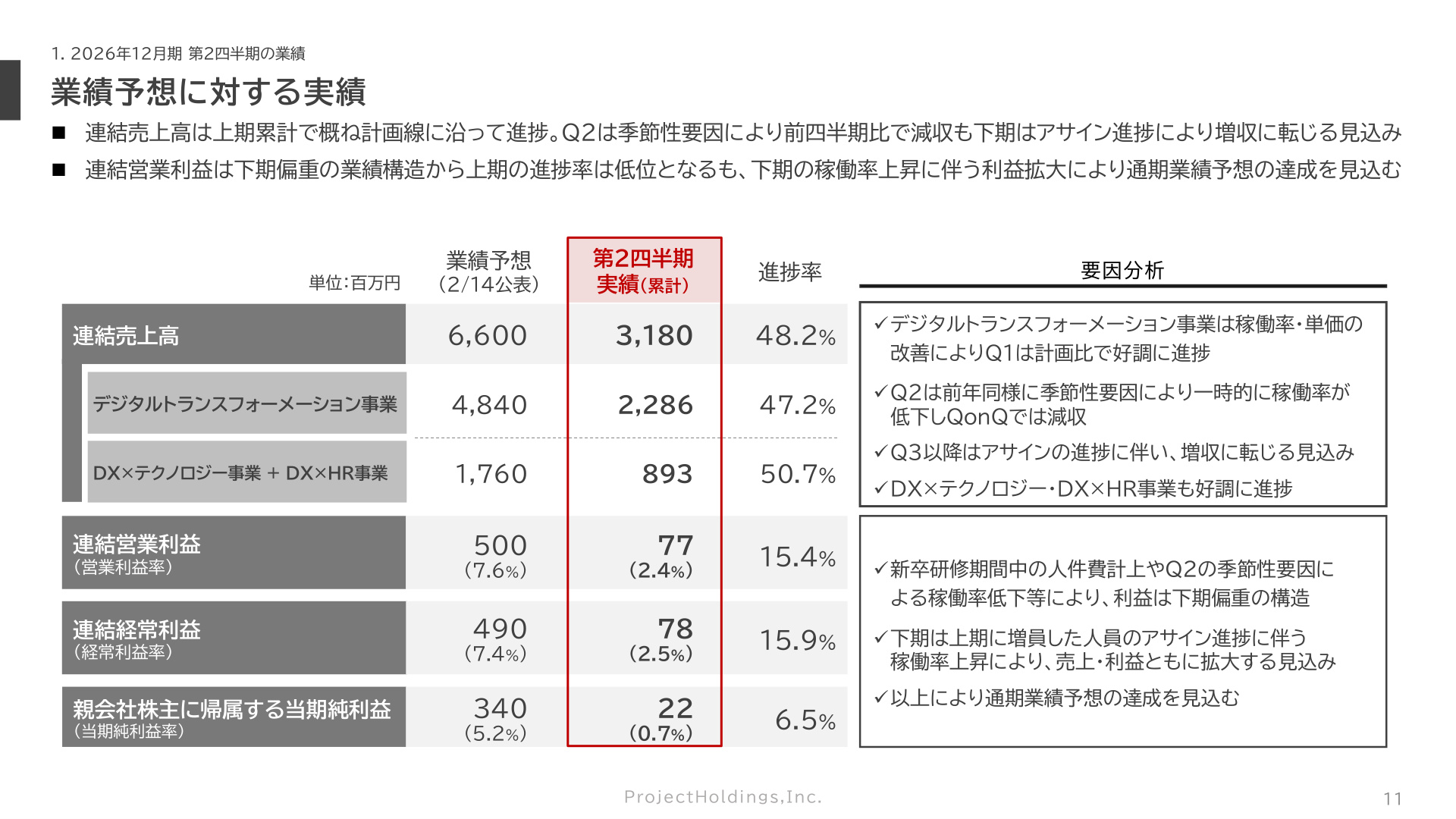
[Slide Commentary: The Importance of Performance Against Forecasts]
This slide provides the rationale for the low H1 progress and the logic behind the expected sharp recovery in H2. While revenue progress is at 48.2%, largely in line with the plan, operating profit progress stands at 15.4% (77 million JPY against a full-year forecast of 500 million JPY) . While this may appear low, it is due to the company's business model characteristics—specifically the H2-weighted earnings structure —where new graduate training costs and Q2 seasonal utilization dips are concentrated in the first half. The plan anticipates significant profit growth in the second half as personnel hired and trained in H1 are assigned to projects, driving up utilization rates.
5. Mid-to-Long-Term Growth Strategy: Evolving Business Structure in the AI Co-Creation Era
The company is pursuing a new mid-to-long-term growth strategy that goes beyond traditional consulting, focusing on the "AI Co-Creation Era."
-
Adapting to Structural Changes in the Corporate Transformation Market The market focus has shifted from "AI adoption" to "implementing AI into operations to achieve results." The company leverages its "on-site accompaniment" strength, embedding itself within client organizations (department/section manager level) to support everything from conceptualization to implementation.
-
Prioritizing the Middle-Market While maintaining and strengthening its foundation in the Enterprise market (revenue over 100 billion JPY), the company has identified the Middle-Market (revenue between 10 billion and 100 billion JPY) as a new priority growth area due to its rapid decision-making and high demand for AI implementation. It is promoting nationwide expansion through the opening of a Tokai branch and alliances with regional financial institutions.
-
Building Intellectual Assets and Expanding "Non-Man-Month" Revenue The company is evolving its model by structuring and capitalizing the "on-site intelligence" accumulated through its support, repurposing it into AI products and performance-based models .
The following roadmap illustrates the future revenue vision:
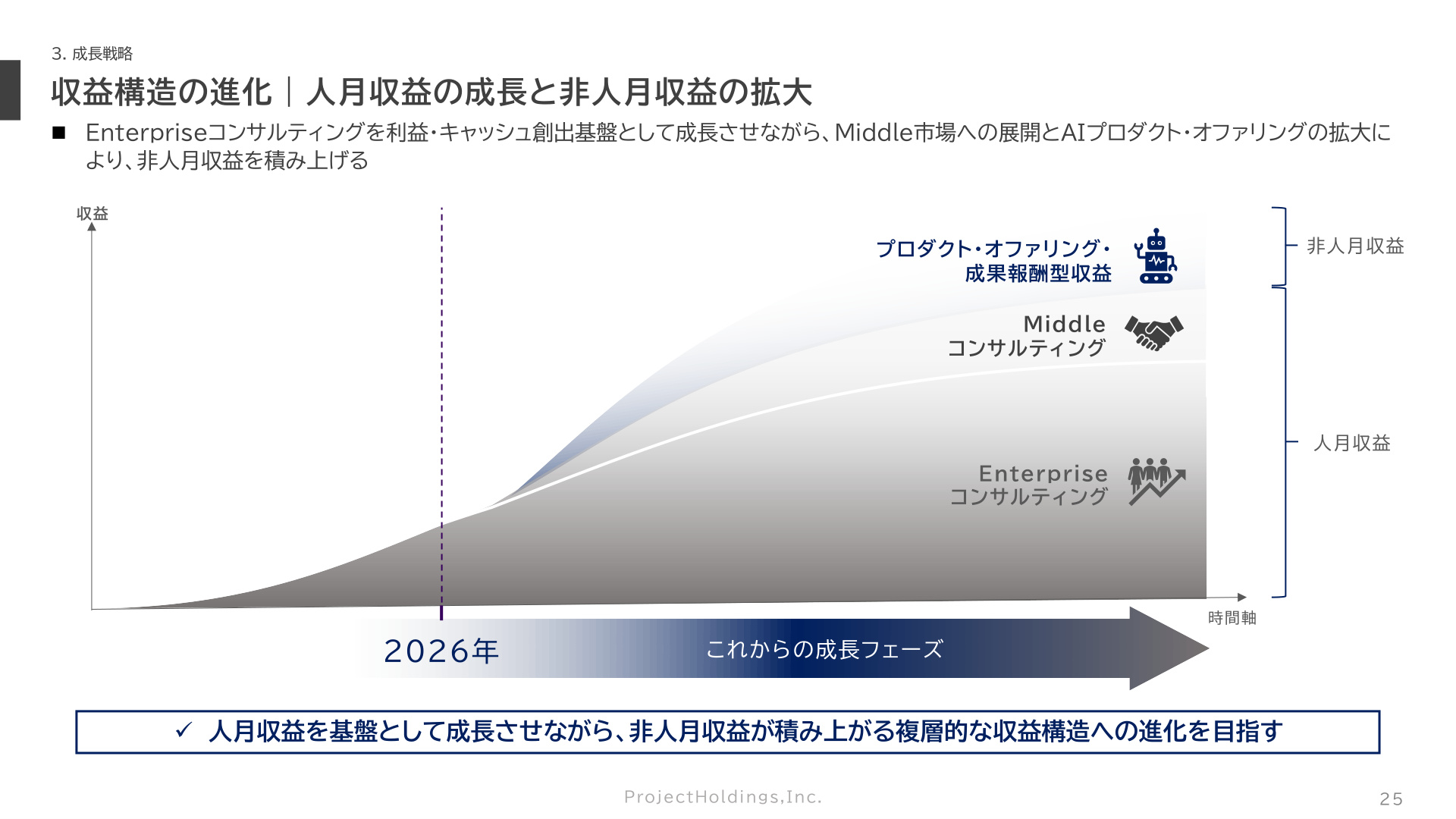
[Slide Commentary: The Importance of Evolving Revenue Structure]
This slide visualizes the mid-to-long-term transformation the company aims to achieve. Previously, consulting support was centered on a model dependent on consultant "man-months" (gray area). Moving forward, the company aims to productize the know-how cultivated in enterprise consulting as "intellectual assets," building a structure that accumulates "non-man-month revenue" (blue area) through Middle-Market expansion, AI products, and performance-based models. This strategy aims to achieve high profitability and labor productivity that exceeds the pace of headcount growth.
6. Capital Policy and Shareholder Returns
The company is executing a flexible capital policy aimed at improving capital efficiency and enhancing shareholder returns.
- Completion of Share Buybacks : Between May 18 and August 7, 2026, the company completed the repurchase of 30,000 shares (30.7 million JPY) against a limit of 30,000 shares (52.5 million JPY). These shares will be used as a source for future stock-based compensation.
- Shareholder Perks and Dividends : In addition to a shareholder benefit program worth up to 5.1% annually (at the end of Q1 and Q3), the company is considering the initiation of semi-annual dividends (interim and year-end), provided that sufficient internal reserves are maintained. The company intends to design a multi-faceted return scheme that may eventually include four record dates per year.
Summary
Project Holdings' FY2026 Q2 earnings report confirmed a steady strengthening of the business foundation, characterized by YoY revenue growth across all segments and improved gross margins through internalization , despite temporary profit pressure from Q2-specific seasonal factors.
Looking toward the second half, the focus will be on utilization recovery and profit expansion as newly hired graduates and mid-career staff are assigned to projects. In the mid-to-long term, attention will be on how the accumulation of "non-man-month AI product revenue," leveraged by intellectual assets cultivated on the front lines of consulting, will evolve the company's revenue structure during the execution phase.
This content is not intended as investment advice or a recommendation. Any opinions expressed are solely the personal views of each article.