


In-Depth Earnings Analysis: Being Holdings (9145) H1 FY2026 – Temporary Profit Decline Due to Upfront Investment and the Growth Scenario for H2 Recovery

StockClub
Published: Aug 14, 2026, 12:43 PM
Sentiment Analysis
Being Holdings Co., Ltd. (Tokyo Stock Exchange Standard: 9145) reported double-digit revenue growth for the first half of the fiscal year ending December 2026, driven by the full-year operation of numerous logistics centers opened in the previous fiscal year and steady demand for daily necessities . However, the company was forced to report a decline in profit due to temporary initial costs associated with facility relocations and expenses incurred from profit improvement initiatives .
This report provides a comprehensive analysis based on the disclosed earnings presentation materials, covering the factors behind the H1 performance, current trends in profitability recovery, strategic topics (M&A, human capital investment, and external sales of proprietary systems), and the feasibility of a V-shaped profit recovery in the second half.
1. Earnings Highlights: Structure of Revenue Growth vs. Profit Decline
Consolidated performance for H1 FY2026 saw steady growth in operating revenue, supported by the expansion of logistics centers in the core logistics business. Conversely, profit was significantly impacted by upfront investment costs.
- Operating Revenue : 17.52 billion JPY (+10.6% YoY)
- Operating Profit : 986 million JPY (-15.6% YoY)
- Ordinary Profit : 971 million JPY (-18.3% YoY)
- Net Income Attributable to Owners of Parent : 545 million JPY (-23.6% YoY)
Looking at the profit structure, the cost of sales ratio rose by 2.2 percentage points from 88.0% in the same period last year to 90.2% , which was the primary factor squeezing profits. The SG&A ratio improved by 0.4 percentage points from 4.5% to 4.1%, indicating effective control of administrative expenses; however, this was insufficient to cover the rise in operational costs at the site level.
2. Analysis of Operating Revenue: Driven by Facility Operations and Stable Demand for Daily Necessities
There is a clear growth trajectory behind the 1.681 billion JPY (+10.6%) increase in operating revenue. By segment, the logistics business reached 17.005 billion JPY (+10.9% YoY) , serving as the powerful engine for group-wide growth.
The following slide details the quarterly trends in operating revenue and the breakdown of its fluctuations.
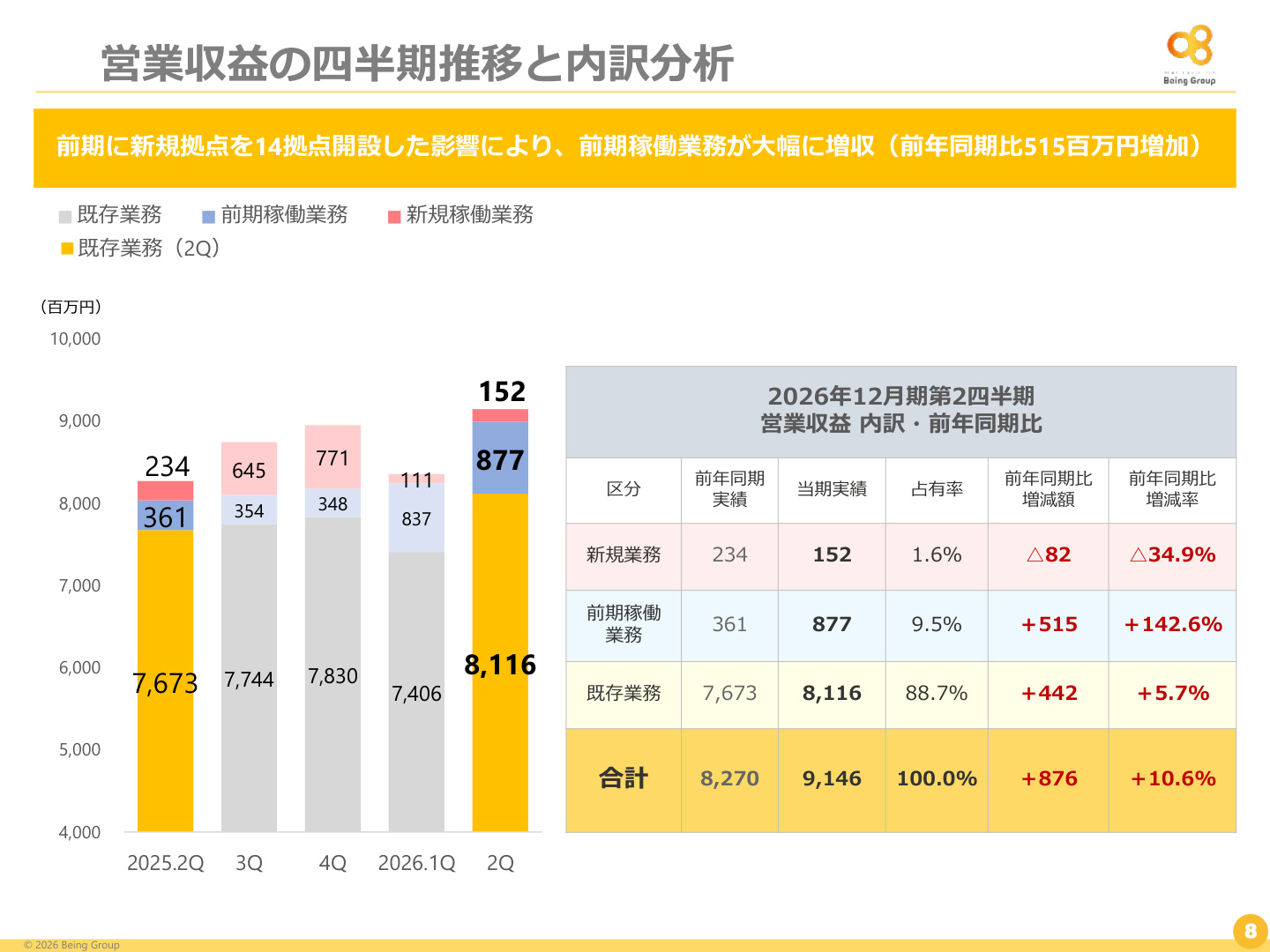
[Slide Commentary: Quarterly Trends and Breakdown Analysis of Operating Revenue]
This slide is critical because it clearly quantifies that the company's growth model is built on two pillars: "launching new facilities invested in the previous year (previous-year operations)" and "deepening relationships with existing clients and increasing unit prices (existing operations)."
Operating revenue for Q2 (April–June 2026) expanded to 9.146 billion JPY (+10.6% YoY) . The breakdown is as follows:
- Previous-Year Operations : 877 million JPY (+515 million JPY / +142.6% YoY)
- The 14 facilities opened in the previous year have begun operations smoothly, contributing significantly to revenue growth compared to the same period last year.
- Existing Operations : 8.116 billion JPY (+442 million JPY / +5.7% YoY)
- In addition to increased handling volumes of daily necessities (food, household goods, etc.), the company maintained steady growth in existing operations through the optimization of logistics unit prices in response to rising costs.
- New Operations : 152 million JPY (1.6% share)
As shown, the top-line growth process is proceeding according to plan.
3. The Primary Profit Squeeze: The "Tokai SCM Center" and the Path to Recovery
The majority of the decline in operating profit for H1 (down 182 million JPY YoY) is attributed to transitional costs associated with the relocation and expansion of the Tokai SCM Center . Of the 175 million JPY decrease in gross profit, approximately 85%, or 150 million JPY, was due to the deteriorating performance of this center (actual gross profit: -72 million JPY) .
Specifically, temporary burdens included moving out of the old center, initial costs for the new center, increased outsourcing (temporary staffing) costs until operational standardization was achieved, and support expenses for business improvement.
The company has formulated a clear improvement roadmap for this issue and has already begun implementation.
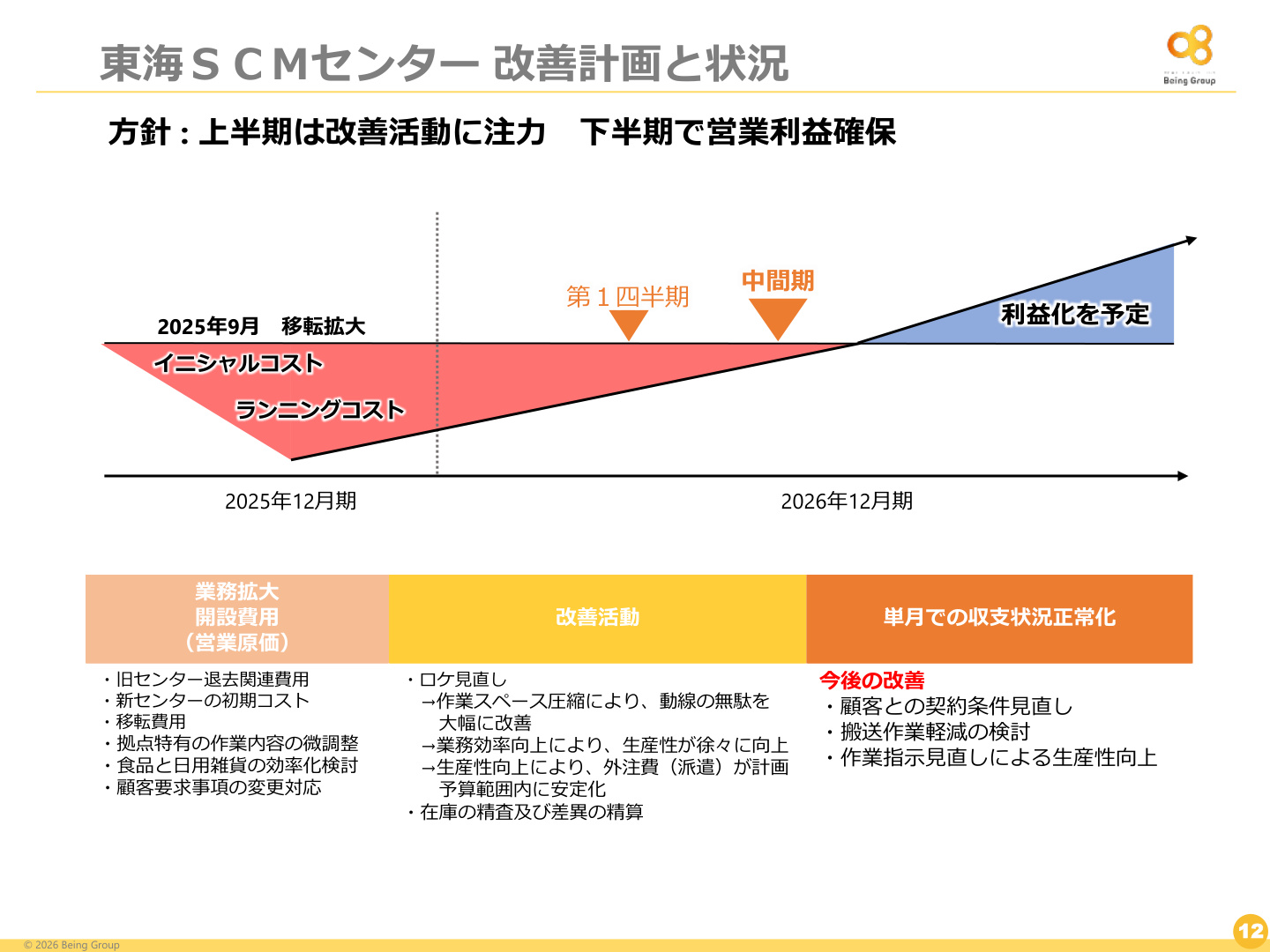
[Slide Commentary: Tokai SCM Center Improvement Plan and Status]
This slide illustrates the full scope of the management's top-priority project , showing how the company will move past the transitional period of high initial and running costs and pivot toward profitability in the second half.
In H1, the company implemented the following drastic improvement measures:
- Review of Location (Storage Positioning) : Compressed workspace and significantly reduced waste in operational flow.
- Productivity Improvement and Outsourcing Optimization : By streamlining operations, the company stabilized high-cost temporary staffing and support expenses within the budget.
- Normalization of Monthly Profitability : Aiming for monthly profitability and stable earnings by reviewing contract terms with clients and reducing transport labor.
The effects of these initiatives are already appearing in the quarterly figures. The operating profit margin bottomed out at 4.6% in Q1 and improved by 1.9 percentage points to 6.5% in Q2 , signaling a clear shift toward profitability recovery.
4. Five Key Strategic Topics Supporting Growth
During H1, the company strengthened its business foundation and organizational structure for sustainable future growth. Five key topics extracted from the materials are as follows:
- Opening of the "Yuki Center" and Expansion of the Facility Network
- In April 2026, the "Yuki Center" (handling food and household goods) was opened in Yuki City, Ibaraki Prefecture. The group's business locations have expanded to a total of 73 facilities (including closures/integrations), strengthening the dominant network in the East Japan area.
- Transformation of Sales Structure via the New "Marketing Headquarters"
- In July 2026, the "Marketing Headquarters" was established to oversee the "Sales Department" and "Business Development Department." The company is shifting from conventional single-year negotiations to a multi-year project management system to improve group-wide client acquisition and proposal capabilities.
- M&A of Two Food Logistics Companies
- In July 2026, the company acquired Sugaya Trans Co., Ltd. (Chiba, 34 vehicles) and J-U Keiso Ltd. (Niigata, 14 vehicles) as subsidiaries. By incorporating their expertise in cold-chain and food delivery, the company secures vehicles and driver talent to drive business expansion with existing clients.
- Proactive Approach to Labor Shortages and the "2024 Problem" (120 Annual Holidays)
- Starting April 2026, the company significantly increased annual holidays from 105 to 120 days . By implementing a "substantial wage increase" while maintaining wage levels, the company aims to strengthen recruitment and retention by aligning working conditions with 3PL industry standards. Furthermore, it is enforcing operations to limit annual overtime to 720 hours or less in the future.
- Building a Stock-Based Business via External Sales of the "Jobs" System
- The company has begun selling its proprietary delivery and warehouse management system (TMS/WMS) to other companies in the industry . By generating monthly system usage fees in addition to initial implementation costs, the company aims to cultivate a new revenue pillar and establish a foundation for supply chain optimization.
5. Full-Year Consolidated Forecast and H2 Profit Recovery Scenario
The company has maintained its full-year consolidated earnings forecast for the fiscal year ending December 2026, as announced at the beginning of the period.
- Operating Revenue : 36.87 billion JPY (+10.0% YoY)
- Operating Profit : 2.40 billion JPY (+4.1% YoY)
- Ordinary Profit : 2.35 billion JPY (+3.6% YoY)
- Net Income : 1.41 billion JPY (+0.5% YoY)
- Annual Dividend per Share : 15.00 JPY (6.0 JPY interim, 9.0 JPY year-end forecast; planned increase from 13.0 JPY in the previous year)
As of the end of H1, the progress rate against the full-year plan is 47.4% for operating revenue , while operating profit stands at 41.1% . However, the company expects to fully recover this delay in the second half.
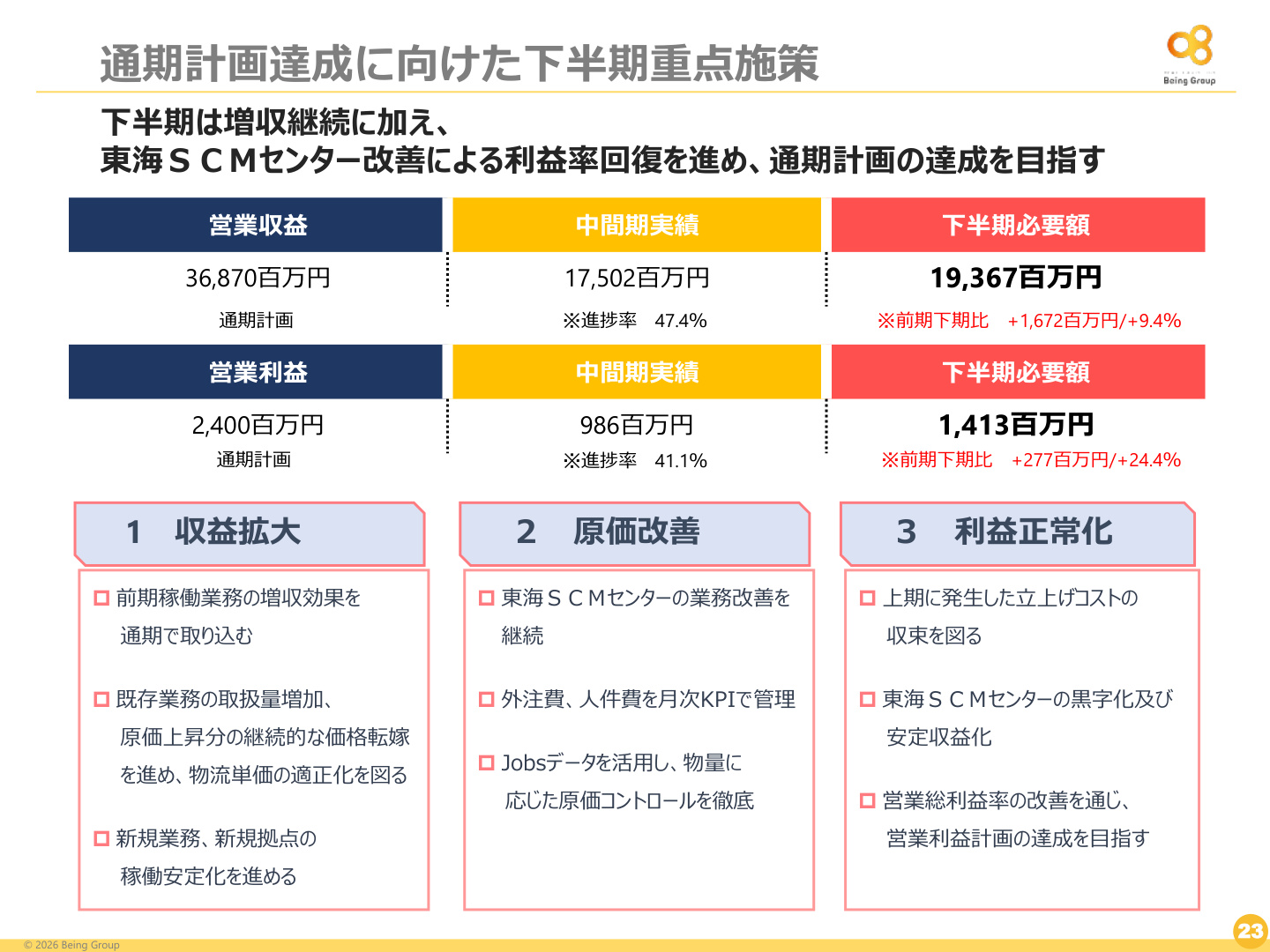
[Slide Commentary: H2 Priority Measures to Achieve Full-Year Plan]
This slide outlines the most important policy, showing the concrete action plan to achieve the high hurdle of 1.413 billion JPY in operating profit (+24.4% YoY) in the second half .
H2 priority measures are consolidated into three axes:
- Revenue Expansion : Stabilizing operations at new facilities opened in the previous and current years, and continuing to pass on costs to logistics unit prices in line with rising costs.
- Cost Improvement : Establishing business improvements at the Tokai SCM Center, strengthening monthly KPI management for outsourcing and personnel costs, and thorough dynamic cost control using the proprietary "Jobs" data.
- Profit Normalization : Convergence of initial launch costs incurred in H1 and improvement of the gross profit margin through the return to profitability of the Tokai SCM Center.
6. Summary and Key Points to Watch
Although the H1 FY2026 earnings report shows a "decline in profit," the reality is that this is due to transitional costs for expanding the facility network and temporary expenses associated with the relocation of the specific Tokai SCM Center .
Future points to watch include:
- Whether the improving trend in operating profit margin seen in Q2 (4.6% → 6.5%) will accelerate from Q3 onwards .
- Whether the Tokai SCM Center will transition from monthly profitability to contributing to H2 profits as planned .
- Whether human capital investments, such as the 120-day annual holiday policy, will translate into numerical results in terms of driver acquisition and reduced outsourcing costs (higher in-house handling ratio) .
The execution of H2 measures, as the company shifts from an upfront investment phase to a profit recovery phase, holds the key to achieving the full-year targets.
This content is not intended as investment advice or a recommendation. Any opinions expressed are solely the personal views of each article.