

![[In-Depth Analysis] T.S.I. Co., Ltd. FY2026 Q2 Earnings: Achieving Profitability and Entering a Phase of Profit Expansion Through Medical-Integrated Models and In-House DX](https://news-images.stock-club.net/market_news/images/7362/140120260813520001/slide_eyecatch_en_f36d5801.webp)
[In-Depth Analysis] T.S.I. Co., Ltd. FY2026 Q2 Earnings: Achieving Profitability and Entering a Phase of Profit Expansion Through Medical-Integrated Models and In-House DX

StockClub
Published: Aug 14, 2026, 12:33 PM
Sentiment Analysis

T.S.I. Co., Ltd. (Securities Code: 7362) has reached a pivotal milestone in its Q2 FY2026 earnings, marking a clear recovery in performance and a return to profitability , signaling improved margins following a period of aggressive upfront investment.
This report provides a comprehensive analysis based on 10 key topics derived from the earnings presentation materials, covering current performance highlights, KPI trends, responses to medical fee revisions, the structural shift toward medical-integrated models, and long-term growth strategies.
1. Executive Summary: Significant Revenue and Profit Growth and Return to Profitability
Following a period of upfront investment in 2025—including the opening of multiple facilities in the Kanto region, the recruitment of foreign workers under the Specified Skilled Worker program, and DX investments—the company has entered a full-scale profit expansion phase starting in FY2026.
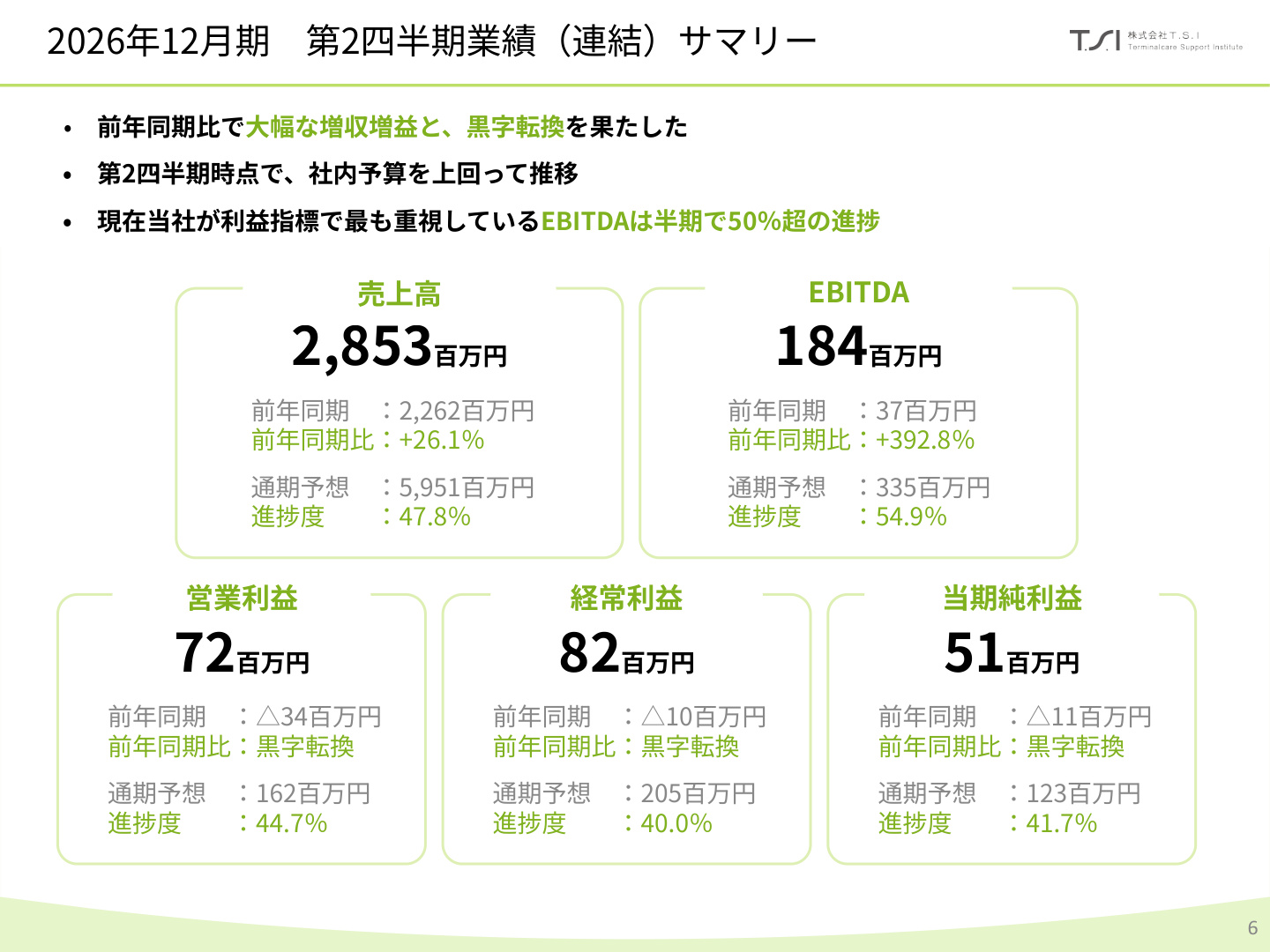
- Net Sales : 2,853 million JPY ( +26.1% YoY)
- EBITDA : 184 million JPY ( +392.8% YoY)
- Operating Profit : 72 million JPY (Turned profitable from a 34 million JPY loss in the same period last year)
- Ordinary Profit : 82 million JPY (Turned profitable from a 10 million JPY loss in the same period last year)
- Net Income : 51 million JPY (Turned profitable from an 11 million JPY loss in the same period last year)
Performance is trending ahead of internal budgets, with EBITDA—a key profit metric for the company—reaching a 54.9% progress rate against the full-year forecast of 335 million JPY.
2. Consolidated Earnings Summary and Analysis of Key P&L Items
The following consolidated summary slide is critical for understanding the dramatic shift in the company's profit structure.
[Slide Commentary: The Importance of the Consolidated Earnings Summary]
The slide above (P.6) summarizes the consolidated P&L, which shows a V-shaped recovery from the same period last year. The most notable feature is that while net sales grew significantly by +26.1% (+591 million JPY) YoY , the company achieved a substantial turnaround to profitability across all profit lines—operating, ordinary, and net income—compared to the losses recorded in the previous year. This confirms that the burden of initial costs from new facilities has passed, and that improved occupancy rates at new sites, combined with optimized staffing at existing locations, have successfully shifted the company into a profit-generating structure.
3. Full Compliance with Listing Maintenance Criteria and First-Ever Dividend Declaration
Alongside the stabilization of its earnings base, the company has announced significant progress in governance and shareholder returns.
- Compliance with TSE Growth Market Listing Maintenance Criteria : As of the end of June 2026, the market capitalization of tradable shares reached 537 million JPY, exceeding the TSE Growth market requirement (500 million JPY or more). The company has now achieved compliance in all four categories , including the number of shareholders, the number of tradable shares, and the tradable share ratio.
- Inauguration of Dividends : Shareholder returns will commence in FY2026. The company plans to pay a commemorative interim dividend of 5 JPY (end of June) to mark its 5th anniversary since listing, and a year-end ordinary dividend of 10 JPY (end of December), balancing growth investment with shareholder returns.
4. Impact of the June 2026 Medical Fee Revision and Swift Response
The medical fee revision effective June 1, 2026, introduced a new "Comprehensive Visiting Nursing Care Fee" for stations attached to elderly housing, shifting from a fee-for-service model to a daily comprehensive evaluation. While this caused a temporary dip in revenue for the visiting nursing business (Luce) in June, the impact on the company remains limited and temporary for the following reasons:
- Diversified Business Portfolio : Visiting nursing (Luce) accounts for only 6.7% of total sales, while the core businesses of serviced housing for the elderly (Anges) at 44.0% and home-visit care (Anges) at 46.8% provide a solid foundation.
- Impact Mitigation via Hybrid Facilities : The company employs a structure that allows for flexible adjustments to the ratio of medical to nursing beds (typically 20 medical/30 nursing out of 50 rooms) based on regional needs.
- Operational Measures : Since July, the company has already confirmed a recovery trend through improved occupancy rates, staffing adjustments linked to utilization, and enhanced sales efforts via social media and public relations.
5. KPI Trends in the Nursing Care Segment
Tracking key performance indicators is essential to understanding the operational status of the nursing care business, which forms the core of the company's operations.
[Slide Commentary: Significance of Nursing Care KPIs]
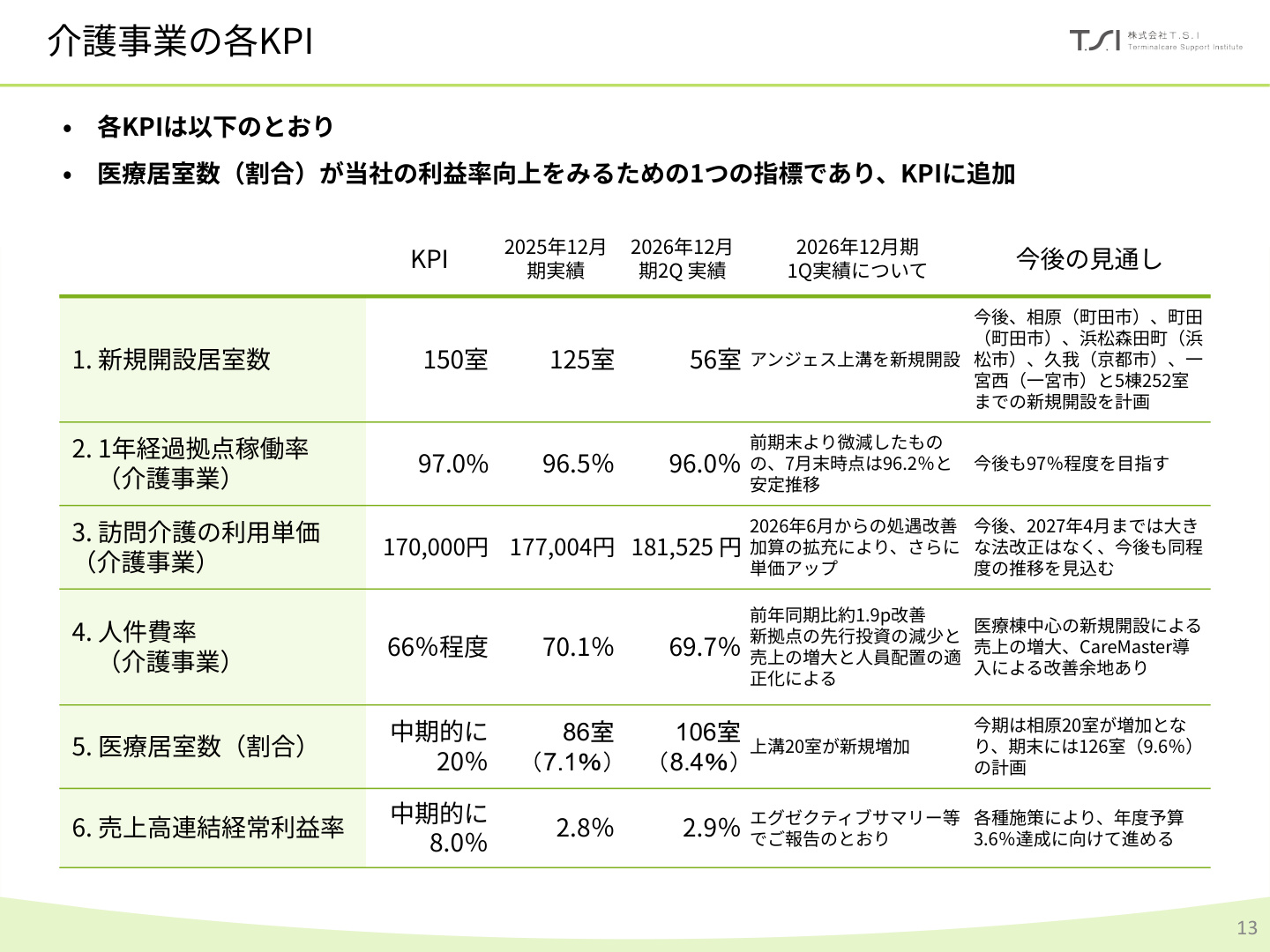
The slide above (P.13) provides the most critical data for measuring service quality and profitability. Notably, the occupancy rate for facilities in operation for one year is 96.5% , maintaining an extremely high level (target is approximately 97%). Furthermore, the unit price for home-visit care increased to 177,004 JPY (up from 170,000 JPY in the previous period) due to the expansion of treatment improvement allowances. Additionally, the labor cost ratio improved by 1.9 percentage points YoY to 70.1% (69.7% in Q1), quantitatively demonstrating the stabilization of upfront investments for new facilities and the optimization of staffing.
6. Structural Shift Toward a "Medical-Integrated Model" to Accelerate High Profitability
The company has identified the shift to medical-integrated serviced housing for the elderly as its most important strategy for future margin expansion.
[Slide Commentary: Shift to the Medical-Integrated Model]
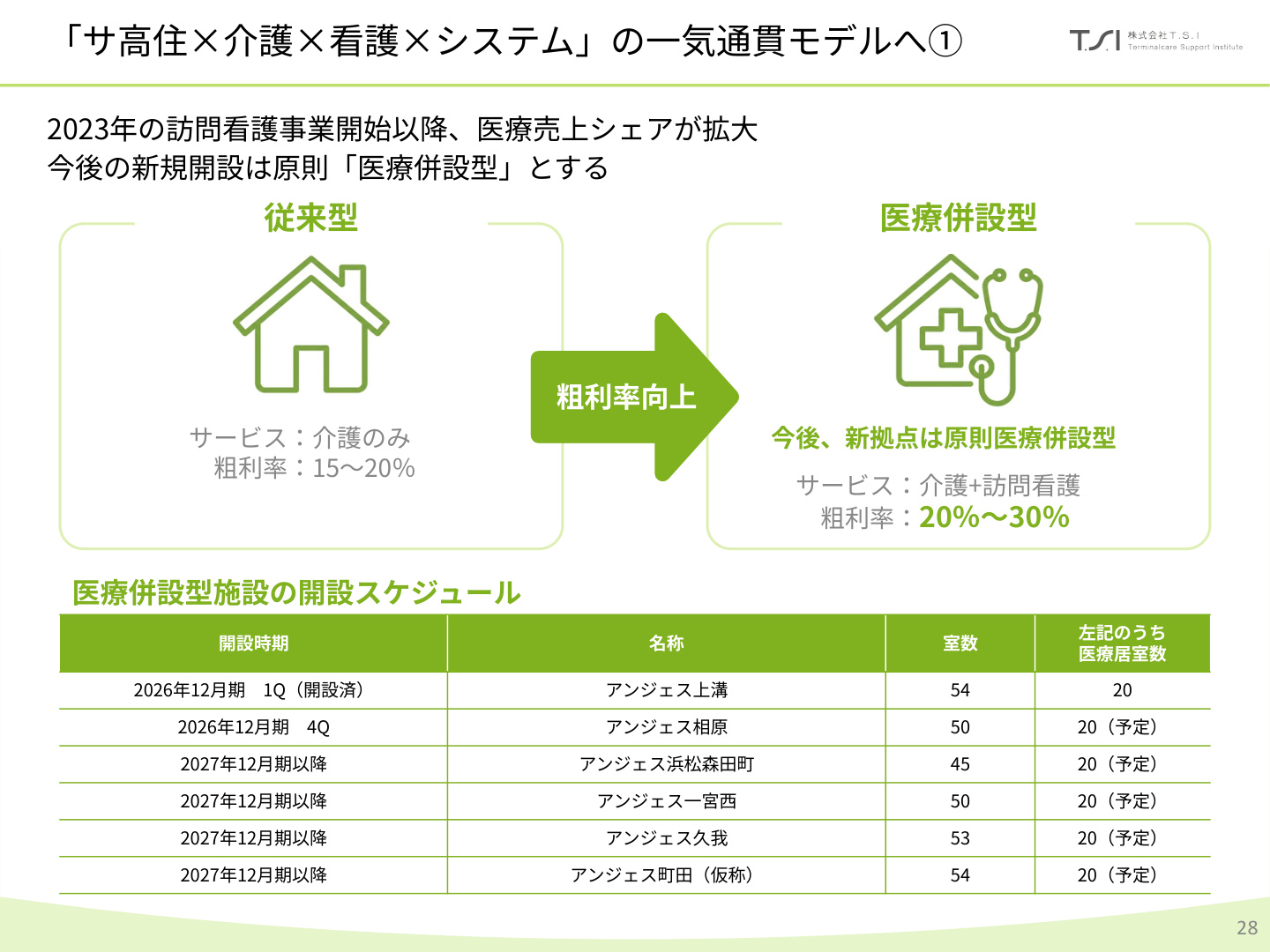
The slide above (P.28) illustrates the difference in gross margins between conventional facilities and medical-integrated facilities, as well as the development schedule for new sites. While the gross margin for the traditional "serviced housing + home-visit care" combination is 15–20%, the medical-integrated model combining "serviced housing + home-visit care + visiting nursing" significantly boosts the gross margin to 20–30% . The company plans to make all future new openings "medical-integrated" in principle. Starting with "Anges Kamimizo" (opened in Q1 2026 with 20 medical rooms out of 54), upcoming sites in Sagamihara, Hamamatsu Morita-cho, Ichinomiya Nishi, Kuga, and Machida are all planned to include medical rooms, which is expected to lift company-wide profit margins.
7. DX, In-House System Development (CareMaster / BillMaster), and AI Utilization
To achieve operational efficiency and improved profitability, the company is focusing on the use of technology:
- Nursing Care Record System "CareMaster" : Full-scale implementation is complete, promoting paperless operations and reducing administrative burdens, resulting in an estimated 25,000 hours of annual labor savings .
- Nursing Care Billing System "BillMaster" : In-house development began in June 2026. By eliminating external SaaS and outsourcing billing costs, the company estimates a cumulative cost reduction of approximately 100 million JPY over 10 years .
- AI Implementation : A new "DX Division" was established to deploy "AI Store Managers" (for automated daily reporting and real-time facility status monitoring) and "AI Secretaries" (for automated scheduling and administrative reduction). By thoroughly eliminating repetitive administrative tasks, the company maximizes the time staff can spend directly with users.
8. Talent Acquisition Strategy (Active Recruitment of Specified Skilled Foreign Workers)
To address the industry-wide challenge of labor shortages, the company is leveraging its unique strengths through the Specified Skilled Worker program .
Against an annual target of 50 recruits, 49 have already been hired or have received job offers , putting the company on track to achieve its goal months ahead of schedule. By combining the recruitment of high school graduates with the stable acquisition of specified skilled foreign workers, the company has established a system to secure high-quality nursing staff while controlling recruitment costs.
9. Unit Economics and Development Plan per Facility
The revenue model for the company's standard 50-room (medical-integrated) facility is defined as follows:
- Break-even Point (Monthly Profitability) : 2–4 months after opening (achieved early through phased staffing aligned with occupancy).
- Cumulative Profitability : Approximately 18 months after opening.
- Annual Sales at Stable Operation : 250 million JPY+ (assuming 20 medical rooms out of 50).
- Profit Margin at Stable Operation : Approximately 25% (before head office expense allocation).
Based on this highly reproducible model, the company aims to expand its dominant presence, targeting a total of 4,500 rooms nationwide by 2036.
10. Mid-to-Long-Term Growth Scenario and Roadmap to the Standard Market
The company has outlined a roadmap to achieve a tradable market capitalization of 1 billion JPY by 2030 and transition to the TSE Standard Market.
- 2026–2027 (Expansion Phase) : Expansion of the visiting nursing business, deepening of dominant market presence, and commencement of shareholder returns.
- 2028–2029 (Leap Phase) : Consideration of M&A strategies and asset liquidation (diversification of financing methods).
- 2030 (Goal) : Transition to the TSE Standard Market.
To achieve this, the company plans to promote comprehensive corporate value enhancement measures focused on three variables: "Tradable share ratio (currently 42.3%)," "EPS (FY2026 forecast 81.13 JPY, +50.3% YoY)," and "Expected P/E ratio (10.4x)."
This content is not intended as investment advice or a recommendation. Any opinions expressed are solely the personal views of each article.