


Foodison Q1 FY2027 Earnings Analysis: Revenue Growth Driven by BtoB Commerce Amid Profitability Challenges and Structural Strengths

StockClub
Published: Aug 14, 2026, 12:30 PM
Sentiment Analysis

Foodison Co., Ltd. (Securities Code: 7114), a company dedicated to the digital transformation (DX) of fresh food distribution, has released its financial results for the first quarter of the fiscal year ending March 2027 (April–June 2026). This report provides a multi-faceted analysis of the company's recent performance highlights, segment-specific trends, cost structure, and its mid-to-long-term growth narrative and structural competitive advantages, based on the official earnings presentation materials.
1. Q1 FY2027 Earnings Summary and Overview
In the first quarter, consolidated net sales reached 1,974 million yen (+8.2% YoY), and gross profit was 649 million yen (+1.3% YoY), marking both revenue growth and a slight increase in gross profit. However, in terms of bottom-line profitability, the company reported an EBITDA of 4 million yen (-86.8% YoY), an operating loss of 2 million yen (compared to a 24 million yen profit in the same period last year), and a net loss of 5 million yen (compared to an 11 million yen profit last year), reflecting a significant decline in earnings and losses across all profit stages.
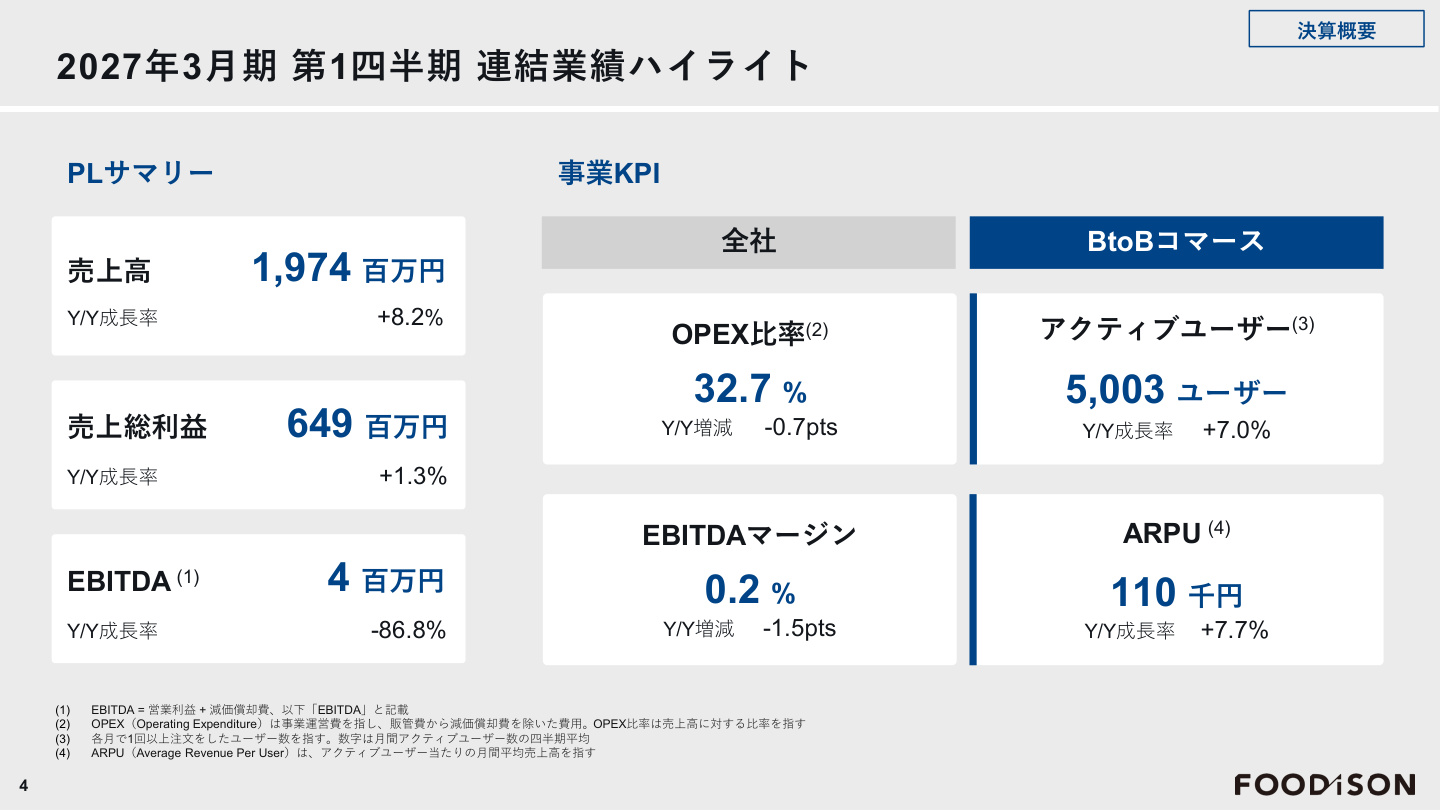
The slide above provides a critical summary of the Q1 profit and loss (P&L) and key business KPIs. Two main points should be noted from this data:
- Steady Top-Line Growth : The core BtoB Commerce business drove revenue, contributing to the company-wide 8.2% YoY increase.
- Margin Compression and Rising Costs : While the company-wide OPEX ratio was 32.7% (-0.7pts YoY), indicating improved operational efficiency relative to sales, the EBITDA margin fell to 0.2% (-1.5pts YoY). This was primarily due to a decline in the high-margin HR business and increased logistics and personnel costs within the BtoB Commerce segment.
2. Detailed Segment Performance Analysis
The company operates through three segments: "BtoB Commerce," "BtoC Commerce," and "HR." This quarter saw divergent results across these segments.
(1) BtoB Commerce (Food EC for Restaurants "Uo-Pochi")
The core BtoB Commerce segment maintained robust growth with net sales of 1,662 million yen (+15.6% YoY), serving as the backbone of the company's overall performance.
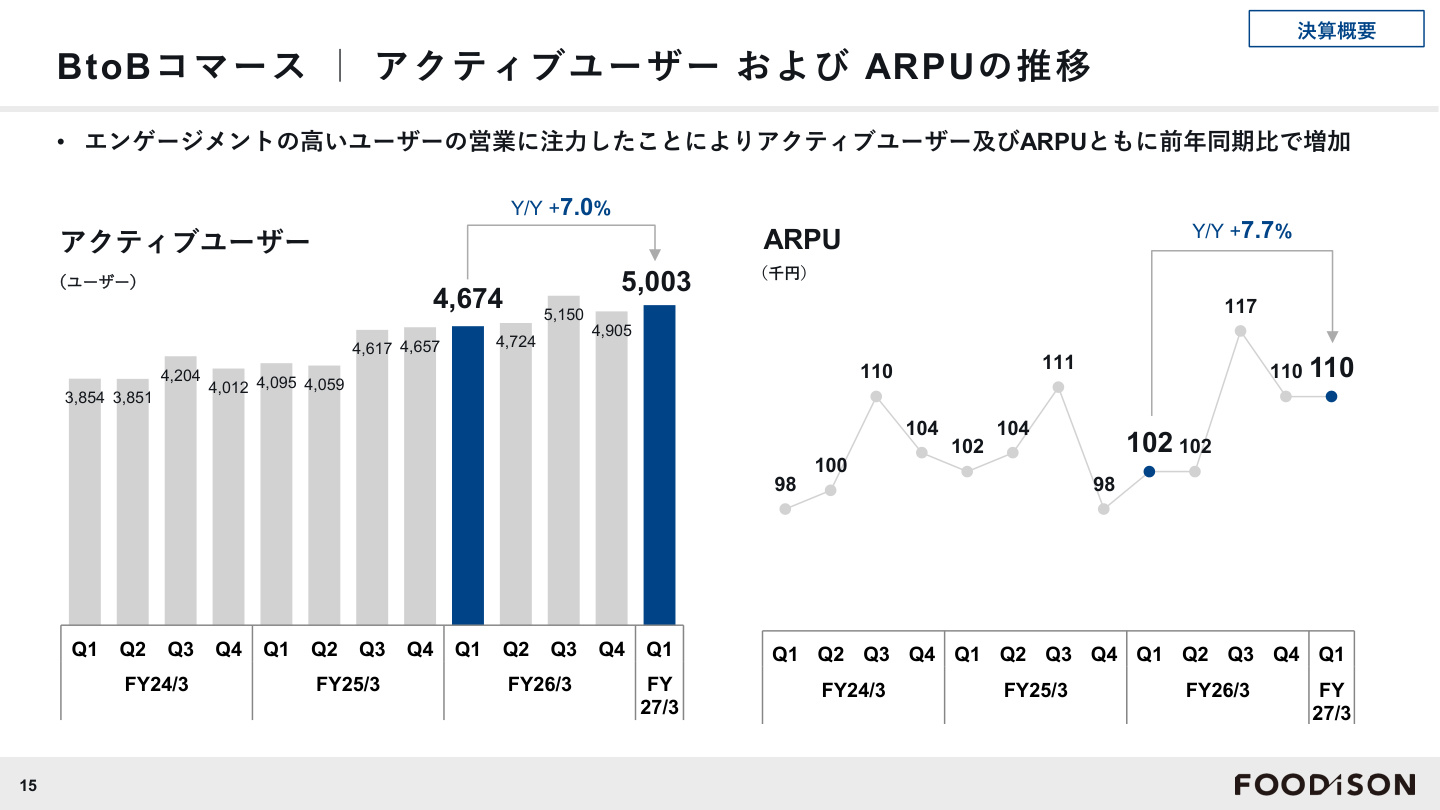
The slide above illustrates the trends in active users and ARPU (Average Revenue Per User) , the drivers of BtoB Commerce growth. This data carries two significant implications:
- Expansion of Customer Base : Efforts to strengthen sales to highly engaged restaurant clients have paid off, with the number of active users reaching 5,003 (+7.0% YoY), surpassing the 5,000 mark.
- Increase in ARPU : ARPU stood at 110,000 yen (+7.7% YoY), maintaining a level higher than the previous year. The strategy of focusing on high-frequency, high-ticket users is yielding results.
However, there is a nuance regarding cohort analysis. While the existing cohort acquired before the previous fiscal year showed strong stock-like characteristics with a 13.6% YoY revenue growth rate , the new cohort acquired this period saw a 12.0% YoY decline . This suggests a lag in nurturing new customers (activation and ARPU growth), and optimization of the onboarding process is expected moving forward.
(2) BtoC Commerce (Fishmonger Brand "sakana bacca")
Net sales for BtoC Commerce were 259 million yen (-8.8% YoY). The primary factor for the decline was a reduction in the number of stores by one compared to the same period last year. The company is currently reviewing product specifications and adjusting prices to secure gross margins and improve profitability against rising procurement costs.
(3) HR Business (Food Industry-Specialized Recruitment "Food Jinzai Bank")
The HR business faced a challenging quarter, with net sales of 52 million yen (-49.1% YoY), effectively halving from the previous year. The direct cause was a slowdown in successful placements. Given that the HR business has an extremely high marginal profit ratio (gross margin), this decline significantly impacted the company-wide gross margin and overall profitability. The company is currently reviewing operations, including optimizing processes and strengthening marketing, to improve productivity per head.
3. Deep Dive into EBITDA Factors and Cost Structure
We analyze the factors behind the significant decline in EBITDA from 30 million yen to 4 million yen (-26 million yen) through the lens of the cost structure.
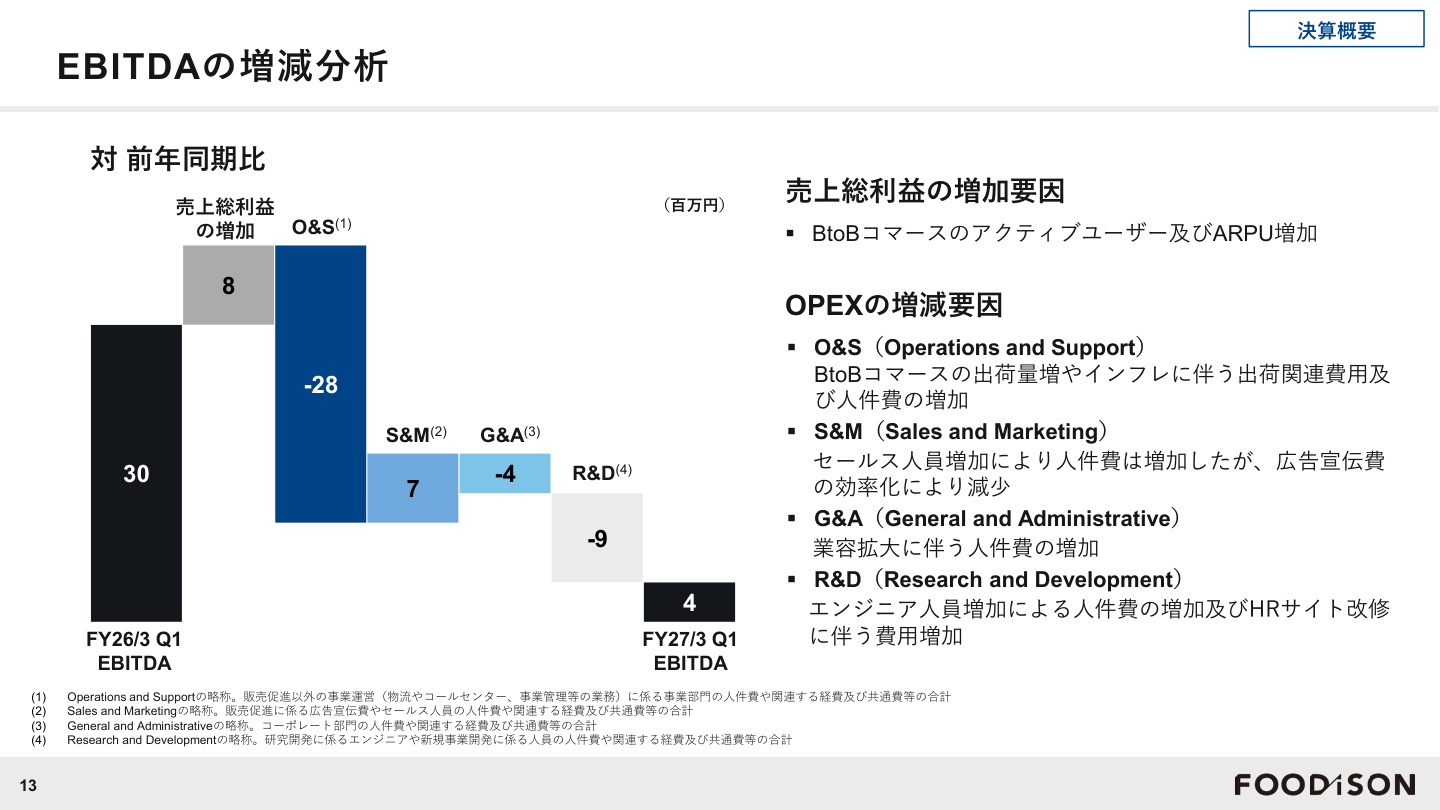
The slide above uses a waterfall chart to explain the factors behind the EBITDA change. The primary drivers of profit pressure are clear:
- Increase in Gross Profit (+8 million yen) : Gross profit accumulated in line with the growth of BtoB Commerce.
- Increase in O&S (Operations & Support) Expenses (-28 million yen) : The largest factor in the EBITDA decline. Increased logistics costs due to higher shipment volumes in BtoB Commerce, combined with inflation-driven shipping costs and rising personnel expenses in business divisions, directly impacted profits.
- Improvement in S&M (Sales & Marketing) Expenses (+7 million yen) : Despite higher personnel costs due to an increase in sales staff, the company successfully reduced expenses through more efficient advertising and promotion.
- Increase in G&A and R&D Expenses (-4 million yen / -9 million yen) : Costs were incurred due to an increase in administrative staff to support business expansion, as well as the hiring of additional engineers and expenses related to HR website renovations.
The company-wide gross margin fell from 35.1% in the previous year to 32.9% (-2.2pts). Excluding the HR business, the gross margin for the commerce business (BtoB and BtoC) remained largely flat at 31.1% (-0.1pts YoY). This confirms that the decline in the company-wide gross margin is not due to deteriorating profitability in commerce itself, but rather a structural factor caused by the lower revenue contribution of the high-margin HR business (from 5.6% last year to 2.6% this period) .
4. Progress Toward FY2027 Full-Year Forecast and Seasonality
The company's full-year consolidated forecast targets 8,400 million yen in net sales , 220 million yen in operating profit , 220 million yen in ordinary profit , and 180 million yen in net income attributable to owners of the parent .
The progress rate toward the full-year sales target at the end of Q1 is 23.5% , which is in line with historical trends. It is important to note that the company's performance is subject to clear seasonal fluctuations :
- Q2 (July–September) : Demand for BtoB Commerce tends to dip temporarily due to the summer heat.
- Q3 (October–December) : This period coincides with the peak season for restaurants (e.g., year-end parties), leading to a sharp expansion in BtoB Commerce demand, with sales and profits typically concentrated here.
Therefore, the business model is designed to achieve full-year targets through demand expansion in the second half (particularly Q3), even if profit levels remain low in Q1 and Q2.
5. Structural Competitive Advantages and Mid-to-Long-Term Potential
The latter part of the earnings presentation highlights the barriers to entry and structural strengths of the company's fresh food distribution platform:
- Huge Untapped Market and Low EC Penetration : Against a total final consumption of food and beverages in Japan of 76 trillion yen, the EC penetration rate is only 4.5% (significantly lower than the 43.0% for consumer electronics). The room for EC growth is immense.
- High Barriers to Entry via Regulations and Physical Infrastructure : Fresh food distribution is subject to institutional regulations such as "wholesale market intermediary permits" and "marine product manufacturing permits." Furthermore, the company has built an end-to-end integrated system, including the Ota Market Fulfillment Center (FFC) and a nationwide procurement and proprietary delivery network, which is difficult for new entrants to replicate in the short term.
- Over a Decade of Accumulated Structured Data : Unlike traditional ordering (phone, fax, paper), the company digitally records all transaction data (order history, products, origins, specifications, supply/demand, prices, delivery routes, etc.) daily. This data foundation serves as a robust base for future AI utilization and operational automation.
- Positioning to Turn Macro Changes into Tailwinds : Challenges such as the "severe labor shortage" in the restaurant industry, "increased complexity of information management" due to HACCP and food labeling laws, and "rising industry operating costs" (e.g., the 2024 logistics problem) are headwinds for traditional operators. However, for Foodison, with its proprietary delivery network and efficient EC ordering platform, these factors act as tailwinds, encouraging replacement of existing providers and increased usage.
6. Conclusion
Foodison's Q1 FY2027 results show that while the core BtoB Commerce business drove revenue growth by increasing both user numbers and ARPU , the struggles of the HR business and rising logistics and personnel costs significantly pressured profits .
Key points to watch moving forward include: (1) the speed of recovery and improvement in the high-margin HR business, (2) the efficiency of nurturing newly acquired BtoB Commerce customers, (3) measures to absorb cost inflation (logistics and personnel), and (4) the pace of earnings expansion toward the peak Q3 season. We will continue to monitor how the company leverages its unique infrastructure and data foundation to navigate its path toward mid-to-long-term compounding growth.
This content is not intended as investment advice or a recommendation. Any opinions expressed are solely the personal views of each article.