


Adish (7093) H1 FY2026 Earnings Deep Dive: Record-High Revenue Despite Fire Incident, Accelerating Mid-to-Long-Term Growth via BPaaS and Enterprise Expansion

StockClub
Published: Aug 14, 2026, 12:28 PM
Sentiment Analysis

This report provides a comprehensive analysis of the H1 FY2026 financial results for Adish, Inc. (Securities Code: 7093), covering performance metrics, key KPIs, business topics, and future growth strategies. The company provides customer success (CS) and SNS monitoring support to clients ranging from startups to large enterprises, demonstrating steady growth while overcoming unexpected challenges during the current period.
1. H1 FY2026 Earnings Highlights and Profit Analysis
Record-High Revenue for a Second Quarter
Adish’s consolidated revenue for the first half of the fiscal year ending December 2026 reached 1,865 million yen (+4.6% YoY), marking the highest revenue ever recorded for a cumulative second quarter . Quarter-on-quarter (QoQ) trends show growth across all metrics, validating the robust demand for outsourced services in its core customer success segment.
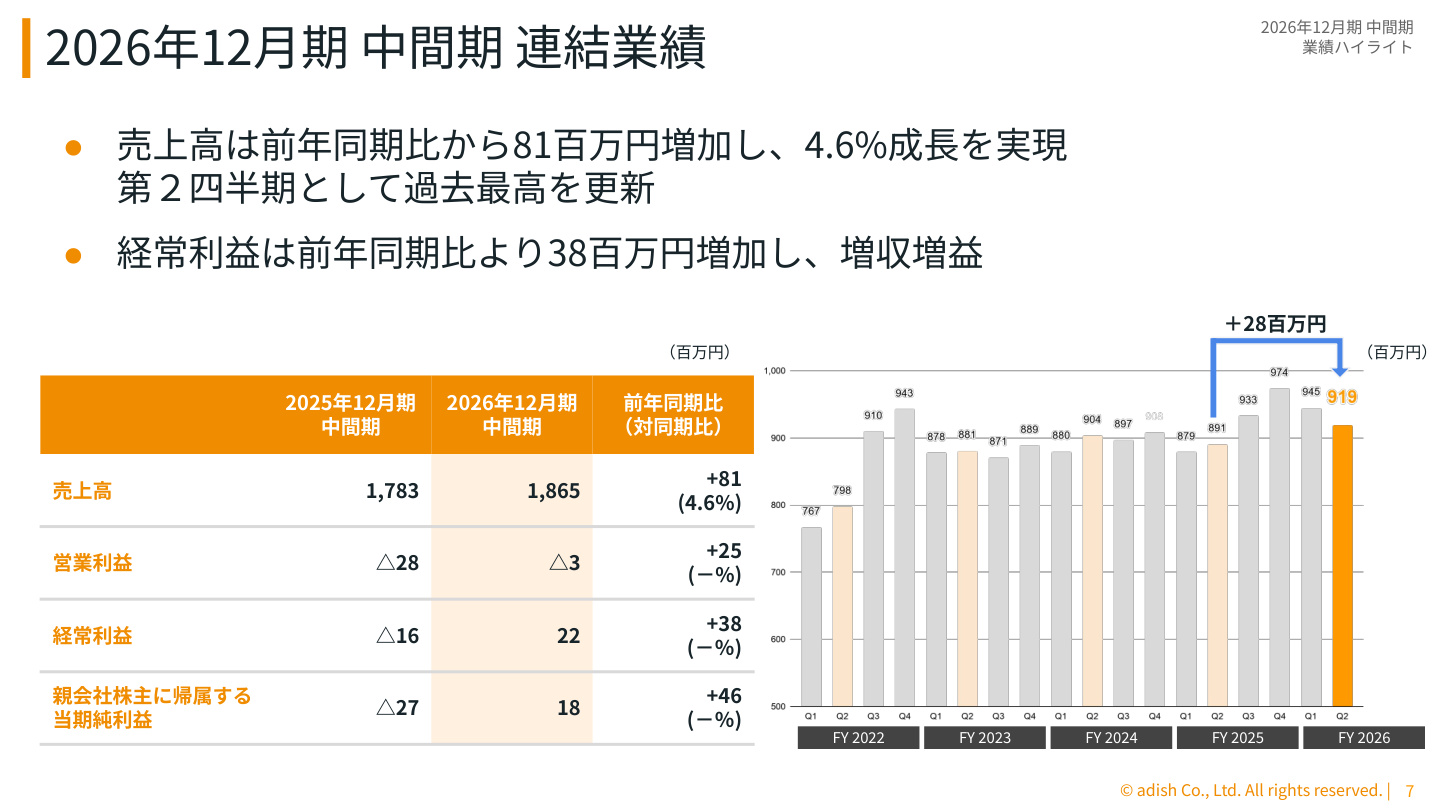
As shown above, in addition to achieving an 81 million yen revenue increase from the 1,783 million yen reported in the same period last year, the company saw positive growth (improvement) across operating profit, ordinary profit, and net profit attributable to owners of the parent.
Impact of the Fire Incident on Earnings
A critical factor in understanding this period's performance is the fire at the building housing the company's headquarters in February 2026. The company opened a temporary office in May and incurred extraordinary expenses related to the procurement of equipment and fixtures. These costs were recorded as operating expenses (SG&A, etc.), resulting in a minor operating loss of -3 million yen (compared to -28 million yen in the same period last year, an improvement of +25 million yen).
Conversely, the company received 27,262 thousand yen (approx. 27 million yen) in compensation from the company responsible for the fire. This was recorded as non-operating income, leading to an ordinary profit of 22 million yen (+38 million yen YoY) and a net profit of 18 million yen (+46 million yen YoY), marking a return to profitability . Although the expense classification (operating expense) differs from the compensation classification (non-operating income), the ordinary profit—which reflects the actual underlying business profitability—indicates that the negative impact of the fire was kept to a minimum.
Financial Position and Improved Equity Ratio
Steady improvements are also evident in the company's financial position. Total assets at the end of the first half stood at 1,313 million yen , with cash and deposits increasing to 623 million yen (+78 million yen from the end of the previous fiscal year) due to new borrowings. Furthermore, with equity increasing to 588 million yen due to the exercise of stock options and the booking of interim net profit, the equity ratio rose to 44.3% (+3.5 points from the end of the previous fiscal year), further strengthening financial stability.
2. Key KPI Trends and Business Model Strengths
Adish’s growth model is supported by key KPIs that demonstrate high recurring revenue and a solid customer base.
- Recurring Revenue : 1.81 billion yen (Cumulative Jan–Jun 2026)
- Recurring Revenue Ratio : 97.3%
- Monthly Churn Rate : 1.2%
- ARPA (Average Revenue Per Account) : 6.7 million yen/year
Maintaining a recurring revenue ratio of 97.3% is a significant strength. The monthly churn rate is also controlled at a low level of 1.2% , establishing a relational business model that does not rely on one-off spot projects. The annual ARPA of 6.7 million yen is also trending well, reflecting the scaling of projects, particularly among large enterprises.
3. Growth Strategy and Business Topics: Structural Revenue Expansion
During the first half, the company secured several strategic partnerships and large-scale enterprise projects to accelerate future growth.
① Partnership with Global AI Agent "Fin" (Accelerating the BPaaS Model)
Adish announced a business partnership with Fin , a US-based company that provides AI customer agents deployed by over 30,000 companies worldwide.
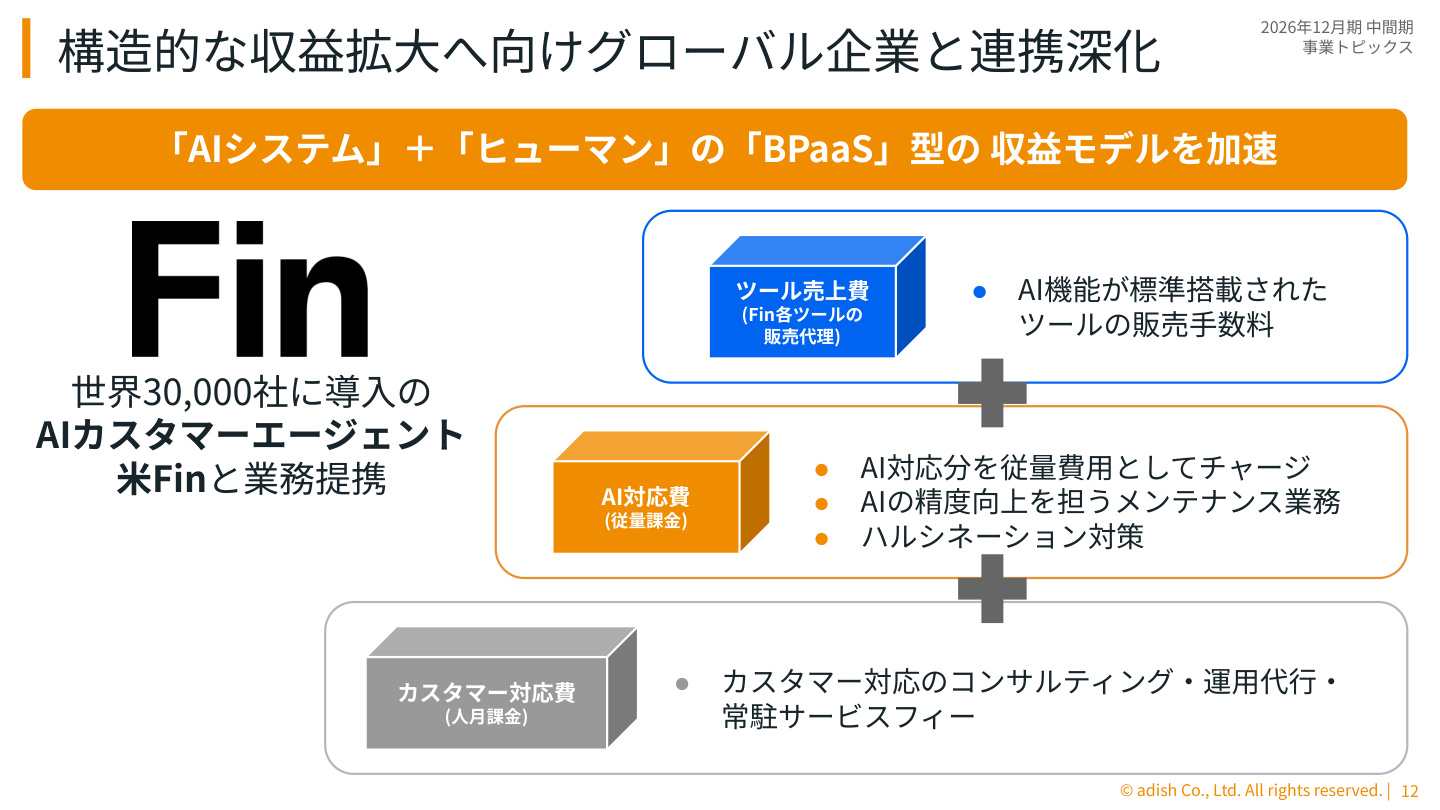
This partnership goes beyond simple AI tool implementation; it has strategic significance in establishing a "BPaaS" (Business Process as a Service) revenue model that fuses "AI systems" with "human support." Specifically, the company aims to monetize through a three-layer structure:
- Tool Sales Fees : Commission income from the sale of Fin tools with integrated AI features.
- AI Handling Fees : Usage-based fees for AI interactions, plus maintenance revenue for managing AI hallucinations and ensuring accuracy.
- Customer Support Fees : Fees for high-level human consulting, operational outsourcing, and resident services. By automating simple inquiries with AI while Adish handles complex customer interactions and AI operations, the company aims to simultaneously improve gross margins and maximize customer value .
② Entry into Non-SaaS Sectors via Capital and Business Alliance with Hammock
Adish entered into a capital and business alliance with Hammock Corporation , a software manufacturer listed on the TSE Growth market (holding 3.07% of common stock). While Adish’s CS support has traditionally focused on SaaS companies and startups, this partnership allows it to capture customer success demand in non-SaaS sectors (traditional IT, packaged software, etc.) , further expanding its target customer base.
③ Accumulation of Enterprise CS Case Studies (Mitsubishi Electric)
Success in building CS structures for large enterprises was highlighted by the implementation at Mitsubishi Electric Corporation . To address issues such as declining retention rates due to insufficient customer support, Adish provided end-to-end support from consulting to operational design. As a result, they built a CS structure in just 5 months , achieving a 100% initial login rate and a 90% onboarding completion rate .
④ Intellectual Property Protection and Social Issue-Solving Services
- Toei Animation Case : Through the "MONI" counterfeit and piracy patrol service, the company conducted approximately 72,000 patrols in six months, leading to the reporting and removal requests for approximately 5,800 suspected pirated items , contributing to the protection of brand value for entertainment companies.
- School Guardian / EdTech : Through a partnership with South Korea’s ZEP, the company is expanding internet literacy education in the metaverse and conducting awareness campaigns regarding SNS risks and "dark part-time jobs" (yami-baito) through major media outlets like NHK and TV Asahi.
4. Full-Year FY2026 Consolidated Earnings Forecast
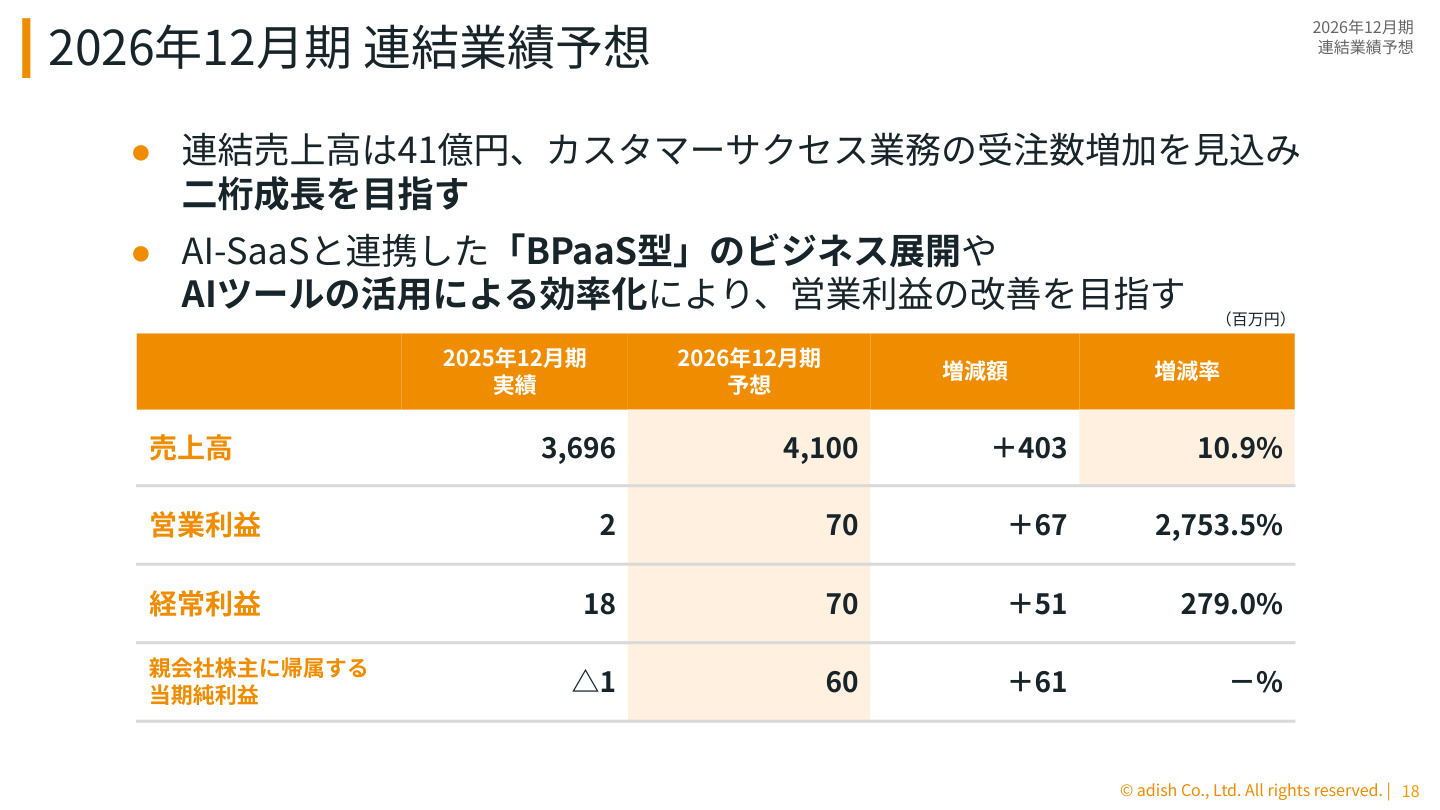
The full-year consolidated earnings forecast for the fiscal year ending December 2026 remains unchanged from the initial guidance.
Full-Year Forecast Figures
- Revenue : 4,100 million yen (+10.9% YoY)
- Operating Profit : 70 million yen (+2,753.5% YoY / approx. 35x)
- Ordinary Profit : 70 million yen (+279.0% YoY)
- Net Profit Attributable to Owners of the Parent : 60 million yen (vs. -1 million yen loss in the previous year)
The company is targeting double-digit growth (10.9% increase) with a full-year revenue goal of 4.1 billion yen. The progress rate at the end of the first half is approximately 45.5%, with expectations for increased CS project orders and contributions from large-scale projects in the second half. Regarding profits, the company plans a significant V-shaped recovery to 70 million yen in operating profit from 2 million yen in the previous fiscal year. This improvement is driven by operational efficiencies through AI tool utilization and increased marginal profit margins from the expansion of high-value "BPaaS" services.
5. Summary and Future Outlook
Adish’s H1 FY2026 results can be summarized as a strong performance that achieved record-high second-quarter revenue while absorbing the unexpected shock of an office fire through appropriate risk management and compensation receipts.
The customer success market the company operates in continues to benefit from structural tailwinds, as evidenced by the expansion of the domestic public cloud market (projected to reach 2.2 trillion yen by 2028, CAGR 17.6%) and the fact that the number of CS-related job openings has reached approximately 18 times the 2019 level.
Moving forward, key observation points for validating the company's growth story include the speed of monetization of the BPaaS model through the partnership with Fin , the acquisition of non-SaaS enterprise clients through the alliance with Hammock , and the progress in margin improvement in the second half toward achieving the full-year operating profit target of 70 million yen .
This content is not intended as investment advice or a recommendation. Any opinions expressed are solely the personal views of each article.