


PIALA Inc. Q2 FY2026 Earnings Deep Dive Report

StockClub
Published: Aug 14, 2026, 12:20 PM
Sentiment Analysis

PIALA Inc. Q2 FY2026 Earnings Deep Dive Report
In its Q2 earnings for the fiscal year ending December 2026, PIALA Inc. (Securities Code: 7044) achieved record-high revenue and gross profit, signaling a clear transition into a phase of renewed growth following a dramatic structural reform. Below, we provide a comprehensive analysis of the company's performance, segment trends, KPI progress, and long-term growth story, based on the 10 key topics highlighted in the earnings supplementary materials.
1. Executive Summary: Record Performance and Sustained Profitability
For the first half of the fiscal year ending December 2026, the company reported revenue of 8,970 million JPY (+7.6% YoY) , gross profit of 1,567 million JPY (+28.29% YoY) , and operating profit of 112 million JPY (+190.15% YoY) . Both revenue and gross profit reached all-time highs since listing, and the company successfully turned a significant operating profit, reversing the loss recorded in the same period last year.
All three businesses under the new segment structure are on a growth trajectory, establishing a virtuous cycle of continuous quarter-on-quarter (QoQ) growth in both revenue and profit from Q1 to Q2.
2. Analysis of H1 Operating Profit and Visualization of "Core Operating Profit"
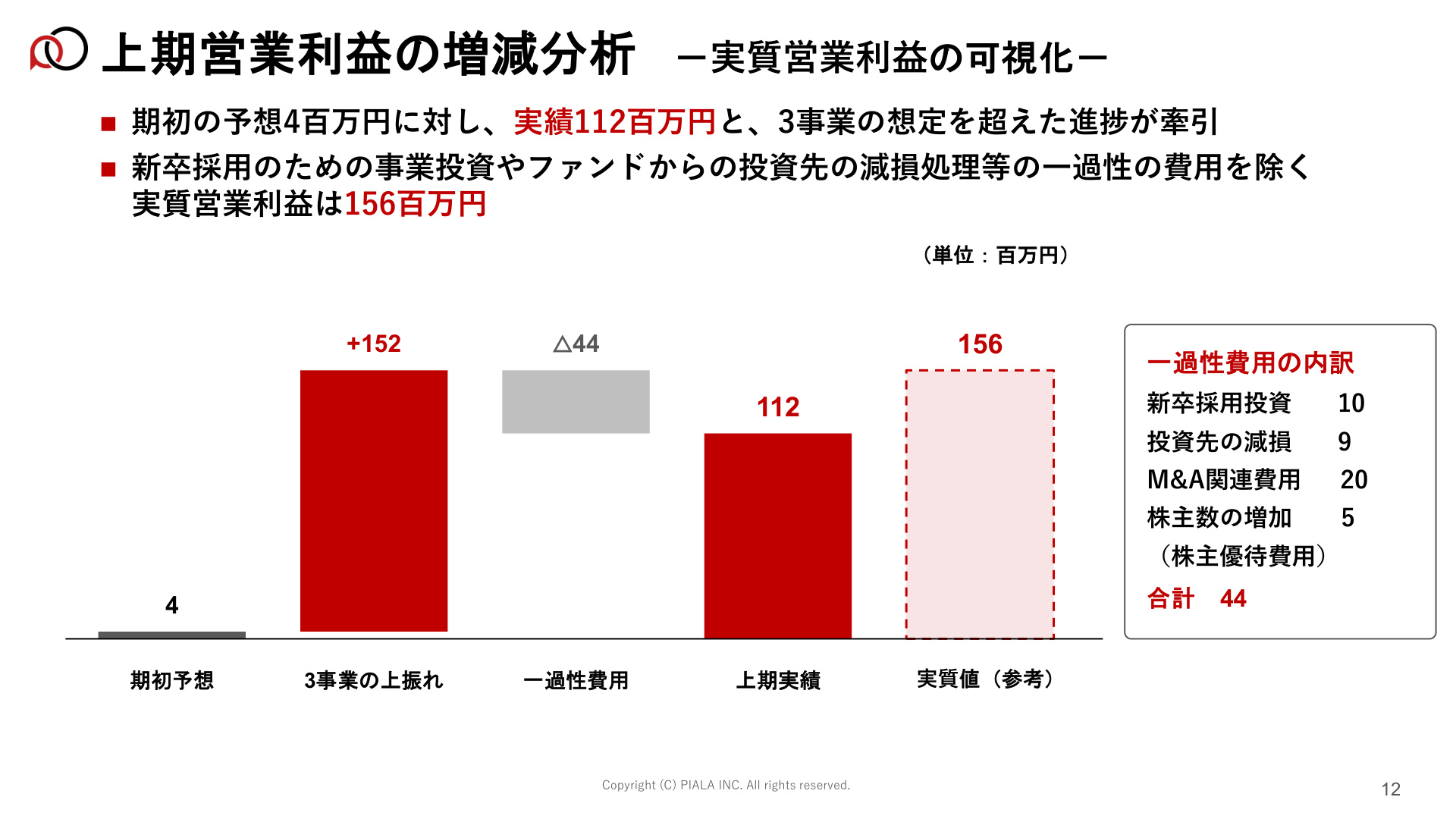
While the initial forecast for H1 operating profit was 4 million JPY, the actual result was 112 million JPY, representing a significant upside of +108 million JPY . This was driven by performance exceeding expectations across all three business segments.
Furthermore, the current period included growth investments and one-time expenses; the core operating profit , which reflects the company's underlying earning power, reached 156 million JPY .
[Slide Commentary: Analysis of H1 Operating Profit Variance]
The slide above (page 12) visually breaks down the factors contributing to the upside against the initial forecast and the nature of one-time costs. Against the initial forecast of 4 million JPY, strong business performance contributed +152 million JPY . Conversely, 44 million JPY in one-time costs were incurred, including new graduate recruitment investments (10 million JPY) to strengthen human capital, impairment losses on existing fund investments (9 million JPY) , M&A-related expenses (20 million JPY) aimed at creating synergies, and shareholder benefit expenses (5 million JPY) due to an increase in the number of shareholders. By excluding these one-time costs, the robust earning power inherent in PIALA's core business (core operating profit of 156 million JPY) is clearly demonstrated.
3. Quarterly Revenue and Gross Profit Trends
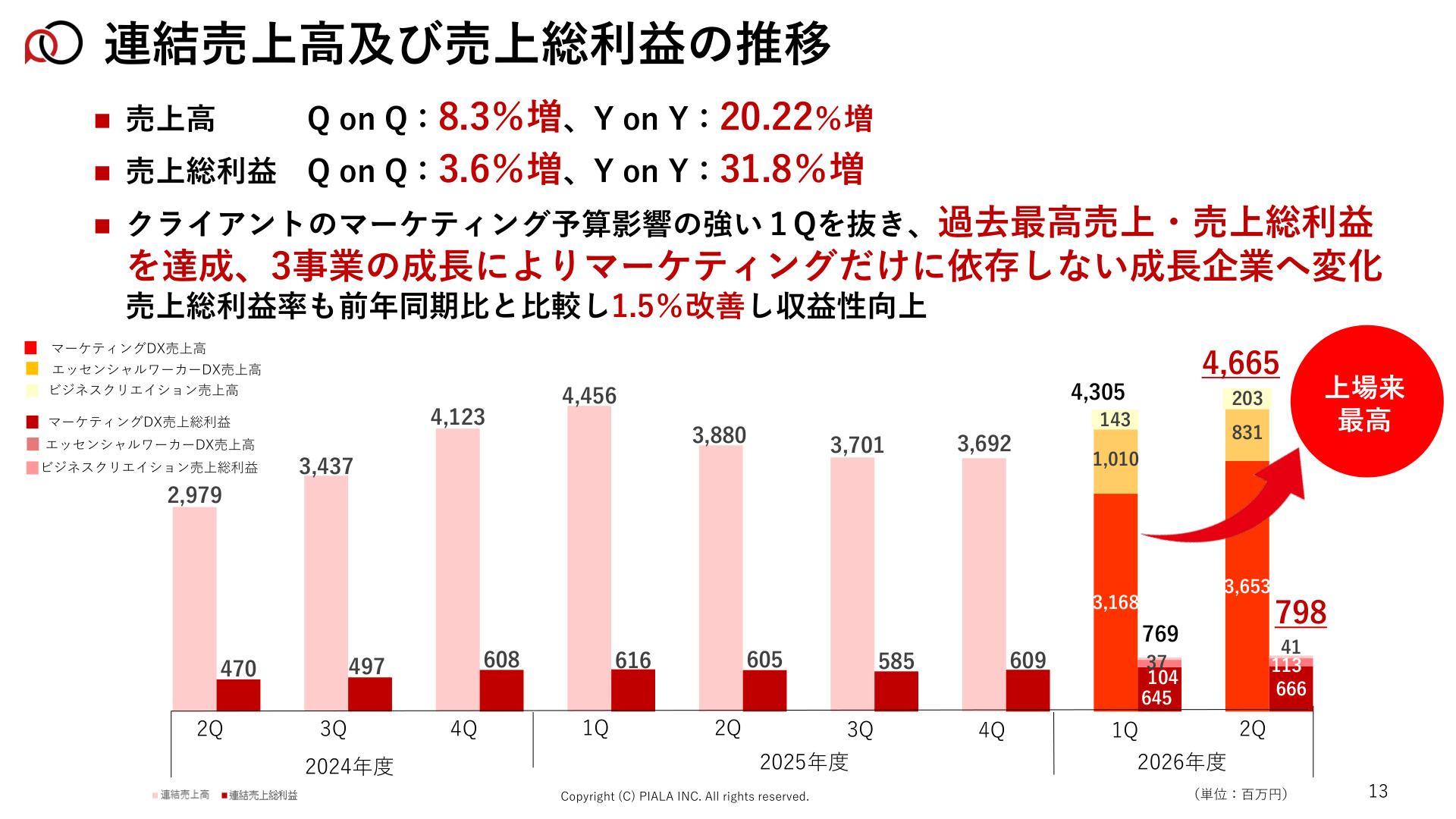
Looking at PIALA's performance on a quarterly basis, the company surpassed the seasonality of Q1 (when client marketing budgets tend to concentrate) and recorded record-high revenue (4,665 million JPY) and record-high gross profit (798 million JPY) in Q2.
[Slide Commentary: Trends in Consolidated Revenue and Gross Profit]
The slide above (page 13) illustrates the quarterly performance momentum since Q2 2024. Revenue grew steadily by +20.22% YoY and +8.3% QoQ . Gross profit also increased by +31.8% YoY and +3.6% QoQ , indicating that diversified business growth—not reliant solely on marketing support—has taken root. Notably, the gross profit margin improved by 1.5% YoY , reflecting enhanced profitability.
4. Segment Restructuring and the "Three-Layer" Business Model
Starting in the fiscal year ending December 2026, PIALA reorganized its business from the traditional single "EC Support Business" into a new three-segment structure to maximize profitability and growth:
- Marketing DX Business : The foundation of the group, acting as a "reproducibility engine" to accelerate each business (2028 revenue target: 25 billion JPY, operating margin: 4-5%).
- Essential Worker DX Business : Recruitment (100% gross margin model) and recruitment DX in sectors facing severe labor shortages, such as medical, nursing, and childcare (2028 revenue target: 5 billion JPY, operating margin: 7-10%).
- Business Creation Business : High-margin proprietary businesses with cost-of-sales ratios below 30%, such as P2C brands and CyberStar (IP/audio domain) (2028 revenue target: 2 billion JPY, operating margin: 10-15%).
This structure leverages the know-how cultivated in Marketing DX to support the other two segments, creating a high-profitability synergy across the three layers.
5. Mid-Term Management Policy and Roadmap to "PIALA2035VISION"
The company positioned the period of stagnation (2021–2023) as a time for structural reform. Following the return to operating profitability in 2025, 2026 marks the beginning of a "period of regrowth and leap."
- 2028 Mid-Term Targets : Revenue of 32 billion JPY , Operating Profit of 2 billion JPY (6.3% margin) .
- PIALA2035VISION : Revenue of 100 billion JPY , Operating Profit of 10 billion JPY (10% margin) .
The company aims to evolve from a mere support firm into a "Growth Infrastructure Company" that combines AI and marketing.
6. Key KPI Monitoring and Progress
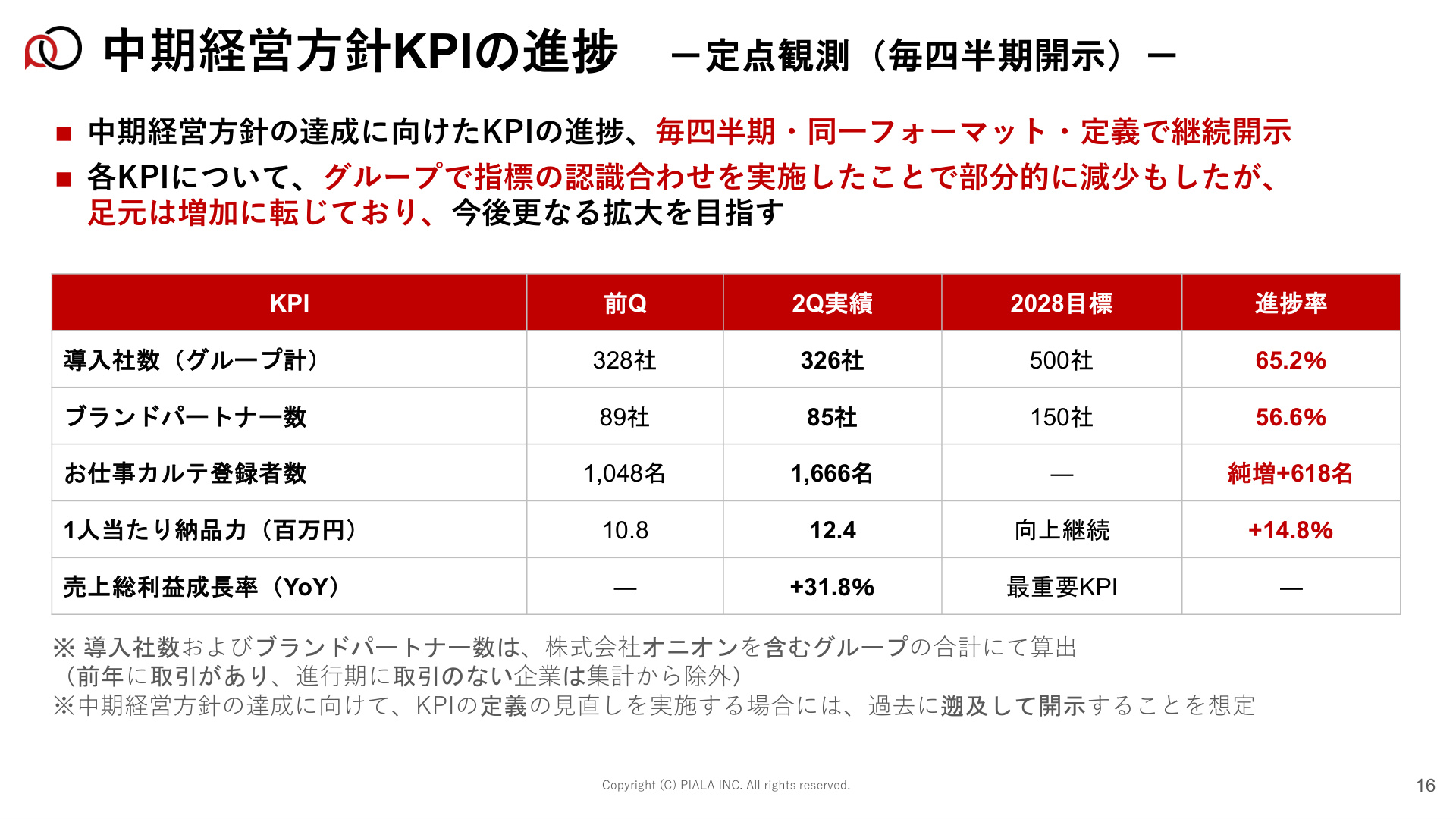
To achieve its mid-term management goals, PIALA discloses its key KPIs using a consistent format every quarter.
[Slide Commentary: Progress on Mid-Term Management KPIs]
The slide above (page 16) lists the key indicators showing current progress toward the 2028 targets:
- Number of Clients (Group Total) : 326 (65.2% progress toward the 500-client target).
- Number of Brand Partners : 85 (56.6% progress toward the 150-partner target).
- "Oshigoto Karute" Registrants : 1,666 (a net increase of 618 from the previous quarter).
- Delivery Capacity per Employee : 12.4 million JPY (+14.8% QoQ).
- Gross Profit Growth Rate (YoY) : Maintained at a high level of +31.8%.
By standardizing KPI definitions across the group, the company has eliminated excessive inflation of figures, ensuring highly effective KPI tracking.
7. Marketing DX Business Transformation and "Brand Co-Creation" Model
In the Marketing DX business, PIALA is shifting from a traditional "performance-based (acquisition-focused)" model to a "full-funnel brand co-creation partner" that handles everything from awareness and interest to acquisition and LTV.
By combining the creative capabilities of Onion Inc. (which joined the group) with PIALA's data analysis and AI utilization, the company creates synergies between "Brand Spark" (branding) and "Retail Spark" (word-of-mouth/buzz). This establishes a unique competitive position that offers partial guarantees on marketing budgets combined with budget optimization .
Furthermore, through a mass-production system utilizing vertical video and AI (including creative centers in Thailand and Vietnam), the company is equipped to conduct over 4 million multi-variable tests per month.
8. Rapid Growth and Competitive Advantage in Essential Worker DX
PIALA is applying its unique customer acquisition and marketing expertise to address the social issue of labor shortages, which are projected to exceed 10 million people by 2040 in the medical, nursing, and childcare sectors.
While typical recruitment agencies compete in a "red ocean" for people already looking to change jobs, PIALA possesses a structural advantage by using marketing to mobilize "latent candidates" (those not yet actively looking).
The recruitment service "Oshigoto Karute," launched in August 2025, has reached 1,666 registrants and over 2,000 job listings. The gross profit growth rate is up 12.8% QoQ , and the company plans to expand into new job categories such as drivers, rehabilitation staff, and nutritionists, alongside the establishment of a Sendai branch.
9. Strategic Significance of Business Creation and CyberStar Profitability
The Business Creation business serves as a "field for empirical experiments (in-house implementation)," where the company takes risks to test the latest marketing methods. The feedback loop—where successful models and creator networks are fed back into the Marketing DX business—is functioning effectively.
In Q2, the segment recorded a revenue growth rate of 41.96% (203 million JPY) . The CyberStar business achieved quarterly profitability , driven by the "TuneMATE" IP/audio project and collaboration earphones with the virtual girls' HIPHOP unit "KMNZ." Additionally, upfront investments and renewals for P2C brands (such as SHAPEDAYS) are progressing smoothly.
10. Conclusion and Outlook
The Q2 FY2026 earnings report confirms that PIALA has overcome its past structural reform period and has entered a clear growth spiral.
After absorbing one-time costs, the company significantly exceeded its H1 operating profit forecast. With the transformation of the core Marketing DX business, the high growth of the Essential Worker DX business, and the profitability of the Business Creation business, a structure where the three pillars complement each other is nearing completion. With the most important KPI—gross profit growth rate (+31.8%)—as the anchor, the company is steadily making progress toward its 2028 mid-term targets (32 billion JPY in revenue, 2 billion JPY in operating profit).
This content is not intended as investment advice or a recommendation. Any opinions expressed are solely the personal views of each article.