


Allied Architects FY2026 Q2 Earnings Deep Dive: Strategic Transformation into an 'AX Company' and Mid-to-Long-Term Growth Story

StockClub
Published: Aug 14, 2026, 11:57 AM
Sentiment Analysis

Allied Architects, Inc. (Securities Code: 6081) reported its FY2026 Q2 earnings , marking a critical transition period characterized by a significant overhaul of its business portfolio and a strategic pivot toward becoming an 'AX (AI Transformation) Company.'
This report provides a detailed analysis of the company's current performance, management structural reforms, segment-specific status, and mid-to-long-term growth trajectory, centered on 10 key topics identified from the earnings materials.
1. Overview of Earnings and 10 Key Topics
- Change in Reporting Segments : Starting this period, the company has reorganized into two segments: 'Marketing AX Business' and 'Asset AX Business' (formerly Crypto-related Business).
- Current Consolidated Performance : Q2 (quarterly) revenue was ¥629 million (down 8.8% YoY), with an operating loss of ¥63 million (compared to a ¥65 million loss in the same period last year). Cumulative H1 revenue reached ¥1.397 billion (down 6.8% YoY), with an operating loss of ¥87 million (compared to a ¥48 million loss in the same period last year).
- Restructuring and Exit from Overseas Business : The decline in revenue is primarily due to the deconsolidation of overseas subsidiaries (e.g., SuperFaction) following their divestiture or closure. This portfolio streamlining aims to reduce costs and concentrate resources on domestic operations.
- SG&A Control and One-time Expenses : While costs related to governance strengthening have subsided, the company incurred one-time expenses for Tokyo Stock Exchange Standard Market transition preparations and overseas subsidiary liquidation. These were absorbed while maintaining a cost-control stance.
- Strategic Shift to 'AX Company' : The company has explicitly adopted an approach to redesign its business model, organization, and KPIs with AI as the foundation, aiming to move away from reliance on individual expertise and outsourcing.
- Mid-term Profit Plan (FY2026–FY2027) : A plan has been established to achieve an operating profit of ¥50 million in FY2026 , followed by ¥5 billion in revenue and ¥500 million in operating profit (10% operating margin) in FY2027 .
- Promotion of 4 AX Reform Areas : The company seeks to create corporate value through four axes: 'Marketing AX,' 'Management AX,' 'Human Resources AX,' and 'Asset AX,' pursuing both improved margins in existing businesses and dual growth in new ventures.
- Evolution of Marketing AX and 'Kaname.ax®' : A shift from simple tool provision (SaaS) and execution support to an upstream strategy and decision-making support platform centered on VOC (Voice of Customer) data.
- Three-Tier Support Model and Significant Increase in ARPU : By moving to upstream support layers, the average customer unit price has expanded to ¥3.54 million (1.3x YoY) in the Tier 3 area and ¥0.94 million (2.7x YoY) in the Tier 1 area.
- Full-scale Launch and Profitability of Asset AX : Utilizing a strategy of switching operational engines based on 'summer/winter' crypto market cycles, the segment achieved profitability in Q2 (¥11 million revenue, ¥0 million operating profit) and verified an annualized monthly yield exceeding 13% .
2. Performance Highlights and Expense Structure Analysis
Consolidated Performance Trends and Factors
Revenue for Q2 FY2026 was ¥629 million (down 8.8% YoY). This decline is primarily due to the restructuring of the overseas business portfolio , including the exit from SuperFaction in October 2024. The company is currently in a phase of continuing growth investments for the mid-to-long term while curbing operational costs.
Regarding profitability, the Q2 operating loss was ¥63 million , a slight improvement from the ¥65 million loss in the same period last year. Cumulative H1 net loss improved significantly to ¥137 million (compared to ¥438 million in the same period last year), aided by the absence of special investigation expenses incurred in the previous year.
SG&A and Structural Reform Costs
While governance strengthening costs have converged , the current period included audit fees related to the transition to the TSE Standard Market. Additionally, one-time personnel and outsourcing costs (totaling ¥18 million) associated with the liquidation of overseas subsidiaries were recorded. However, indirect operational costs are being optimized through the promotion of BPR (Business Process Reengineering).
3. Business Structural Reform: The 'AX Company' Approach
The most critical strategy being pursued is the transition to an 'AX Company,' which involves transforming the business structures of both the company and its clients to be AI-native.
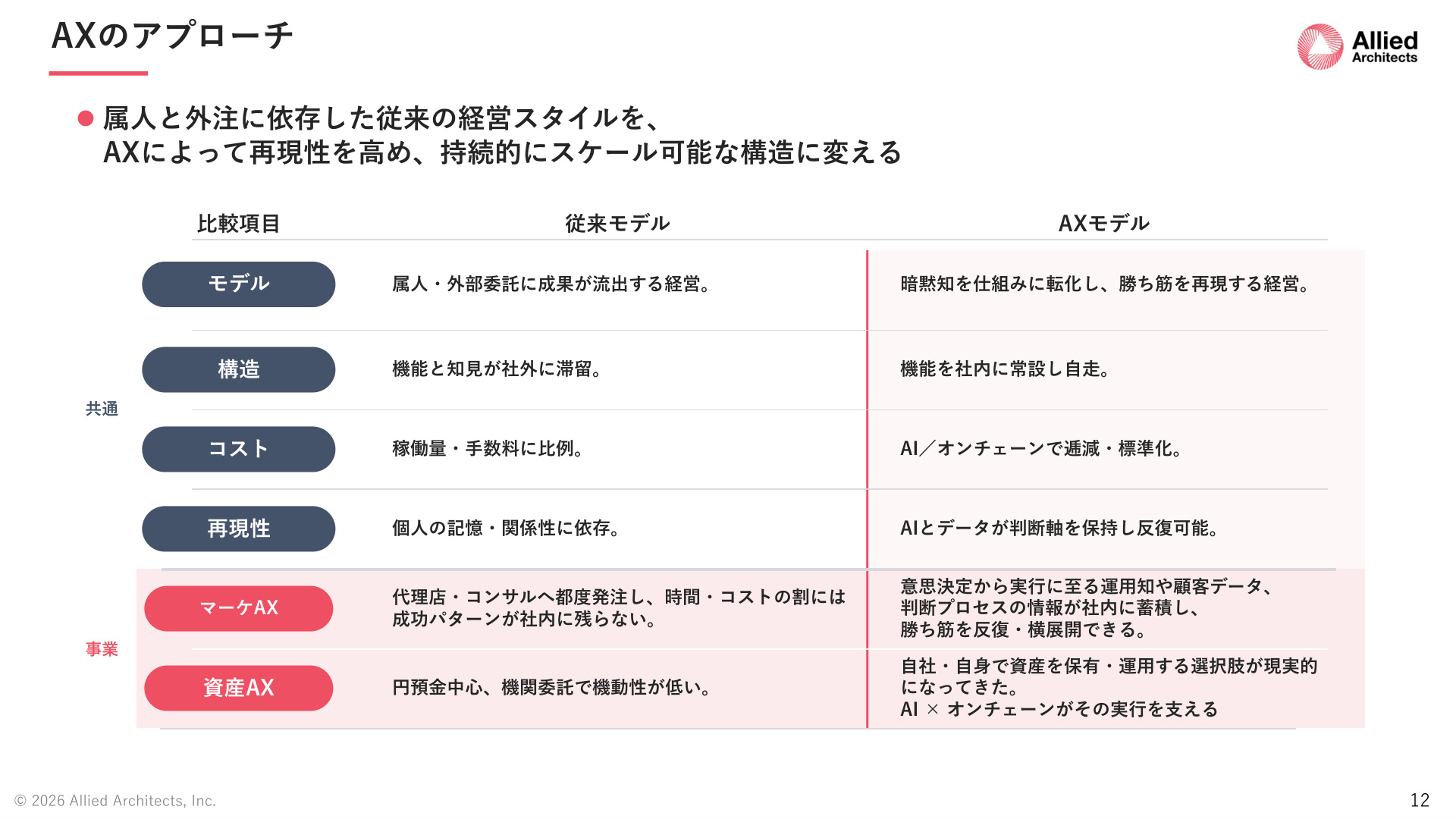
Why this slide is important: The Essence of the AX Model
This slide presents a comparative view of the fundamental shift in the company's management style. The traditional business model relied on 'individual expertise and outsourcing,' where specialized knowledge was tied to specific people or external contractors, leading to costs that scaled linearly with workload.
In contrast, the 'AX Model' systematizes and standardizes tacit knowledge through AI and data platforms. By connecting the entire business loop—from decision-making to execution and effect measurement—via AI, the company aims to achieve 'organizational reproducibility' and 'sustainable scalability.' This is the core of a structural reform that goes beyond internal efficiency, dramatically improving the gross margin and productivity of the services provided.
4. Mid-term Profit Plan and Growth KPIs (FY2026–FY2027)
The company has set clear performance targets for when the results of its structural reforms are expected to materialize.
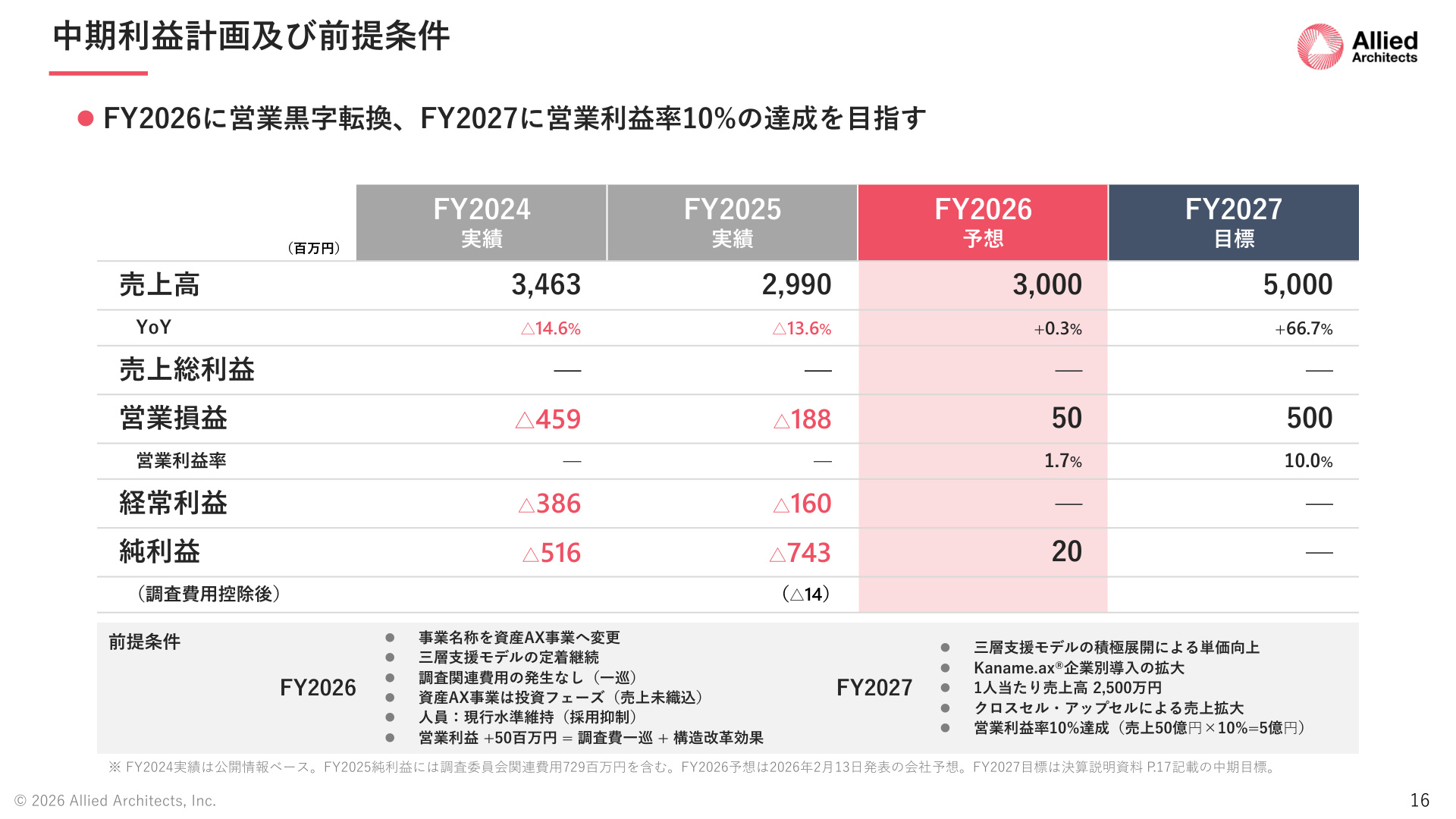
Why this slide is important: Numerical Targets and Prerequisites
This slide is crucial for understanding the company's future earnings profile. It outlines a V-shaped recovery scenario: achieving an operating profit of ¥50 million in FY2026 , followed by rapid growth to ¥5 billion in revenue and ¥500 million in operating profit (10.0% operating margin) in FY2027 .
Three key prerequisites/KPIs for achieving these FY2027 targets are identified:
- Revenue Growth : Increase in customer unit price through the active deployment of the Three-Tier Support Model.
- Value Enhancement : Expansion of 'Kaname.ax®' adoption and promotion of cross-selling/up-selling through the integration of business divisions.
- Operating Margin Improvement : Achieving ¥25 million in revenue per employee (compared to ¥4.24 million as of 2026 Q2) through productivity gains via AI-driven task replacement.
5. Segment Trends and Growth Strategy
① Marketing AX Business: 'Three-Tier Support Model' and Rising Unit Prices
The Marketing AX Business recorded Q2 revenue of ¥618 million and a segment profit of ¥75 million (12.2% operating margin). While revenue is lower than the previous year due to the transition, profitability is improving.
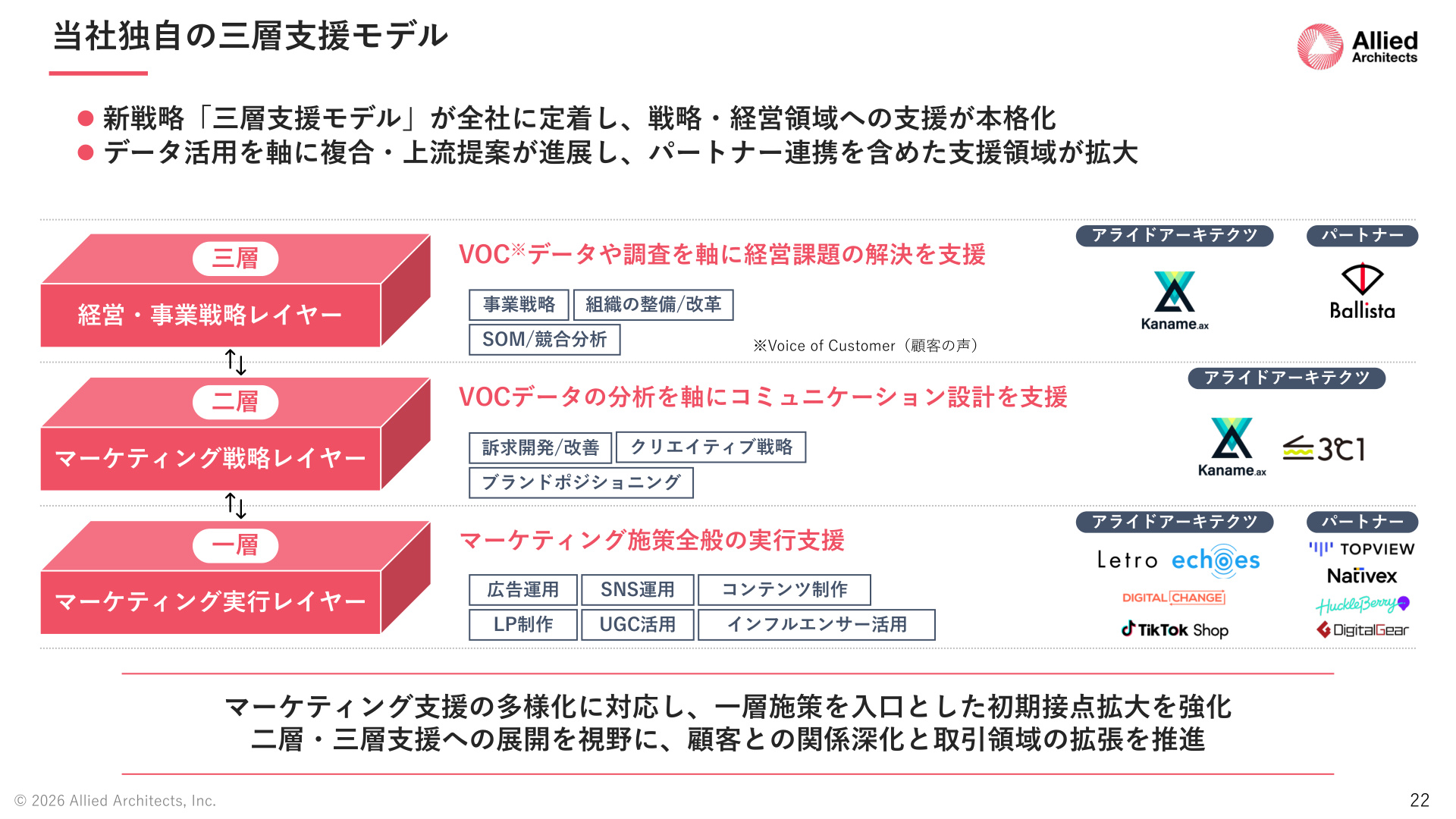
Why this slide is important: High Value-Added via the Three-Tier Support Model
This slide illustrates the overall structure of the 'Three-Tier Support Model' driving the growth of the Marketing AX Business. Previously, the company focused on 'Tier 1 (Marketing Execution Layer)' services like ad management and SNS operation, or SaaS tools. The new strategy strengthens approaches to the 'Tier 3 (Management/Business Strategy Layer)' and 'Tier 2 (Marketing Strategy Layer)' centered on VOC data.
By utilizing the proprietary data analysis platform 'Kaname.ax®' to visualize consumer shopping insights (CEPs), the company provides upstream support such as redesigning management issues and appeal axes. As a result, the average customer unit price has surged to ¥3.54 million in the Tier 3 area (1.3x from ¥2.8 million YoY) and ¥0.94 million in the Tier 1 area (2.7x from ¥0.35 million YoY). This demonstrates that expanding the support domain is effectively driving unit price growth (e.g., strategic redesign for FANCL's additive-free skincare).
② Asset AX Business (formerly Crypto-related Business): Profitability in On-chain Operations
Renamed from the former Crypto-related Business, the 'Asset AX Business' provides digital asset holding and management as an option for corporate financial strategy. The company developed an 'operational engine switching strategy' to secure yields in both rising (summer) and falling/stagnant (winter) crypto markets. In 2026 Q2, it achieved ¥11 million in revenue and ¥0 million in segment profit (turning profitable) , demonstrating an annualized monthly yield of over 13% . Moving forward, the company will commercialize solutions such as 'DeFi Development Corp.' for corporate adoption based on its internal operational track record.
6. Summary and Future Outlook
While Allied Architects' FY2026 Q2 earnings show continued revenue decline and operating losses due to overseas business restructuring and one-time expenses, the company is steadily advancing internal reforms aimed at 'transformation into an AX Company' and 'optimization of the business portfolio.'
Key points for investors and the market to watch include:
- Penetration of the Three-Tier Support Model : Whether upstream proposals centered on 'Kaname.ax®' will maintain or accelerate the expansion of customer unit prices and order intake.
- Progress toward Profitability : Whether SG&A control and revenue recovery will proceed as planned in H2 to achieve the full-year operating profit target of ¥50 million for FY2026.
- Productivity Improvement for FY2027 Targets : Whether the company can approach the target of ¥25 million in revenue per employee through the company-wide use of AI agents (Human Resources AX).
- Scaling of the Asset AX Business : Whether the now-profitable Asset AX Business can grow into a new pillar of revenue as a corporate solution.
To achieve the mid-to-long-term vision of ¥5 billion in revenue and ¥500 million in operating profit, the extent to which AI-driven structural transformation contributes to improved profitability will be a critical indicator for assessing future corporate value.
This content is not intended as investment advice or a recommendation. Any opinions expressed are solely the personal views of each article.