


I-Grid Solutions (603A) FY2026 Earnings Deep Dive: A Growth Story Driven by Asset-Light Strategies and AI Platforms

StockClub
Published: Aug 14, 2026, 11:55 AM
Sentiment Analysis
1. Introduction: IPO and Business Model Overview
I-Grid Solutions, Inc. (Securities Code: 603A) successfully completed its initial public offering on the Tokyo Stock Exchange Growth Market on July 29, 2026. Guided by the vision of "realizing a world where green energy circulates," the company is a GX (Green Transformation) growth company that promotes the adoption of distributed renewable energy—primarily onsite solar power—by utilizing underused spaces such as the rooftops of commercial and logistics facilities.
The company's business structure is built upon two mutually synergistic segments :
- GX Solutions Business : Installs and operates solar power generation equipment and storage batteries on the rooftops of stores and factories, supplying and selling renewable energy. This segment focuses primarily on onsite PPA (Power Purchase Agreement) services.
- Energy Trading Business : Integrates and manages the surplus electricity that cannot be consumed by the onsite facilities of the GX Solutions business, supplying it to other power consumers through long-term fixed-price contracts or appropriate market transactions.
Supporting the robust collaboration between these two segments is the company's proprietary AI platform, "R.E.A.L. (New Energy Platform)." While traditional onsite solar projects were limited to installing panels based on "self-consumption" capacity, I-Grid's AI platform can predict and adjust power demand and generation in real-time with high precision. This enables maximum panel installation based on the building's full potential , achieving overwhelming energy generation efficiency by channeling surplus power into the Energy Trading business.
2. FY2026 Full-Year Earnings Highlights
The consolidated financial results for the fiscal year ended June 2026 were exceptionally strong, with both revenue and profit at all levels significantly exceeding initial projections and reaching record highs .
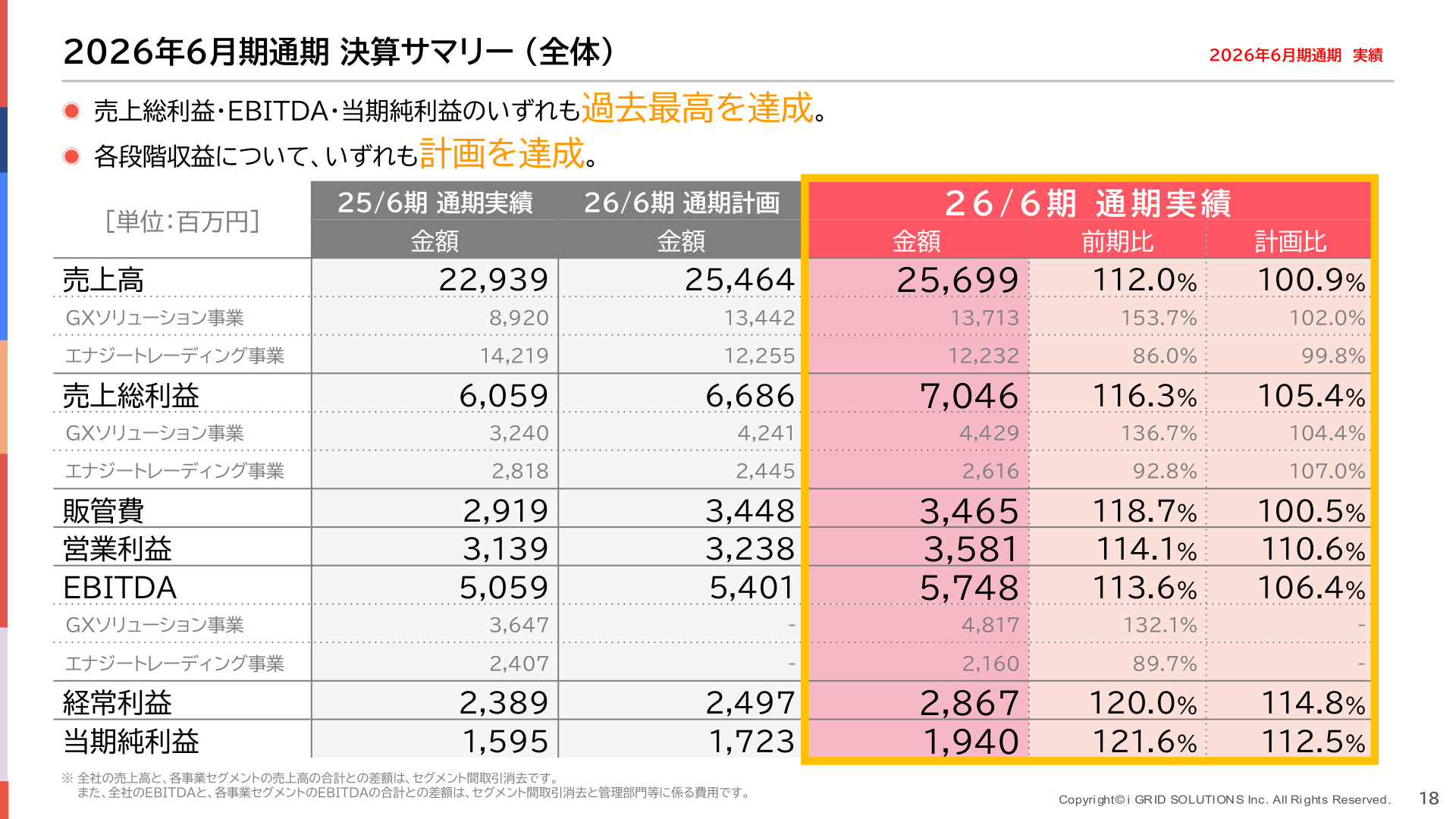
As shown in the earnings summary slide above, revenue reached 25,699 million yen (up 12.0% YoY, 100.9% of the plan) , and gross profit reached 7,046 million yen (up 16.3% YoY, 105.4% of the plan) . Furthermore, EBITDA , a key indicator of cash-generating ability and profitability, stood at 5,748 million yen (up 13.6% YoY, 106.4% of the plan) , while net income reached 1,940 million yen (up 21.6% YoY, 112.5% of the plan) , with all profit items significantly outperforming the full-year targets.
The GX Solutions business was the primary driver of this strong performance. Revenue for the GX Solutions business reached 13,713 million yen (up 53.7% YoY) , and gross profit reached 4,429 million yen (up 36.7% YoY) , growing into the company's core business, accounting for 62.9% of total gross profit.
3. Evolution of the Business Model: Asset-Light Strategy via "Alliance Solutions"
The most significant strategic shift supporting the company's high growth and capital efficiency (ROE/ROIC) is the expansion from "PPA Services (Company-owned)" to "Alliance Solutions (Partner-owned)."
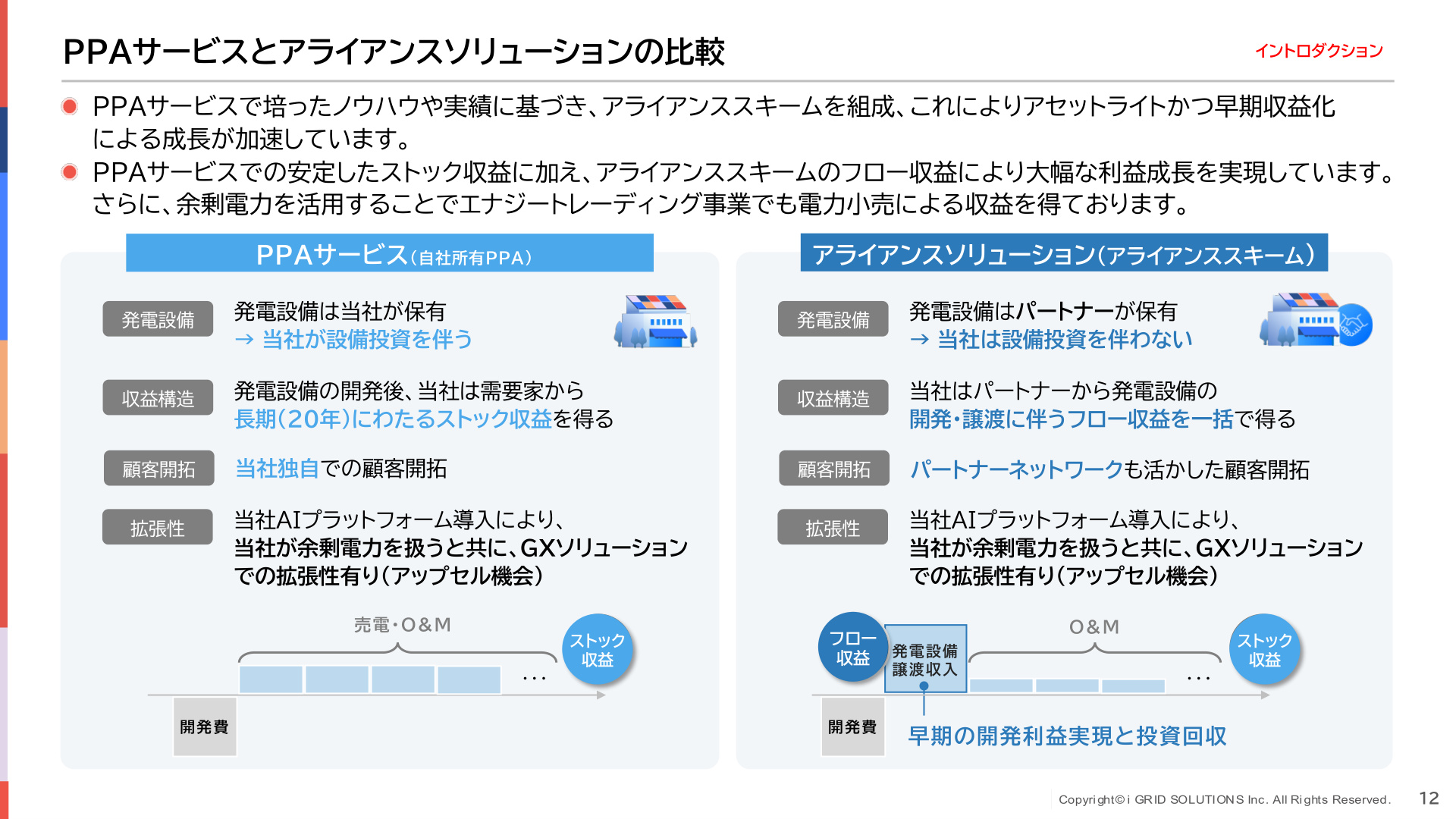
The slide above clearly illustrates the structural differences between the two revenue models the company is promoting:
- PPA Services (Company-owned) : The company invests in equipment and holds the power generation assets on its balance sheet (B/S). This generates stock-type revenue through electricity sales and O&M (operations and maintenance) income over 20 years. While it creates stable long-term cash flow, it can be constrained by the company's own capital procurement and investment capacity.
- Alliance Solutions (Alliance-type) : Developed solar power equipment is transferred to alliance partners (financial institutions, energy companies, etc.) or constructed using partner capital. The company captures flow revenue (development transfer consideration) upfront while retaining O&M rights, surplus power management rights via the AI platform, and a portion of the stock revenue.
By introducing this alliance model, the company can achieve high-speed business expansion without being constrained by investment capacity or borrowing limits, as it does not need to record large-scale fixed assets on its B/S (asset-light) . In FY2026, gross profit from Alliance Solutions reached 1,937 million yen (an 87.5% increase from 1,033 million yen the previous year) , with new operational capacity expanding rapidly to 67MW (215 projects) . The company has set a policy to ensure that over 70% of future new capacity will be based on the alliance model.
4. External Tailwinds and Competitive Advantages
The company's rapid growth is underpinned by structural changes in the Japanese renewable energy market:
- Shift from Mega-Solar to "Distributed Onsite Solar" : Traditional mega-solar projects that clear forests face severe headwinds, including a lack of suitable land, stricter environmental regulations by local governments, and reduced FIT support (new installations have dropped by approximately 60% compared to FY2020). In contrast, onsite solar using rooftops of stores and warehouses has a low environmental impact and requires no transmission fees (grid usage fees) due to its self-consumption nature, benefiting from strong policy tailwinds.
- Energy Security and Soaring Power Prices : With rising geopolitical risks and fuel price volatility, corporate demand for power cost reduction and long-term price fixing is surging. Since the onsite PPA provided by the company requires zero initial investment and offers fixed-price renewable energy, it is seeing constant demand from major retail chains and logistics operators.
- Overwhelming Development Track Record and Market Share : The company's cumulative onsite PPA development track record has reached 1,497 facilities and 387MW (as of the end of June 2026), securing the No. 1 spot in Japan for four consecutive years . It has recorded an extraordinary compound annual growth rate (CAGR) of 59% .
5. FY2027 Full-Year Earnings Forecast and Growth Outlook
The company has announced that it expects to continue its high-level top-line growth and profit-upward trend in the fiscal year ending June 2027.
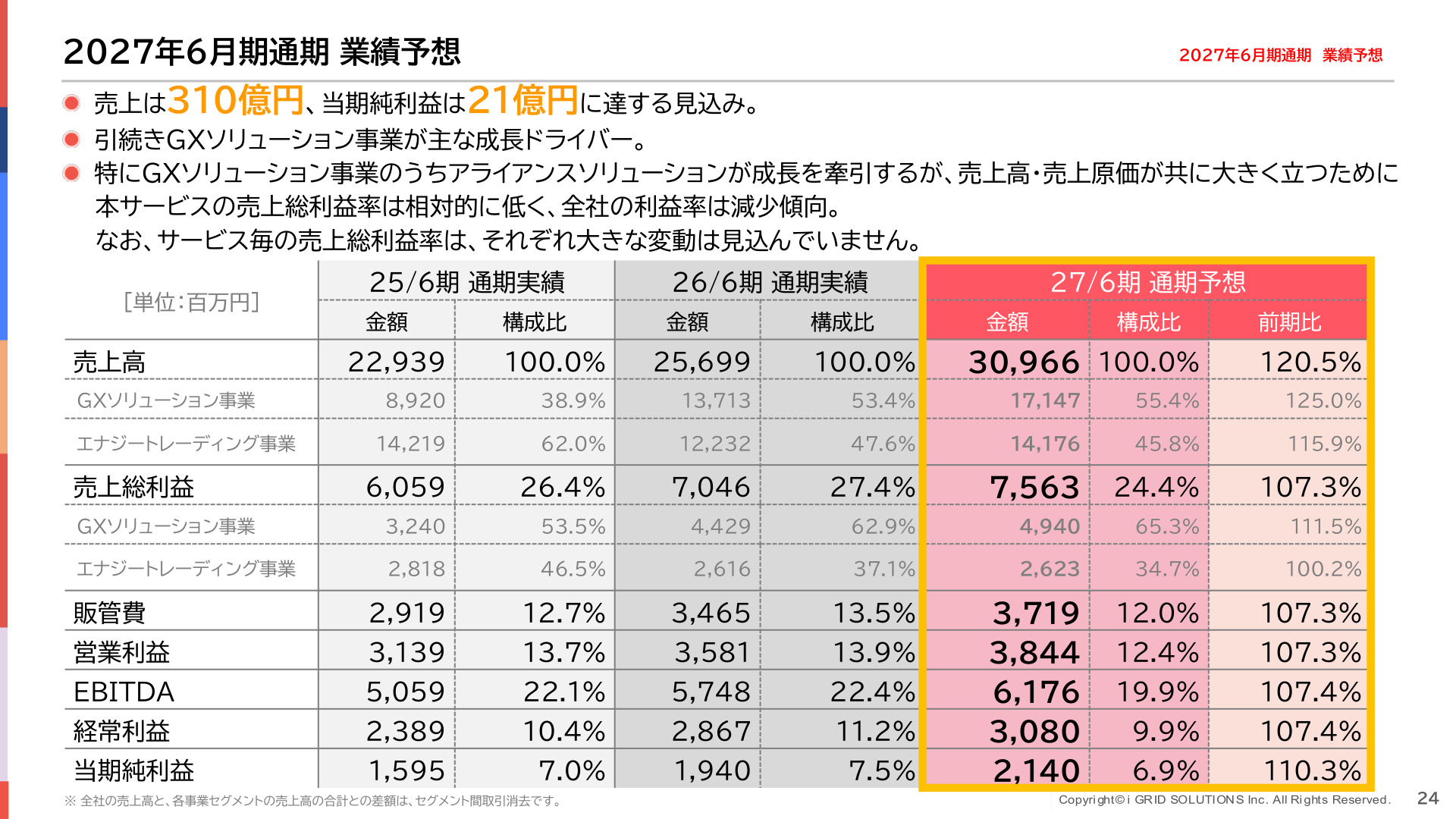
Summary of the earnings forecast for FY2027:
- Revenue : 30,966 million yen (up 20.5% YoY )
- Gross Profit : 7,563 million yen (up 7.3% YoY )
- Operating Profit : 3,844 million yen (up 7.3% YoY )
- EBITDA : 6,176 million yen (up 7.4% YoY )
- Net Income : 2,140 million yen (up 10.3% YoY )
A key point in analyzing this forecast is the structural background where profit growth (7.3%–10.3%) appears moderate relative to revenue growth (20.5%) . As mentioned, the company is aggressively increasing the ratio of its asset-light "Alliance Solutions." Because the alliance model involves larger revenue figures from equipment sales and development transfers (which include costs), the company's overall gross profit margin appears to decline from 27.4% to 24.4%. However, this is the result of a rational strategy to steadily expand the absolute amounts of net income (2,140 million yen) and EBITDA (6,176 million yen) while enhancing capital efficiency .
By segment, the GX Solutions business revenue is expected to reach 17,147 million yen (up 25.0% YoY) , with gross profit of 4,940 million yen (up 11.5% YoY) , continuing to serve as the growth driver for the entire company. Furthermore, in the Energy Trading business, the "Circular Power" service, which began full-scale deployment in July 2025, is starting to contribute to both revenue and gross profit, signaling a return to a growth trend.
6. Conclusion and Key KPIs to Watch
I-Grid Solutions is not merely a solar panel installer but a next-generation energy solution company that uses its proprietary AI technology, "R.E.A.L.," to manage the creation, procurement, supply, and adjustment of renewable energy in one integrated system .
Moving forward, the key KPIs that investors should monitor to evaluate the company's growth potential are as follows:
- Growth in Onsite PPA Development Capacity (MW) and Number of Facilities : Progress in approaching the potential market of over 50,000 facilities, including large-scale retail and logistics centers.
- Alliance Model Composition Ratio : Achievement of the alliance ratio for new projects (target of over 70%) and the sustainability of asset-light growth that does not pressure the B/S.
- Expansion Speed of "Circular Power" in the Energy Trading Business : The degree to which the ecosystem expands by efficiently monetizing surplus electricity generated by the GX Solutions side and converting it into stock-type revenue through 20-year long-term contracts.
Against the backdrop of social demands for decarbonization (GX) and energy cost stabilization, the synergy between the company's alliance strategy and its AI platform serves as a solid foundation for sustainable corporate value enhancement.
This content is not intended as investment advice or a recommendation. Any opinions expressed are solely the personal views of each article.