


Tier IV (593A) Q3 FY2026 Earnings Deep Dive: Mapping the Path to Autonomous Driving Implementation and Profitability through 30% Revenue Growth and Disciplined R&D

StockClub
Published: Aug 14, 2026, 11:52 AM
Sentiment Analysis

This report provides a comprehensive analysis and detailed commentary on the Q3 FY2026 earnings results of Tier IV, Inc. (Ticker: 593A), covering the market environment, business strategy, recent performance trends, and the long-term growth narrative.
1. Macro Environment and Policy Tailwinds: Entering the Social Implementation Phase
The autonomous driving industry is rapidly transitioning from the traditional "technical verification (pilot testing)" stage to a "social implementation and commercialization phase." Globally, progress is evident in the deployment of robotaxis by Waymo (operating in 11 cities with 500,000 weekly rides), the use of unmanned dump trucks in mining, and the application of physical AI in Europe.
In Japan, government-led initiatives and legal frameworks are aligning. Following the 2023 amendment to the Road Traffic Act, which enabled Level 4 autonomous driving, the "3rd Basic Plan for Transport Policy" aims for the deployment of 10,000 autonomous service vehicles by FY2030. Furthermore, the "Japan Growth Strategy" sets a target for Japanese companies to capture approximately 25% of the global market share for autonomous vehicles by the 2030s, creating significant macro momentum.
2. Tier IV’s Business Operations and Three Business Models
Tier IV utilizes the world’s largest open-source autonomous driving software, "Autoware," as a common platform, providing it to a wide range of automakers (OEMs) and transport operators. Its business structure is built on three core models tailored to customer needs:
- Mobility Services : Directly providing autonomous vehicles and service systems to local governments and transport operators.
- Development Services : Joint development and licensing of autonomous driving systems for mass production with OEMs.
- Solution Services : Providing tool development, data sharing, and development infrastructure (such as MOMOps) to ecosystem partners.
3. Evolution of Monetization: From Initial Development to One-time and Recurring Revenue
Tier IV’s business model is designed to layer revenue opportunities as projects progress through different phases:
- Initial Development Phase : Contracting for autonomous system development and adaptation to new environments (Average Development Service unit price: approx. 124 million JPY).
- Mass Production Launch (One-time Revenue) : Sales of autonomous driving kits (sensors, ECUs, network equipment) and vehicles (Average new Mobility Service unit price: approx. 80 million JPY).
- Ongoing Operations (Recurring Revenue) : Software licensing fees and after-sales services associated with continuous vehicle operation (Cumulative average operational unit price: approx. 7 million JPY).
This portfolio is designed to accumulate high-margin recurring revenue as the number of deployed vehicles increases.
4. Vehicle Deployment Targets and Growth Roadmap
The most critical KPI for Tier IV’s growth and monetization is the "Cumulative Number of Operational Vehicles." The company plans to scale from 114 units in FY2025 to over 1,800 units by FY2030, focusing on buses, shuttles, and special-purpose vehicles.
Given the existing domestic vehicle stock (approx. 62,000 buses and 94,000 special-purpose vehicles) and annual replacement demand, there remains vast market potential even after achieving the 1,800-unit target.
5. Efficiency in R&D through Open Source
A major challenge for tech companies is the pressure on earnings from massive R&D spending. Tier IV addresses this with a unique strategy that maximizes the open-source ecosystem.
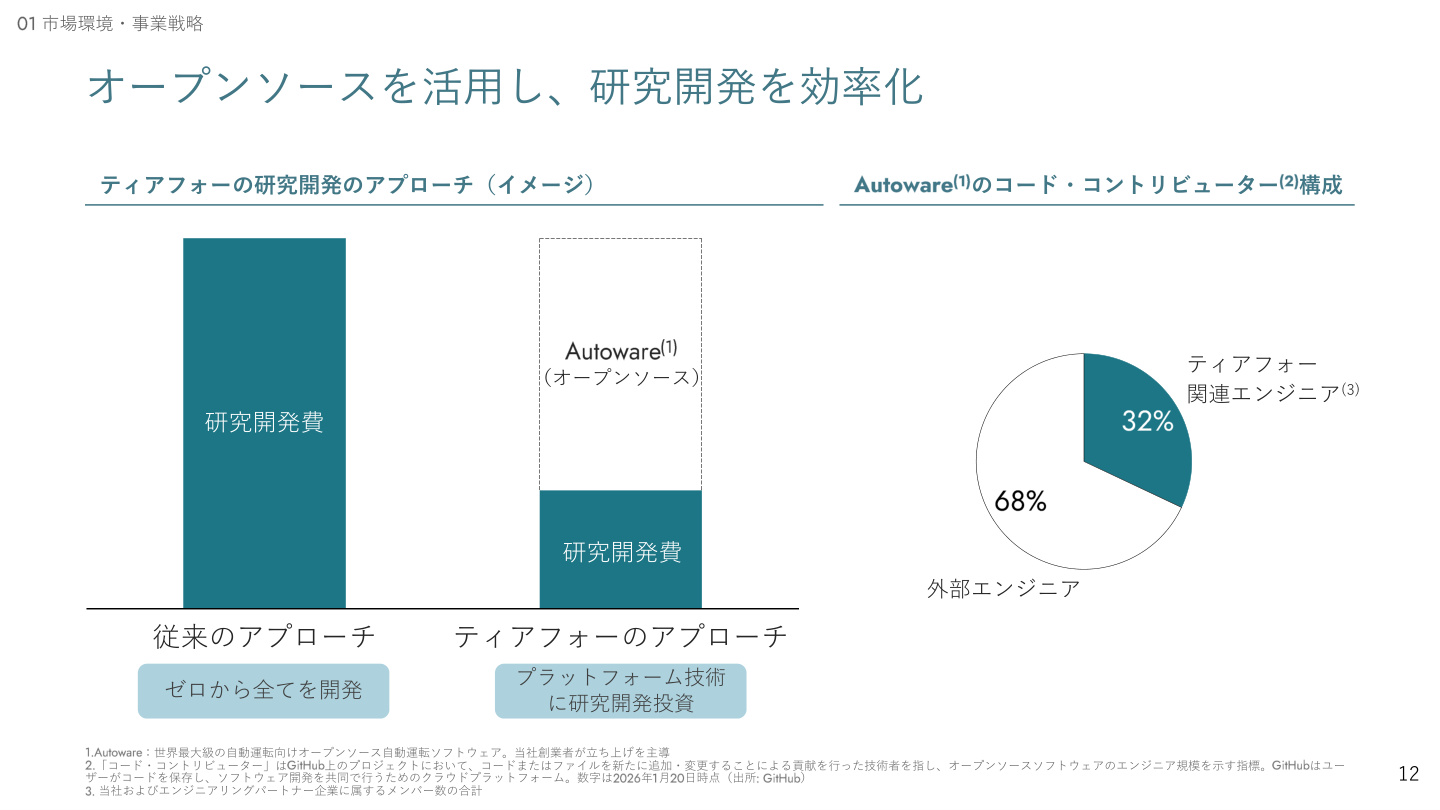
Unlike traditional approaches that develop all code from scratch, Tier IV centers its development on Autoware . As shown in the materials, Tier IV-affiliated engineers account for only 32% of code contributors, while 68% are external engineers. By leveraging contributions from engineers worldwide, the company focuses its R&D budget on "core platform technology," dramatically increasing investment efficiency.
6. Break-even Point and Disciplined Cost Management
Tier IV has outlined a clear scenario for reaching profitability based on the efficiency of R&D investment and the growth in vehicle numbers.
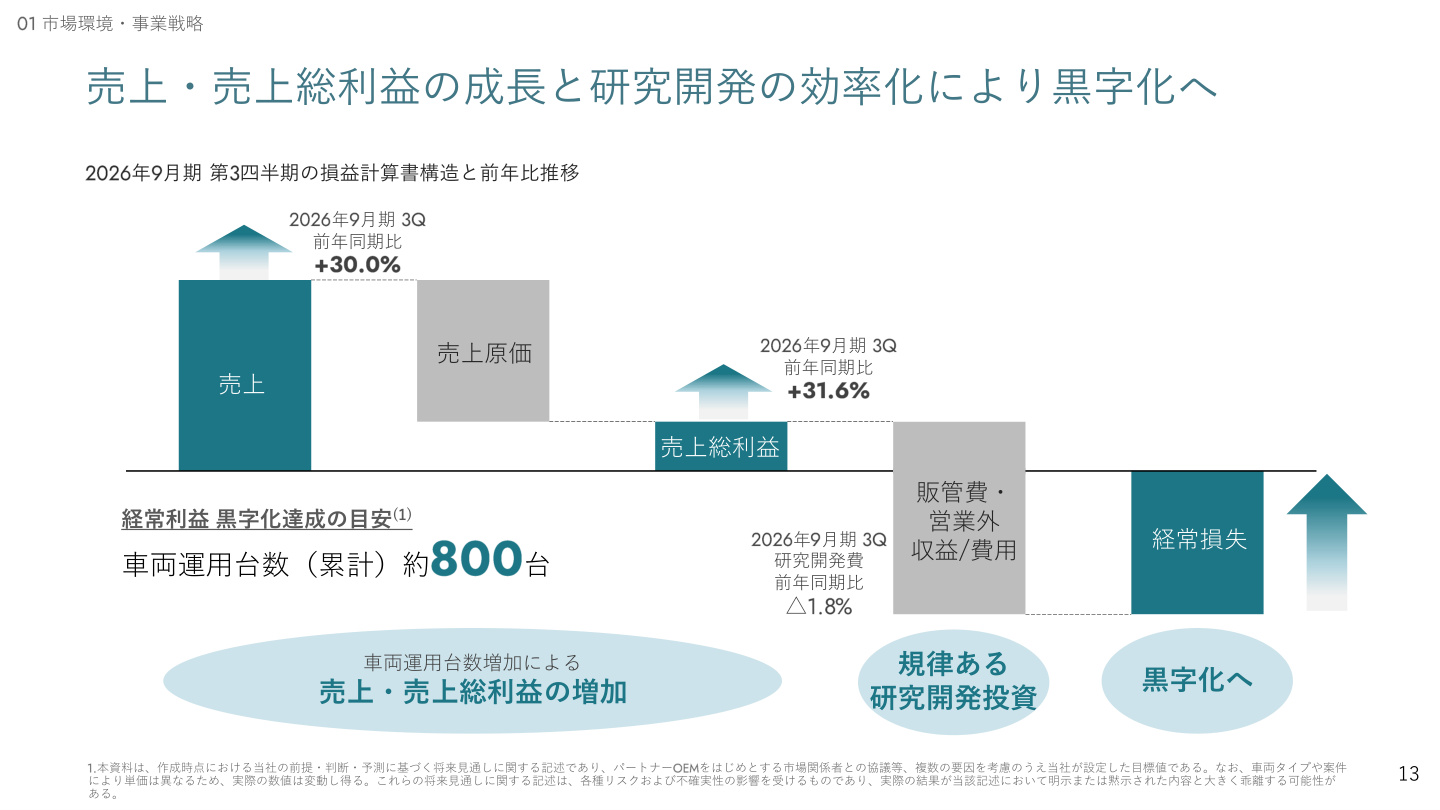
This slide provides critical data on the company’s profit structure and path to profitability. The company estimates that ordinary profit break-even will be achieved at approximately 800 cumulative operational vehicles.
As the number of vehicles increases, revenue and gross profit expand. By maintaining disciplined control over R&D expenses—which have a fixed-cost nature (down 1.8% YoY in Q3)—the company demonstrates a logical path where gross profit eventually exceeds R&D costs, leading to ordinary profitability.
7. A "Two-Pronged" Investment Strategy Based on Market Phase
Tier IV employs a differentiated investment strategy based on market characteristics rather than a one-size-fits-all approach:
- First-Mover Strategy : Applied to special-purpose vehicles (e.g., factory transport) and the bus/shuttle market. The company has secured an early lead and aims to maintain its position while expanding the Autoware economic zone.
- Fast-Follower Strategy : Applied to trucks, taxis, and passenger cars. In the initial phase where overseas competitors invest heavily, Tier IV limits its own investment. As technology commoditizes, it aims to catch up and penetrate the market efficiently using the horizontal division of labor enabled by Autoware.
8. Q3 FY2026 Earnings Highlights
Consolidated results for the first nine months of FY2026 are as follows:
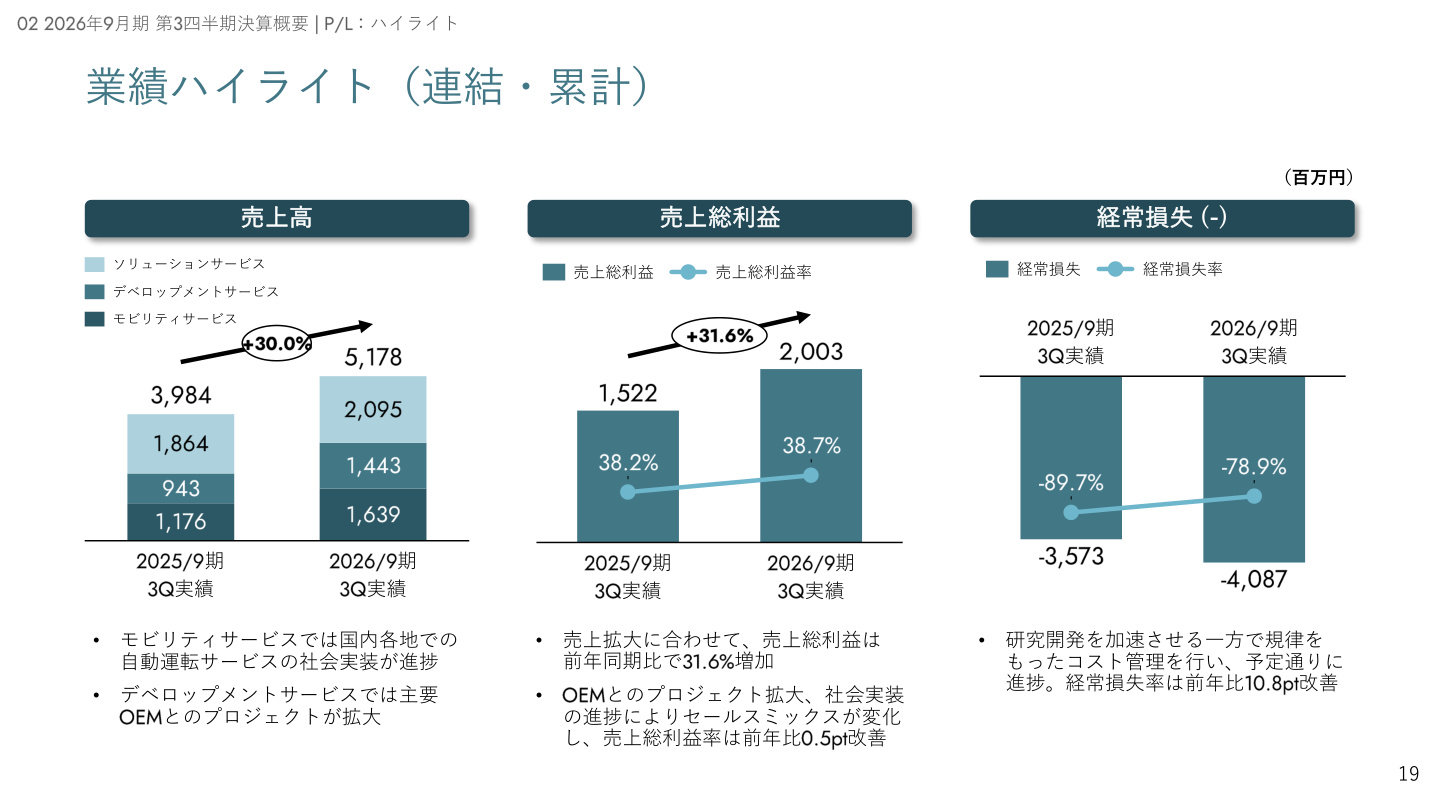
Financial Results (Cumulative)
- Revenue : 5,178 million JPY (+30.0% YoY)
- Gross Profit : 2,003 million JPY (+31.6% YoY)
- Gross Profit Margin : 38.7% (+0.5pt YoY)
- R&D Expenses : 5,989 million JPY (-1.8% YoY)
- Ordinary Loss : -4,087 million JPY (vs. -3,573 million JPY in the previous year)
Revenue grew by 30.0% due to the expansion of projects with major OEMs and progress in implementations for domestic municipalities. Gross profit also rose by 31.6% due to changes in the sales mix, with the margin improving to 38.7%. While the ordinary loss widened to 4,087 million JPY, operating profit improved by 5.3% YoY. The widening of the ordinary loss is primarily attributed to non-operating factors , such as a decrease in subsidy income following the completion of government-contracted projects and the recording of equity-method investment losses. The full-year revenue forecast (8,484 million JPY) remains unchanged as project progress is tracking according to plan.
9. Segment Trends and Progress with Major Partners
Collaboration with industry-leading partners is accelerating across all business areas:
- Mobility Services (Expanding partnership with KDDI)
- Secured a high market share, participating in 8 out of 13 "Advanced Commercialization Regions" nationwide.
- Aiming for the commercial introduction of 1,000 autonomous service vehicles by 2030 in partnership with KDDI and KDDI Smart Mobility.
- Development Services (Mass production projects with major OEMs/Construction machinery)
- Yamaha Motor (eve autonomy) : Unmanned factory transport is already commercialized, with 90 units in operation as of June 2026.
- Komatsu : Developing autonomous dump trucks for construction and quarry sites (targeting trial introduction/practical use by FY2027).
- Toyota Motor : Promoting collaboration for the use of "e-Palette."
- Isuzu Motors : Advancing Level 4 development using the large EV bus "Erga EV."
- Suzuki : Conducting demonstrations using the "Solio" shuttle vehicle.
- Solution Services (Expansion into passenger cars and semiconductors)
- Hitachi Astemo : Jointly promoting the development of End-to-End (E2E) autonomous driving AI models (providing "Co-MLOps" solutions).
- JST Project (AI Semiconductor Development) : Participating in the design and development of SoCs (System on Chip) for Level 4, driving ecosystem expansion from the hardware layer.
10. Summary and Future Outlook
Tier IV’s earnings materials clearly highlight three key pillars: "steady 30% top-line growth," "suppression and efficiency of R&D costs through open source," and "strong collaboration with major partners for mass production and implementation."
Moving forward, the key focus for achieving the business plan will be whether the vehicle deliveries and project acceptances scheduled for Q4 proceed as planned, and whether the company can maintain the growth momentum required to reach the "800 cumulative operational vehicles" milestone for profitability.
This content is not intended as investment advice or a recommendation. Any opinions expressed are solely the personal views of each article.