

Envipro Holdings: Comprehensive Analysis of FY2026 Financial Results and Future Growth Strategy

StockClub
Published: Aug 14, 2026, 11:46 AM
Sentiment Analysis
This report provides an overview of the financial results for the fiscal year ended June 30, 2026, for Envipro Holdings Inc. (Securities Code: 5698), along with the earnings forecast for the fiscal year ending June 30, 2027, and an analysis of key medium- to long-term strategic businesses.
Although revenue declined during the current fiscal year due to changes in transaction structures following the application of revenue recognition standards, the company achieved a significant increase in profit, driven by the refinement of sorting technologies, the strengthening of collection and sales of high-value-added products, and rising prices for major metals. This report provides a comprehensive analysis of performance highlights, segment-specific results, financial structure, shareholder return policy, and the strategic businesses that will drive future growth.
1. FY2026 Consolidated Financial Highlights: Achieving Significant Profit Growth
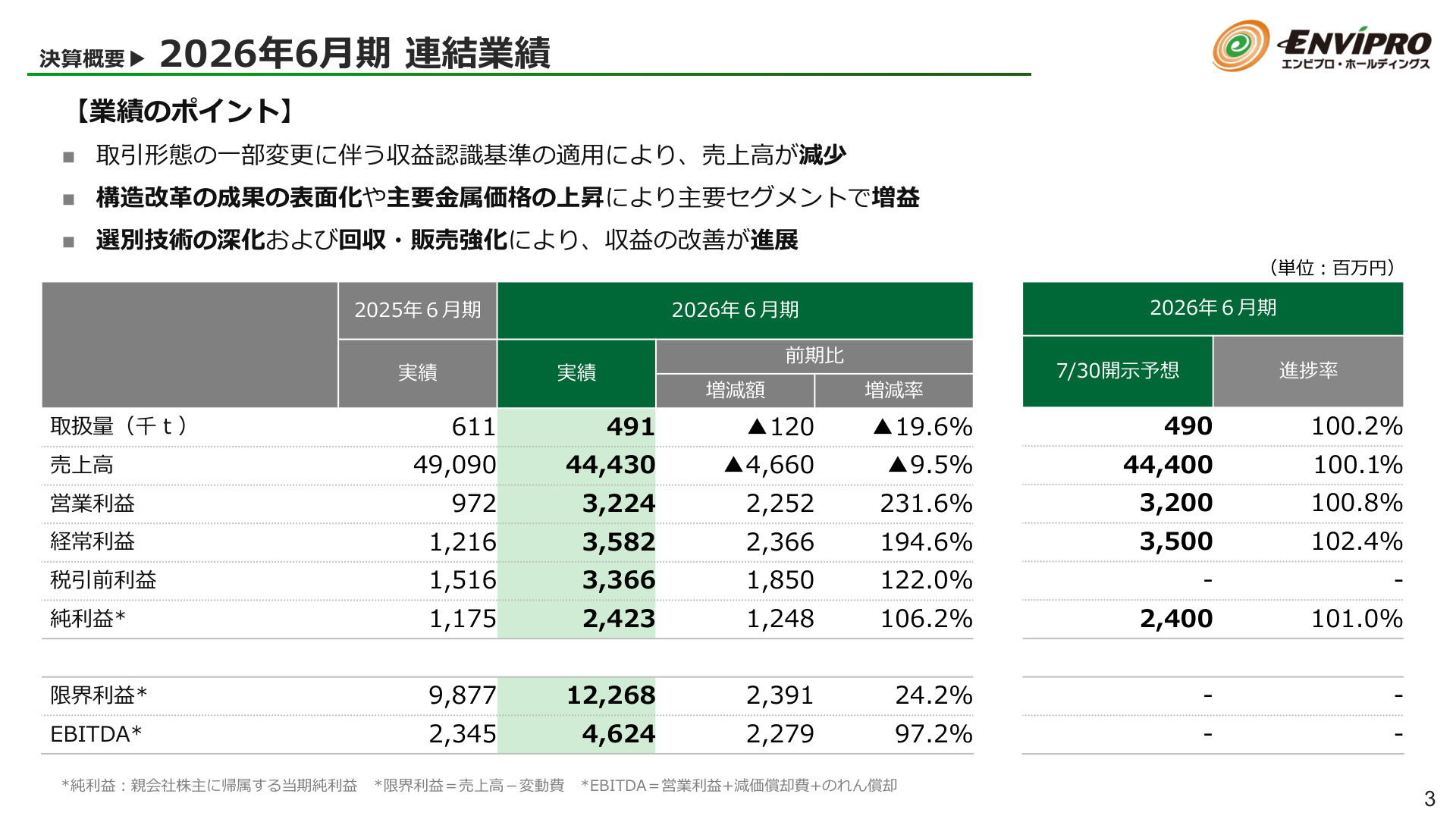
For the fiscal year ended June 30, 2026, consolidated net sales were 44,430 million yen (down 9.5% YoY) . Conversely, operating profit reached 3,224 million yen (up 231.6% YoY) , ordinary profit was 3,582 million yen (up 194.6% YoY) , and net profit attributable to owners of the parent was 2,423 million yen (up 106.2% YoY) , marking a substantial increase in profit that exceeded the initial forecasts.
The following slide provides a summary of the financial results, showing key financial indicators for FY2026, year-on-year comparisons, and progress against the initial forecasts.
Significance of the Slide and Commentary on Numerical Data
The reason this slide is critical is that it clearly illustrates the structure behind the seemingly contradictory trends of declining revenue and surging profits. While net sales decreased by 4,660 million yen year-on-year due to the application of revenue recognition standards associated with changes in certain transaction forms, the marginal profit , which represents the company's core earning power, expanded to 12,268 million yen (up 24.2% YoY) , and EBITDA (operating profit + depreciation + amortization of goodwill) reached 4,624 million yen (up 97.2% YoY). Although the total handling volume was narrowed to 491 thousand tons (down 19.6% YoY) , initiatives to increase profitability per ton (value-added enhancement) bore fruit, with progress rates against management targets exceeding 100% for both operating and ordinary profit.
2. Analysis of Factors Affecting Ordinary Profit: Driven by Expanded Trading Margins
The primary factor behind the 2,366 million yen increase (+194.6%) in ordinary profit compared to the previous year was the expansion of trading margins (+2,335 million yen). Specifically, the following elements contributed to the profit improvement:
- Improvement in gross profit margins due to the refinement of sorting technologies and the strengthening of collection and sales of high-value-added products.
- Favorable market conditions due to rising prices for major metals such as iron scrap, copper, gold, and silver.
- Improvements in variable costs such as dust treatment and electricity expenses (+55 million yen) and an increase in equity-method investment income (+123 million yen).
On the other hand, despite an increase in fixed costs such as personnel cost variances (-64 million yen) and other expense variances (-100 million yen) due to improvements in employee compensation, including regular pay raises and base-up increases, the profit-growth effect significantly absorbed the rise in fixed costs.
3. Performance Trends by Segment
Detailed performance trends for each segment are as follows:
① Resource Recycling Business
- Net Sales : 23,940 million yen (up 13.9% YoY)
- Segment Profit : 2,627 million yen (up 126.6% YoY)
- Trends : In the metal resource recycling sector, the rise in major metal prices, combined with the extraction and sale of high-value-added products through advanced sorting technology, boosted earnings. In the polymer resource recycling sector, structural reforms and the optimization of transaction terms led to strong order performance.
② Global Trading Business
- Net Sales : 24,730 million yen (down 21.7% YoY)
- Segment Profit : 703 million yen (up 161.3% YoY)
- Trends : While revenue declined due to the optimization of transaction forms, profit margins improved significantly due to the penetration of structural reforms in metal raw material trading, the development of new sales channels, and rising market prices. Some impact was felt on cargo destined for Dubai due to the de facto blockade of the Strait of Hormuz.
③ Lithium-Ion Battery (LIB) Recycling Business
- Net Sales : 2,641 million yen (up 56.0% YoY)
- Segment Profit : 704 million yen (up 215.7% YoY)
- Trends : The steady trend in lithium and cobalt prices and an increase in handling volume, centered on processing consignment projects, contributed to significant growth in both revenue and profit. However, some extraordinary losses were recorded due to inventory loss resulting from a fire at a processing contractor's facility.
4. Financial Position and Cash Flow
- Total Assets : 34,712 million yen (+3,413 million yen from the end of the previous fiscal year)
- Net Assets : 19,129 million yen (Equity ratio: 54.1%)
- Operating Cash Flow : 3,071 million yen generated (including 3,366 million yen in profit before income taxes and 1,396 million yen in depreciation)
- Investing Cash Flow : -910 million yen (acquisition of property, plant, and equipment, etc.)
- Financing Cash Flow : -1,669 million yen (repayment of borrowings and payment of dividends)
The year-end balance of cash and cash equivalents was 7,386 million yen (+522 million yen YoY) , maintaining investment capacity for future business growth while building a robust financial foundation.
5. FY2027 Earnings Forecast and Segment Plans
The consolidated earnings forecast for the fiscal year ending June 30, 2027, is as follows:
- Handling Volume : 550 thousand tons (+12.0% YoY)
- Net Sales : 49,000 million yen (+10.3% YoY)
- Operating Profit : 2,700 million yen (down 16.3% YoY)
- Ordinary Profit : 3,100 million yen (down 13.5% YoY)
- Net Profit : 2,100 million yen (down 13.4% YoY)
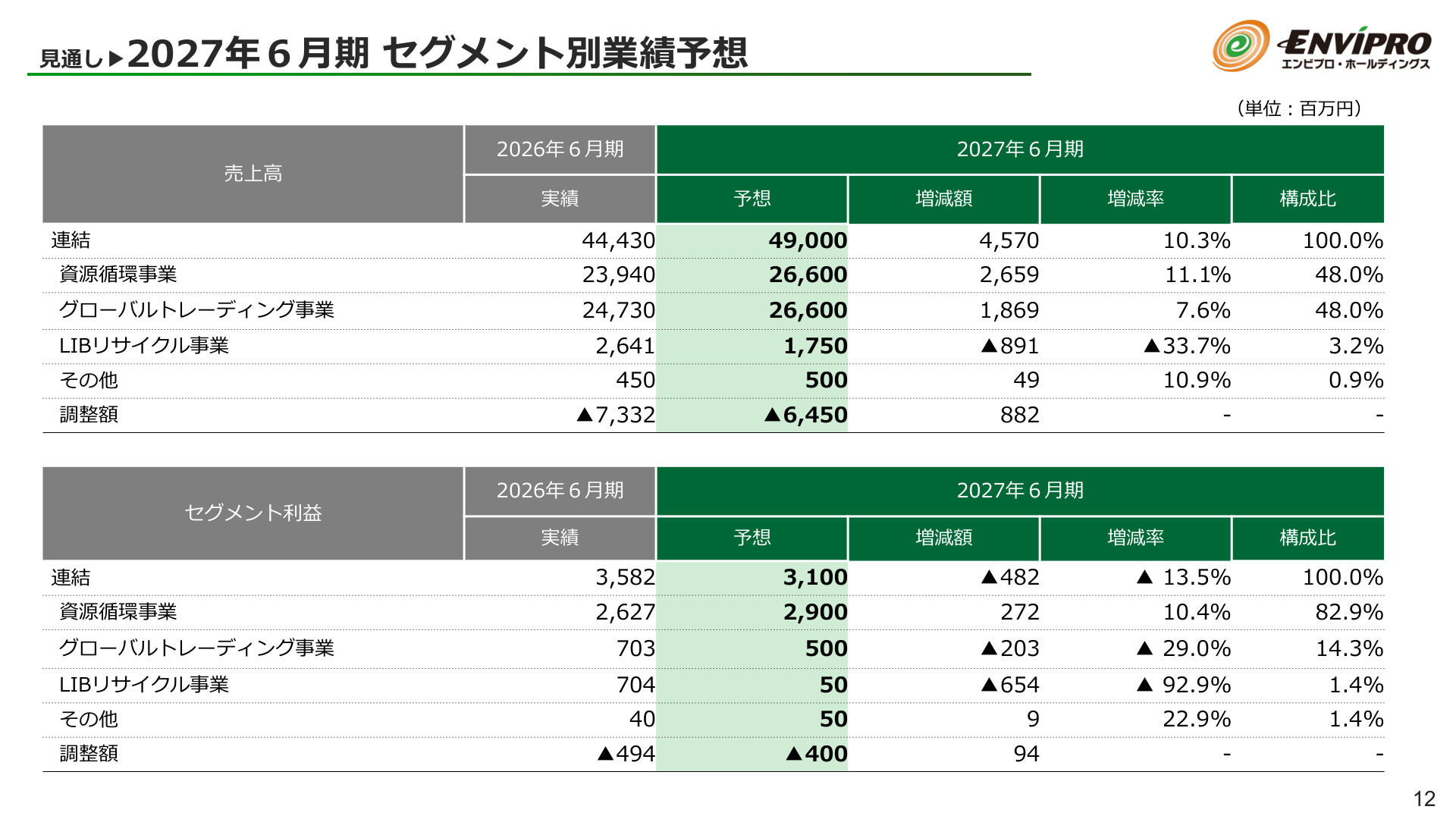
The following slide shows the planned breakdown of sales and profit by segment for FY2027.
Significance of the Slide and Commentary on Numerical Data
This slide is essential for understanding the growth potential of each business and the temporary profit-decreasing factors in FY2027. The core Resource Recycling Business is expected to continue its expansion trend with net sales of 26,600 million yen (+11.1%) and segment profit of 2,900 million yen (+10.4%). Conversely, the LIB Recycling Business is planned to see a significant decline, with segment profit of 50 million yen (down 92.9% YoY). This is because production capacity will be limited this fiscal year due to the impact of the disaster at the processing contractor. Additionally, upfront fixed cost increases, such as personnel cost variances (-340 million yen) due to sustainable wage increases and equipment cost variances (-224 million yen) due to the operation of new facilities, are factors pushing down overall profit.
6. Shareholder Return Policy: Stable Dividends with a Minimum DOE of 2.5%
Even during periods of rising personnel costs and active capital investment, the company maintains a dividend policy with a Dividend on Equity (DOE) ratio of 2.5% as a lower limit to ensure stable shareholder returns that are not swayed by short-term profit fluctuations.
- FY2026 : Annual dividend of 25 yen per share (Payout ratio: 29.4%)
- FY2027 Forecast : Annual dividend of 22 yen per share (Payout ratio: 29.9%)
While maintaining a payout ratio of around 30%, the company adopts a return style that considers securing ROE (13.6% in FY2026) and improving capital efficiency.
7. Three Key Strategic Businesses Driving Medium- to Long-Term Growth
Aiming to be a leader in the circular economy (CE), the company is concentrating resources on the following key strategic areas:
① Gold and Silver Residue Business: Strengthening Recovery from Urban Mines
This business develops urban mines, starting with gold and silver recovery technology from crushing and incineration residues. Leveraging proprietary sorting technology and a wide-area collection network, the company is promoting higher-grade recovery. A strong tailwind is the revision of the Ministry of the Environment's guidelines in March 2026, where examples of resource recovery from "incineration ash" were included in the manual for waste treatment facility specifications.
② LIB Recycling Business: Foundation Building for Re-growth
Regarding the market environment, an increase in the collection volume of small LIBs is expected due to the expansion of designated recycling products effective April 2026, and demand for large-scale energy storage systems (ESS) for grids and data centers is anticipated.
The following slide summarizes the market environment and action plan for the LIB recycling business for this fiscal year.
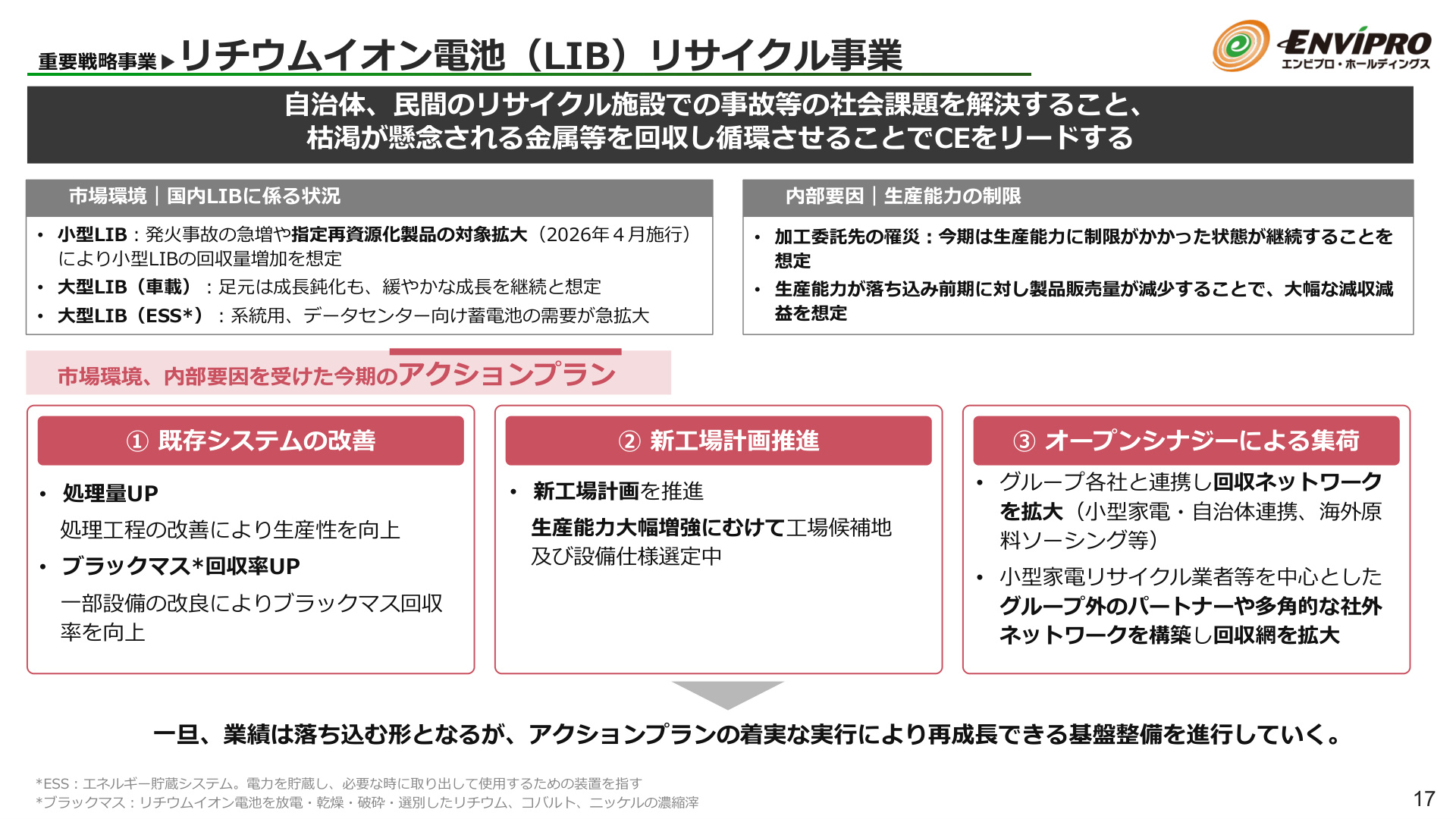
Significance of the Slide and Commentary on Numerical Data
This slide shows the roadmap from short-term performance decline to medium- to long-term re-growth. Although a short-term decline in revenue and profit (50 million yen profit) is unavoidable due to internal factors such as the disaster at the processing contractor, the company views this as an opportunity for foundation building. As a concrete action plan, the company is executing three axes in parallel: (1) improvement of existing systems (increasing processing volume and black mass recovery rate), (2) promotion of new factory plans for significant production capacity expansion (site selection and specification selection), and (3) expansion of the collection network through open synergies with partners inside and outside the group , preparing for medium- to long-term re-growth.
③ Polymer CE Business: Resource Circulation through Three Approaches
To build a circular society in the resin and plastic field, the company is promoting business through the following three forms:
- Thermal Recovery : Strengthening the supply system for low-carbon fuel (RPF, etc.) by upgrading composite material pre-treatment crushers and improving waste plastic crushing lines.
- Material Recycling : Increasing production capacity for CE rubber mats utilizing waste tires and waste rubber, and launching color rubber chips for artificial turf containing recycled plastic.
- Chemical Recycling : Commencing raw material procurement management and waste plastic supply for chemical recycling demonstration projects for waste plastics.
8. Comprehensive Analysis and Summary
Envipro Holdings' FY2026 financial results were a fruitful year in which, despite an apparent decline in revenue due to the application of revenue recognition standards, operating profit increased dramatically to 3.3 times the previous year's level due to value-added enhancement strategies and market tailwinds.
Although FY2027 is expected to see a decline in profit due to temporary production restrictions in the LIB business and an increase in fixed costs associated with base-up and capital investment, this is positioned as a "period of foundation reconstruction" for the next leap forward. With steady progress in measures such as legal tailwinds in the gold and silver residue business , new LIB factory plans , and social implementation of the polymer CE business , the company is structured to expect further business growth in line with the expansion of the medium- to long-term circular economy market.
This content is not intended as investment advice or a recommendation. Any opinions expressed are solely the personal views of each article.