


In-Depth Earnings Report: First Accounting (5588) Q2 FY2026 – Scaling the 'Steward' AI Agent and the Path to 10 Billion Yen by 2028

StockClub
Published: Aug 14, 2026, 11:41 AM
Sentiment Analysis

First Accounting Co., Ltd. (Securities Code: 5588) delivered a solid performance in the second quarter of the fiscal year ending December 2026, with both revenue and profit metrics showing steady progress toward the company's mid-to-long-term growth objectives. As a pioneer in accounting-specialized AI, the company continues to expand its enterprise-grade solutions against the backdrop of an intensifying shortage of accounting professionals.
This report provides a multi-faceted analysis of the company's performance highlights, revenue structure, social context, product strategy, and mid-to-long-term growth targets, based on the disclosed financial materials.
1. Q2 FY2026 Cumulative Performance Highlights
For the first half of the fiscal year ending December 2026, the company reported revenue of 1,298,807 thousand yen , operating profit of 170,375 thousand yen , ordinary profit of 181,034 thousand yen , and net profit attributable to owners of the parent of 112,244 thousand yen . Compared to the same period last year, revenue grew by +16.3% , while operating profit surged by +49.9% (approximately 150% of the previous year's level) , marking a significant improvement in profitability.
Gross profit reached 921,975 thousand yen , maintaining a high gross margin of 71.0% . Progress against the full-year forecasts (revenue of 3,191,128 thousand yen and operating profit of 312,364 thousand yen) stands at 41.8% for revenue and 54.3% for operating profit . The company is showing strong momentum, having already achieved over half of its operating profit target with the second half of the year still ahead.
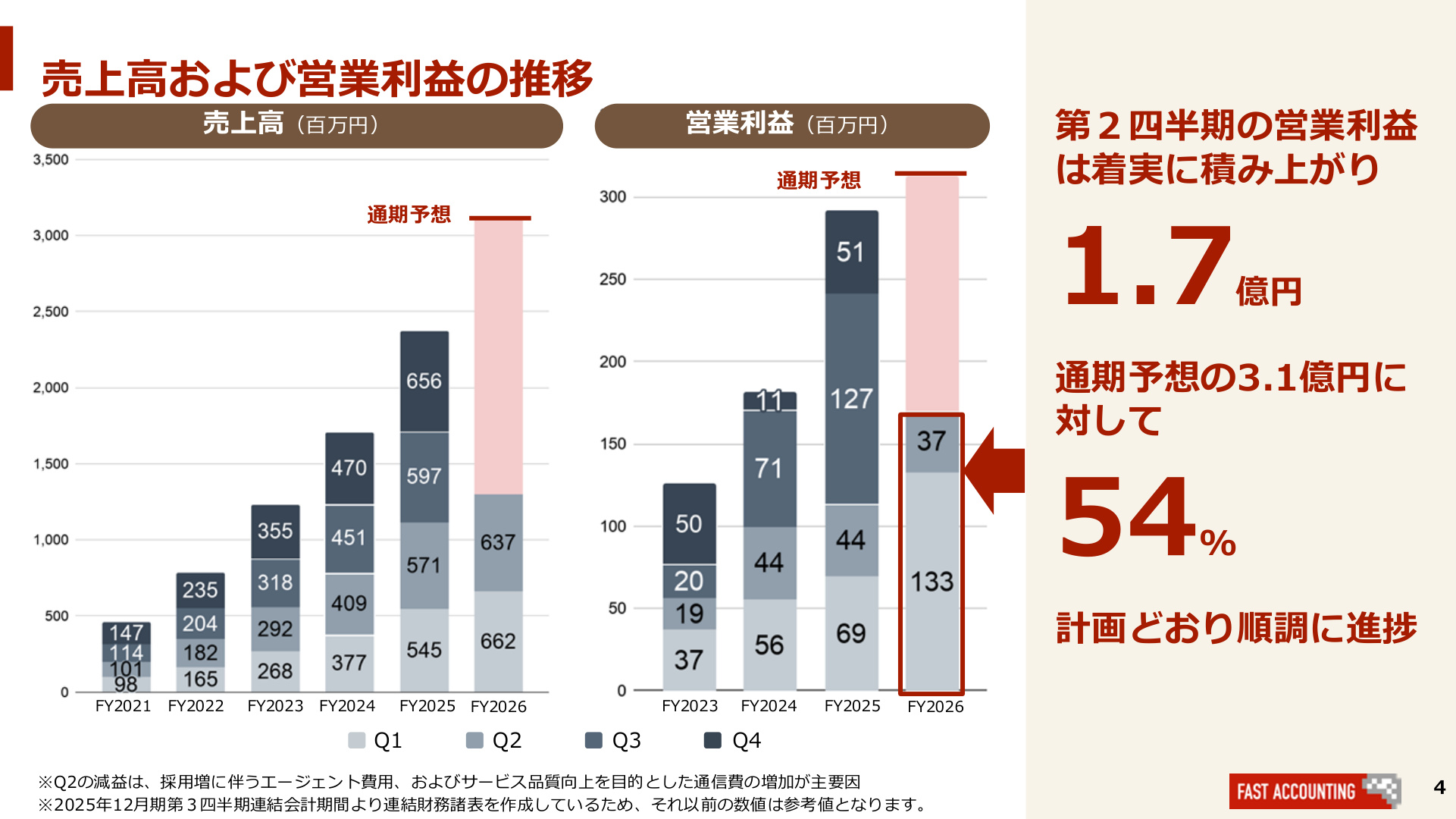
The slide above illustrates the quarterly trends in revenue and operating profit. This data underscores the steady expansion of the company's revenue structure quarter over quarter. In Q2 (April–June), despite investments in recruitment-related agency fees and communication costs aimed at improving service quality, the company successfully absorbed these expenses to achieve a 54% progress rate toward the full-year operating profit target , confirming the robustness of its operating cash flow as the business foundation scales.
2. Robust Recurring Model and Improved Capital Efficiency
A key characteristic of the company's revenue structure is its exceptionally high ratio of stable recurring income. The revenue composition is as follows:
- Monthly Subscription Fees (Recurring): 77%
- Usage-based Fees: 11%
- Implementation Support (Initial Fees, etc.): 12%
Consequently, 88% of total revenue is derived from a stable base (stock-type revenue) . The ARPA (Average Revenue Per Account) remains high at 1,047 thousand yen , and the ARR (Annual Recurring Revenue) has grown to 2,262,060 thousand yen . Furthermore, the monthly churn rate , a critical metric for SaaS businesses, is kept at a low level of 0.84% , reflecting high customer satisfaction and strong retention among enterprise clients.
In terms of financial efficiency, the company recorded an ROE of 14.8% and an ROIC of 15.0% (a 2.8-point improvement year-on-year), demonstrating management's commitment to generating high returns on invested capital.
3. The Growing Accounting Talent Shortage and the 'Accounting Singularity' Concept
The company's target market is driven by structural social issues in Japan. The materials highlight a decline in the number of examinees for the Nissho Bookkeeping Certification—down 39% for Level 1 and 28% for Level 2—as well as an 80% drop in commercial high school test-takers from their peak. Furthermore, the removal of 'Bookkeeping/Accounting' from common university entrance exams suggests a long-term contraction in the supply of accounting practitioners and management candidates.
In response, the company has adopted the vision: 'Making accounting a source of profit,' and the mission: 'Realizing the Accounting Singularity and unleashing the power of accounting.' The 'Accounting Singularity' refers to the stage where AI performs complex accounting judgments and processes with higher precision than humans. The company's AI model has demonstrated its capabilities by achieving a 99% accuracy rate on the Nissho Bookkeeping Level 1 exam , 100% on Levels 2 and 3 , and even perfect scores on the CPA primary examination , proving its advanced accounting judgment capabilities beyond simple OCR.
4. Competitive Advantage of the Core AI Agent 'Steward'
The product embodying the Accounting Singularity concept is the AI agent 'Steward.' Evolving from traditional receipt and invoice reading (Robota), it fully automates accounting judgments and reconciliation processes in accordance with internal regulations and tax laws.
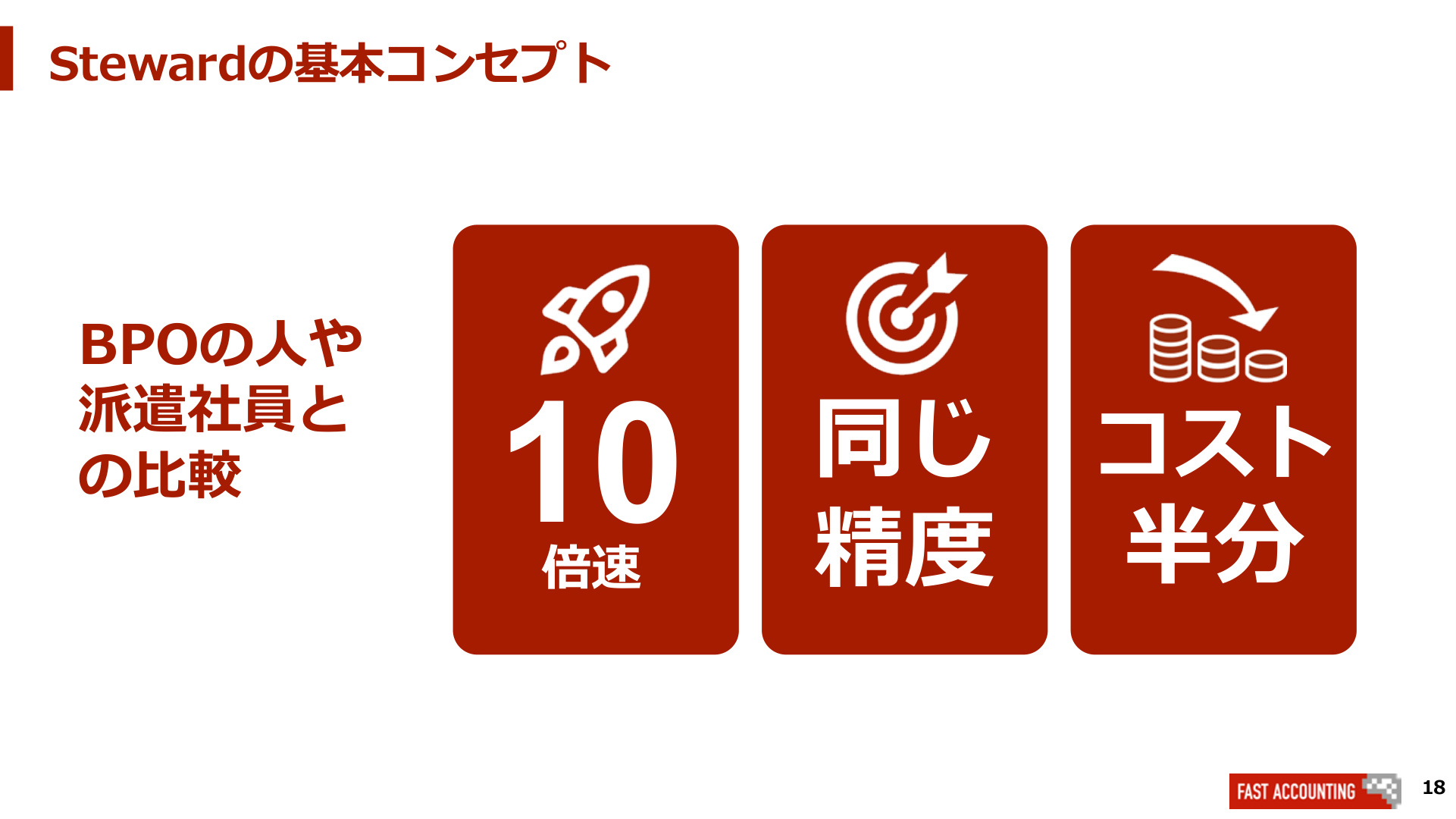
The slide above, 'Steward's Basic Concept,' is a critical document that clearly illustrates the company's differentiation strategy. Compared to traditional BPO (Business Process Outsourcing) or manual labor via temporary staff, Steward delivers '10x processing speed,' 'accuracy equal to or better than humans,' and 'half the cost.' For large enterprises struggling with rising labor costs and staff shortages, adopting Steward as a replacement or supplement to BPO is a powerful solution that achieves both cost reduction and increased processing speed.
In terms of development, the company utilizes 'modular development,' where 80% consists of common modules (bookkeeping/accounting knowledge, etc.) and 20% is tailored to individual company requirements , enabling both shorter delivery times and lower costs.
5. Response to 'New Lease Accounting Standards' and H2 Priorities
For the second half of the year, the company has set the following three priorities:
- Promotion of Steward Expense and Payment Reconciliation : In response to growing market demand, the number of clients using monthly billing has expanded from 2 in Q1 to 8 in the Q2 cumulative total . The monthly subscription fee for Steward alone contributes to higher unit prices, being approximately 1.4 times higher than the overall average.
- Promotion of Steward for New Lease Accounting Standards : With new lease accounting standards for large enterprises taking full effect from 2027, the company analyzed that 53% of large firms are still in the 'policy organization stage.' By hosting joint events with Proship (243 attendees) and listing on the SAP Store, the company has secured 10 implementation support contracts, 7 monthly billing contracts, and 10 paid trials as of the first half.
- Securing Large-Scale Strategic AI Projects (100–400 million yen scale) : The company is currently proposing multiple large-scale Steward-related projects for the second half.
Furthermore, by speaking at major events like SAP Concur Fusion and promoting internal projects such as 'A World Without Expense Reporting' (zero out-of-pocket expenses, zero manual input), the company is raising market awareness through both external partnerships and internal practice.
6. Mid-to-Long-Term Growth Strategy: The 'Stretch Goal' for 2028
The company has established a clear roadmap for its mid-to-long-term growth.
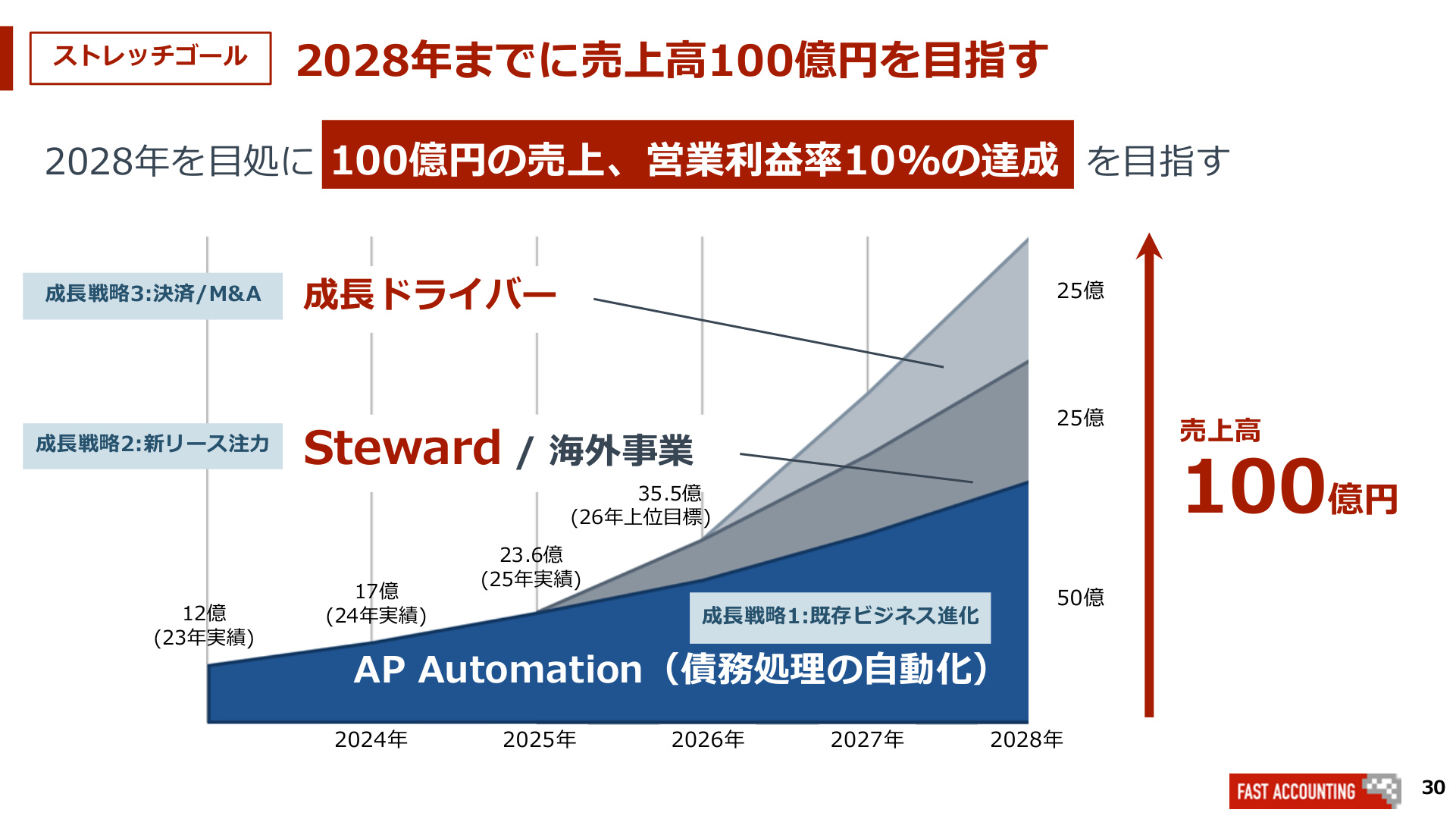
The slide above illustrates the 'stretch goal' of '10 billion yen in revenue and 10% operating profit margin by 2028.' The growth story is based on a layered business model:
- Growth Strategy 1 (Baseline) : Build a 5 billion yen revenue foundation through the evolution of existing AP Automation business.
- Growth Strategy 2 (Growth Driver) : Add 2.5 billion yen through compliance with new lease accounting standards, horizontal expansion of Steward, and overseas business development.
- Growth Strategy 3 (New Domains) : Generate 2.5 billion yen in new areas utilizing payment solutions and M&A.
By combining these, the company has clearly presented a policy to scale from its 1.2 billion yen revenue level in 2023 to a 10 billion yen scale over five years.
Summary
First Accounting's Q2 FY2026 earnings report demonstrates a steady accumulation of results, with a 54.3% progress rate toward the full-year operating profit forecast, while maintaining the strengths of a SaaS business model characterized by high margins and high recurring revenue.
Against the backdrop of an intensifying accounting talent shortage, the company is advancing the social implementation of the 'Accounting Singularity' by providing automation solutions through its AI agent, 'Steward.' With its focus on new lease accounting standards, collaboration with powerful ecosystems like SAP, and the pursuit of its 2028 '10 billion yen revenue' stretch goal, the company's H2 initiatives and business developments warrant close attention.
This content is not intended as investment advice or a recommendation. Any opinions expressed are solely the personal views of each article.