


monoAI technology Q2 FY2026 Earnings Deep Dive: Progress in Structural Reform and Entry into 'Physical AI'

StockClub
Published: Aug 14, 2026, 11:35 AM
Sentiment Analysis

1. Earnings Overview and Background of Business Transformation
For the first half of the fiscal year ending December 2026 (January–June 2026), monoAI technology Inc. reported net sales of 268 million JPY (down 58.0% YoY), an operating loss of 269 million JPY (compared to a 109 million JPY loss in the same period last year), an ordinary loss of 246 million JPY (compared to a 105 million JPY loss), and a net loss attributable to owners of the parent of 255 million JPY (compared to a 46 million JPY loss).
While these figures represent a significant decline in revenue and profit compared to the previous year, this is primarily due to a major restructuring of the business portfolio, including the divestiture of subsidiaries and the liquidation of unprofitable businesses . The company is pursuing a business plan weighted toward the second half of the year and maintains that performance is generally within the expected range relative to its full-year forecasts.
2. Earnings Highlights and P&L Analysis
The overall performance and summary comparison with the same period last year are as follows:
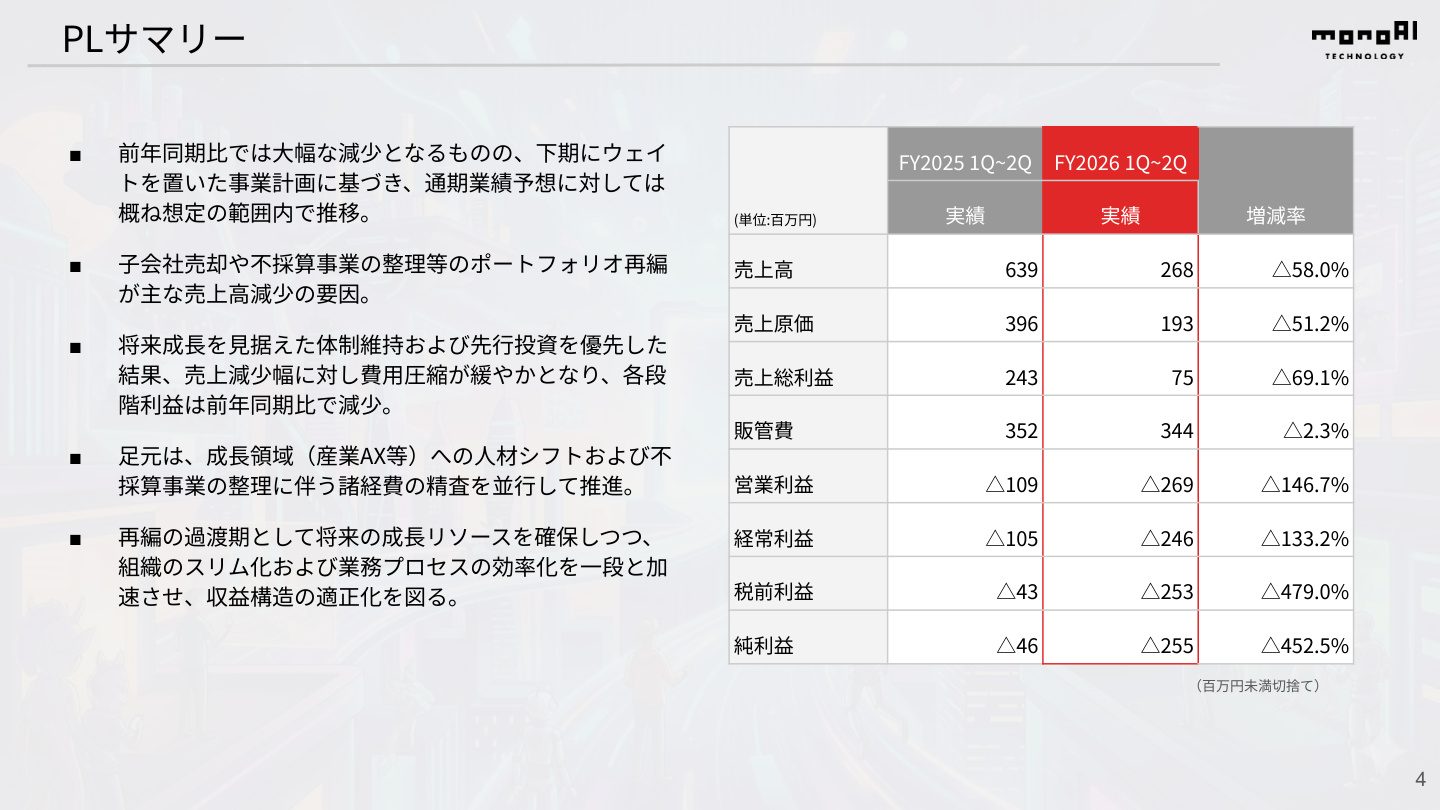
[Significance of the Slide and Commentary on Numerical Data]
This slide is crucial for understanding these earnings, as it clearly illustrates the impact of the business portfolio restructuring and the transitional phase of the cost structure .
Net sales decreased by 58.0% from 639 million JPY in the same period last year to 268 million JPY. However, this is not merely business stagnation, but the result of decisive action to eliminate unprofitable areas and focus on growth sectors. Cost of sales decreased by 51.2% from 396 million JPY to 193 million JPY, reflecting successful cost reductions in line with the decline in sales.
On the other hand, the expansion of losses at each profit level is attributed to prioritizing the maintenance of organizational structure and upfront investments for future growth. The strategic decision to maintain SG&A expenses (344 million JPY, down 2.3% YoY) despite the significant drop in sales reflects a commitment to building a foundation for future growth.
3. Financial Foundation and Balance Sheet (BS) Stability
Despite the ongoing operating losses, the company’s balance sheet maintains strong stability.
As of the end of June 2026, current assets stood at 1,043 million JPY , with cash and deposits accounting for 890 million JPY . Total liabilities decreased to 137 million JPY compared to the end of the previous year due to the progress in portfolio restructuring, while total net assets reached 968 million JPY .
As a result, the equity ratio rose to 87.6% (up from 86.5% at the end of December 2025), confirming that the company maintains sufficient liquidity and a stable financial base for future growth investments and the launch of new businesses.
4. Progress in Cost Structure Reform and Allocation of Upfront Investment
The company is steadily implementing measures to optimize its cost structure:
- Thorough In-house Production : "Outsourcing expenses" within the cost of sales decreased by 94.9% , from 158 million JPY in the same period last year to 8 million JPY , marking a steady shift toward an independent production system.
- Active Investment in R&D : While curbing overall SG&A expenses, the company increased "R&D expenses" by 67.1% , from 37 million JPY to 62 million JPY . This represents 23.3% of net sales, signaling an acceleration of upfront investment in next-generation technologies and AI-related infrastructure.
5. Revenue by Service and Key KPI Trends
Looking at the revenue composition by service, Metaverse services remain the core driver at 109 million JPY (Q2 standalone). While XR Event services (4 million JPY) and XR Peripheral services (22 million JPY) are in a transitional phase due to portfolio adjustments, the company is shifting talent toward growth areas such as Industrial AX (Agility Transformation).
Regarding KPIs, the number of projects per quarter is 98 , and the company-wide gross profit margin is 33.3% (up from 22.5% in the previous quarter), indicating a shift toward profitability-focused project management.
6. Internal AI Adoption and the Evolution of an "AI-Driven" Organization
The company is not merely a provider of AI technology; it is implementing company-wide initiatives to evolve its own organization into an AI-driven entity.
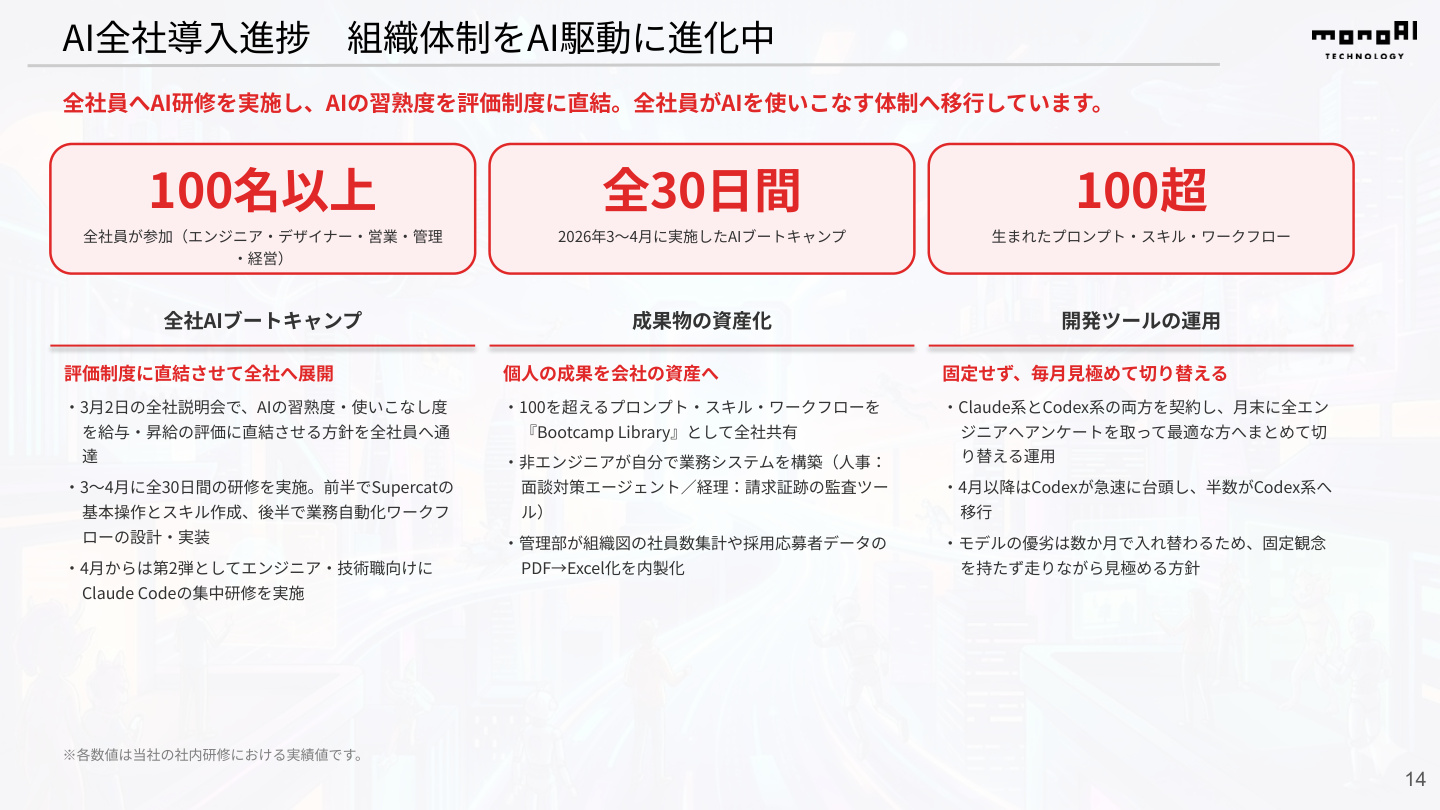
[Significance of the Slide and Commentary on Numerical Data]
This slide provides important data on the quantitative achievements and institutional approach to the company-wide AI transformation.
Over 100 employees (including engineers, designers, sales, administration, and management) participated in a 30-day "Company-wide AI Bootcamp." Notably, the company has linked AI proficiency and practical application directly to its salary and promotion evaluation system . This represents an attempt to transform the core of the organizational culture, going beyond simple tool adoption.
Through this bootcamp, over 100 prompts, skills, and workflows were generated and codified as internal assets in the "Bootcamp Library." In practical terms, this has led to concrete efficiency gains, such as reducing accounting invoice processing from 3.5 hours to 0.3 hours per month, and automating the aggregation of resident tax payments for all 71 municipalities (reducing time from 2 hours to 30 minutes per month).
7. Full-Scale Entry into the "Physical AI (Robotics)" Sector
A strategic highlight of this earnings announcement is the full-scale entry into the Physical AI sector and the launch of the strategic subsidiary "monoAI Robotics Inc." (effective August 14, 2026).
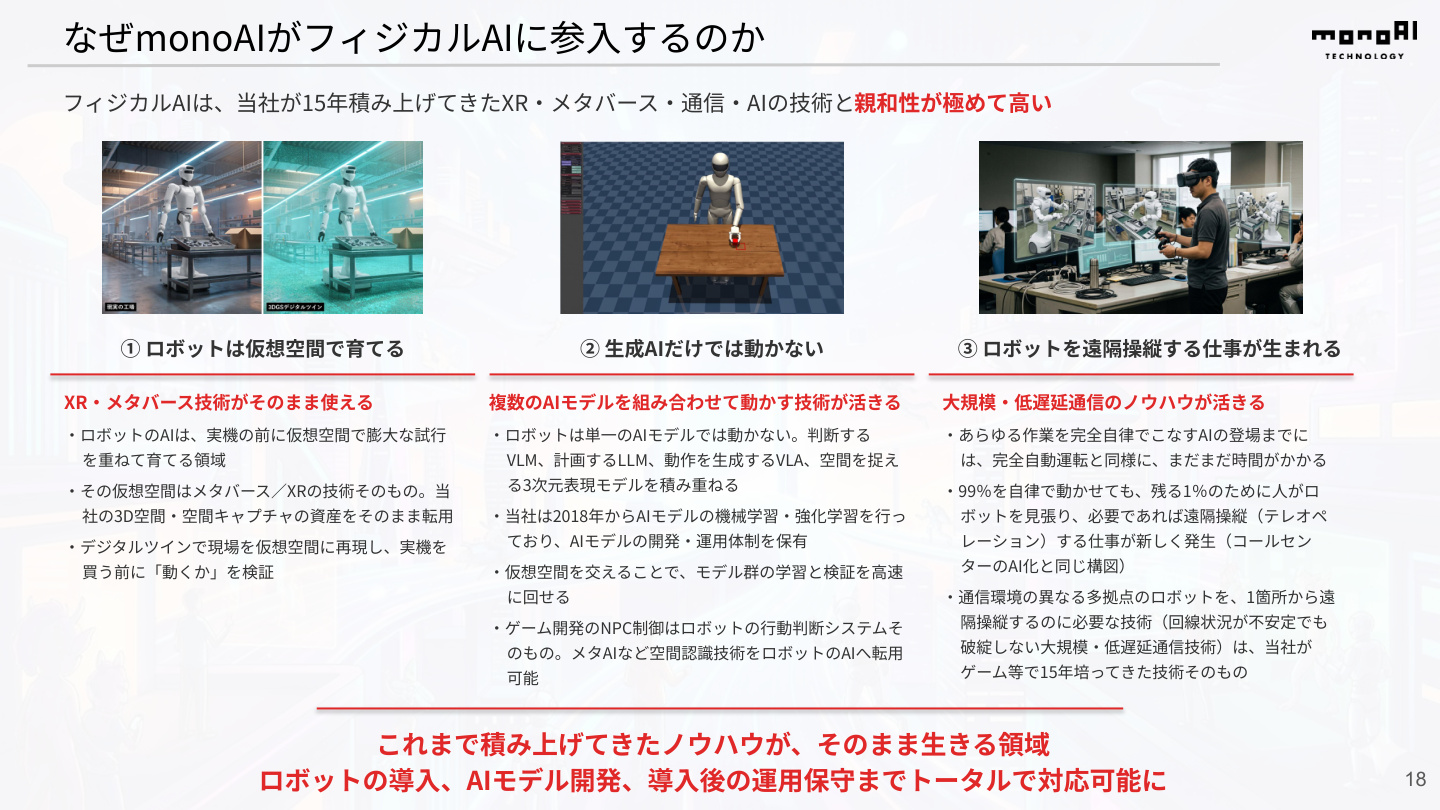
[Significance of the Slide and Commentary on Numerical Data]
This slide is a key conceptual diagram explaining the technical synergy and reasons for entering the Physical AI (robotics) field.
Physical AI is a technical field involving the advanced control and operation of robots and other physical entities using AI. The XR, metaverse, communication, and AI technologies that the company has accumulated over the past 15 years have extremely high affinity with the construction process of Physical AI.
Three specific reasons for entry are cited:
- Raising Robots in Virtual Spaces (Digital Twins) : Utilizing metaverse/XR technology to conduct extensive trial-and-error in virtual spaces before deploying physical hardware.
- Combination of Multiple AI Models (Integrated Control) : Leveraging development expertise in combining multiple AI models, such as judgment (VLM), planning (LLM), and motion generation (VLA).
- Demand for Remote Operation (Teleoperation) : During the transition period toward full autonomy, the company's expertise in large-scale, low-latency communication technology is essential for remote operation infrastructure.
8. Product Development and Future Outlook for Physical AI
The company has announced plans to deploy three products and services in the Physical AI sector to solve on-site challenges:
- Pre-deployment Simulation Service : Recreating factories and stores in virtual space via spatial capture to simulate ROI and operational feasibility before purchasing hardware.
- General-purpose Teleoperation Infrastructure : Enabling smooth remote operation even in unstable network environments, while accumulating operation data for AI training.
- Robot Deployment and Operation Service : Providing one-stop support from on-site assessment and simulation to VLA model development and remote maintenance/operation.
The company intends to leverage its proven track record and infrastructure in both simulation (XR) and model development (AI) to drive market expansion.
9. Comprehensive Analysis Summary
The overall picture emerging from the Q2 FY2026 earnings is a business transformation process characterized by "cost structure reform through the liquidation of unprofitable businesses and in-house production," "operational efficiency through company-wide AI adoption," and "entry into the new field of Physical AI."
While the decline in revenue and operating losses are results of this transitional restructuring phase, the company is building a new growth story that integrates its XR and AI technical axes, supported by a stable financial foundation of an 87.6% equity ratio and 890 million JPY in cash and deposits.
This content is not intended as investment advice or a recommendation. Any opinions expressed are solely the personal views of each article.