


Def consulting (4833) Q1 FY2027 Earnings Deep Dive: Consulting Segment Achieves Gross Profitability; Assessing Progress on Structural Reform and Path to Profitability

StockClub
Published: Aug 14, 2026, 11:25 AM
Sentiment Analysis

Def consulting (Securities Code: 4833) marked a significant milestone in its Q1 FY2027 earnings , with its core consulting business demonstrating substantial profitability improvements and achieving its first-ever gross profit as a first-quarter result. Conversely, the company reported an expansion in operating and ordinary losses, driven by increased corporate-wide expenses and the impact of market price fluctuations in Ethereum (ETH) within its Digital Asset Treasury (DAT) segment.
This report provides a detailed analysis of the company’s growth narrative and management status, based on disclosed financial materials, covering performance highlights, factor analysis, segment-specific KPI trends, future profitability milestones, and non-listed M&A strategies.
1. Executive Summary and Performance Highlights
For the first quarter, consolidated net sales reached ¥224.9 million (+22.4% YoY) , and gross profit was -¥8.2 million (an improvement of ¥4.1 million from -¥12.2 million in the same period last year) . While the expansion of the consulting business drove top-line growth, the operating loss widened to -¥148.1 million (compared to -¥131.1 million in the same period last year, an increase in loss of ¥17.0 million) .
The following slide visualizes the key P/L metrics and the factors contributing to the change in operating profit/loss for the first quarter.
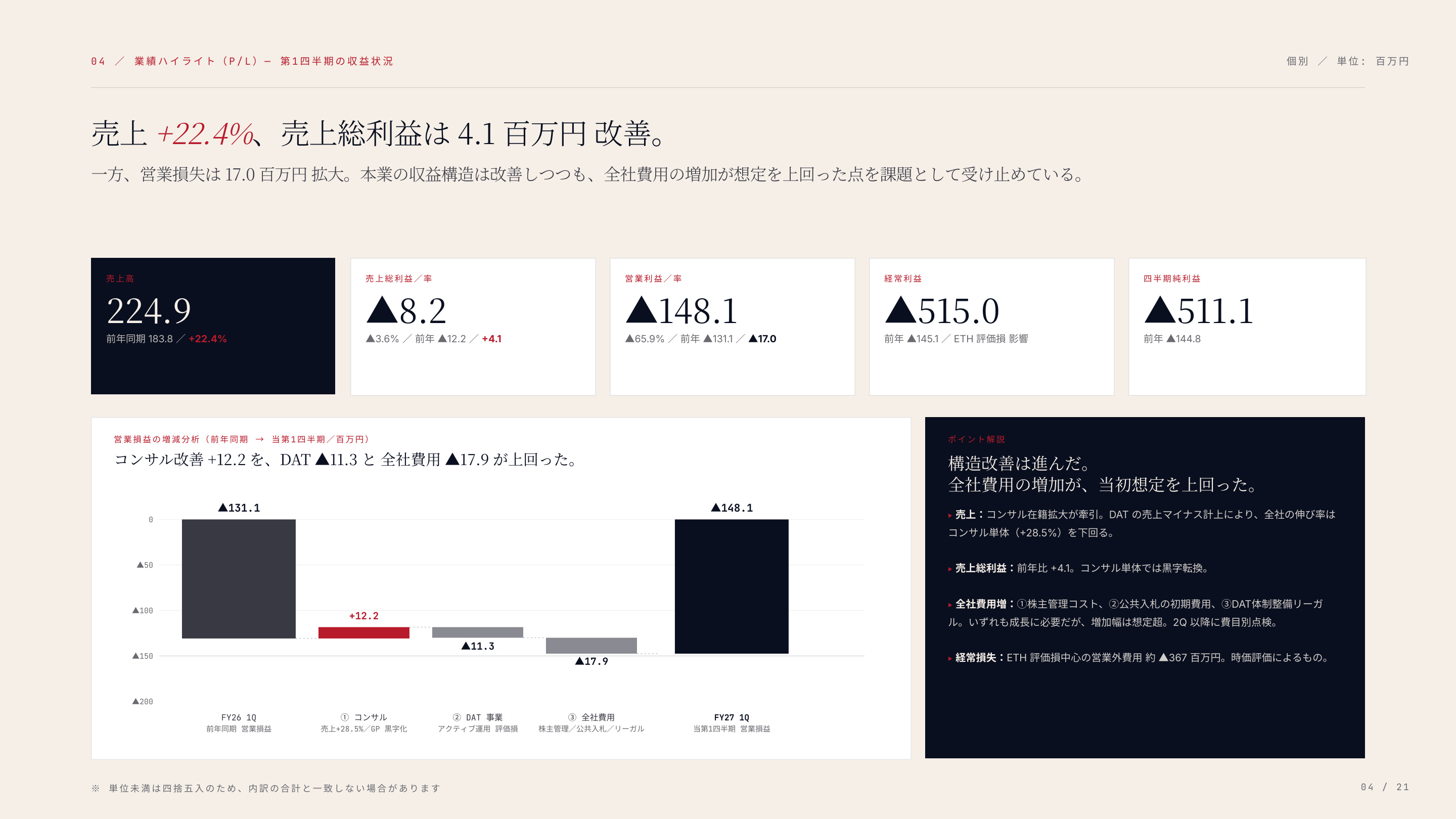
[Why this slide matters: P/L structure and breakdown of operating profit/loss]
The slide above (P4) illustrates the most essential "profit and loss structure trends" for evaluating this quarter's performance:
- Sales Growth : The core consulting business grew by 28.5% YoY , serving as the primary driver for the total net sales of ¥224.9 million .
- Consulting Segment Turnaround : As shown in the waterfall chart, the improvement in the consulting business contributed +¥12.2 million , leading to gross profitability at the segment level.
- Factors for Widening Losses : Conversely, active management valuation losses in the DAT business accounted for -¥11.3 million , while corporate-wide expenses—including shareholder management costs, initial costs for public tenders, and legal fees—exceeded expectations, acting as a -¥17.9 million drag.
- Ordinary Loss and Exogenous Variables : The primary reason for the expansion of ordinary loss to -¥515.0 million was the mark-to-market valuation loss on ETH (approx. -¥367 million) recorded as non-operating expenses. This is an exogenous variable dependent on crypto market price trends and should be clearly distinguished from the operating performance of the core business.
2. Profitability Improvement in the Core Consulting Business and Human Capital Strategy
In Q1, the consulting business recorded net sales of ¥236.2 million (+28.5% YoY) and a gross profit of +¥3.1 million (compared to -¥12.2 million in the same period last year, with a gross margin increase of +1.3%) , marking a clear shift from the previous year's negative figures. The segment loss was -¥46.6 million (an improvement of 20.7% from -¥58.8 million in the same period last year) .
(1) Record-High Recruitment and Organizational Scale
New hires during the quarter reached 47 (up 67.9% YoY) , marking the highest quarterly recruitment on record. Consequently, the number of consultants as of the end of June 2026 reached 219 (+37 or +20.3% from the end of March) , achieving the target range of 200–230 for the fiscal year-end ahead of schedule.
(2) Strategic Shift in Recruitment (Entering the "Scale and Monetize" Phase)
With headcount reaching the target range, the company has decided to temporarily suspend mass hiring from the second quarter onwards. Excluding strategic hires in specialized areas (such as the public sector), the focus will shift entirely from recruitment investment to "utilization and early productivity of existing talent" to harvest gross profits.
(3) Utilization Rate Trends and Structural Factors for Underperformance
The average monthly utilization rate for Q1 was 85.5% (84.7% in the same period last year) . The decline compared to the previous quarter (97.1% in Q4 FY2026) is due to the following structural reasons:
- Concentration of project transitions and contract renewals at the start of the fiscal year on the client side.
- Overlap in training and assignment adjustment periods due to the record-high intake of 47 new hires between April and June.
- The rapid expansion of headcount increased the denominator for the utilization rate, temporarily magnifying the impact on P/L.
Utilization rates have been on a recovery trend since July, and the company expects to return to target high-utilization levels by the end of Q2.
(4) Unit Price Trends and Upstream Shift (Full-scale Entry into the Public Sector)
The average monthly unit price in the engineering/SES domain showed signs of bottoming out at ¥418,838 (+2.5% from March) . While unit prices in the consulting domain saw a temporary adjustment (¥1,026,035) due to project turnover, the company secured two public sector contracts , marking its first achievement as a prime contractor. By shortening the supply chain and shifting to upstream processes, the company is driving unit price premiums and stabilizing utilization.
3. Profitability Milestones and Fixed-Point Disclosure Framework
To enhance dialogue with investors and improve transparency, the company has defined and disclosed its profitability criteria and achievement roadmap in advance.
The following slide shows the progress tracking format introduced this quarter.
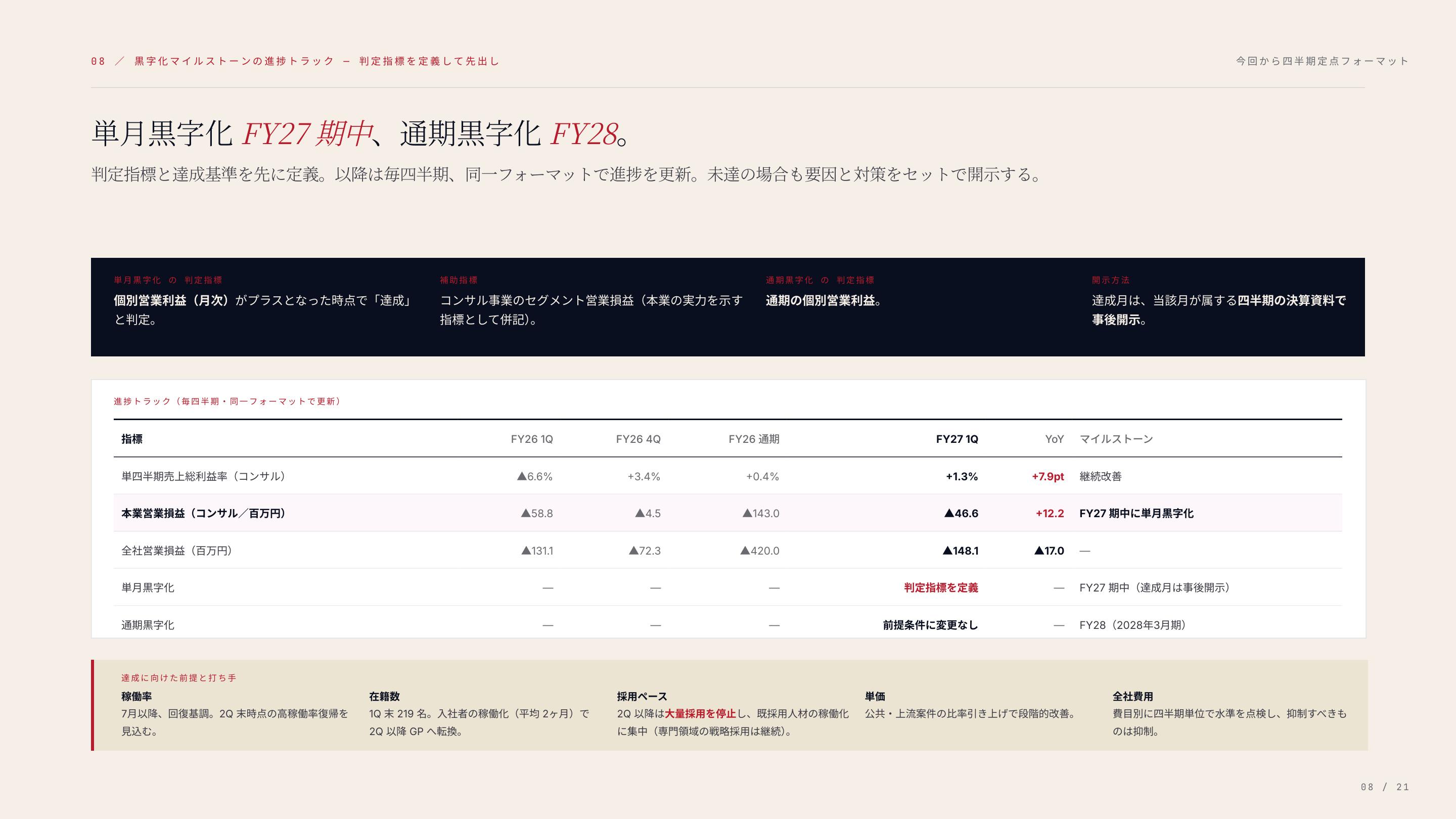
[Why this slide matters: Commitment to profitability and transparency of criteria]
The slide above (P8) shows the fixed-point observation metrics for the specific profitability process toward the "Year of Reversal":
- Monthly Profitability (within FY27) : Clearly defined as the point when "individual operating profit (monthly) turns positive," with a goal to achieve this during FY2027 . The segment operating profit of the consulting business will be tracked as a supplementary metric.
- Full-Year Profitability (FY28) : The target for full-year individual operating profit profitability is set for FY2028 , with no changes to the prerequisites.
- Visualization of Prerequisites and Actions : The company presents a set of actions including utilization recovery, fixing personnel costs through hiring freezes, increasing the ratio of public/upstream projects, and quarterly reviews of corporate-wide expenses, with progress to be disclosed in the same format every quarter.
4. Digital Asset Treasury (DAT) Business and Financial Soundness
The DAT business manages Web3 assets through Ethereum (ETH) staking and option trading.
(1) Quarterly Performance and Volatility Impact
DAT segment revenue for Q1 was -¥11.3 million . While income from staking and option trading remained stable at +¥12.8 million , the decline in volatility across the crypto market led to a contraction in risk premiums, resulting in a -¥24.1 million valuation loss on actively managed assets.
(2) ETH Holdings and mNAV Trends
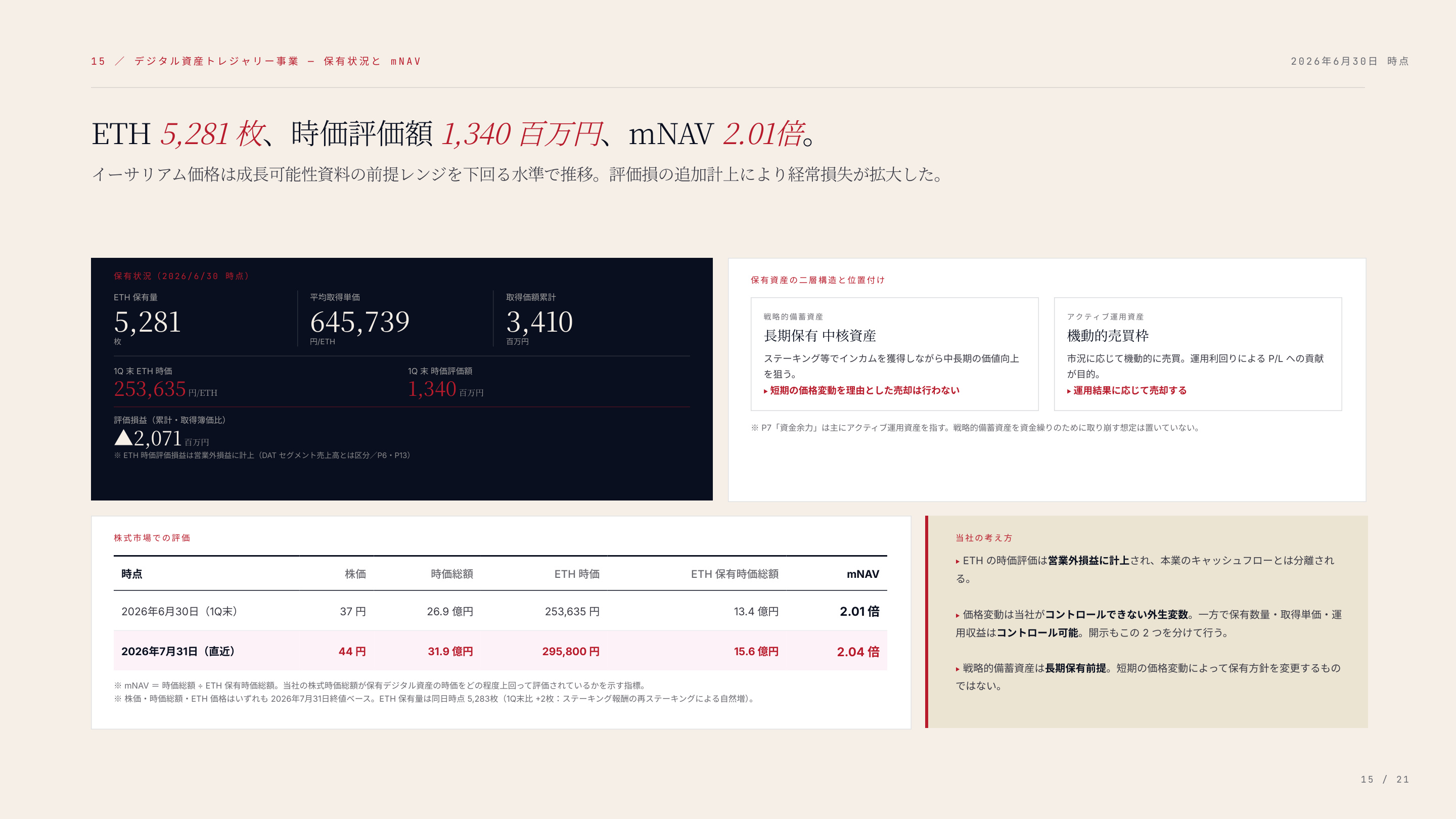
As of the end of June 2026, ETH holdings were 5,281 ETH (+305 from the end of the previous fiscal year) , with an average acquisition cost of ¥645,739/ETH and a cumulative acquisition cost of ¥3,410 million . Based on the ETH market price at the end of Q1 (¥253,635/ETH), the market value was ¥1,340 million , with a cumulative valuation loss of -¥2,071 million (recorded as non-operating P/L). Notably, the mNAV (multiple) , which compares the company's market cap to the value of its ETH holdings, stands at 2.01x (as of end-June), indicating that the stock market continues to value the company above the value of its digital assets.
(3) Robust Balance Sheet and Financial Structure
With total assets of ¥2,070 million and net assets of ¥1,897 million , the company boasts a very high equity ratio of 91.6% . It maintains a financial foundation independent of interest-bearing debt, creating a structure resilient to the impact of financial costs even in a rising interest rate environment.
5. Non-listed M&A Status and Sourcing Funnel Disclosure
The company is promoting M&A of non-listed companies as its second pillar of growth and has begun disclosing the funnel (number of projects by stage) starting this quarter.
The following slide illustrates the sourcing progress and investment discipline.
[Why this slide matters: Visualization of M&A strategy based on strict discipline]
The slide above (P15) proves with numbers that the company is sourcing with discipline even before execution:
- Fixed-Point Funnel Observation : The process is clearly shown, starting from collaboration with intermediaries (6 firms), leading to long-lists (41 cases), IM receipt/review (28 cases), and top-level meetings/letters of intent (3 cases), leading to final contracts (0 cases).
- Revision to Disciplined Investment Levels : As an acquisition discipline, the entry level has been revised from the previous "EV/EBITDA of around 6x" to a more conservative "EV/EBITDA of 4–5x." Given current cash reserves and sourcing conditions, the company is clearly avoiding overpaying and focusing on selecting profitable, self-sustaining businesses.
6. Future Outlook and Conclusion
The company has maintained its full-year FY2027 earnings forecast, with net sales of ¥1,290–¥1,629 million and operating profit/loss of -¥200 to +¥150 million .
Regarding full-year ordinary and net income, there is a possibility that results may fall below the announced range because current market prices are lower than the ETH price assumptions (¥400k–¥800k/ETH) used at the time of announcement. However, the company has indicated a policy of focusing all efforts on achieving early profitability in operating profit, which reflects the true strength of the core business , without being overly swayed by the exogenous variable of ETH price fluctuations.
Although operating losses widened in Q1 due to upfront corporate expenses, this quarter provided clear signals for structural improvement, including "gross profitability in the consulting business," "securing personnel within the planned range," "acquisition of public sector projects," and "enhanced disclosure of M&A and profitability milestones." The recovery of utilization rates from Q2 onwards and the transition of the expanded workforce into a monetization phase will be the most critical points for the future turnaround of performance.
This content is not intended as investment advice or a recommendation. Any opinions expressed are solely the personal views of each article.