


Digital Garage: Q1 FY2027 Earnings Deep Dive Report

StockClub
Published: Aug 14, 2026, 11:24 AM
Sentiment Analysis
Digital Garage: Q1 FY2027 Earnings Deep Dive Report
1. Earnings Summary and Management Direction: Structural Reform in a "Transition Year"
Digital Garage’s Q1 FY2027 (ending March 2027) results mark a "Transition Year" leading up to the announcement of a new medium-term business plan later this year. The company is steadily advancing group-wide cost structure optimization, restructuring core businesses, and reallocating management resources toward next-generation growth areas.
In Q1, consolidated profit before tax was -¥430 million (compared to -¥1.345 billion in the same period last year), representing an improvement of ¥917 million year-on-year. This was primarily driven by a reduction in valuation losses on operational investment securities in the Global Investment Incubation (GII) segment. Meanwhile, core business revenue remained solid at ¥9.675 billion (+0.5% YoY) , although core business profit stood at ¥680 million (-44.9% YoY) . This decline in profit was due to temporary factors in the core Platform Solutions (PS) segment, as well as one-time costs related to office optimization and the Kakaku.com tender offer.
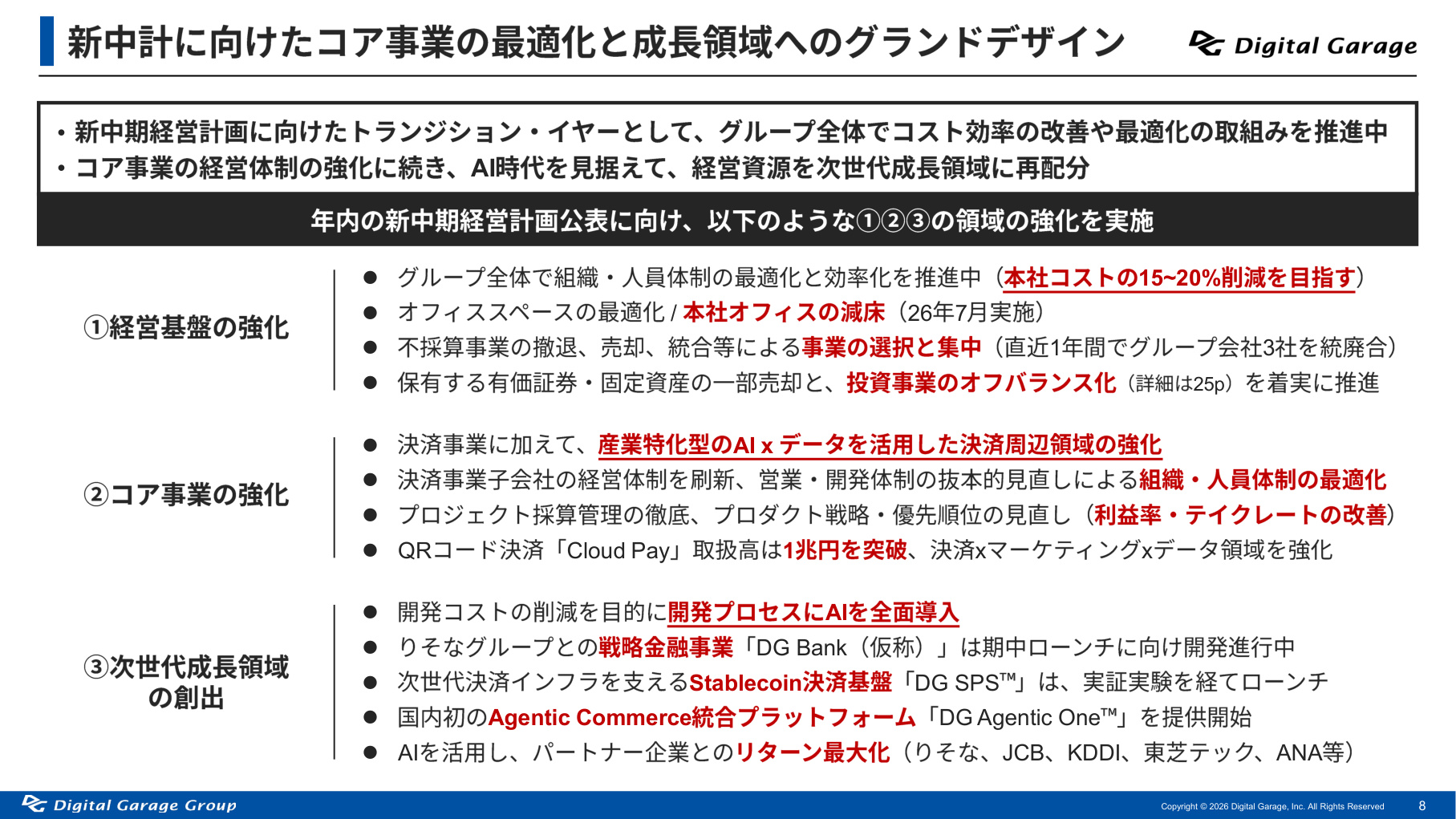
[Slide Commentary: The Importance of the Grand Design for the New Medium-Term Plan]
PAGE_7 (Slide 8) above is a critical slide illustrating the company-wide structural reforms and the roadmap for future growth currently being undertaken by Digital Garage. In preparation for the new medium-term business plan to be announced later this year, the company is strengthening its corporate structure in the following three areas:
- Strengthening the Management Foundation : The company is optimizing its organizational and personnel structure across the group, aiming for a 15–20% reduction in head office costs . A reduction in office floor space is scheduled for July 2026. Furthermore, the company is accelerating the "selection and concentration" of its businesses—having consolidated three group companies over the past year—and is steadily advancing the off-balancing of its investment business through the sale of securities and fixed assets.
- Strengthening Core Businesses : In the payment business, the company is aggressively promoting industry-specific AI and data utilization while fundamentally reviewing its organizational, sales, and development structures. This initiative aims to enforce strict project profitability management and improve profit margins and take rates . The transaction volume for the "Cloud Pay" QR code payment service has surpassed ¥1 trillion , strengthening the synergy between payments, marketing, and data.
- Creating Next-Generation Growth Areas : Beyond implementing AI across development processes to reduce costs, the company is focusing on maximizing returns through partnerships, such as the development of the strategic financial business "DG Bank (tentative name)" with the Resona Group, the launch of the Stablecoin payment infrastructure "DG SPS" following pilot testing, and the rollout of Japan’s first Agentic Commerce integrated platform, "DG Agentic One."
This grand design presents a clear strategy that goes beyond simple cost-cutting, focusing on reallocating freed-up resources into next-generation areas that will serve as future pillars of revenue.
2. Analysis of Segment Performance
(1) Platform Solutions (PS) Segment: Expansion of Transaction Volume and Recovery Trajectory Toward H2
The PS segment is the company’s core business, consisting of payment and marketing services. In Q1, segment revenue was ¥6.037 billion (+2.3% YoY) , and segment profit was ¥1.942 billion (-11.9% YoY) .
- Payment Business : Segment revenue was ¥4.731 billion (+0.3% YoY) , with segment profit at ¥1.429 billion (-19.2% YoY) . The primary factor for the profit decline is the lingering impact of contract terminations and condition revisions with large merchants that occurred in the previous fiscal year (Q2). However, the company plans to return to a growth trajectory from the second half of this fiscal year onwards as these impacts subside and structural reforms take effect.
- Marketing Business : Segment revenue was ¥1.306 billion (+10.5% YoY) , and segment profit was ¥513 million (+17.8% YoY) . The business achieved double-digit growth in both revenue and profit, bolstered by the revitalization of the advertising market , particularly in payment and finance-related sectors.
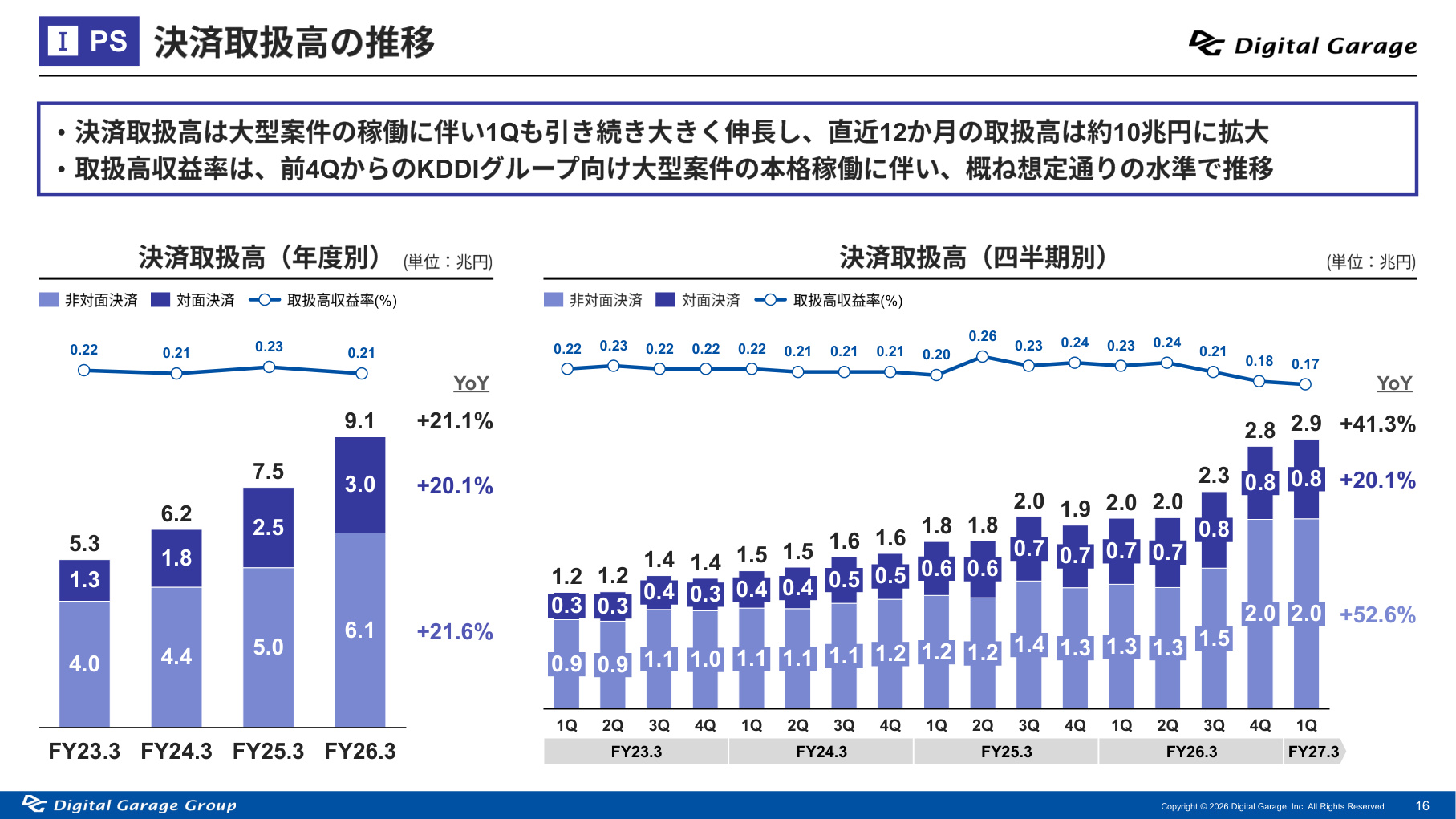
[Slide Commentary: Trends in Payment Transaction Volume and Mid-to-Long-Term Growth Potential]
PAGE_15 (Slide 16) shows the quarterly and annual trends in payment transaction volume, demonstrating the sustainable growth foundation of the PS segment. In Q1, payment transaction volume reached ¥2.9 trillion, up 41.3% YoY , with the trailing 12-month total rapidly expanding to approximately ¥10 trillion .
- Non-face-to-face payments : Increased significantly by 52.6% YoY to ¥2.01 trillion . This was largely driven by a major project for the KDDI Group that went into full operation in Q4 of the previous year (the information/communications and SaaS sector grew by 445.6% YoY).
- Face-to-face payments : Despite the impact of a slowdown in inbound consumption, volume grew by 20.1% YoY to ¥0.84 trillion , marking the first time in three quarters that the growth rate has exceeded 20%.
- Full-Year Outlook : In addition to organic growth, the full-year contribution of the major KDDI project is expected to bring total annual payment transaction volume to ¥11.5 trillion (+26% YoY) . The take rate is trending largely in line with expectations as the major project scales, creating a structure where increased volume will lift the base profit floor in the future.
(2) Long-Term Incubation (LTI) Segment: Monetization of Strategic Businesses and Significant Profit Growth
The LTI segment is responsible for developing and nurturing strategic businesses that have high affinity with the payment business and collaboration with Kakaku.com. Although Q1 segment revenue was ¥3.291 billion (-1.9% YoY) , segment profit achieved significant growth, reaching ¥895 million (+43.2% YoY) .
- Rapid Growth of Strategic Businesses : As multiple development and incubation projects transitioned into the monetization phase, business losses narrowed significantly from -¥398 million in the same period last year to -¥78 million .
- In-App Payment "AppPay" : Benefiting from the Smartphone Act (effective December 2025), global expansion has been successful, with transaction volume surging approximately 6x YoY , solidifying its position as Japan’s No. 1 in-app payment service.
- Real Estate DX "Musubell" : The company launched "Musubell Smart Identity Verification (eKYC)" in anticipation of revisions to the Act on Prevention of Transfer of Criminal Proceeds, steadily expanding its customer base.
(3) Global Investment Incubation (GII) Segment: Volatility Suppression and Structural Transformation
The GII segment conducts startup investments both domestically and internationally. Q1 profit before tax was -¥952 million (compared to -¥2.617 billion in the same period last year); while there was a decrease in the fair value of some investments, the scale of the deficit narrowed significantly.
- Balance of Operational Investment Securities : The ending balance was ¥52.8 billion .
- Outlook for Achieving Medium-Term Plan Targets : In May 2026, the company reached a basic agreement on a strategic partnership with a major secondary fund manager . By selling and transferring (off-balancing) the majority of its portfolio, the company aims to achieve its medium-term plan target of ¥30 billion in cumulative investment business income over five years (current cumulative total is ¥16.3 billion) , while transitioning to a stable management foundation with reduced earnings volatility caused by valuation gains and losses.
3. Growth Strategy Utilizing Next-Generation Technology: Agentic Commerce and Stablecoin
By capturing the advancements in Generative AI (Gen AI) and Web3, Digital Garage is evolving from a mere payment service provider into a next-generation commerce infrastructure provider .
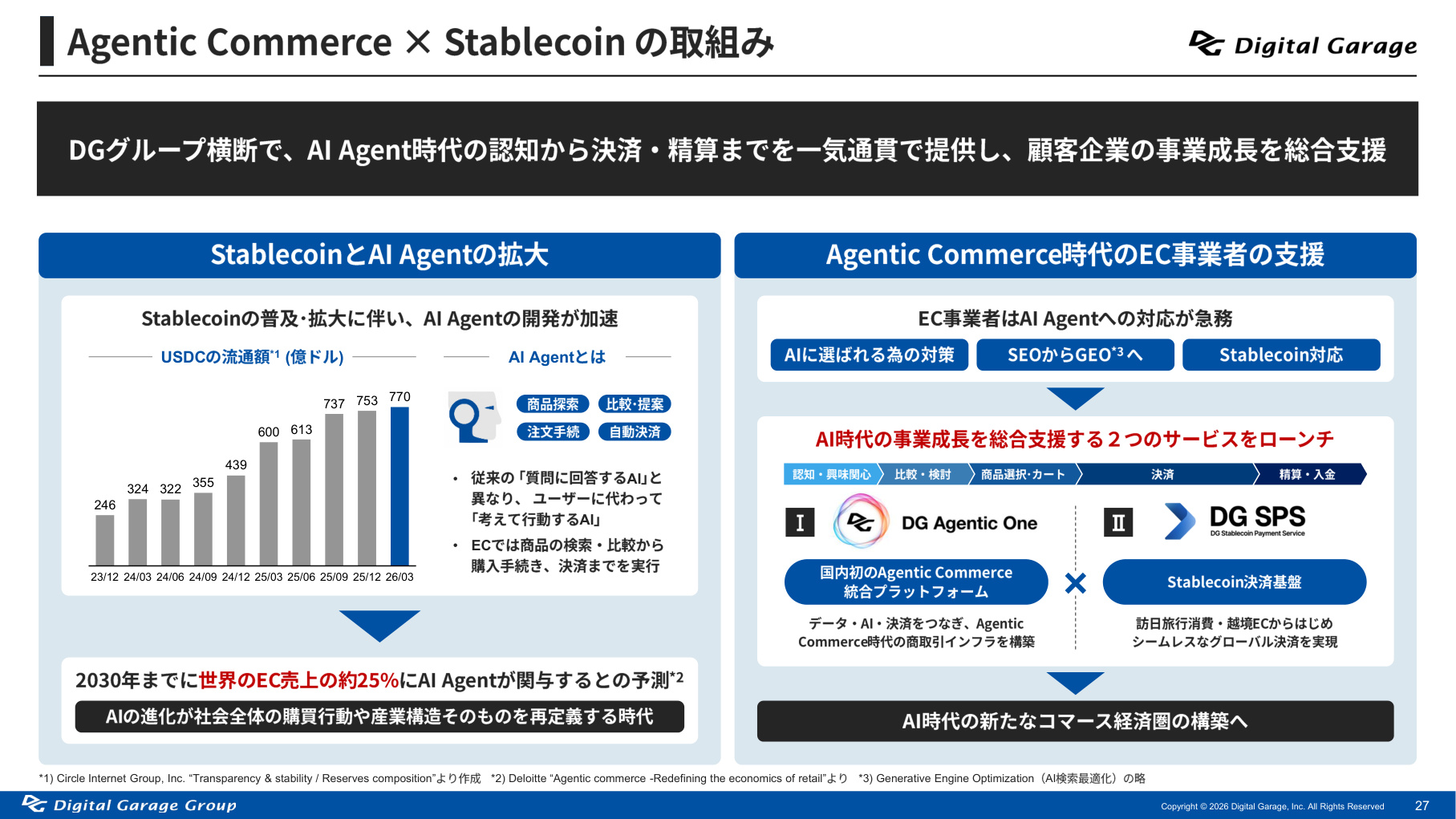
[Slide Commentary: A New Ecosystem via Agentic Commerce × Stablecoin]
PAGE_26 (Slide 27) is a conceptual diagram showing the full scope of the next-generation commerce and payment platform the company is promoting for the AI era. It is predicted that by 2030, approximately 25% of global e-commerce sales (equivalent to ¥15 trillion , or 20% of Japan’s ¥78 trillion non-face-to-face payment market) will be in the era of "Agentic Commerce," where AI Agents are involved in the process. Users will shift from searching and purchasing products themselves to delegating exploration, comparison, purchase procedures, and payment to AI agents.
To address this structural change, the company is rolling out the following two innovative services:
- Japan’s First Agentic Commerce Integrated Platform "DG Agentic One"
- A platform that provides end-to-end support, from data optimization (DataFeed, GEO) for e-commerce merchants to be selected by AI Agents, to conversation and negotiation with AI agents (MCP), and the execution of the actual purchase process and payment.
- Stablecoin Payment Infrastructure for Face-to-Face, Non-Face-to-Face, and AI: "DG SPS"
- Utilizing stablecoins such as USDC and JPYC, this service provides a global next-generation payment infrastructure that supports travel consumption by foreign visitors to Japan (a ¥9.5 trillion market), cross-border e-commerce (a ¥4 trillion market), and even autonomous micro-payments between AI Agents.
By integrating its ¥10 trillion-scale payment infrastructure (PS), media and strategic businesses like Kakaku.com (LTI), and a global startup network (GII), the company is building a new commerce economic zone that connects "Data × AI × Payments."
4. Future Outlook and Summary
While Q1 FY2027 results were temporarily impacted by the lingering effects of large-scale customer churn from the previous year and one-time costs associated with structural reforms, the company is simultaneously rebuilding its business foundation and accelerating growth .
- H1 to H2 Earnings Recovery Scenario : Heading into the second half of the year, as the impact of contract terminations and condition revisions subsides, the full-scale contribution of the KDDI Group project and the cost-reduction effects of structural reforms are expected to emerge, driving a return to a growth trajectory in profitability.
- Expectations for the New Medium-Term Business Plan : The new plan, to be announced later this year, will incorporate specific achievements such as the 15–20% reduction in head office costs, the "DG Bank (tentative name)" project with the Resona Group, and Agentic Commerce, serving as a compass for mid-to-long-term corporate value enhancement.
Digital Garage’s strategy of fusing next-generation technologies like AI agents and stablecoins onto a robust ¥10 trillion payment platform is moving into a new phase of growth following this transition year.
This content is not intended as investment advice or a recommendation. Any opinions expressed are solely the personal views of each article.