


Dream Arts (4811) Q2 FY2026 Earnings Deep Dive Report

StockClub
Published: Aug 14, 2026, 11:23 AM
Sentiment Analysis
1. Executive Summary & Financial Overview
For the first half of the fiscal year ending December 2026, Dream Arts Corporation (Securities Code: 4811) reported net sales of ¥2,977 million (up 6.0% YoY) , operating profit of ¥481 million (down 20.9% YoY) , and net profit attributable to owners of the parent of ¥384 million (down 19.7% YoY) .
Despite the reactionary decline from large-scale license and professional service sales recorded in the previous fiscal year, the company’s core growth driver—the Cloud Business (particularly Horizontal SaaS)—strongly propelled overall performance . As this is the first year of the medium-term management plan, operating profit fell short of the previous year's level due to proactive growth investments, such as talent acquisition and marketing expenses. However, the progress rate against the full-year operating profit target (¥865 million) has reached 55.6% , indicating that performance is tracking steadily in line with the plan.
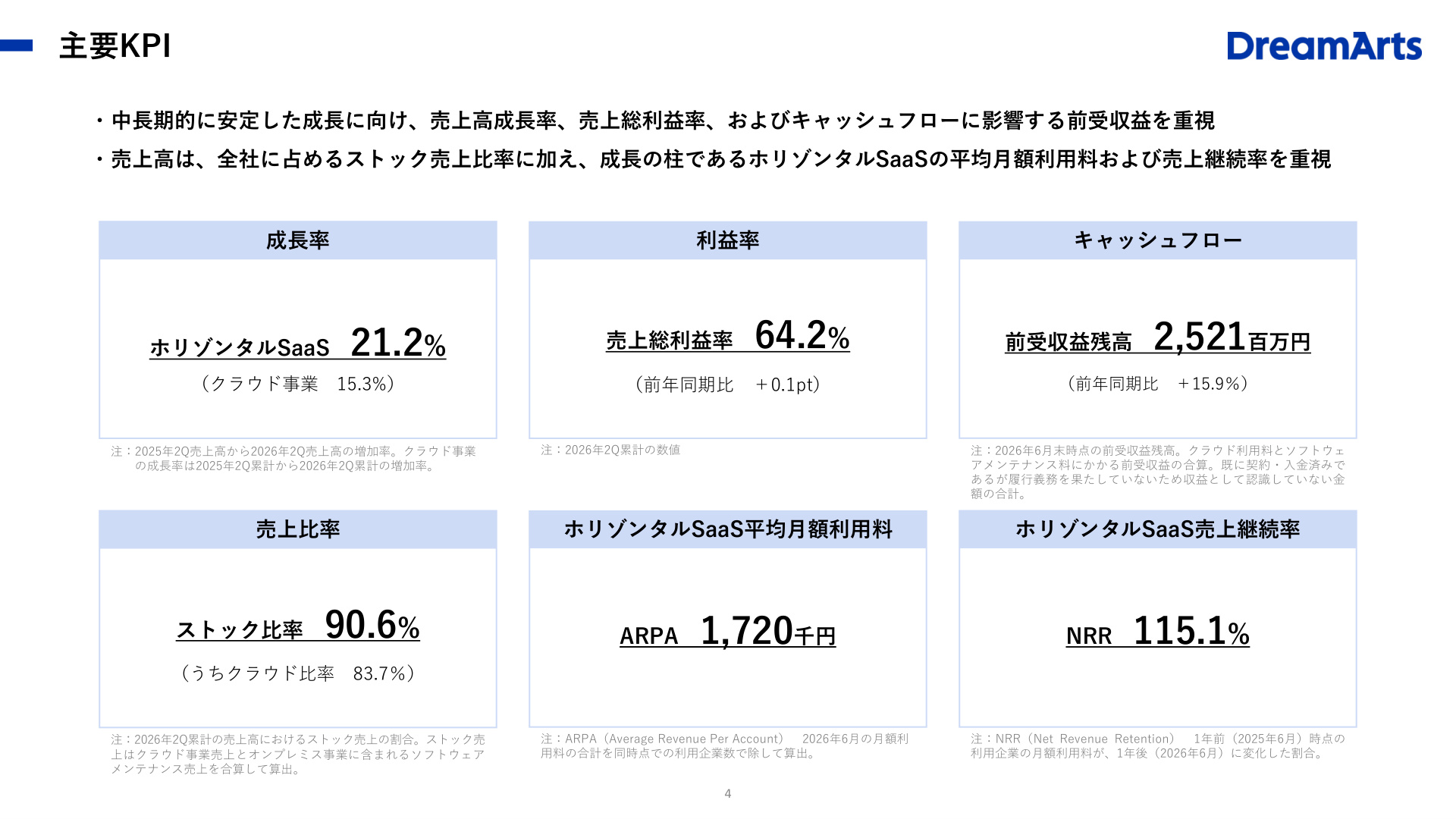
The KPI trends demonstrating the health of the company's business model are summarized in the slide below.
[Significance and Background of the Data in the Slide Above]
This slide presents quantitative indicators that encapsulate the strengths of the company's sustainable SaaS business model. The Horizontal SaaS sales growth rate is up 21.2% YoY , the gross profit margin stands at 64.2% , and the stock revenue ratio remains at an extremely high level of 90.6% (with the cloud ratio at 83.7%). Furthermore, the Net Revenue Retention (NRR) rate is 115.1% , confirming that the company is successfully driving not only new customer acquisition but also churn prevention and expansion (upselling) within its existing customer base. Additionally, the accumulation of deferred revenue at ¥2,521 million (up 15.9% YoY) signifies that future revenue is secured with high stability.
2. Comprehensive Analysis by Topic (10 Key Points)
Based on 10 critical topics extracted from the earnings materials, we provide a comprehensive analysis of the company's current status and growth narrative.
① Consolidated Performance Trends and Progress
First-half net sales reached a record high of ¥2,977 million, up 6.0% YoY. The progress rate against the full-year sales target (¥6,250 million) is 47.6% , while the operating profit progress rate is 55.6% . Driven by the strong performance of the cloud business and the capitalization effects of software development investments, the decline in profit is narrowing compared to the Q1 stage.
② High Growth of Core Horizontal SaaS (e.g., SmartDB®)
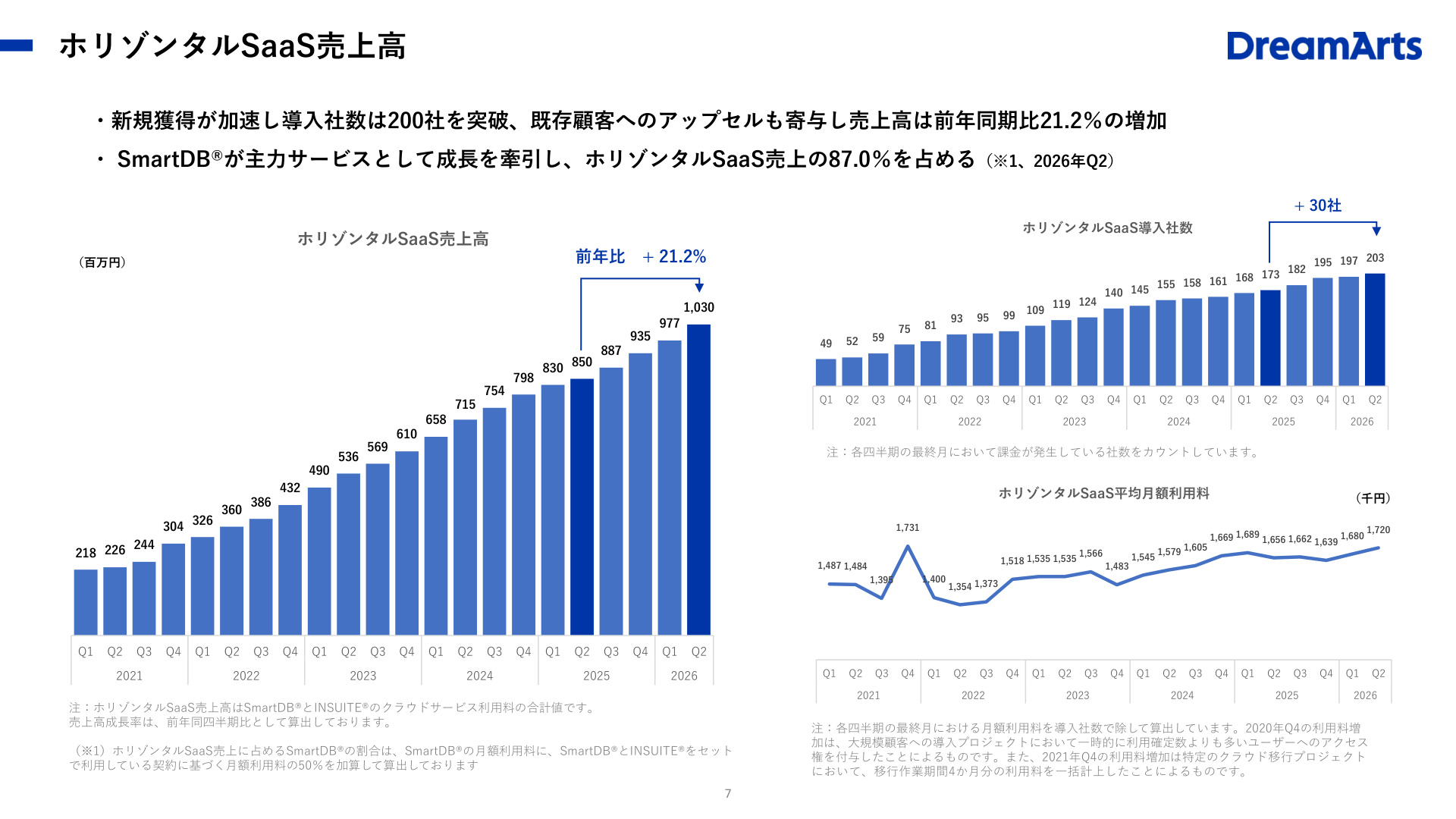
Horizontal SaaS sales for the first half grew 21.2% YoY to ¥1,030 million , surpassing the ¥1 billion mark for a single quarter for the first time. In particular, the no-code development platform for large enterprises, "SmartDB®," serves as the primary engine, accounting for 87.0% of total growth.
③ Expansion of Horizontal SaaS Customer Base and ARPA
The number of Horizontal SaaS customers increased by 30 from 173 at the end of the same period last year to 203 , crossing the 200-customer milestone. Furthermore, ARPA (Average Revenue Per Account) , representing the average monthly usage fee per customer, has steadily expanded to ¥1,720 thousand (up 2.4% QoQ) .
[Significance and Background of the Data in the Slide Above]
This slide illustrates the multi-faceted quarterly trends of "Sales," "Number of Customers," and "ARPA" for Horizontal SaaS, the company's growth driver. Notably, the growth in the number of customers (203) and the rise in ARPA (¥1,720 thousand) are occurring simultaneously . While general SaaS businesses often see a decline in average unit price as the customer base expands rapidly, Dream Arts is following an ideal growth pattern where the contract scale per company increases as the software is deployed across multiple departments and the entire organization of large enterprises.
④ Bottoming Out and Recovery of Vertical SaaS (e.g., Shop-ran®)
The Vertical SaaS business, centered on "Shop-ran®" for multi-store retailers, maintains a recovery trend with sales of ¥205 million (up 5.2% YoY) , driven by increased store usage among large chains and higher adoption via agencies. The number of customers is 171 (up 7 YoY), with an ARPA of ¥399 thousand.
⑤ Strategic Shift from On-Premise and Professional Services
On-premise business sales were ¥209 million (down 30.3% YoY), and professional service business sales were ¥275 million (down 20.3% YoY). This is the result of the planned transition from traditional license sales to cloud (SaaS) models, representing a healthy structural shift toward a stock-based, high-margin business portfolio.
⑥ Cost Structure and Strengthening of Talent and Marketing Investments
The cost of sales ratio remained low at 35.8% (down 0.1pt YoY) . Meanwhile, as a result of hiring new graduates and others, primarily in the sales and marketing departments, the total number of employees at the end of the period increased by 20 from the end of the previous year to 313 (86 in sales/marketing, 62 in implementation/service, 120 in development/operations, and 45 in administration). Consequently, the SG&A ratio rose to 48.1% (up 5.6pt YoY) due to increased personnel costs and advertising/promotional expenses (¥232 million) for large-scale user events.
⑦ Accumulation of Large-Scale Enterprise Adoption
Success stories with major enterprises continue to be announced, including the no-code construction of intellectual property management workflows (14 workflows) at Sekisui Chemical, the replacement of legacy systems for export control (security trade control) at Hitachi, Ltd. (serving approximately 5,000 users), and company-wide adoption at Earth Corporation.
⑧ Expansion of Support Structure through Capital and Business Alliance
In June 2026, the company entered into a capital and business alliance with Cocoo Inc. This partnership establishes DX talent services specialized in SmartDB® (such as "Sma-Debi Joshi"), aiming to train 100 certified professionals over three years. This significantly strengthens the company's "EC2" (External Capability & Capacity) to provide hands-on support to adopting companies, accelerating churn prevention and user retention.
⑨ Patent Acquisition for Proprietary "Dynamic Branch Function"
Dream Arts obtained a patent for its "Dynamic Branch Function," which allows for the flexible reproduction of complex, multi-layered business processes (such as ordering/payment, budget management, and store opening management) within SmartDB® without relying on scratch development. This strengthens the technical barrier to entry against competitors.
⑩ Introduction of Next-Generation Technology Concept "DAPA®2.0"
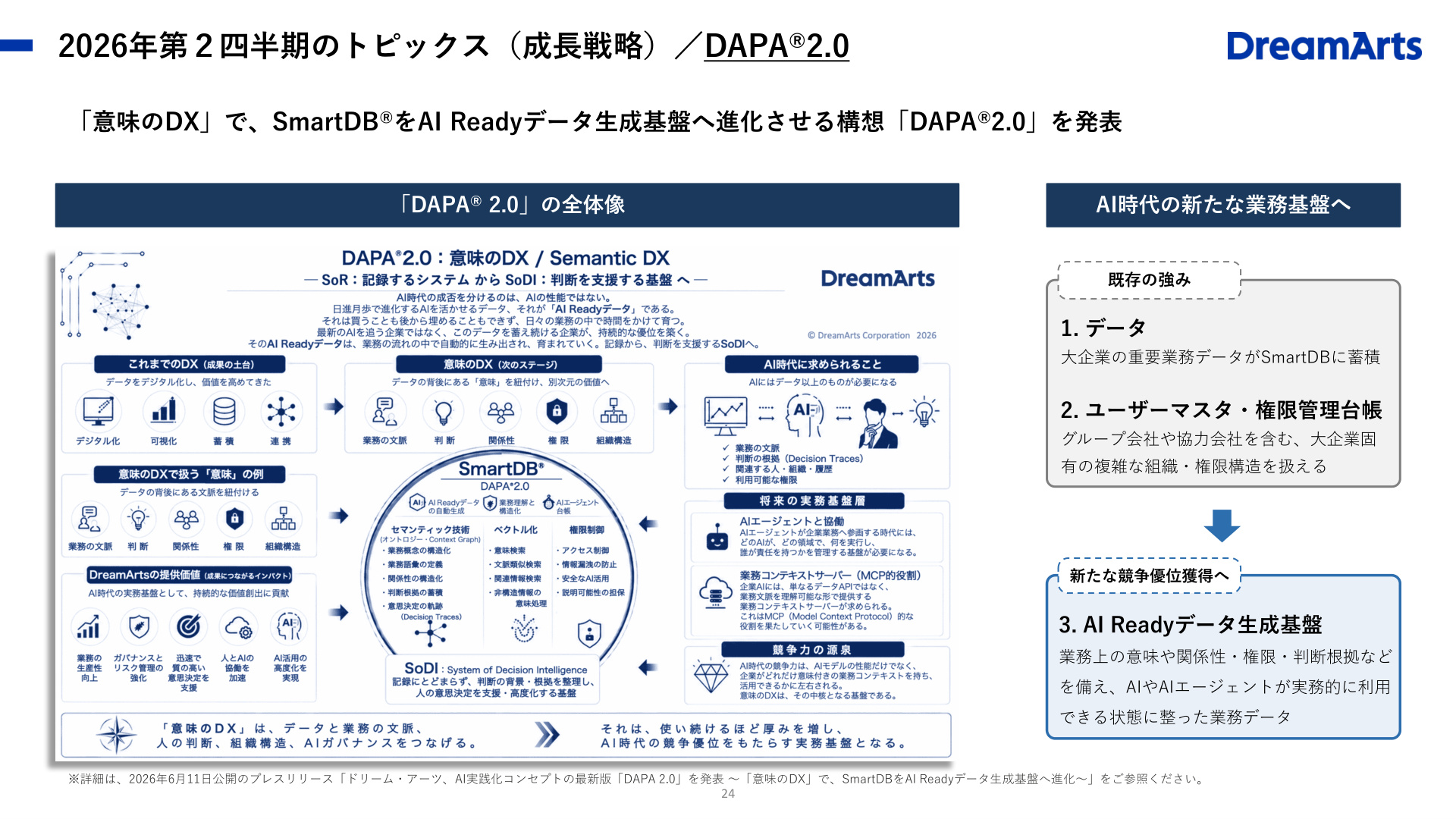
The company announced "DAPA®2.0" as a new business foundation concept for the AI era. By promoting "DX of Meaning," the company aims to evolve SmartDB® from a mere System of Record (SoR) into an "AI-Ready Data Generation Foundation" and a "Decision Support Foundation (SoDI)" by maintaining business context, decision-making rationale, and authority structures as structured data.
[Significance and Background of the Data in the Slide Above]
This slide represents the most important vision symbolizing Dream Arts' mid-to-long-term product differentiation strategy and competitive advantage in the AI era. With the proliferation of generative AI, the importance of "meaning"—understanding the business context and approval authority under which data was generated—is increasing. By positioning SmartDB® as a hub that converts data into "AI-Ready" data while retaining the complex organizational structures and decision-making rules unique to large enterprises, the company aims to establish a unique position that other SaaS providers cannot easily replicate.
3. Detailed Performance by Segment
[Cloud Business]
- Sales : ¥2,492 million (up 15.3% YoY)
- Segment Profit : ¥509 million (up 2.3% YoY, segment profit margin 40.0%)
- Overview : Driven by the rapid expansion of Horizontal SaaS, sales continue to hit record highs on a quarterly basis. Despite increased personnel, cloud infrastructure costs, and advertising expenses, the segment profit margin remains at a high level of 40% , demonstrating exceptional profitability.
[On-Premise Business]
- Sales : ¥209 million (down 30.3% YoY)
- Segment Profit : ¥30 million (down 66.3% YoY, segment profit margin 30.6%)
- Overview : Sales and profits declined due to the gradual decrease in maintenance revenue as cloud migration progresses, as well as the reactionary effect of large license orders in the previous year. However, this is in line with the company's expectations, and the leveling of the revenue structure is progressing as seasonal fluctuations are mitigated.
[Professional Service Business]
- Sales : ¥275 million (down 20.3% YoY)
- Segment Profit : -¥1 million (compared to a profit of ¥53 million in the same period last year)
- Overview : Sales declined during the transition period of implementation support projects associated with cloud migration. However, a gradual recovery in both sales and profit is expected toward the second half of the year as customer cloud migrations and large-scale implementation projects progress.
4. Full-Year FY2026 Forecast and Growth Investment Direction
There are no changes to the full-year consolidated earnings forecast for the fiscal year ending December 2026, and the following plan remains in place:
- Net Sales : ¥6,250 million (up 10.5% YoY)
- Operating Profit : ¥865 million (down 11.2% YoY)
- Ordinary Profit : ¥890 million (down 17.1% YoY)
- Net Profit Attributable to Owners of the Parent : ¥616 million (down 18.6% YoY)
The full-year operating profit decline is due to intentional upfront investments (growth investments) to achieve the Medium-Term Management Plan (2026-2028). The revenue increase is being prioritized for "human capital (enhancing recruitment and compensation systems)" and "advertising/promotion (event hosting, media exposure, and AIO measures)."
In terms of talent, the company continues aggressive hiring throughout the year, and in marketing, it is working to increase brand awareness through large-scale user events such as "Sma-Debi Jamboree!" (attended by approximately 600 people). While appropriately controlling infrastructure costs and software amortization expenses, the company is building a solid business foundation for re-acceleration in the mid-to-long term.
5. Conclusion
Dream Arts' Q2 FY2026 earnings clearly demonstrated the overwhelming growth of its core Horizontal SaaS (SmartDB®) and the establishment of a high-stock revenue base .
While absorbing temporary profit-reducing factors from the cloud shift and increased costs from growth investments, the company is showing steady progress against its full-year plan. With the strengthening of product capabilities through patented technology, the expansion of support capabilities through the partnership with Cocoo, and mid-to-long-term strategies aimed at the AI era represented by "DAPA®2.0," it is clear that the company's competitive advantage in the enterprise SaaS market for large corporations is further intensifying.
This content is not intended as investment advice or a recommendation. Any opinions expressed are solely the personal views of each article.