


GMO Internet Group Q2 FY2026 Earnings Deep Dive: Growth Strategy Driven by Recurring Revenue Foundations and Accelerated GPU Cloud Investment

StockClub
Published: Aug 14, 2026, 11:21 AM
Sentiment Analysis

1. Q2 FY2026 Consolidated Earnings Highlights
GMO Internet Group delivered a robust performance in the first half (H1) of the fiscal year ending December 2026, with significant year-on-year growth across both top-line revenue and all profit tiers. Revenue reached ¥41.2 billion (+7.2% YoY) , operating profit stood at ¥4.76 billion (+46.2% YoY) , ordinary profit was ¥4.54 billion (+39.5% YoY) , and net profit attributable to owners of the parent company totaled ¥3.08 billion (+28.1% YoY) .
The following slide summarizes the consolidated earnings, showing the H1 results and the progress rate against the full-year forecast.
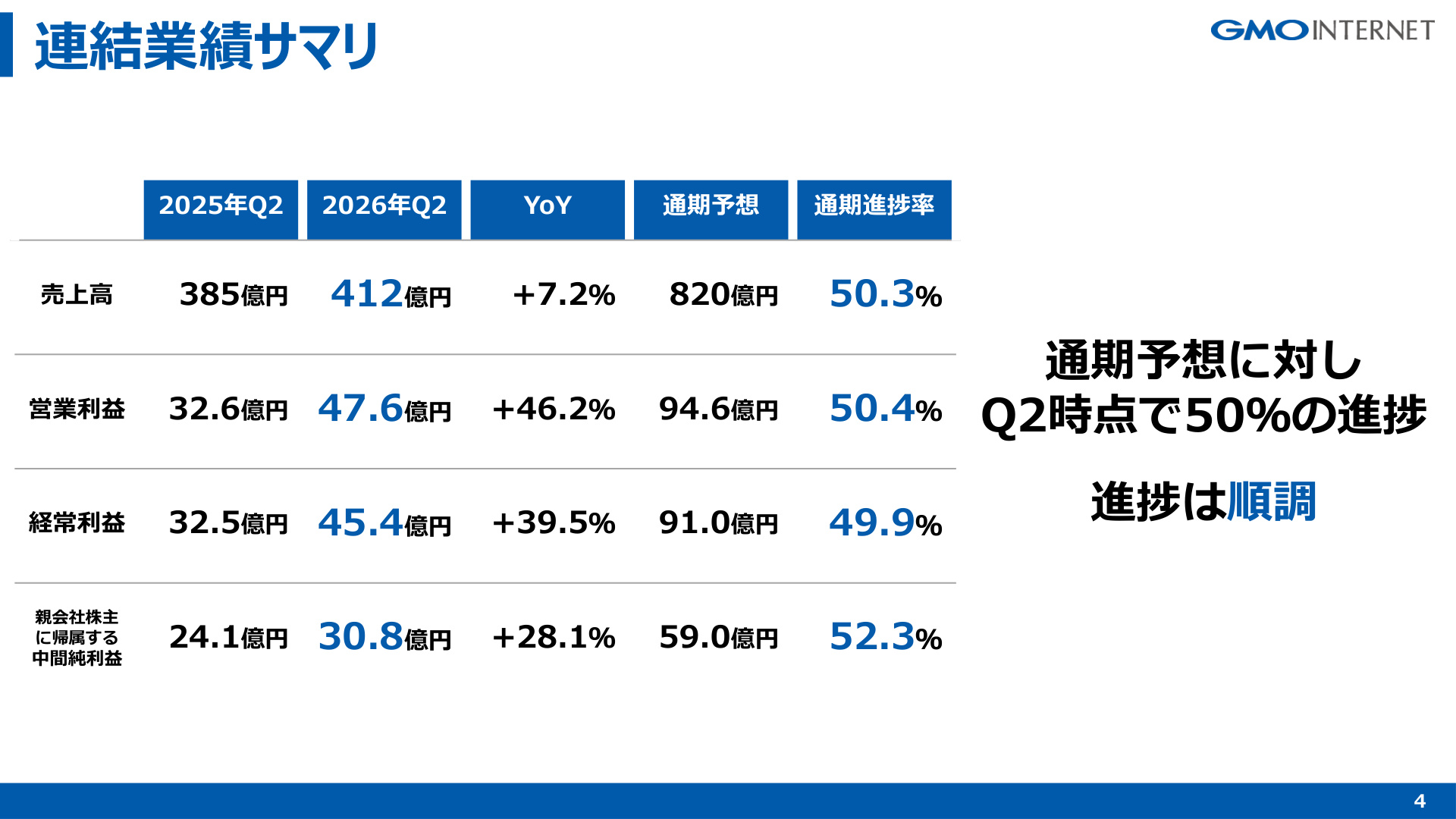
The most critical takeaway from this slide is that the progress rate against full-year forecasts has exceeded (or nearly reached) 50% across all metrics . Specifically, the progress rates are 50.3% for revenue (full-year forecast: ¥82 billion) , 50.4% for operating profit (full-year forecast: ¥9.46 billion) , 49.9% for ordinary profit (full-year forecast: ¥9.1 billion) , and 52.3% for net profit (full-year forecast: ¥5.9 billion) . Given the potential for further growth in the second half, the company is tracking well ahead of its annual plan. Notably, the operating profit margin improved significantly from 8.5% in the same period last year to 11.6% , reflecting the efficiency of the profit structure and the growth of high-margin businesses.
2. Core Business Model: High Recurring Revenue Ratio and Expanding Customer Base
The company’s solid management foundation is underpinned by a "stock-type" (recurring) business model that generates predictable, continuous revenue.
The following slide illustrates the trend in the recurring revenue ratio within consolidated sales.
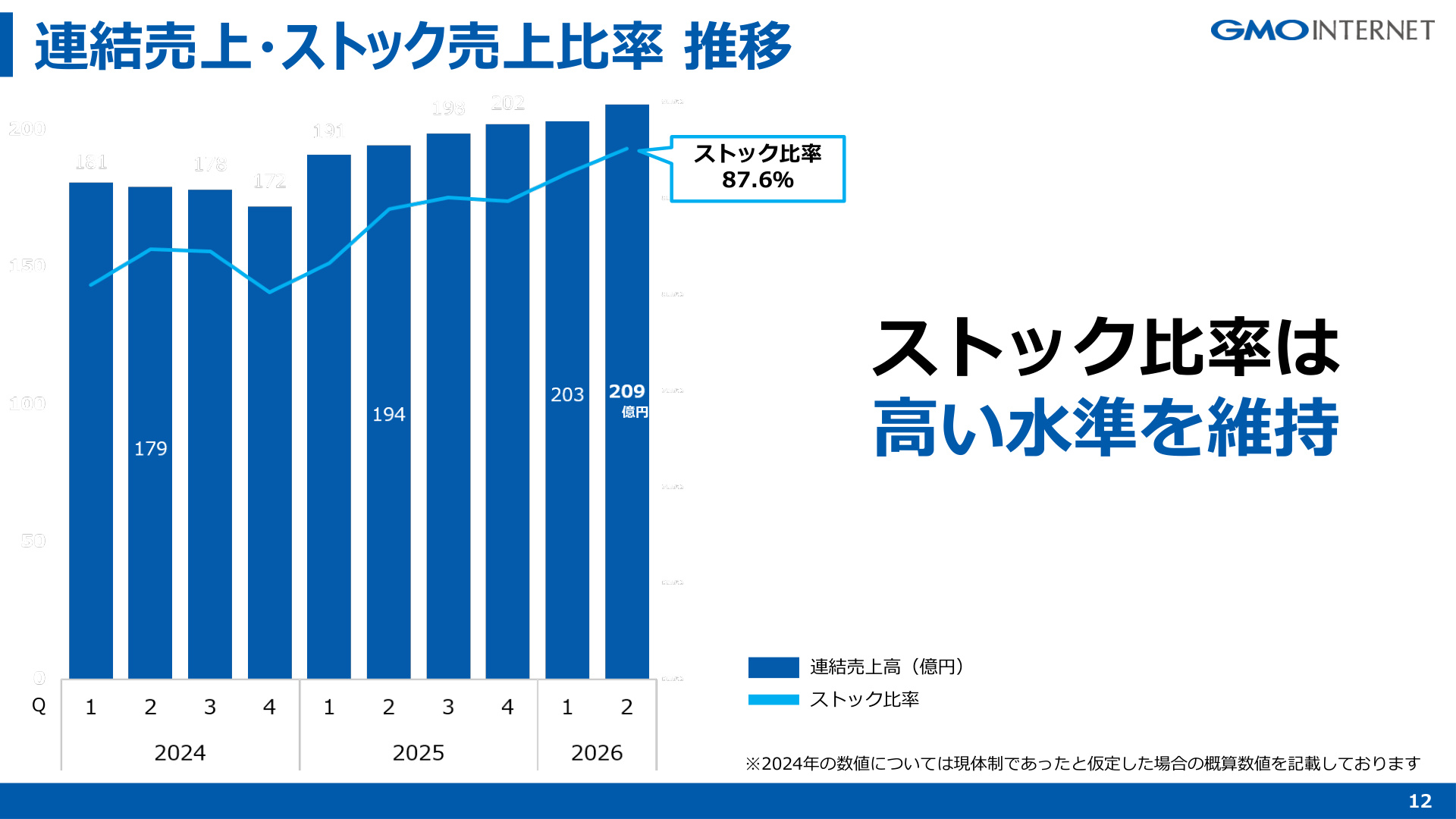
This slide highlights that the recurring revenue ratio remains at a very high level of 87.6% . With monthly and annual recurring revenues—such as domain registration/renewal fees, monthly rental server fees, and internet provider connection fees—accounting for approximately 90% of consolidated sales, the company possesses extreme resilience against economic fluctuations and short-term market changes.
Furthermore, the customer base (number of contracts) supporting this recurring revenue continues to expand steadily. Domestic contracts reached 13.7 million , overseas contracts reached 130,000 , and the total number of contracts increased by 830,000 quarter-on-quarter (QoQ) . This vast "bedrock customer base" serves as the driving force for stable cash flow generation and aggressive capital investment in new business areas.
3. Segment Performance Analysis
(1) Internet Infrastructure: Stable Growth and Enhanced Profitability
The core Internet Infrastructure segment reported H1 revenue of ¥35.8 billion (+12.2% YoY) and operating profit of ¥4.53 billion (+27.0% YoY) , driving the overall increase in revenue and profit.
- Domain & Rental Server Business (Hosting) : Revenue reached ¥11.5 billion (+18.1% YoY), and operating profit surged to ¥3.1 billion (+73.6% YoY). While continuing advertising investments in existing hosting services, the company is enhancing product value by integrating AI features (such as AI agent collaboration in ConoHa VPS and remote MCP server provision). Revenue contributions from the GPU cloud business, discussed later, are also beginning to materialize.
- Internet Connection Business (Provider) : Revenue was ¥21.7 billion (+4.3% YoY), with operating profit at ¥4.26 billion (+8.8% YoY). New contract acquisitions for fiber-optic lines and home routers, such as "GMO Tokutoku BB" for Docomo Hikari and "UQ WiMAX," remain strong. There has been no reactionary decline following peak seasons like the moving season, and steady profit accumulation continues. Additionally, the company is expanding into new areas, such as providing communication infrastructure support for robotics, including a contract for the Japan Ground Self-Defense Force’s quadrupedal security robot system.
(2) Internet Advertising & Media: Dramatic Profitability Improvement via Structural Reform
Although H1 revenue for the Internet Advertising & Media segment was ¥5.82 billion (-14.4% YoY) , operating profit saw a dramatic improvement to ¥380 million (+476.4% YoY) (operating profit for GMO NIKKO, GMO INSIGHT, etc., was ¥840 million, +54.4% YoY). By shifting away from pursuing mere revenue scale toward reviewing organizational structures and focusing on high-value-added projects, productivity has improved significantly. The company has also launched the "GMO AI Optimization Boost," an AIO (AI Search Optimization) comprehensive support tool designed for the AI search era, fostering high-margin services that incorporate cutting-edge marketing techniques.
4. Creating Business Synergies and Evolving Existing Businesses
The company leverages unique synergies by combining the strengths of its "Infrastructure" and "Advertising & Media" businesses.
- Infrastructure x Advertising & Media Synergies : The company applies the marketing expertise of the Advertising & Media segment to its 13.7 million-strong bedrock revenue base in the Infrastructure segment. Specifically, it is working to improve customer satisfaction and increase ARPU (Average Revenue Per User) through cross-selling, such as providing the "GMO AI Easy Attraction" web traffic support service to "Onamae.com" users and operating the "Tokutoku Club" member benefits site for internet providers.
5. Accelerating Growth of "GMO GPU Cloud" and Front-loading Investment Plans
The most significant focus in the company’s future growth story is the "GMO GPU Cloud," a high-performance computing infrastructure designed to meet the demand for generative AI development.
The following slide shows the roadmap of past investment achievements and future plans for the GPU cloud business.
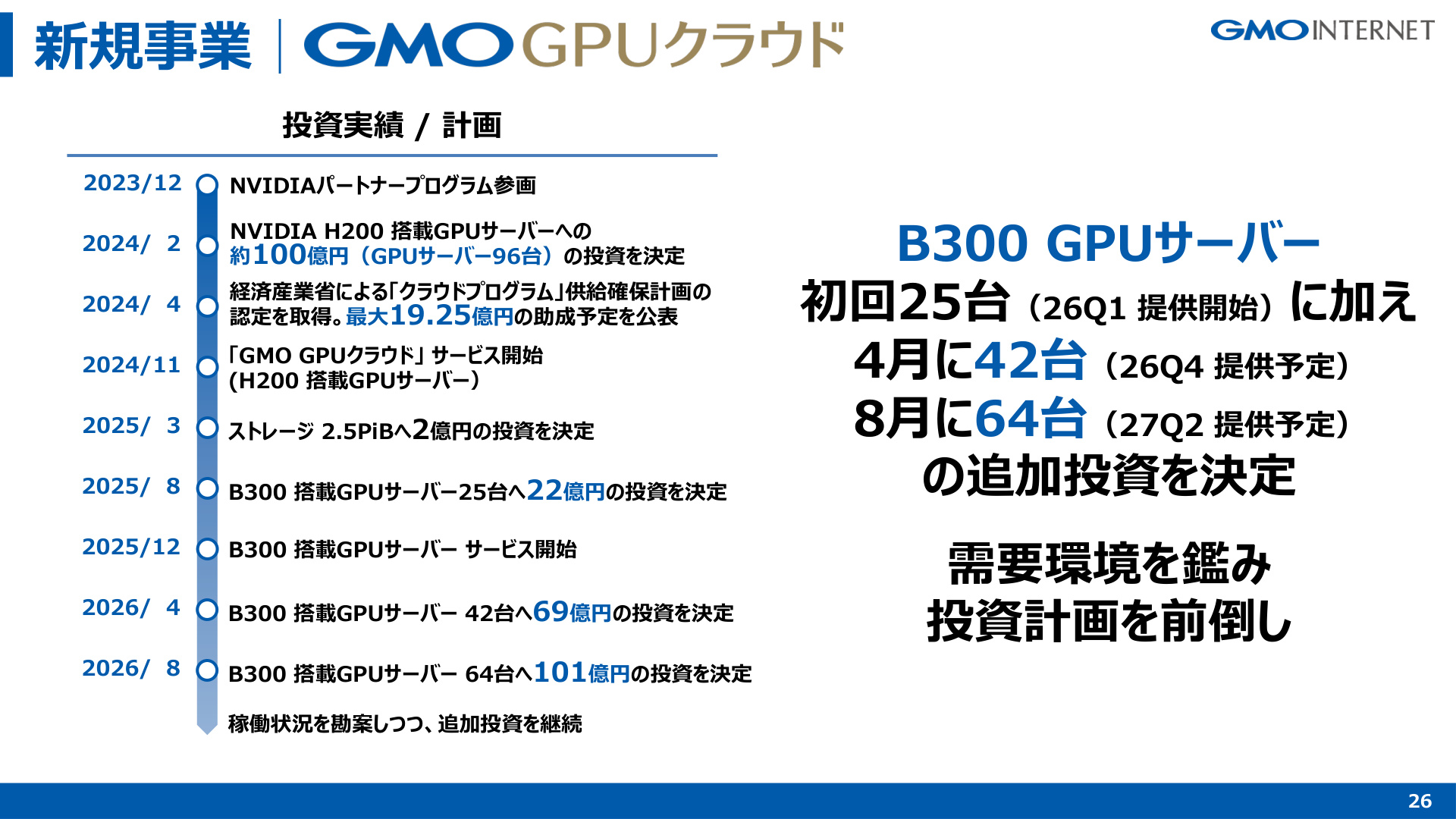
This slide clearly demonstrates the company’s stance of significantly front-loading and expanding its investment plan for GPU servers in response to the rapid expansion of the generative AI market and robust demand.
Specific investment history and future plans are as follows:
- February 2024 : Decided to invest approximately ¥10 billion in 96 NVIDIA H200-equipped GPU servers. Certified under the Ministry of Economy, Trade and Industry’s "Cloud Program" supply security plan, with subsidies of up to ¥1.925 billion approved.
- November 2024 : Launched services using H200-equipped GPU servers, maintaining high utilization rates.
- August 2025 : Resolved to invest ¥2.2 billion in 25 next-generation NVIDIA HGX B300-equipped GPU servers. All units were deployed by Q1 2026, achieving a high utilization rate of over 90% as of Q2 2026 .
- April and August 2026 (Additional Resolutions) : Driven by strong demand, the company front-loaded investments, announcing the addition of 42 B300 units in April 2026 (¥6.9 billion) and a further 64 B300 units in a resolution on August 10, 2026 (¥10.1 billion) . This is expected to expand the provision capacity to 42 units from Q4 2026 and 64 units from Q2 2027 onwards.
Furthermore, in terms of security, the company has partnered with "GMO Cybersecurity by Ierae" to equip each GPU node with standard EDR (Endpoint Detection and Response) security monitoring, creating an environment where companies and research institutions can focus on AI development with peace of mind.
6. Financial Strategy and Summary of Future Growth Story
To support large-scale capital investment in the new GPU cloud business, the company raised a total of ¥20.2 billion through a public offering. This exceeded the initial fundraising plan (¥19.7 billion), and the entire amount (¥20.2 billion) is being sequentially executed and allocated to GPU cloud investments. The remaining balance of approximately ¥9.6 billion, originally planned to be invested through the fiscal year ending December 2027, has now been increased and front-loaded following the resolution to acquire the additional 64 B300 units (¥10.1 billion).
Comprehensive Summary
GMO Internet Group’s Q2 FY2026 earnings demonstrate a sustainable growth story driven by three key factors:
- Bedrock Recurring Revenue Base : The stock-type business, accounting for 87.6% of consolidated revenue, and 13.7 million domestic contracts continue to generate stable profits and cash flow.
- Improved Profitability in Existing Businesses : Profit margins in existing fields have increased due to structural reforms in the Advertising & Media segment and productivity gains through AI utilization.
- Establishment of a Second Growth Engine via GPU Cloud : Utilizing funds from the public offering, the company has front-loaded and expanded investments in NVIDIA B300-equipped servers to meet robust demand. A system is being established to aim for long-term earnings growth while maintaining high utilization rates.
With progress rates against full-year forecasts exceeding 50% at the half-year mark, the company continues to execute a business strategy that combines the stability of its existing infrastructure foundation with the growth potential of its advanced GPU cloud business.
This content is not intended as investment advice or a recommendation. Any opinions expressed are solely the personal views of each article.