


gooddays holdings: Q1 FY2027 Earnings Analysis Report

StockClub
Published: Aug 14, 2026, 11:07 AM
Sentiment Analysis

gooddays holdings: Q1 FY2027 Earnings Analysis Report
Based on the Q1 FY2027 (ending March 2027) earnings presentation materials for gooddays holdings, Inc. (Securities Code: 4437), this report provides a detailed analysis of the company's performance highlights, segment trends, and growth strategy centered on its "recurring service business."
1. Earnings Overview and Consolidated Performance Highlights
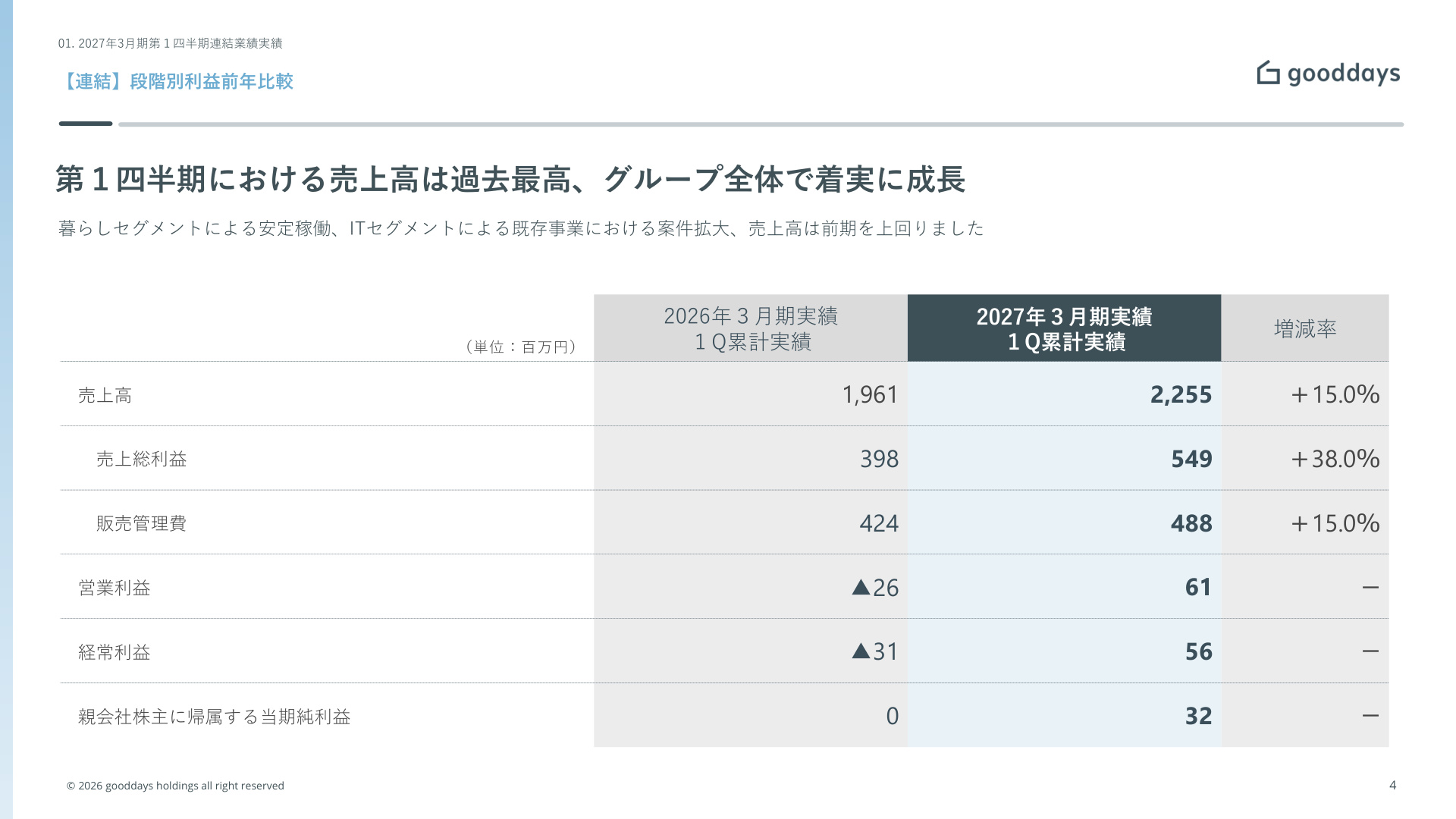
In the first quarter of the fiscal year ending March 2027, consolidated performance reached a record high for a first quarter, with net sales increasing 15.0% year-on-year to 2.255 billion yen. Profitability also saw a dramatic turnaround from the operating loss recorded in the same period last year, achieving a significant return to profitability with an operating profit of 61 million yen, ordinary profit of 56 million yen, and net profit attributable to owners of the parent of 32 million yen.
The following slide illustrates the year-on-year comparison of consolidated profit levels for Q1 FY2027.
[Significance of Slide 3 and Analysis of Performance Drivers]
This slide represents the most symbolic data regarding the dramatic structural change in profitability during the first quarter. In the same period last year (Q1 FY2026), the company recorded an operating loss of 26 million yen on net sales of 1.961 billion yen. However, in the current period, gross profit surged to 549 million yen (+38.0% YoY) alongside the expansion of net sales. By limiting the increase in selling, general, and administrative (SG&A) expenses to 15.0% (488 million yen), the company successfully turned both operating and ordinary profits into significant positive figures.
The two primary factors driving this growth are:
- The increase and stable operation of facilities centered on "goodroom residence" in the Living Segment .
- The expansion of existing client projects in the IT Segment and the progress of stock-based revenue models (recurring service business), such as the "Redx" series.
2. Structural Shift Toward Recurring Service Business
The group is accelerating its company-wide strategy to shift from a business model primarily based on one-off contracts and temporary spot projects to a "recurring service business" that generates stable, stock-based revenue.
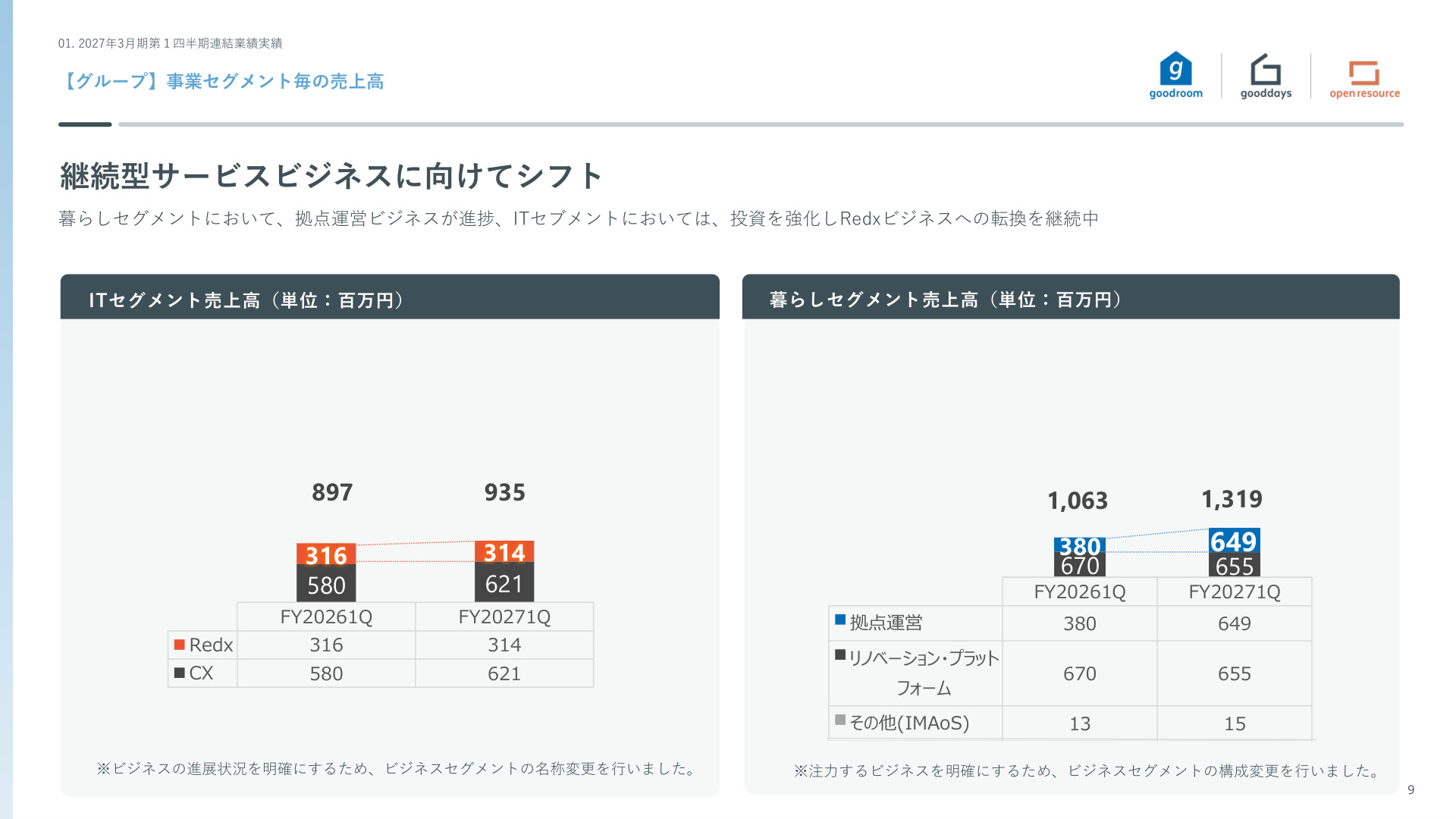
The following slide shows the shift toward recurring service business and the breakdown of net sales across each business segment.
[Significance of Slide 8 and Changes in Segment Structure]
This slide provides crucial performance data that visually confirms the progress of the company's goal to "stock-ify" its revenue base.
-
IT Segment (Net sales: 935 million yen, +4.2% YoY) : Comprised of the "Redx Business" (Net sales: 314 million yen) , which provides front-end platforms for retail and distribution, and the "CX Business" (Net sales: 621 million yen) , which focuses on new system development, maintenance, and automation for finance, distribution, and retail. By promoting business standardization and general-purpose platforms, the company is building a high-margin revenue structure.
-
Living Segment (Net sales: 1.319 billion yen, +24.1% YoY) : The "Facility Operation Business," which provides services such as Co-Living, showed extremely high growth with net sales of 649 million yen (+70.8% YoY). While the renovation platform business (net sales: 655 million yen) remained solid, the proportion of highly recurring facility operations has increased dramatically, providing strong support for the growth of the entire segment.
Note that starting this period, segment names and compositions have been changed to more clearly communicate business progress and focus areas to investors and the market: "User Connect" has been renamed to "CX Business," and "goodroom Solutions" has been renamed to "Facility Operation Business."
3. IT Segment Trends: Promoting Retail DX via Redx
The core strategy of the IT segment, "Redx," is a cloud service that aims to standardize and create common platforms for store front-end areas (such as POS systems) and back-end operations in the distribution and retail industries.
Implementation Cases and Achievements with Major Retailers
- Loft : Achieved the first cloud POS implementation for a large-scale retailer at the major variety store chain, Loft. Rollout is proceeding sequentially to both new and existing stores. Furthermore, the introduction of the "Redx Cloud POS Tax-Free System" has drastically reduced the time required for tax-free procedures from over 10 minutes per transaction to approximately 3 minutes , significantly contributing to staff efficiency and allowing them to focus on customer service.
- Brooks Brothers : Completed implementation across all 67 stores , including direct-managed and department store locations, within approximately eight months. The intuitive UI/UX has reduced training costs for new staff and enabled rapid operational stabilization.
Department Store Standard Model and Ecosystem for Commercial Facilities
- Horizontal Expansion to the Department Store Industry : The "Redx Department Store Standard," developed through a strategic partnership with Mitsukoshi Isetan System Solutions, has been fully implemented at Tobu Department Store and is also complete at Ryubo Department Store . As it becomes established as an industry-standard system, the company plans to evolve it into a "Retail Platform" that anticipates data utilization across retail, commercial facilities, and food services.
- Commercial Facility and Mobile Order Integration : Through a capital and business alliance with Mitsubishi Estate and a joint venture with Skyfarm, the company developed an integrated system linking the mobile order service "NEW PORT" with Redx Cloud POS. Following implementations at "Tokyu Plaza Harajuku Harakado" and "Shibuya Sakura Stage," service is scheduled to launch at "Toranomon Alcea Tower" in November 2025, enabling centralized purchasing data management and real-time marketing for entire commercial facilities.
4. Living Segment Trends: Growth of goodroom residence and Third-Place Expansion
In the Living Segment, the expansion of the "Co-Living" business, which seamlessly connects working environments with living spaces, is yielding remarkable results.
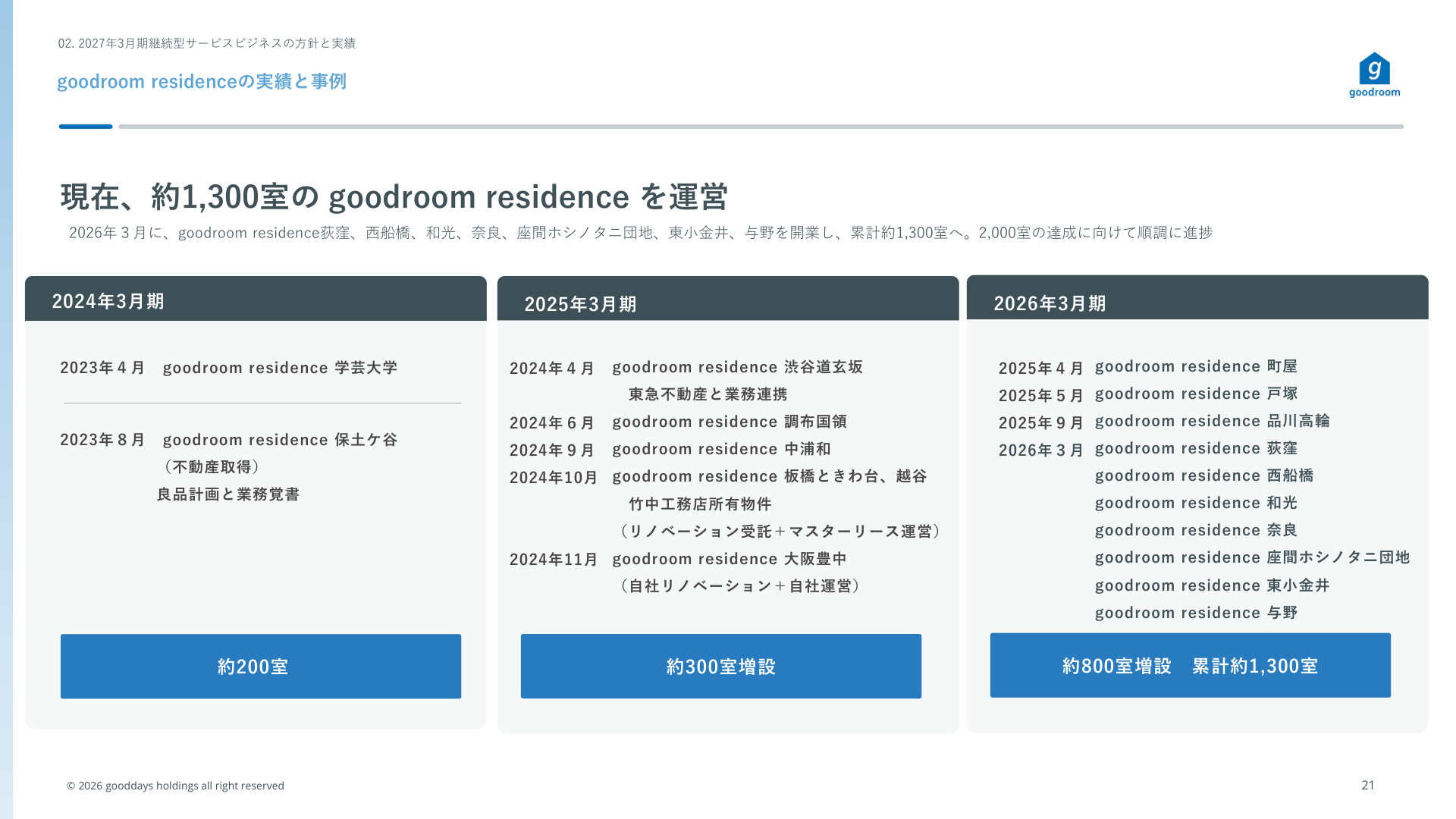
The following slide shows the trend in the number of rooms operated under the core service, "goodroom residence," and its key achievements.
[Significance of Slide 20 and the Trajectory of Facility Expansion]
This slide is vital for demonstrating the pace of business scale expansion for "goodroom residence," the growth engine of the Living Segment.
The company leverages its proprietary renovation technology to revitalize aging employee dormitories and idle real estate, operating them as low-cost, high-value-added residential facilities.
- FY2024 : Started with approximately 200 rooms.
- FY2025 : Added approximately 300 net new rooms through openings in Gakugei-daigaku, Hodogaya, Shibuya Dogenzaka, Chofu Kokuryo, Naka-urawa, Itabashi Tokiwadai, Koshigaya, and Osaka Toyonaka.
- FY2026 (Previous Year) : Expanded to a cumulative scale of approximately 1,300 rooms through sequential openings in Machiya, Totsuka, Shinagawa Takanawa, Ogikubo, Nishifunabashi, Wako, Nara, Zama Hoshinotani Danchi, Higashi-Koganei, and Yono.
High occupancy rates are being maintained through an increase in long-term plan subscribers, showing steady progress toward the company's medium-to-long-term goal of "reaching 2,000 rooms."
Specific Implementation Cases and Lifestyle Proposals
- goodroom residence Shinagawa Takanawa (93 rooms) : Revitalized two former employee dormitories over 60 years old in collaboration with Seibu Real Estate through seismic reinforcement and renovation. It serves as a base for "Minerva University" students, creating a space for international learning and local community interaction.
- goodroom residence Nishifunabashi, Wako, and Nara (200 rooms) : Renovated former Takenaka Corporation employee dormitories. By utilizing an end-to-end scheme covering in-house construction, customer acquisition, and operation, the company has achieved high profitability despite the operational challenges of dormitory-type units without private plumbing and properties in regional cities.
- Expansion of Third-Place and Ancillary Services : The company is promoting brand power and customer touchpoints by integrating living, working, and relaxing. This includes the opening of "goodcoffee" cafes (Aoyama, Shimbashi, Toyocho, Gakugei-daigaku), the planned opening of the stay-type spa facility "goodsauna & spa SAPPORO" within the "COCONO SUSUKINO" complex in Sapporo (scheduled for November 2025), and the development of "goodroom lounge Yokohama Bashamichi" utilizing historical buildings.
5. Future Business Policy and Full-Year Earnings Outlook
Business Policy by Segment
- IT Segment : In the Redx business, the company will horizontally expand the standard model established in the department store industry to all other retail formats and begin standardizing and unifying the back-end area. In the future, it aims to evolve into an "AI Platform" that aggregates and utilizes accumulated data. In the CX business, the company will fuse the knowledge gained in finance with the retail business to promote the standardization of common areas.
- Living Segment : In the Facility Operation Business, the company will achieve further low-cost operations by expanding the introduction of unmanned services and strengthening CX for users. In the renovation business, it will strongly promote the grouping of construction partners and the acquisition of large-scale properties.
FY2027 Consolidated Earnings Forecast
Regarding the full-year consolidated earnings forecast for the fiscal year ending March 2027, the company has made a steady start toward the plan announced at the beginning of the period (Net sales: 11.55 billion yen, Operating profit: 933 million yen). The record-high net sales and the return to profitability in the first quarter demonstrate that the company's shift toward a stock-based "recurring service business" is steadily yielding results.
This content is not intended as investment advice or a recommendation. Any opinions expressed are solely the personal views of each article.