


Himacs (4299) Q1 FY2027 Earnings & Mid-Term Management Plan 'Re:Growth2028' Detailed Report

StockClub
Published: Aug 14, 2026, 10:59 AM
Sentiment Analysis

1. Executive Summary & Earnings Highlights
The Q1 FY2027 earnings report for Himacs, Ltd. (Securities Code: 4299) clearly reflects a phase of expanding revenue scale alongside aggressive investment aimed at future re-growth.
In this first quarter, net sales reached 5,124 million yen (+15.0% YoY) , achieving double-digit growth. This was driven by steady order intake in existing businesses and the consolidated contribution of CoreSoft Co., Ltd. , which was newly acquired as a subsidiary. Conversely, operating profit was 232 million yen (-1.2% YoY) , ordinary profit was 234 million yen (-1.3% YoY) , and quarterly net profit was 149 million yen (-7.0% YoY) , representing a slight decline compared to the same period last year.
The pressure on profits stems from intentional upfront investments as part of the inaugural year of the mid-term management plan 'Re:Growth2028,' including human capital investment , security investment , goodwill amortization , and an increase in business partner (BP) unit costs .
2. Detailed Analysis of Profit Structure and Operating Profit Variance
A detailed look at the Q1 income statement shows that gross profit grew steadily to 1,049 million yen (+19.1% YoY) in line with the increase in net sales. However, selling, general and administrative (SG&A) expenses rose to 817 million yen (+26.5% YoY) , weighing on overall profitability.
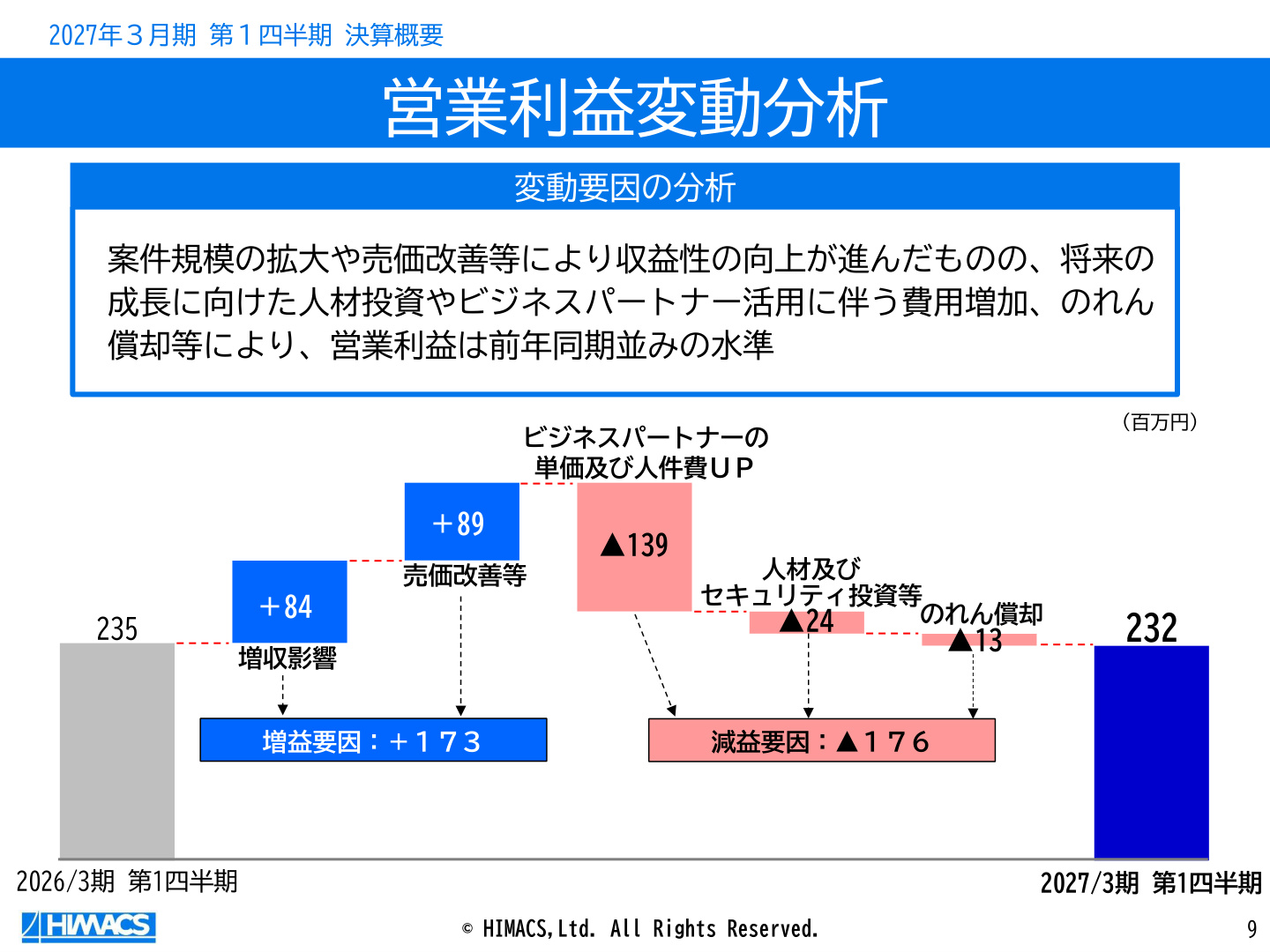
The slide below provides a detailed analysis of the factors behind the change in operating profit from the same period last year (Q1 FY2026) to the current period (Q1 FY2027).
[Slide Commentary: The Importance of Operating Profit Variance Analysis]
This slide provides a quantitative and structural answer to the question: "Why did operating profit remain flat at 232 million yen (-1.2% YoY) despite a 15.0% increase in net sales?"
- Factors for Profit Increase (Total +173 million yen):
- Revenue Growth Impact (+84 million yen): Sales growth driven by the consolidation of CoreSoft and project expansion across segments.
- Price Improvements, etc. (+89 million yen): Improved gross margin through larger project scales, successful unit price negotiations, and the mitigation of unprofitable projects.
- Factors for Profit Decrease (Total -176 million yen):
- BP Unit Costs and Personnel Expenses (-139 million yen): Rising procurement costs for business partners due to IT talent shortages and increased personnel costs for internal staff.
- Human Capital and Security Investment, etc. (-24 million yen): Costs for training talent to handle advanced technologies like AI and strengthening internal security infrastructure.
- Goodwill Amortization (-13 million yen): Accounting amortization of goodwill resulting from the CoreSoft acquisition.
This analysis reveals that the suppression of operating profit is not due to business deterioration, but rather a structure where "improved earning power through price optimization" is being offset by "investments in talent/technology for future growth" and "increased BP costs."
3. Sales Trends by Service Field, Customer, and Industry
(1) Sales by Service Field: Phase Transition from SSS to SMS
- System Solution Service (SSS): 1,567 million yen (-6.9% YoY)
- System Maintenance Service (SMS): 3,557 million yen (+28.4% YoY)
The primary reason for the decline in SSS (planning, design, and development phase) is that development projects for SIers have smoothly transitioned into the maintenance phase (SMS) . In the SMS segment, the combination of customer base retention, the contribution of CoreSoft, and the expansion of SIer-related projects led to a robust 28.4% growth.
(2) Sales by Customer: Dramatic Expansion in End-User Domain
- Sales to SIers: 3,199 million yen (+3.6% YoY)
- Sales to End-Users: 1,924 million yen (+40.8% YoY)
Notably, sales to end-users (direct transactions) surged by 40.8% YoY . This is the result of successfully acquiring and expanding projects with food manufacturers (non-financial sector) and the contribution of CoreSoft. Consequently, the ratio of end-user sales to total revenue has risen to 37.6% (up from 30.7% in the same period last year), indicating steady progress toward a high-profit model.
(3) Sales by Industry: Growth in Both Financial and Non-Financial Sectors
- Financial Sector: 3,276 million yen (+11.1% YoY) (Banking +2.4%, Securities +46.6%, Insurance +9.2%, Credit +12.6%)
- Non-Financial Sector: 1,847 million yen (+22.8% YoY) (Public +16.2%, Distribution -9.5%, Other IT companies +34.3%)
The company is achieving balanced growth across all industries, with the securities, other IT companies, and public sectors driving performance.
4. Trends in Order Intake and Backlog
Order trends, a leading indicator of future sales, remain extremely positive.
- Q1 Order Intake: 4,705 million yen (+12.1% YoY)
- Q1 Order Backlog: 3,393 million yen (+4.9% YoY)
Within the order backlog, end-user projects increased significantly to 1,645 million yen (+143 million yen from the end of the previous fiscal year) , forming a solid backlog to support performance from the second half onward. By industry, both financial (2,319 million yen) and non-financial (1,074 million yen) backlogs have increased since the end of the previous year.
5. Mid-Term Management Plan 'Re:Growth2028' and Growth Strategy
Himacs has set a long-term vision of "shifting to a high-profit model involving upstream processes" and has launched a new three-year mid-term management plan, 'Re:Growth2028.' This plan is positioned as an "investment phase" for future profit growth, cycling through four pillars: "Business Strategy," "Human Capital Strategy," "Investment Strategy," and "ESG Strategy."
Core Strategy: "Utilization of AI"
The key point of this mid-term plan is the comprehensive utilization of AI . The company has set two clear goals:
- Transition all projects to AI-driven development: Incorporating AI into development processes to achieve overwhelming productivity and quality improvements.
- Commercialization of AI solutions: Developing and proposing proprietary AI products (such as AI for automating system infrastructure construction processes) to create new revenue streams.
Financial/Investment Strategy and Cash Allocation
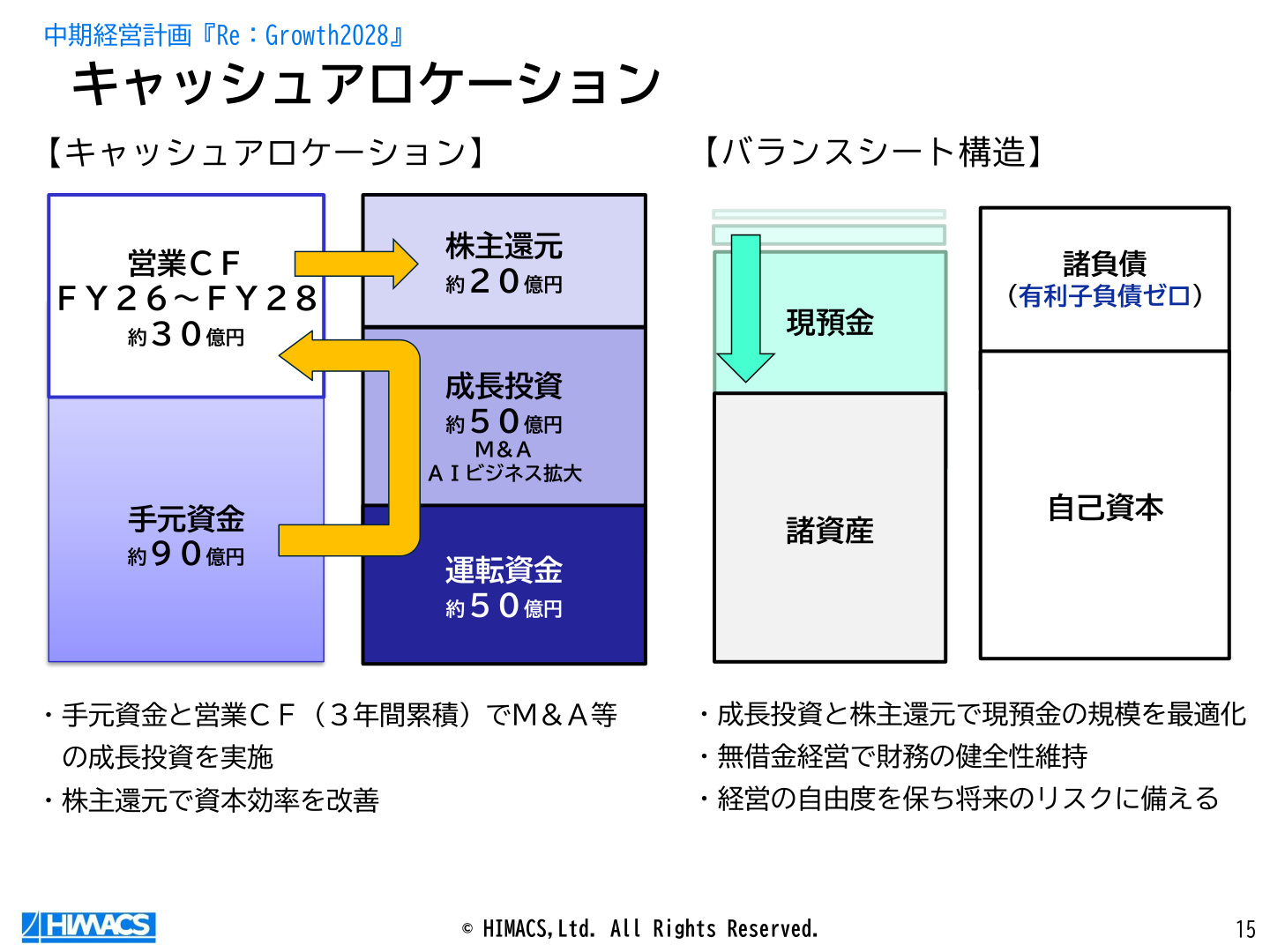
To realize future re-growth, the company has formulated an aggressive capital allocation plan utilizing its strong financial base. The slide below illustrates its cash allocation policy .
[Slide Commentary: Strategic Significance of Cash Allocation and Balance Sheet]
This slide visualizes the company's philosophy on capital efficiency and financial health regarding "how it will raise and where it will invest" over the next three years.
- Funding Sources: Utilizing three years of operating cash flow (approx. 3 billion yen) and existing cash on hand (approx. 9 billion yen) .
- Growth Investment (approx. 5 billion yen): Concentrated allocation toward M&A (following CoreSoft), AI-related investments, and human capital investment.
- Shareholder Returns (approx. 2 billion yen): Continuing stable profit returns and aiming to improve capital efficiency (ROE).
- Balance Sheet Structure: Maintaining a debt-free management status while optimizing cash and deposits to ensure management flexibility while preparing for future risks.
Instead of simply hoarding cash, the company demonstrates a dynamic stance of directing cash on hand and operating CF toward "growth investment (5 billion yen)" and "shareholder returns (2 billion yen)."
6. Full-Year Earnings Forecast and Dividend Policy
(1) FY2027 Full-Year Earnings Forecast
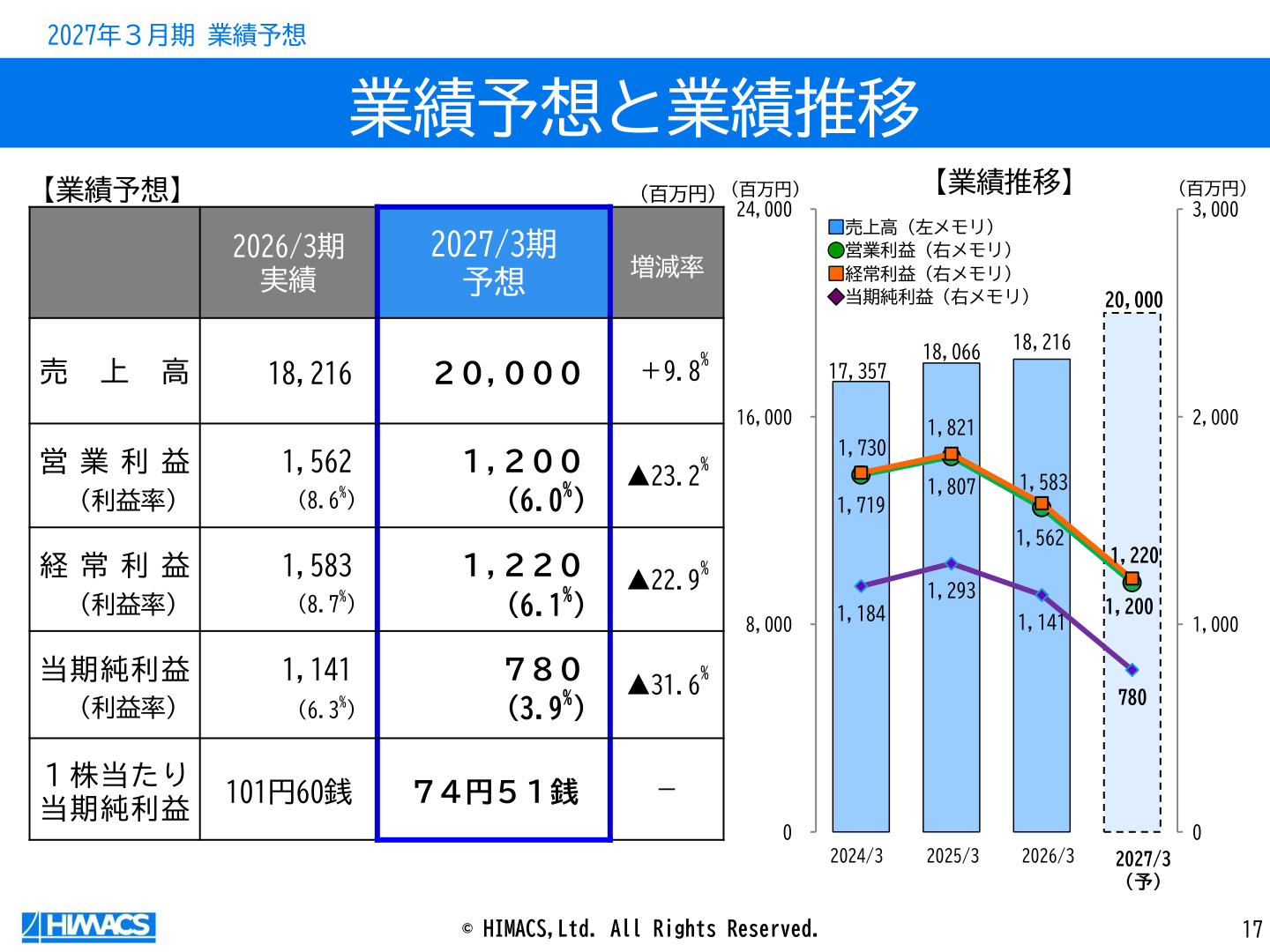
Himacs' full-year earnings forecast for the current fiscal year is as follows:
[Slide Commentary: Positioning of Full-Year Forecast and Performance Trends]
This slide clearly reflects the company's sales growth momentum and the fact that the current fiscal year is an "upfront investment phase."
- Net Sales: 20,000 million yen (+9.8% YoY) - A plan for consecutive growth aiming to reach the 20 billion yen milestone.
- Operating Profit: 1,200 million yen (-23.2% YoY) - Profit margin slowing from 8.6% in the previous year to 6.0%.
- Ordinary Profit: 1,220 million yen (-22.9% YoY)
- Net Profit: 780 million yen (-31.6% YoY)
- Earnings Per Share (EPS): 74.51 yen
As the graph on the right shows, while net sales continue to trend upward (17,357m → 18,066m → 18,216m → 20,000m), the profit side is planned as a temporary "plateau (investment period)" due to heavy upfront investments in personnel, AI, and goodwill amortization.
(2) Shareholder Returns (Dividends)
Despite the profit decline forecast due to upfront investments, the company maintains a very proactive policy regarding shareholder returns.
- Annual Dividend: 51 yen per share (+5 yen increase YoY)
- Interim Dividend: 28 yen (including a 5 yen 50th-anniversary commemorative dividend )
- Year-end Dividend: 23 yen
- Expected Dividend Payout Ratio: 68.4% (Significantly exceeding the basic policy of a "consolidated payout ratio of 40%")
The company also continues its shareholder benefit program , offering social contribution-type QUO cards based on the number of shares held.
7. Summary and Comprehensive Analysis
A comprehensive analysis of Himacs' Q1 FY2027 earnings and future plans can be summarized in three points:
- Steady Top-Line Expansion: Driven by the successful M&A of CoreSoft and the growth of direct end-user transactions (+40.8%), net sales grew by 15.0% YoY, putting the company on track to reach its 20 billion yen annual sales target.
- Intentional Upfront Investment for Structural Reform: The projected profit decline for the current fiscal year is due to positive investments—such as the shift to AI-driven development, human capital investment, security strengthening, and goodwill amortization—necessary to ensure the success of the 'Re:Growth2028' mid-term plan.
- Shareholder-Oriented Stance and Sound Finances: Backed by the financial stability of a debt-free management, the company is realizing high shareholder returns of 51 yen per year (68.4% payout ratio) while investing 5 billion yen in growth over three years.
In exchange for short-term profit margin suppression, the company is steadily pushing forward with a transformation into a high-profit structure characterized by "AI-driven development" and an "increased end-user ratio," which defines the company's current position.
This content is not intended as investment advice or a recommendation. Any opinions expressed are solely the personal views of each article.