


AsiaQuest (4261) H1 FY2026 Earnings Report: Profit Decline Due to Lower Utilization and Upfront Investment, Leading to Full-Year Guidance Revision

StockClub
Published: Aug 14, 2026, 10:58 AM
Sentiment Analysis

AsiaQuest Co., Ltd.'s financial results for the first half of the fiscal year ending December 2026 showed a slight increase in revenue; however, the company faced a significant decline in operating profit due to lower engineer utilization rates and various upfront investments. Consequently, the company has announced a downward revision to its full-year earnings forecast, reflecting both lower revenue and profit.
This report provides a multi-faceted analysis of the quarterly highlights, the structural factors behind the profit decline and forecast revision, changes in engineer hiring policies, the introduction of a shareholder benefit program, and the company's mid-to-long-term growth strategy.
1. H1 FY2026 Earnings Overview
For the first half of the fiscal year, the company reported revenue of 2,471 million yen (+2.4% YoY), operating profit of 6 million yen (-97.0% YoY), ordinary profit of 10 million yen (-95.2% YoY), and a net loss attributable to owners of the parent of -10 million yen (compared to a profit of 138 million yen in the same period last year).
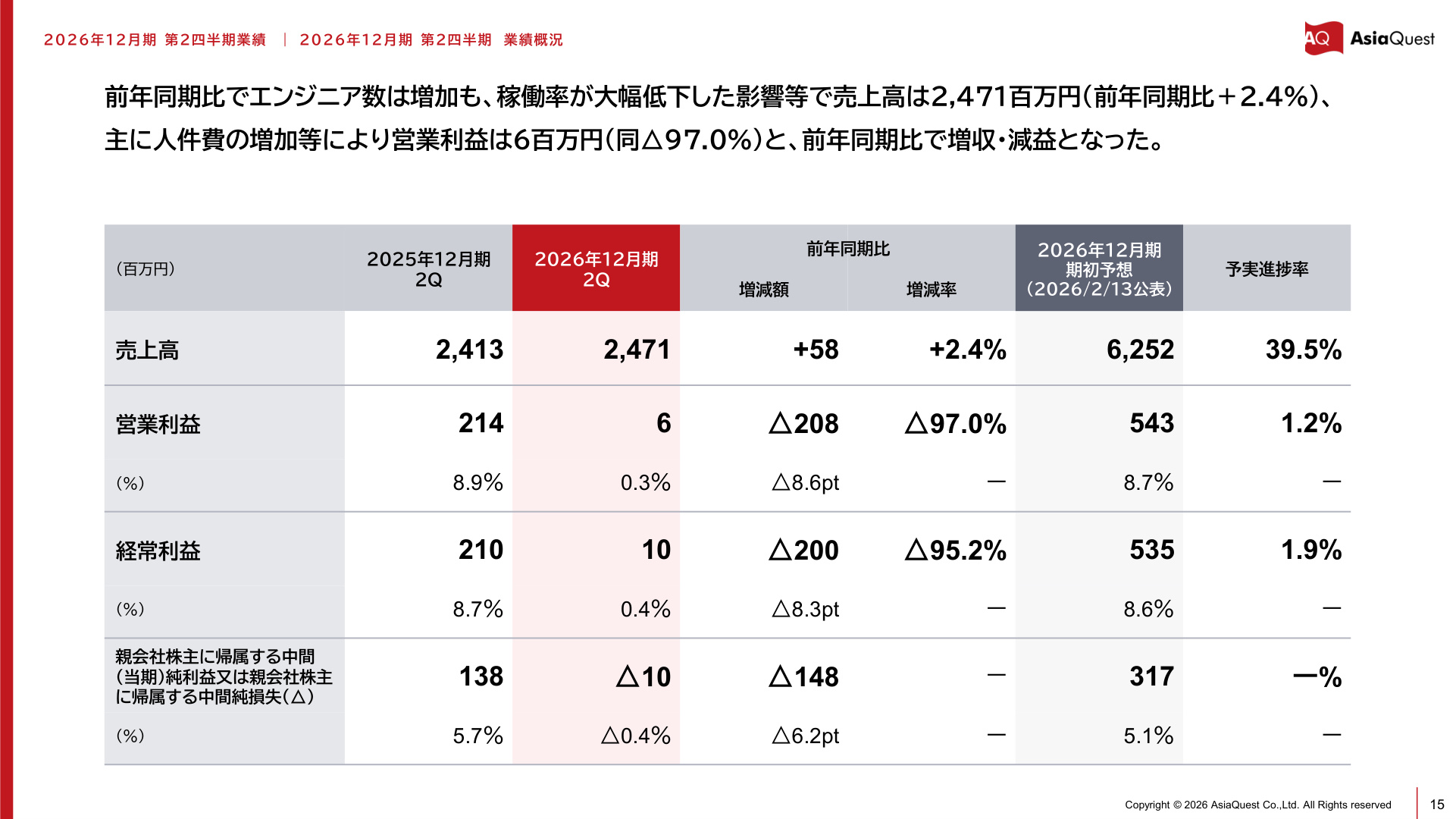
As shown above, while revenue slightly exceeded the previous year's level, maintaining a record high, profitability declined significantly across all metrics. The progress rate against the initial full-year plan stands at 39.5% for revenue and only 1.2% for operating profit, marking a challenging conclusion to the first half.
2. Analysis of Factors Behind the Significant Operating Profit Decline
The decline in operating profit from 214 million yen in the same period last year to 6 million yen is attributed to a combination of rising costs and sluggish revenue growth.
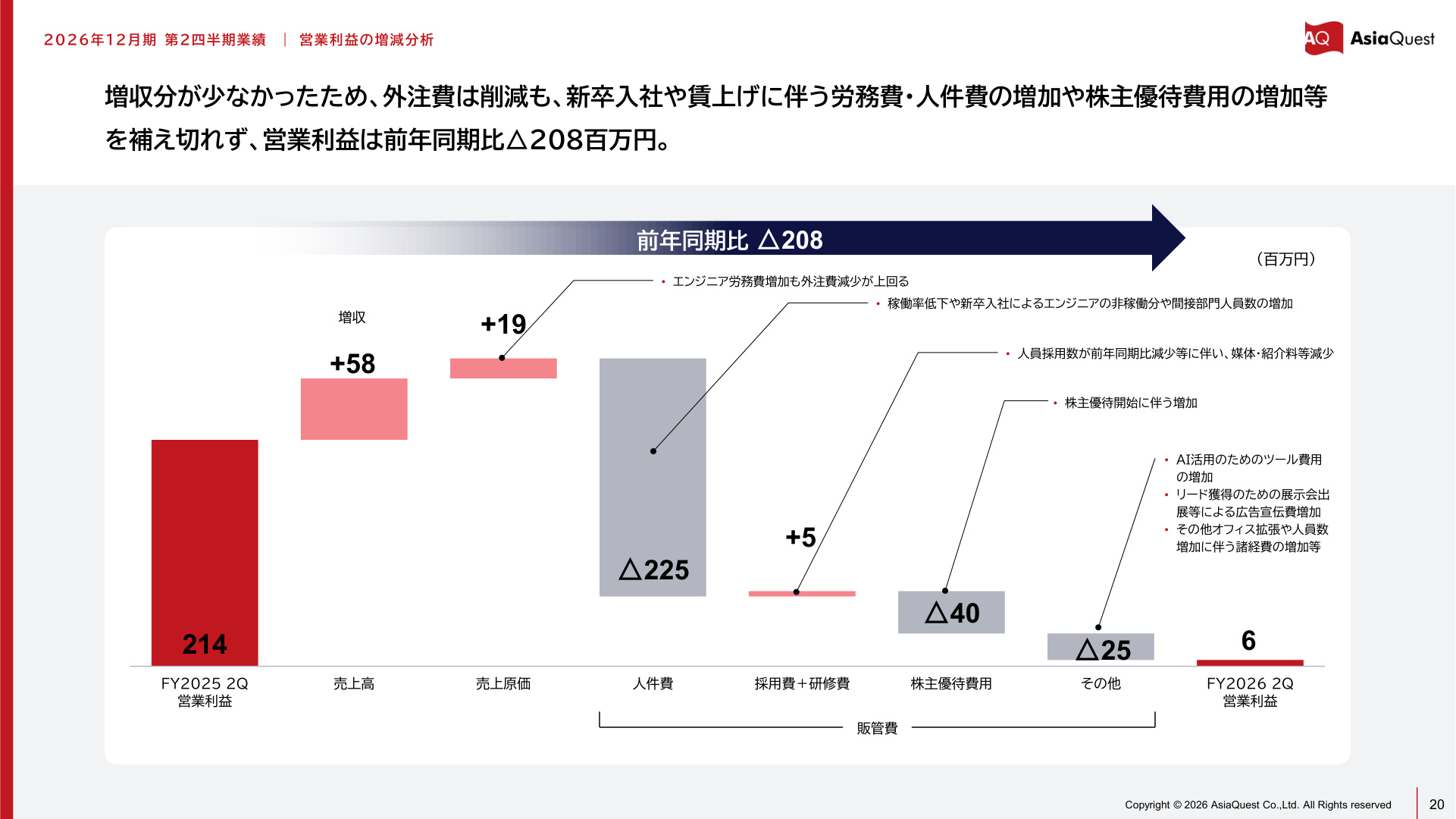
This waterfall chart clearly illustrates the specific factors and financial impact that pressured profits:
- Increase in Personnel and Labor Costs (-225 million yen) : The baseline for personnel costs rose significantly due to the hiring of 38 new graduate engineers and salary increases for existing staff. Meanwhile, the completion or downsizing of certain large-scale projects, delays in the start of replacement projects, and the strategic shift of engineers to the AI specialized department resulted in non-billable time for some engineers. Fixed personnel costs impacted profits while revenue growth failed to keep pace.
- New Shareholder Benefit Expenses (-40 million yen) : In line with the newly established shareholder benefit program aimed at enhancing shareholder returns, 40 million yen in benefit-related expenses were newly recorded under SG&A expenses this quarter.
- Increase in AI Investment and Promotional/Miscellaneous Expenses (-25 million yen) : Costs increased due to AI tool subscription fees to accelerate company-wide AI adoption, advertising and promotional expenses for trade shows aimed at lead generation, and expenses related to office expansion.
The positive impact of revenue growth (+58 million yen), reductions in cost of sales (subcontracting costs) (+19 million yen), and savings in recruitment/training expenses (+5 million yen) were insufficient to absorb these cost increases, resulting in significant profit pressure.
3. Downward Revision of FY2026 Full-Year Earnings Forecast
Based on the slow progress in the first half and current market conditions, the company has announced a downward revision to its full-year earnings forecast for the fiscal year ending December 2026.
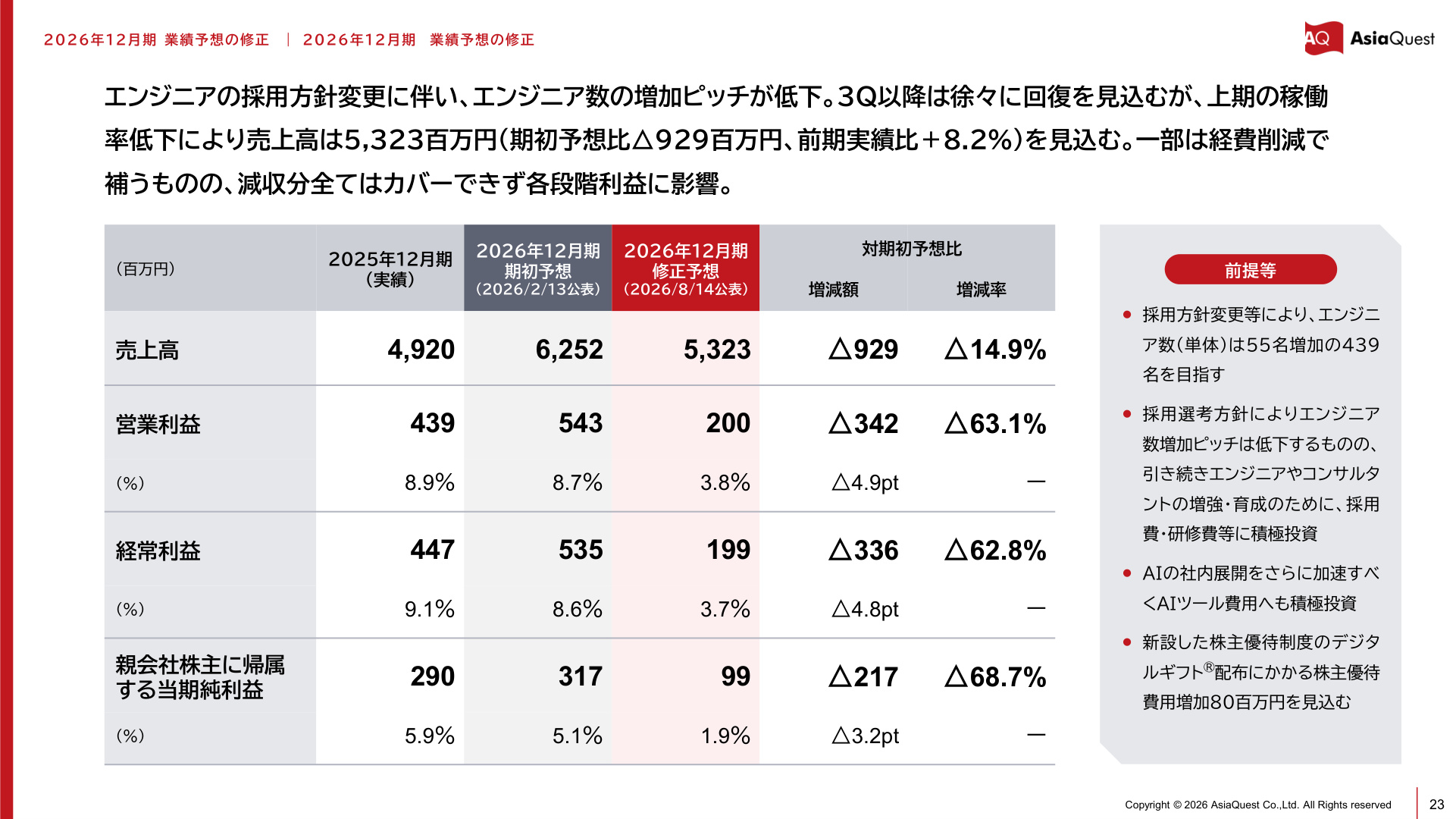
Under the revised plan, the company expects revenue of 5,323 million yen (-14.9% vs. initial forecast, +8.2% YoY), operating profit of 200 million yen (-63.1% vs. initial forecast, -54.4% YoY), ordinary profit of 199 million yen (-62.8% vs. initial forecast, -55.5% YoY), and net income of 99 million yen (-68.7% vs. initial forecast, -65.9% YoY).
This revision reflects the inability to fully recover from the lower utilization rates in the first half and a partial review of the pace of engineer recruitment and staffing plans. While the company expects a gradual recovery in utilization rates from the third quarter onwards due to a growing pipeline of inquiries, it has determined that achieving the initial plan is no longer feasible.
4. Shift in Engineer Structure and Hiring Policy
The number of engineers, which forms the company's business foundation, reached 431 at the end of the second quarter (+47 YoY).
While the initial plan aimed for 470 engineers by the end of FY2026, the company has adopted a more cautious pace of expansion by tightening selection criteria and temporarily curbing some hiring in anticipation of the full-scale AI era. The revised year-end target has been set at 439 , an increase of 55 from the previous year-end. The strategy has shifted from simple headcount expansion to the careful selection and development of high-skilled talent capable of navigating the AI era .
5. Changes in Customer Base and Transaction Structure
The company boasts high customer stickiness, with a repeat rate exceeding 80% . However, this quarter saw changes in the composition of large-scale projects due to shifts in customer investment timing and project reviews.
The proportion of projects with semi-annual revenue of 20 million yen or more in the domestic standalone business fell from 81% to approximately 75% compared to the same period last year. Notably, the share of the largest projects (50 million yen or more) shrank from 56% to 47%. This reduction and the delay in the start of these large-scale projects directly contributed to the lower utilization rate. The challenge moving forward is to convert the accumulated pipeline into actual orders and re-accelerate the utilization of large-scale accounts.
6. Establishment of Shareholder Benefit Program and Shareholder Returns
The company has introduced a shareholder benefit program to increase the appeal of its stock and encourage long-term holding.
- Eligibility : Shareholders who have continuously held 300 shares or more for at least one year as of the end of June and December each year.
- Benefits : Digital gifts worth 50,000 yen every six months, for a maximum of 100,000 yen per year .
- Financial Impact : The company expects 80 million yen in benefit-related expenses for the full fiscal year 2026 (equivalent to approximately 28% of the 2025 consolidated net income).
The number of shareholders increased to 1,408 by the end of 2025 following this introduction. While it acts as an increase in SG&A expenses in the short term, it is positioned as a measure to stabilize the shareholder base.
7. Financial Soundness
Despite challenges in profitability, the company maintains a high level of balance sheet health. As of the end of the second quarter, total assets stood at 2,854 million yen , with net assets of 1,951 million yen . The company holds 1,425 million yen in cash and deposits, maintaining a robust financial position with an equity ratio of 68.3% (+1.1 percentage points from the previous year-end). With sufficient liquidity, the company retains the capacity to continue investing in technology and human resources to support future recovery.
8. Business Model and Future Growth Story
Unlike vendors specializing in a single IT technology, AsiaQuest positions itself as a "Digital Composite Integrator" that combines consulting , modernization (infrastructure building) , and AI integration .
As the market rapidly shifts from the "Second Platform" (traditional SIer focusing on legacy system maintenance) to the "Third Platform" (centered on cloud, AI, IoT, and data infrastructure), the company is establishing its position as an " AI Integrator " that leads the social implementation of AI technology.
The growth scenario for future earnings recovery consists of the following pillars:
- Normalization of Utilization Rates : Commencing delayed large-scale projects and steadily securing new inquiries.
- Monetization of AI Specialized Domains : Providing high-value-added solutions through engineers reassigned to the AI specialized department.
- Expansion of Technical Domains and Consulting : Increasing revenue per customer through end-to-end support starting from upstream processes.
- Expansion of Alliances and Overseas Business : Leveraging bases in Indonesia and Malaysia to drive global expansion.
While the company is currently in a "crouching" phase due to personnel shifts and investments, it is restructuring its organization to ensure it captures the growing demand for AI and DX.
This content is not intended as investment advice or a recommendation. Any opinions expressed are solely the personal views of each article.