


Kaizen Platform Q2 FY2026 Earnings Deep Dive: The 'Magical UX' Strategy and H2-Weighted Performance Structure

StockClub
Published: Aug 14, 2026, 10:54 AM
Sentiment Analysis

Kaizen Platform Q2 FY2026 Earnings Deep Dive Report
Kaizen Platform, Inc. (Securities Code: 4170) reported its financial results for the second quarter of the fiscal year ending December 2026 (January–June 2026). The results reflect a temporary decline in earnings, with revenue of 2,043 million JPY (down 4.8% YoY) and an operating loss of 117 million JPY , primarily due to the discontinuation of overseas operations and the deferral of production and marketing projects.
However, the company’s consulting and development projects centered on its "Magical UX" strategy are growing steadily. The company’s business structure is designed for significant profit concentration in the second half (H2) , driven by the acquisition of large-scale projects. This report provides a detailed analysis of the financial figures, the macro environment of the customer-facing DX market, the company's unique solution architecture, and its future growth strategy.
1. Q2 FY2026 Performance Highlights and Factor Analysis
First, we review the consolidated financial results for the first half of the fiscal year and the progress against the full-year forecast.
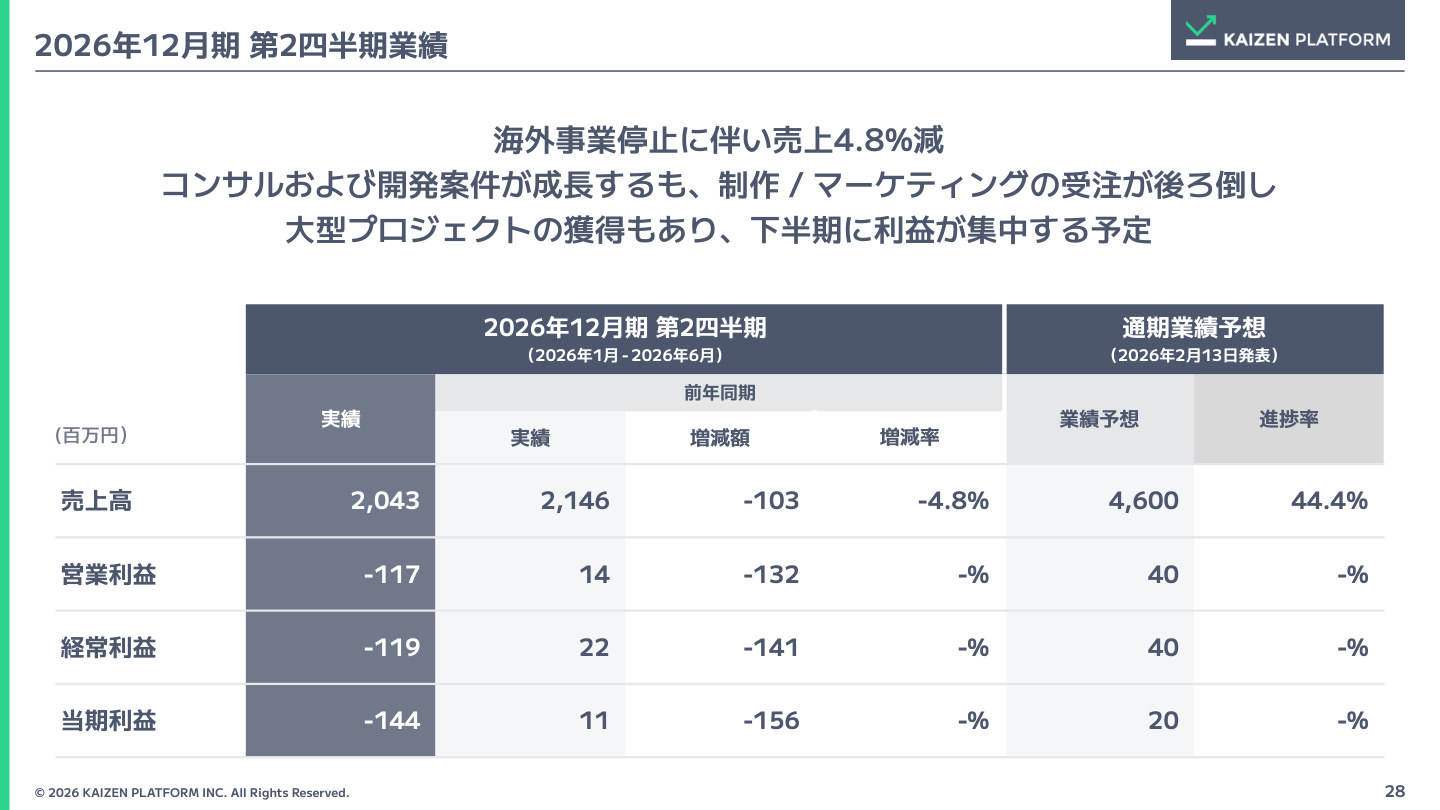
[Financial Summary]
- Revenue : 2,043 million JPY (down 4.8% YoY ; 2,146 million JPY in the same period last year)
- Operating Profit : -117 million JPY (compared to a profit of 14 million JPY in the same period last year)
- Ordinary Profit : -119 million JPY (compared to a profit of 22 million JPY in the same period last year)
- Net Profit Attributable to Owners of Parent : -144 million JPY (compared to a profit of 11 million JPY in the same period last year)
[Progress Against Full-Year Plan and Background]
The progress rate for revenue against the full-year forecast ( 4,600 million JPY revenue, 40 million JPY operating profit) stands at 44.4% as of the end of Q2. While the figures may appear challenging at first glance, there are three objective factors behind this performance:
- Discontinuation of Overseas Operations : The cessation of the US subsidiary’s video solution business (as of the end of March 2026) led to a decline in the top line compared to the previous year.
- Deferral of Orders : Due to the prolonged decision-making processes of client companies, orders in the production and digital marketing sectors were pushed into the second half of the year.
- H2-Weighted Large-Scale Project Pipeline : Conversely, upstream consulting and system development projects are progressing well, with project acquisitions and final inspections expected to concentrate in the second half.
For these reasons, the ramp-up of large-scale projects and the delivery of deliverables in H2 are critical to achieving the full-year targets.
2. Macro Environment and Market Opportunity: Labor Shortages and DX Market Expansion
Two major structural changes are currently underway in the market environment surrounding the company.
① The Gap Between Severe Labor Shortages and 'Generative AI Adoption Rates'
According to labor supply-demand simulations in Japan, a shortage of approximately 11 million workers is projected by 2040 . Declining service levels at customer touchpoints—such as call center wait times, bottlenecks in administrative centers, and lost sales opportunities—have become significant issues. Meanwhile, Japan's generative AI adoption rate in business remains at only 32% , the lowest among 31 countries and regions surveyed. This indicates that DX and AI utilization to compensate for labor shortages are severely insufficient, representing a massive latent opportunity in 'Customer-Facing DX'.
② Rapid Growth of the Customer-Facing DX Market
The 'Customer-Facing DX Market' (sales, marketing, and customer service sectors), which is the company's core target, is projected to grow from 675.6 billion JPY in 2024 to 1.097 trillion JPY by 2030 (within a total Digital Deep Transformation market of 5.5 trillion JPY). IT investment aimed at maximizing LTV (Lifetime Value) is accelerating, particularly among large enterprises.
3. The 'IT Infrastructure Wall' Faced by Large Enterprises and Kaizen Platform's Solutions
When promoting customer-facing DX and generative AI adoption, many Japanese companies hit the 'IT Infrastructure Wall.'
- Technical Debt from SaaS/ASP : Systems are fragmented by service, leading to siloed data and customer experiences.
- SIer Dependency and Lack of Customization : Due to the specifications of core systems and external forms (bank loan screening, hotel booking engines, EC carts, etc.), UI/UX modifications require enormous costs and time.
- Lack of Defensive IT Investment : Resources are consumed by maintaining existing systems, lowering the priority of new feature implementation and UX improvements.
To address this, the company provides technical solutions that improve UX and integrate advanced technologies like generative AI 'without touching the existing system, simply by adding a tag.'
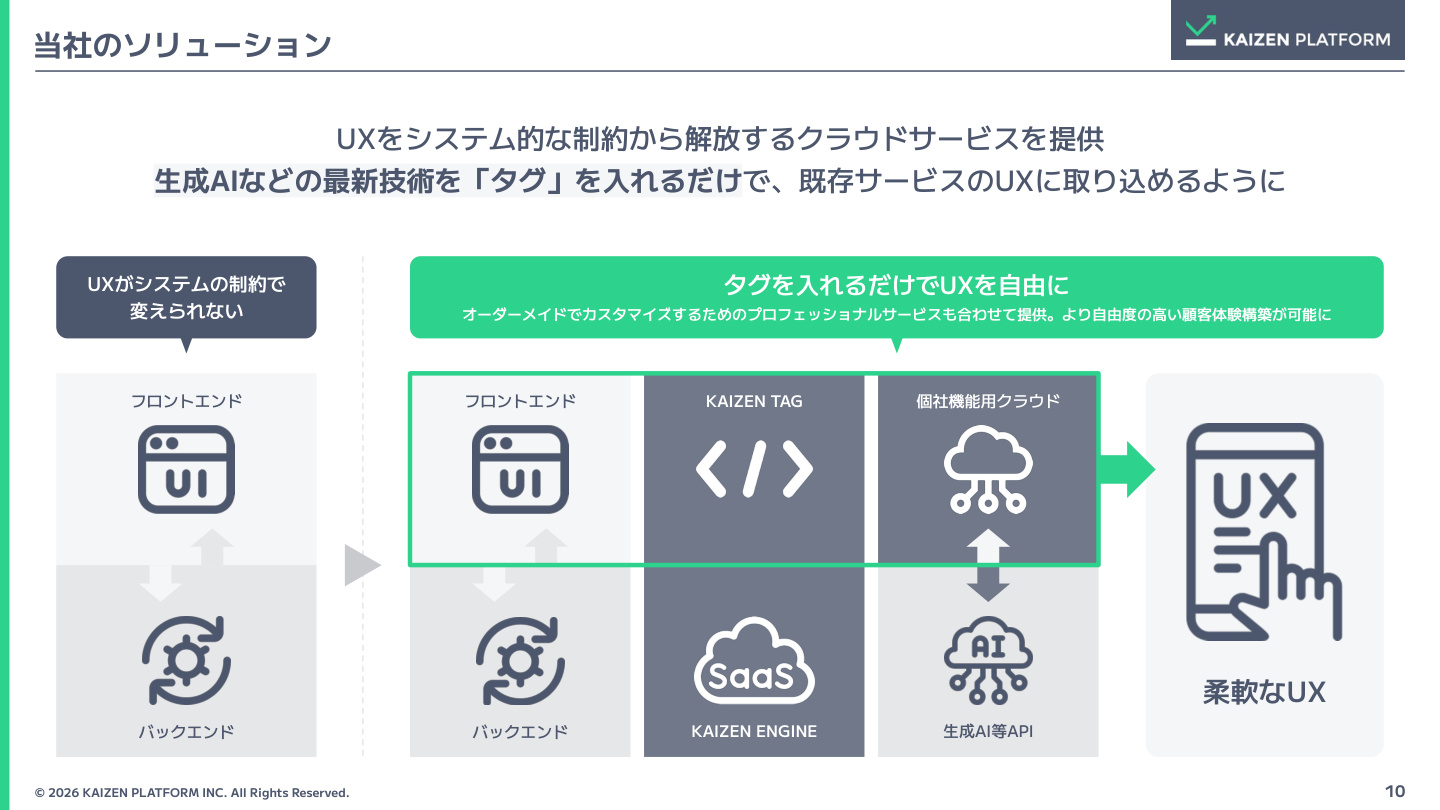
[Slide Commentary: Solution Mechanism and Value]
The slide above illustrates the mechanism of Kaizen Platform's core technologies: 'KAIZEN TAG' and 'Kaizen Cloud Service.' Traditional SI methods require modifying core systems from the frontend to the backend, costing tens to hundreds of millions of yen and requiring development lead times of 6 to 12 months or more. However, with the company's approach, embedding a single line of code in the frontend connects the 'KAIZEN ENGINE' and 'Kaizen AI Cloud' (an LLM integration platform for GPT, Claude, Gemini, etc.). This allows for a small-start approach to frontend UI/UX improvements, AI-driven personalization, and chatbot implementation in a short period of 2–3 months at a low cost , completely avoiding the risks associated with modifying legacy systems.
4. Unique Strengths and High-Profit Business Model
The reason the company continues to be chosen by major enterprises (Amazon, Google, NTT East, KDDI, Mitsui Sumitomo Insurance, etc.) lies in its unique business model and resource procurement capabilities.
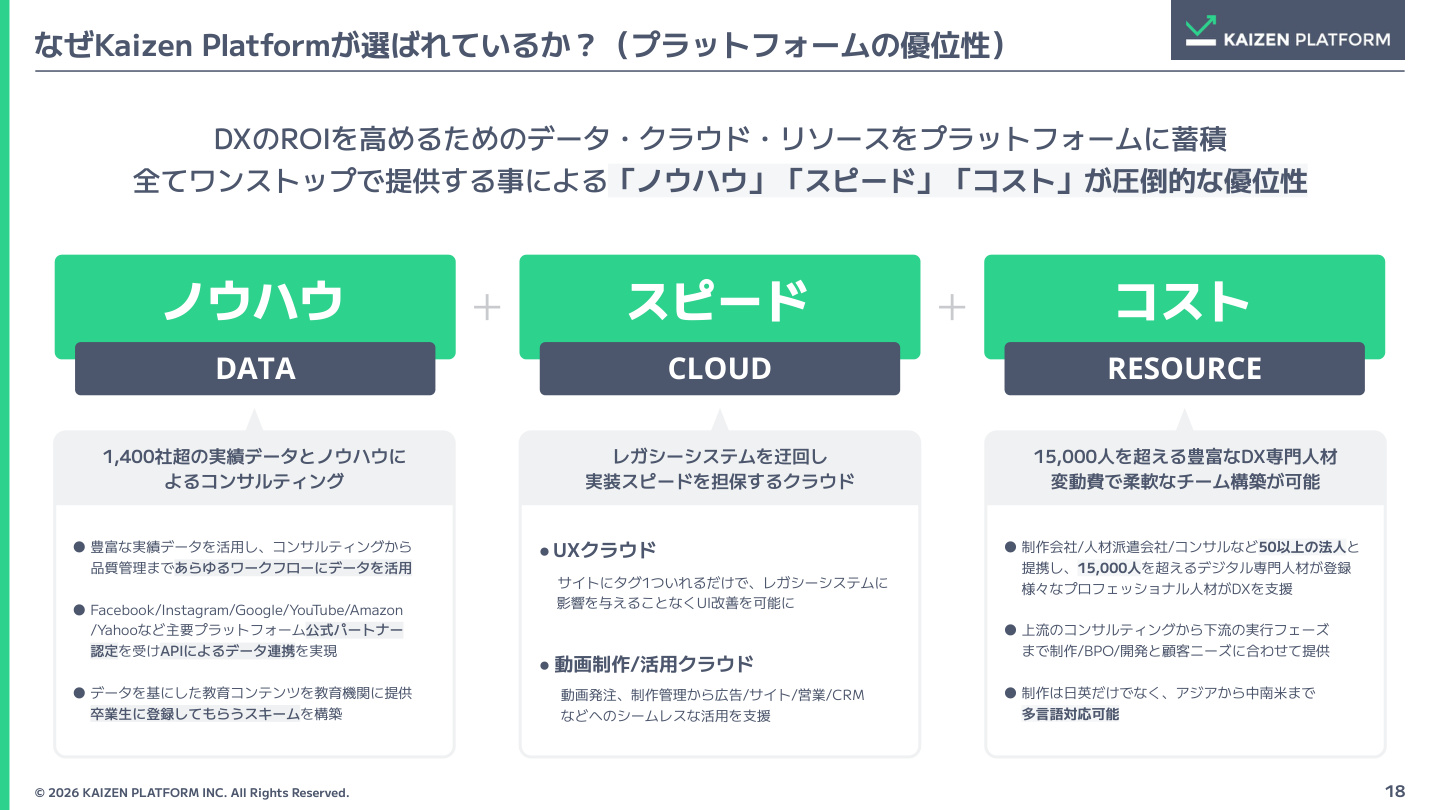
[Slide Commentary: Three Competitive Advantages of the Platform]
The slide above summarizes the company's competitive advantages across three axes: 'Know-how,' 'Speed,' and 'Cost.'
- Know-how (DATA) : Accumulated data and experience from over 1,400 UX improvement projects . As an official partner of major platforms (Meta, Google, Yahoo, etc.), the company conducts data-driven consulting.
- Speed (CLOUD) : As mentioned, the company possesses a cloud platform that bypasses legacy systems to instantly rewrite UI/UX.
- Cost (RESOURCE) : Built a network of over 15,000 highly skilled DX professionals (growth hackers and consultants) . By adopting a 'variable cost model' that assigns the optimal team per project rather than maintaining a massive permanent workforce, the company ensures high productivity.
This structure establishes a high-value-added business model that keeps fixed costs low while achieving a high take rate (gross margin) exceeding 50% per project.
5. Recent Topics and the Expansion of 'KAIZEN ENGINE for Extension'
The company has begun expanding the technology cultivated in the 'CX (Customer Experience)' domain—such as websites and apps—into the 'EX (Employee Experience)' domain, covering internal operations and employee experiences.
[Launch of New Feature: 'KAIZEN ENGINE for Extension']
In July 2026, the company announced a new solution that uses Chrome extensions to overlay AI onto business screens.
- Overview : For internal core systems and SaaS where AI adoption is stalled due to system modification constraints, this solution provides AI features like summarization, generation, and operation assistance via browser extensions.
- Implementation Speed : Since there is zero impact on the core system, a small start is possible in about 1–1.5 months .
- Effect : Through the accumulation/analysis of operation logs and A/B testing, the tacit knowledge of high-performers is converted into AI workflows, improving organizational productivity and reducing lead times.
By expanding its service domain from CX to EX, the company aims to increase ARPU (Average Revenue Per User) and accelerate cross-selling.
6. Growth Strategy and Future Outlook
Kaizen Platform's future growth story is built on the multiplication of 'Expansion of Transaction Accounts' and 'Improvement of ARPU.'
Five Growth Themes
- Capturing the Massive Outsourcing Market in the Enterprise Sector : Targeting large enterprise DX budgets by providing end-to-end services from upstream consulting to downstream production, SES, and development.
- Penetration of the 'Magical UX' Concept : Differentiation through the introduction of product suites utilizing generative AI (AI Agents, AI-Coworkers, etc., such as Kaizen Personalize Agent).
- Reducing Lead Times via System-Bypass Approach : Lowering barriers to entry by reducing the burden on both IT and business departments of client companies.
- Maintaining High Profit Margins through Cloud Utilization and Variable Costs : A flexible project execution system combining the company's platform with a pool of 15,000 professionals.
- Performance Recovery in H2 : Achieving the full-year profit target through the final inspection of large-scale development/consulting projects prepared in the first half and the steady acquisition of deferred projects.
While the second quarter was a transitional period in terms of performance, the company's strength lies in its unique position and core technologies (tag technology × AI integration) within the massive growth market of customer-facing DX. Attention will be focused on the progress of large-scale projects toward H2 and the launch of new initiatives in areas like EX.
This content is not intended as investment advice or a recommendation. Any opinions expressed are solely the personal views of each article.