


betrend H1 FY2026 Earnings Analysis: Mid-to-Long-Term Growth Story Driven by Strategic Investment and Infrastructure Overhaul

StockClub
Published: Aug 14, 2026, 10:47 AM
Sentiment Analysis
1. Overview of H1 FY2026 Financial Results
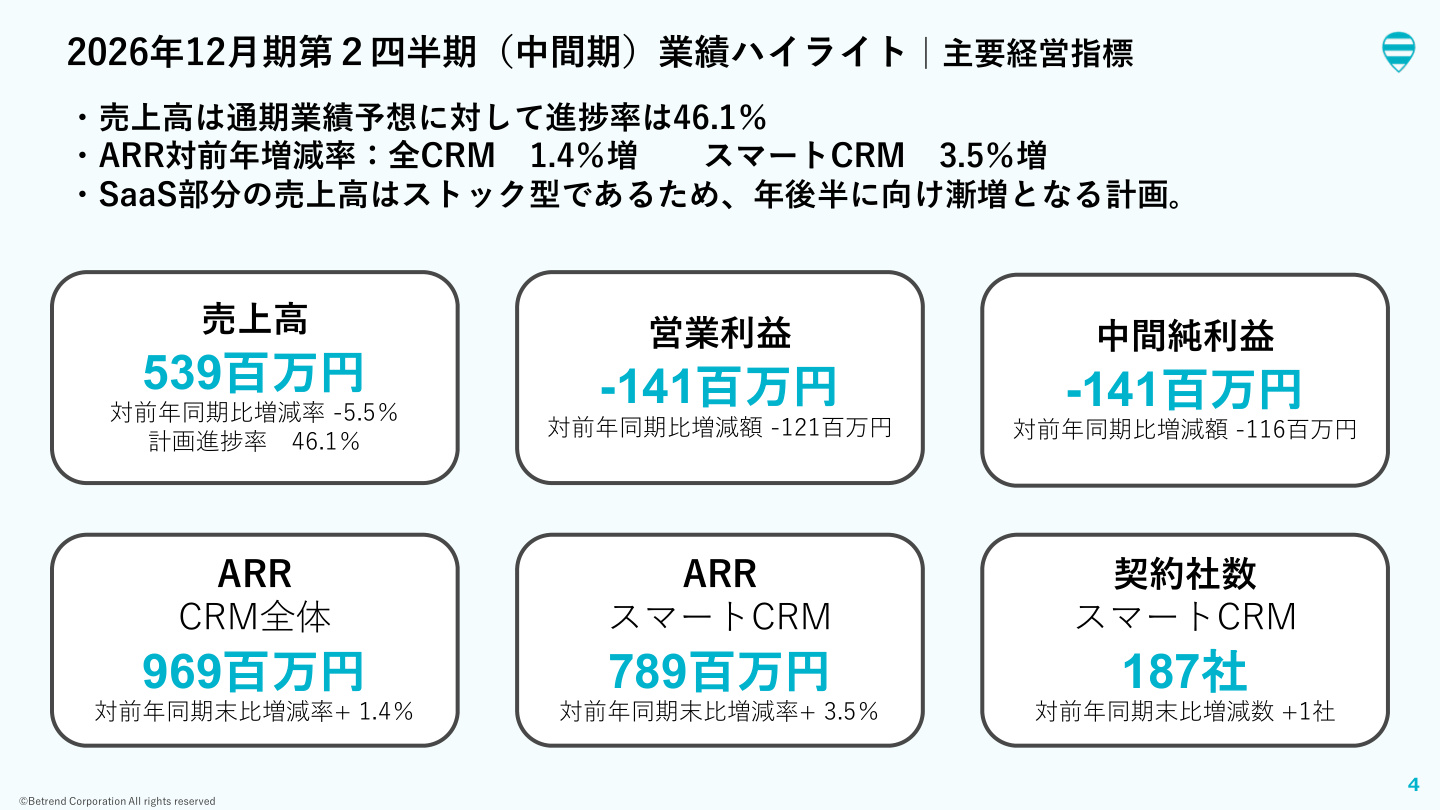
For the first half of the fiscal year ending December 2026 , betrend Co., Ltd. reported net sales of 539 million yen (down 5.5% YoY) , an operating loss of 141 million yen (a 121 million yen decline YoY) , and a net loss of 141 million yen . The progress rate against the full-year sales forecast stands at 46.1% , which is in line with the company's plan for sales to gradually increase toward the second half of the year, consistent with the nature of its stock-based (SaaS) business model.
The key takeaway from these results is the intentional execution of upfront investments aimed at maximizing future ARR (Annual Recurring Revenue) and the associated temporary costs . While short-term profitability shows an expanded deficit, core metrics underpinning stock revenue—such as ARR and the number of active members—remain on a solid upward trajectory.
2. Performance Highlights and Key Management Indicators
An overview of the interim management indicators reveals that while sales saw a slight decline and profits dipped, indicators reflecting the stock-based foundation show steady growth.
[Significance of the Slide and Data Context]
This "Key Management Indicators" slide (P4) is the most fundamental slide for understanding betrend's current revenue structure and business health. While the income statement might suggest lackluster performance due to the 539 million yen in sales and -141 million yen in operating profit, it is crucial to note that ARR (Total CRM) reached 969 million yen (up 1.4% from the end of the previous fiscal year) , and the flagship Smart CRM ARR grew to 789 million yen (up 3.5% from the end of the previous fiscal year) . betrend employs a recurring (stock) business model that generates continuous revenue as long as contracts are not canceled. Since sales are composed of accumulated past contracts, the fluctuation in ARR is a more direct indicator of future earning power than short-term P/L. The fact that ARR is increasing while the number of contract companies remains flat at 187 indicates that rising average revenue per customer (351,000 yen, up 2.9% from the end of the previous fiscal year) is contributing to growth.
3. Trends in Sales by Service and Number of Contracts
A breakdown of sales by segment reveals qualitative changes in the business.
- CRM Service Sales: 480 million yen (down 0.4% YoY)
- Following the cancellation of one major client in Q4 of the previous year (due to absorption into the group parent company's point system), the company focused on recovering MRR (Monthly Recurring Revenue) throughout Q1 and Q2. While MRR recovery progressed steadily to a 1.4% increase , cumulative sales for the period fell slightly below the previous year.
- Customization Service Sales: 54 million yen (down 35.6% YoY)
- Revenue declined significantly compared to the same period last year due to a decrease in development projects associated with new Smart CRM implementations and additional customization requests from existing clients.
- Other Service Sales: 4 million yen (up 7.8% YoY)
Analysis of Contract Numbers and Churn Rate
The number of Smart CRM contracts reached 187 (13 new acquisitions, 12 cancellations), an increase of 1 compared to the end of the same period last year. Growth in "LINE Mini App-type SCRM" is particularly notable, with the number of contracts reaching 41 (CAGR +28.1%) . Demand for LINE Mini Apps, which have a lower barrier to entry compared to smartphone app development, is steadily expanding. Furthermore, the average monthly churn rate for Smart CRM remains stable at an extremely low level of 0.8% to 0.9% , confirming high customer retention.
4. Analysis of Cost Structure Expansion and Profit Pressure
The primary factors behind the expanded deficit in the first half are a sharp rise in the cost of sales ratio and the concentration of investment costs for the future .
[Significance of the Slide and Data Context]
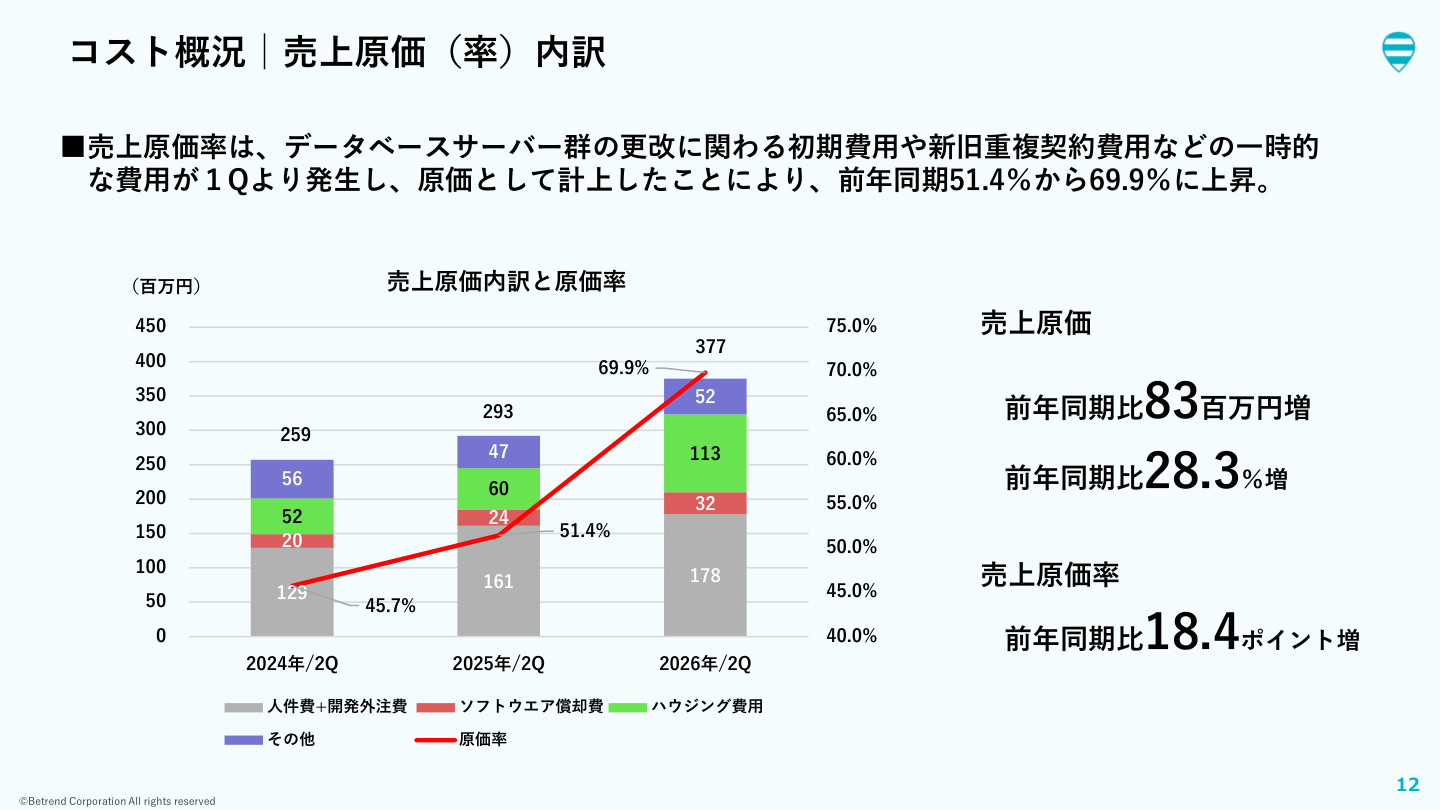
This "Breakdown of Cost of Sales (Ratio)" slide (P12) is critically important data that clearly explains the direct cause of the pressure on current earnings. As the graph shows, the cost of sales ratio has worsened by 18.4 points, from 51.4% in the same period last year to 69.9% . The cost of sales itself swelled to 377 million yen (up 83 million yen, or 28.3% YoY) . The main cause of this increase is the replacement of database server clusters (one-time expense) associated with the migration to next-generation infrastructure, as well as overlapping contract costs for old and new systems that began in Q1. In other words, this is not a structural deterioration in profitability, but rather temporary cost overlaps and upfront expenses associated with infrastructure renewal , as confirmed by this breakdown data.
Selling, General and Administrative (SG&A) expenses also saw a slight increase to 304 million yen (up 2.1% YoY) , primarily driven by higher personnel costs (214 million yen, up 11 million yen YoY) centered on talent and development-related investments.
5. Trends in Active Members Demonstrating Platform Value
The growth in the number of active members serves as an indicator of the scale of the Smart CRM service foundation provided by betrend. At the end of this interim period, the number of active members for the Smart CRM service reached 38.54 million , an increase of 3.76 million from the end of the same period last year (34.78 million). This upward trend from 31.95 million in Q2 2024 demonstrates that the effectiveness of the service as a digital customer touchpoint for stores and brands is highly valued.
6. Full-Year Earnings Forecast and Mid-to-Long-Term Investment Plan
There are no changes to the full-year earnings forecast for the fiscal year ending December 2026 announced at the beginning of the period.
- Net Sales: 1,169 million yen (up 0.9% YoY)
- Operating Profit: -222 million yen (Previous year: -81 million yen)
- Ordinary Profit: -222 million yen (Previous year: -80 million yen)
- Net Income: -223 million yen (Previous year: -101 million yen)
The company has prioritized the maximization of future ARR and plans to execute a total of +421 million yen in investments (single-year basis) compared to FY2023 in FY2026. The investment breakdown includes +256 million yen for talent and development, +120 million yen for infrastructure, and +45 million yen for marketing, reflecting a policy of thoroughly building a foundation for growth.
7. New Initiatives and Progress in Growth Strategy
Several strategic measures are being promoted to accelerate mid-to-long-term growth:
- Strengthening the "betrend connect" Strategy : The partner program, which enhances integration with POS registers and various services, has expanded its ecosystem with the addition of four new services: Toshiba Tec's "FoodFrontia," "OrderLinkage," "CouponLinkage," and "TableCheck." The number of project leads has increased by +76% YoY .
- Participation in the LINE Yahoo "Customer Growth Consortium" : betrend joined the consortium launched by LINE Yahoo to support DX for SMEs as a "Technology Partner," strengthening support for regional businesses by providing low-cost packages such as LINE Mini Apps.
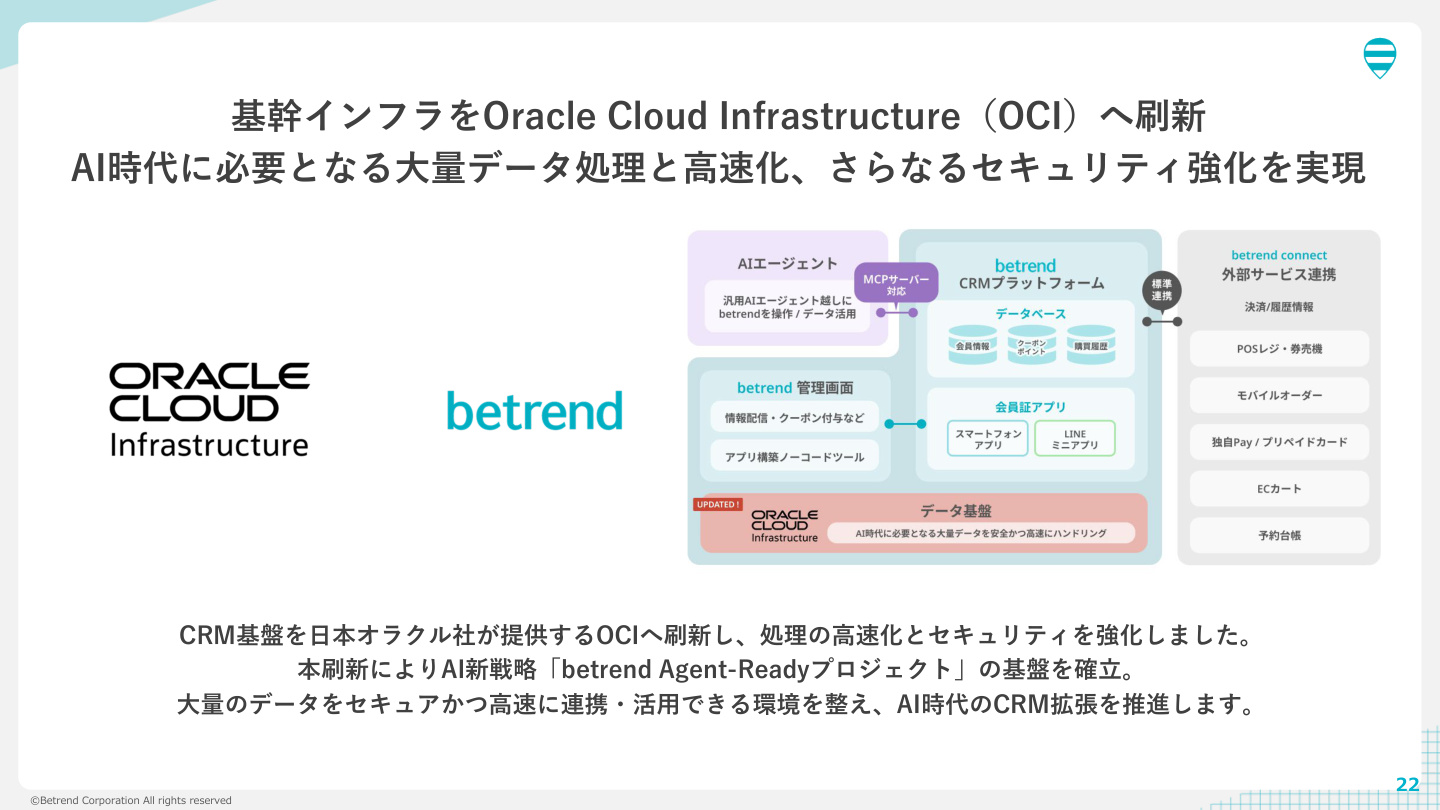
- Infrastructure Overhaul to OCI (Oracle Cloud Infrastructure) : The migration of the core infrastructure has been completed to evolve it into a next-generation CRM foundation.
[Significance of the Slide and Data Context]
This "Core Infrastructure Overhaul" slide (P22) is a strategically invaluable slide that demonstrates betrend's future technological superiority and the direction of its product evolution. By upgrading the CRM foundation to OCI provided by Oracle Japan, the company has achieved faster processing and dramatically enhanced security. This is not merely a system update involving costs, but has the clear purpose of establishing the foundation for the new AI strategy, the "betrend Agent-Ready Project." With an environment now in place where AI can securely and rapidly process and analyze vast amounts of purchase and behavioral data, the company will be able to provide advanced CRM functions tailored to the upcoming era of AI agents.
- Global Expansion and New Businesses : In Vietnam (Ho Chi Minh City), the first user implementation of "Zalo Mini App CRM," utilizing the local major SNS Zalo, has been completed. Additionally, the company is sowing seeds in new areas, such as participating as a development partner for an inter-corporate ESG collaboration cloud service in partnership with Parco Digital Marketing.
- Change in Shareholder Benefit Program : To expand the investor base and encourage long-term stock holding, changes to the shareholder benefit program have been announced (adding tiers based on the number of shares held and increasing the value of digital gifts for long-term holdings of one year or more, and two years or more).
8. Comprehensive Evaluation and Summary
betrend's H1 FY2026 financial results show a prominent deficit (operating loss of 141 million yen) in short-term P/L data due to an increased cost of sales ratio (69.9%) and one-time infrastructure renovation costs. However, behind these figures lie investments based on a clear growth scenario, such as adapting to the AI era through the OCI infrastructure overhaul and strengthening integration with POS vendors . Fundamental business KPIs—such as ARR growth (Smart CRM: 789 million yen) , rising customer unit prices (351,000 yen) , and the steady accumulation of active members (38.54 million) —remain healthy. These results reflect a transitional period as the company moves from an upfront investment phase to a recovery phase.
This content is not intended as investment advice or a recommendation. Any opinions expressed are solely the personal views of each article.