


【Sharing Technology Q3 FY2026 Earnings Analysis】 Operating Profit Surges 208% YoY Driven by Business Divestiture Gains and Expansion of In-house Construction

StockClub
Published: Aug 14, 2026, 10:44 AM
Sentiment Analysis

Sharing Technology Inc. (Securities Code: 3989) reported significant growth in both revenue and profit for the third quarter of the fiscal year ending September 2026 (October 1, 2025 – June 30, 2026). This performance was driven by higher unit prices in its core "Daily Life Troubleshooting" business, the growth of its construction group subsidiaries, and the booking of a one-time gain from a business divestiture.
In this deep-dive report, we extract 10 key topics from the released financial materials to provide an objective analysis of the company's overall financial position, shifts in revenue structure, and its mid-to-long-term growth narrative.
1. Consolidated Financial Highlights for Q3 FY2026 (Cumulative)
For the first nine months of the fiscal year ending September 2026, consolidated results showed revenue of 6,851 million yen (up 114% YoY) , operating profit of 2,993 million yen (up 208% YoY) , and profit attributable to owners of the parent of 2,051 million yen (up 214% YoY) , marking a substantial expansion in both top and bottom lines.
The revenue growth was supported by the steady expansion of core segments and the performance of group companies engaged in in-house construction. Operating profit was bolstered not only by the growth of the core business and disciplined advertising expenditure but also by a one-time gain from the divestiture of the "Franchise no Madoguchi" business during the third quarter.
Notably, even excluding the impact of this divestiture gain (approx. 1.4 billion yen), operating profit still achieved a YoY increase of approximately 110% , demonstrating the robustness of the underlying business foundation.
2. Q3 Rapid Growth and the Impact of Business Divestiture
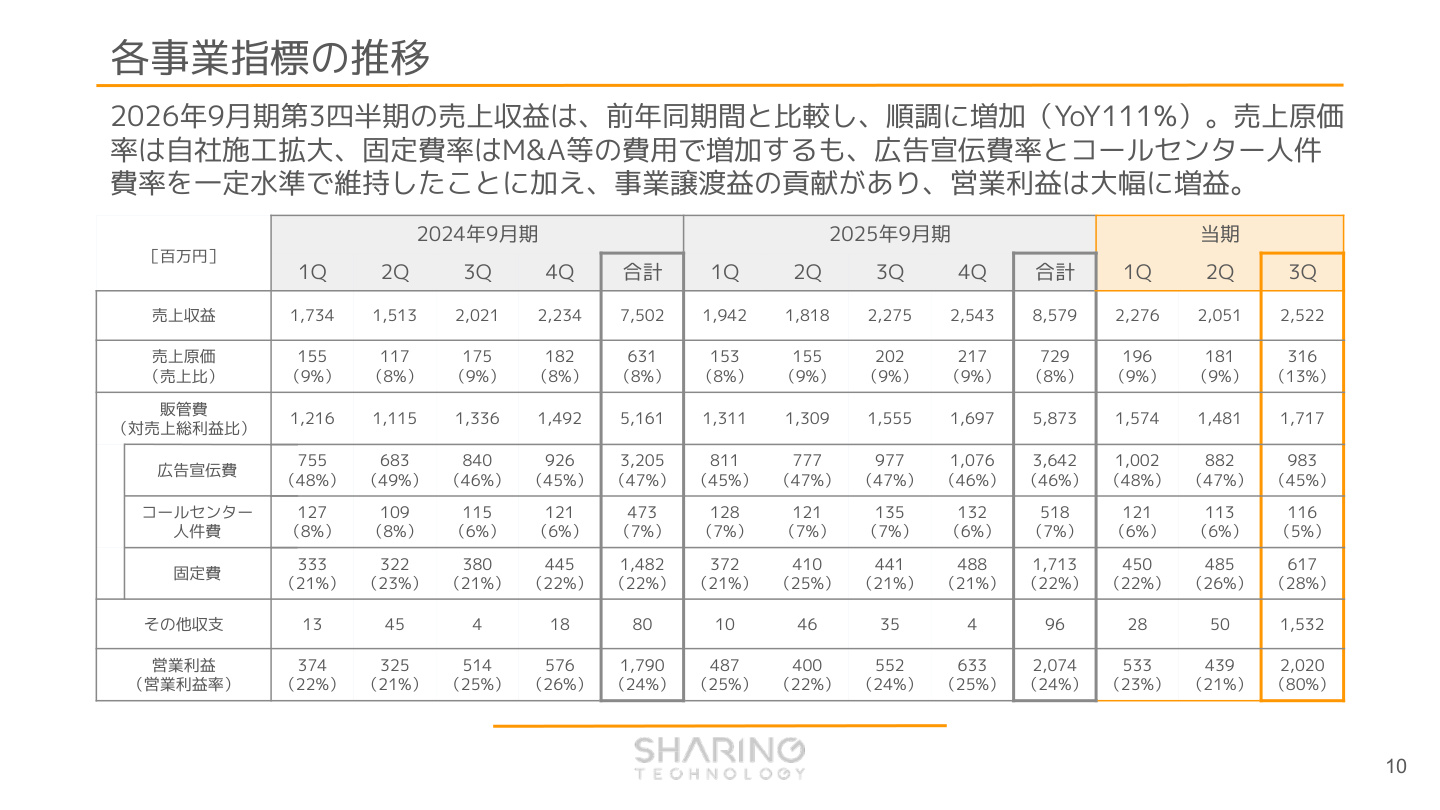
Focusing solely on the third quarter (April–June 2026), revenue reached 2,522 million yen (up 111% YoY) , operating profit was 2,020 million yen (up 366% YoY) , and net profit was 1,381 million yen (up 380% YoY) .
Quarterly revenue continues to hit record highs, showing a strong start heading into the peak seasonal demand period (summer, when pest and vermin control needs increase).
3. Progress Against Full-Year Forecasts
The progress rates against the full-year consolidated earnings forecast as of the end of Q3 are as follows:
[Slide Commentary: Importance of Full-Year Progress Rates]
The slide above provides critical data on the company's progress against its full-year forecast and historical trends. While the revenue progress rate stands at 69.9% , in line with historical averages, the operating profit progress rate has reached a very high level of 82.0% . As shown in the operating profit progress graph on the right, even when excluding special factors such as the divestiture gain, the underlying operating profit progress rate is estimated at approximately 70.3% , confirming steady progress against the full-year plan. Given the seasonality of the business, where demand peaks between Q3 and Q4 (summer), achieving such a high progress rate at this stage provides strong backing for meeting full-year targets.
4. Structural Analysis of Operating Profit Variance
The 1,553 million yen increase in operating profit from the same period last year (1,440 million yen) to the current period (2,993 million yen) is broken down as follows:
- Increase in Revenue : +815 million yen (positive impact)
- Increase in Cost of Sales : -183 million yen (higher construction costs due to increased in-house construction ratio)
- Increase in Advertising Expenses : -301 million yen (investment to maintain customer acquisition)
- Increase in Call Center Personnel Costs : -33 million yen
- Increase in Fixed Costs : -328 million yen (temporary costs and personnel expenses related to in-house construction expansion and M&A)
- Other Income/Expenses (Divestiture Gain, etc.) : +1,518 million yen (positive impact)
While cost of sales and fixed costs are trending upward due to the shift toward in-house construction, the expansion of gross profit from revenue growth, efficient marketing cost management, and the divestiture gain have more than absorbed the increase in expenses.
5. Changes in Cost Structure and Control
To analyze the company's business model, it is essential to understand the trends in various expense ratios relative to revenue.
[Slide Commentary: Meaning and Background of Cost Structure Trends]
This slide breaks down and visualizes the quarterly trends of the company's major costs (cost of sales ratio, advertising expense ratio, call center personnel cost ratio, and fixed cost ratio).
- Cost of Sales Ratio (Top Left) : With the expansion of group companies that perform direct construction, such as Az Support and Lifeline, the cost ratio is on an upward trend (13% in Q3) . This is a result of shifting the business model from a matching fee model to an in-house construction model, representing a structural change in exchange for higher revenue per job.
- Advertising Expense Ratio (Top Right) : This has consistently been kept below 50% of gross profit (45% in Q3) , indicating that operational efficiency in web-based customer acquisition remains at a very high level.
- Call Center Personnel Cost Ratio (Bottom Left) : Thanks to automation and operational efficiency, this has been kept at a low level of 5%–6% (5% in Q3) .
- Fixed Cost Ratio (Bottom Right) : Although temporarily pushed up by M&A-related expenses, it is controlled within a certain range (high 20% range). Overall, the company has formed a profit structure that balances the increase in costs from in-house construction with the efficiency of customer acquisition and operational costs.
6. KPI Trends (Inquiry Volume and Unit Price per Inquiry)
Strategic shifts are evident in the two major indicators that constitute revenue: "Inquiry Volume" and "Unit Price per Inquiry."
- Inquiry Volume : In Q3 FY2026, the volume has trended slightly downward compared to the peak of the same period last year, partly due to an intentional focus on high-unit-price projects .
- Unit Price per Inquiry : The optimization of the matching system , focus on high-unit-price categories (pest control, renovation, etc.), and the expansion of Az Support (the core of in-house construction) have created synergistic effects, keeping the unit price on an upward trend .
This indicates that the adjustments to the matching algorithm, which prioritize quality (unit price and profit margin) over quantity, are proving successful.
7. Performance of In-house Construction Subsidiary "Az Support"
Az Support Co., Ltd., which leads the in-house construction business, has seen strong performance in its core pest and vermin control segment , as well as in peripheral segments such as lock troubleshooting.
- Consolidated revenue impact (after eliminating inter-group transactions) for Q3 reached 439 million yen (up 124% YoY) .
- Cumulative revenue reached 1,024 million yen (up 132% YoY) , serving as a key growth engine driving consolidated performance. Further strengthening of the construction system is expected while continuing to make upfront investments.
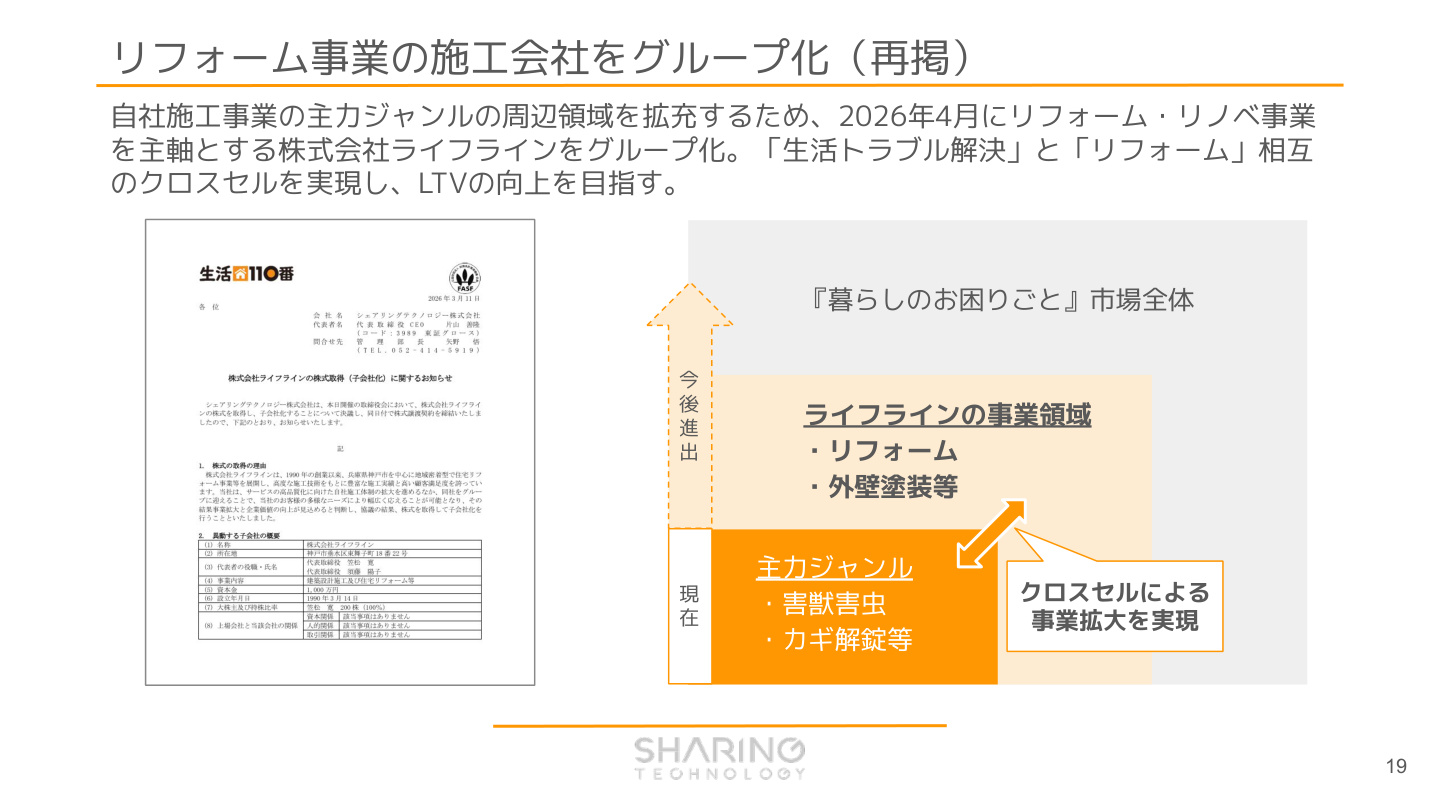
8. Initiatives and Cross-selling Strategy for New Subsidiary "Lifeline"
Progress is also being made regarding Lifeline Co., Ltd. (engaged in renovation and remodeling), which became a wholly-owned subsidiary in April 2026.
- Q3 Results (April–June) : Revenue of 123 million yen and operating profit of 13 million yen.
- Post-acquisition Measures : Currently promoting fixed cost reduction and review of SG&A expenses through the integration of administrative departments. Future plans include strengthening customer acquisition by leveraging Sharing Technology's customer base and systematizing customer management.
- Objective : To promote cross-selling by proposing high-unit-price "renovation" services, such as exterior painting or large-scale remodeling, to customers acquired through "daily life troubleshooting" services like water leaks or pest issues, thereby improving Customer Lifetime Value (LTV) .
9. Upward Revision of Full-Year Earnings Forecast
The company announced an upward revision to its full-year earnings forecast on March 19, 2026, and this information is reiterated in the current materials.
[Slide Commentary: Background and Essence of the Upward Revision]
This slide shows the structural factors behind the upward revision of the full-year earnings forecast. Regarding revenue, although there will be a decrease in the second half due to the divestiture of the "Franchise no Madoguchi" business, this is offset by the acquisition of construction companies and the expansion of existing businesses, maintaining the initial forecast of 9,800 million yen . On the other hand, operating profit has been revised upward from the initial forecast of 2,350 million yen to 3,650 million yen, an increase of 1,300 million yen (+55.3%) . As the graph shows, the main factor for this profit increase is the gain from the business divestiture. While the divestiture gain is a one-time factor, the company is using the funds and resources obtained to concentrate investment in its core "Daily Life Troubleshooting" business and in-house construction, positioning this as part of a portfolio restructuring for sustainable mid-to-long-term growth.
10. Shareholder Return Policy and Financial Foundation
Amidst significant earnings growth, the company's shareholder returns and financial position are as follows:
- Dividend Policy : The annual dividend forecast is maintained at 55.00 yen per share (27.50 yen interim paid, 27.50 yen year-end planned). The policy to decide dividends while considering M&A progress and cash on hand remains in place.
- Financial Soundness : The equity ratio as of the end of June 2026 is 65.2% . Although slightly down from the end of the previous fiscal year (69.0%), it maintains a high level of safety, exceeding 60%. Total assets expanded to 8,544 million yen (+1,107 million yen from the end of the previous fiscal year).
Summary: Outlook for the Growth Story
Sharing Technology's Q3 FY2026 results reflect a clear strategy: generating profit and optimizing the balance sheet through the divestiture of non-core businesses , while simultaneously promoting higher matching unit prices and in-house construction (Az Support and Lifeline) in the core business .
The domestic "daily life troubleshooting" market is vast, estimated at 14 trillion yen (approx. 5 trillion yen for light tasks alone), and continues to benefit from structural tailwinds such as an aging population, an increase in single-person households, and the spread of service e-commerce. Attention will be focused on the growth trajectory the company will chart by combining its web customer acquisition power with its in-house construction network cross-selling structure.
This content is not intended as investment advice or a recommendation. Any opinions expressed are solely the personal views of each article.