


Earnings Analysis: RAKUS (3923) Q1 FY2027 – Record-High Operating Margin of 33.5% Following Cloud-Native Pivot; New Growth Story Driven by Major M&A and AI Integration

StockClub
Published: Aug 14, 2026, 10:37 AM
Sentiment Analysis
Earnings Summary: Transition to Cloud-Native Business and Record-High Profits Following IT Talent Business Divestiture
RAKUS Co., Ltd. (Securities Code: 3923) reported a very strong start to the first quarter (1Q) of the fiscal year ending March 2027 , with both revenue and profit at all levels exceeding internal targets.
For this quarter, consolidated revenue reached 14,210 million yen (+0.9% YoY) , and consolidated operating profit hit 4,756 million yen (+30.1% YoY) . While the growth in consolidated revenue may appear modest at first glance, this is the result of fully absorbing the impact of the divestiture (deconsolidation) of the IT Talent business conducted in the previous fiscal year (IT Talent business revenue in the same period last year: 2,016 million yen). The core Cloud business alone achieved revenue of 14,210 million yen (+17.8% YoY) , maintaining a high growth rate.
Furthermore, as the business structure became unified (specialized) around the high-margin Cloud business, the consolidated operating profit margin reached 33.5% (+7.5 percentage points YoY) , marking a record high on a quarterly basis. Additionally, due to the booking of extraordinary income of approximately 16.7 billion yen associated with the business divestiture, quarterly net profit attributable to owners of the parent surged to 14,631 million yen (+313.6% YoY) .
Performance Highlights and Revenue Structure Analysis: Overwhelming Growth in the Cloud Segment
Looking at the revenue structure by segment, it is clear that the Cloud business, the company's growth engine, is strongly driving overall corporate performance.
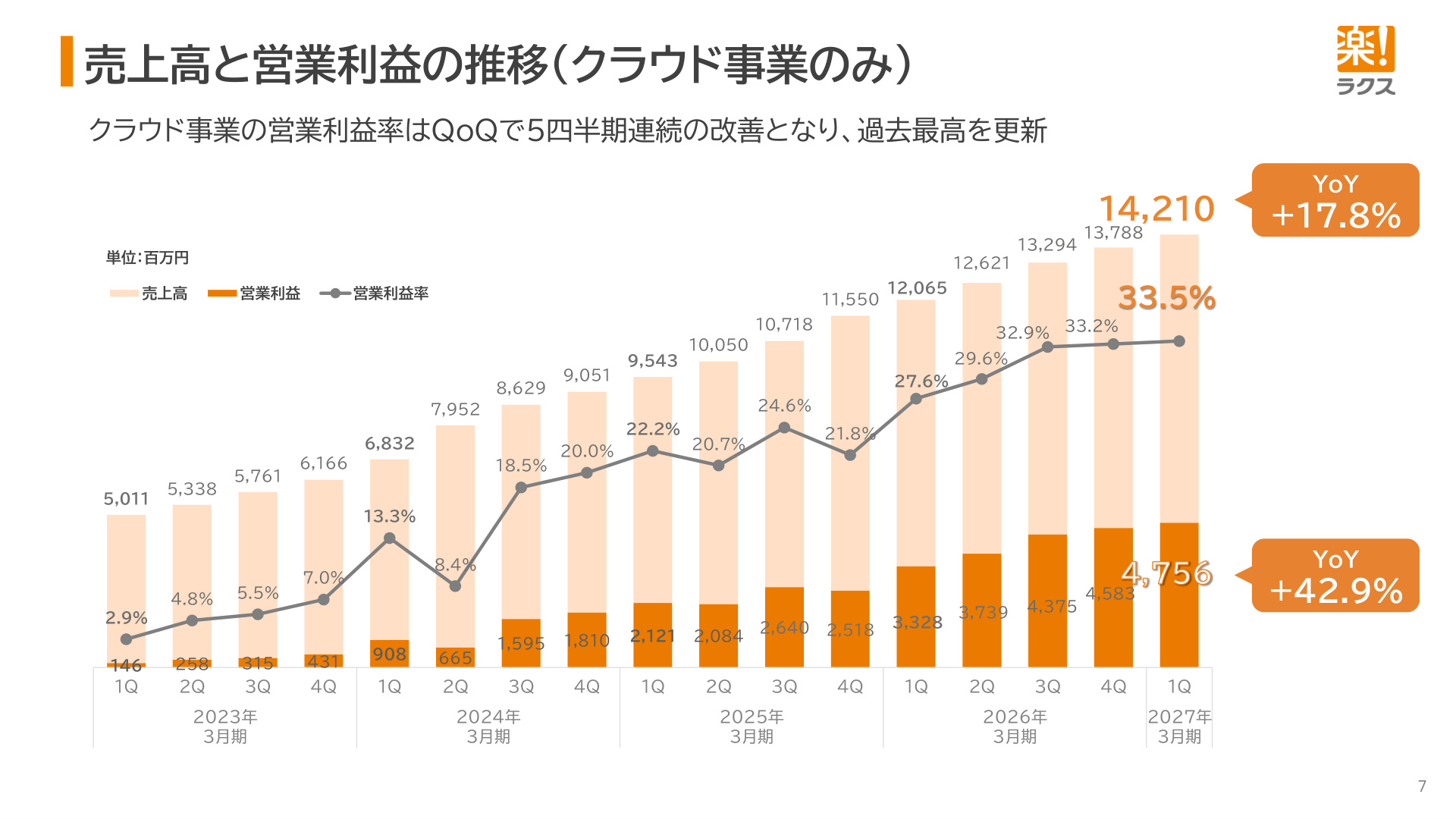
The following graph shows the trends in revenue and operating profit for the Cloud business over the past few years.
[Slide Commentary: Why this data is important]
This slide provides the most critical data for understanding RAKUS's intrinsic growth potential and evolution in profitability . While the apparent growth speed of consolidated revenue seems to have temporarily stabilized due to the divestiture of the IT Talent business, this data demonstrates that the Cloud business alone continues to achieve extremely high growth, with a 17.8% increase in revenue and a 42.9% increase in operating profit YoY . Furthermore, focusing on the operating profit margin trend indicated by the line graph, it has improved steadily from 2.9% in 1Q FY2023 to 33.5% in this quarter, marking the fifth consecutive quarter of QoQ (quarter-on-quarter) improvement . This strongly proves that the benefits of scale from revenue expansion and efficient cost management are manifesting simultaneously.
Factors Behind Operating Profit Changes and Cost Efficiency Mechanisms
The significant increase in operating profit this quarter (+1,100 million yen, +30.1% YoY) is backed by clear structural reforms and cost optimization.
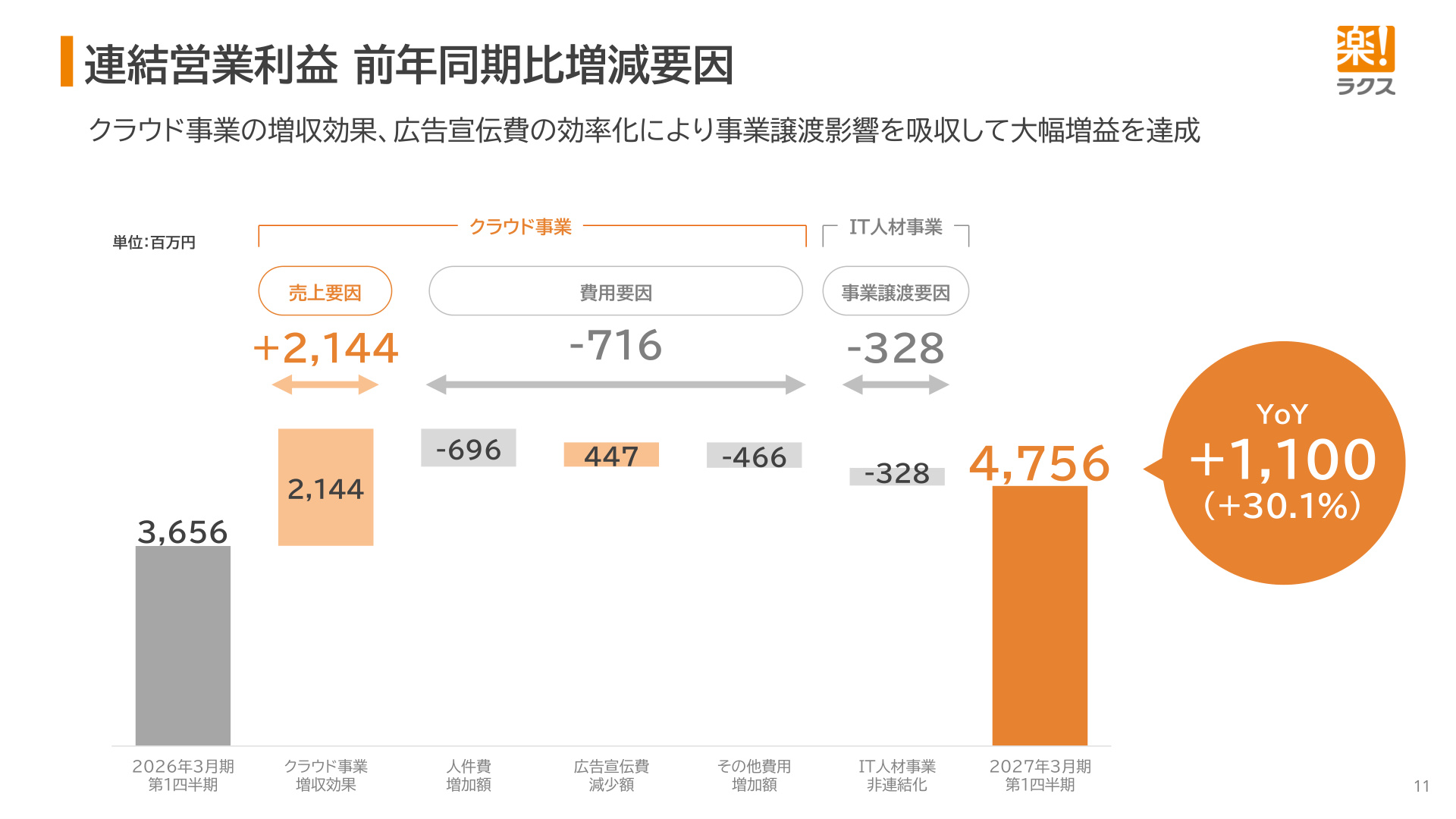
The following waterfall chart provides a detailed breakdown of the factors contributing to the profit increase compared to the same period last year.
[Slide Commentary: Why this data is important]
This slide clearly shows the breakdown of how the company generated profit far exceeding the loss of profit (-328 million yen) associated with the deconsolidation of the IT Talent business. The primary driver of profit growth is the revenue increase effect (+2,144 million yen) from the top-line expansion of the Cloud business. While increases in Cloud business personnel costs (-696 million yen) and other expenses (-466 million yen) occurred, these were absorbed by the efficiency gains in advertising and promotion expenses (+447 million yen in cost savings) . As a result, the company achieved a significant profit increase of +1,100 million yen , clearly demonstrating a logical profit improvement process that easily overcame the negative impact of the business divestiture.
Digging into costs, the personnel expense-to-revenue ratio was 35.5% (44.6% in the same period last year), and the advertising expense-to-revenue ratio was 13.7% (21.3% in the same period last year), both showing a significant downward trend. In addition to the dramatic decrease in personnel costs equivalent to cost of sales due to the divestiture, the shift toward marketing investments focused on acquisition efficiency contributed to the improvement in profit margins.
Product Growth and KPI Trends (ARR, Customer Count, Churn Rate)
RAKUS's stock business foundation continues to expand robustly.
- ARR (Annual Recurring Revenue) : Surpassed 53,578 million yen, up 17.6% YoY . The stock revenue ratio remains at an extremely high level of 93.3% , establishing a stable revenue structure with high predictability.
- Revenue by Service :
- RAKURAKU Seisan : Revenue of 5,449 million yen (+10.6% YoY) . While entering a cruising speed after the price revision effect, it continues to expand steadily as a core product.
- RAKURAKU Meisai : Revenue of 3,677 million yen (+23.4% YoY) . The number of active customers reached 15,304 , maintaining high growth driven by the Electronic Book Preservation Act and the Invoice System.
- RAKURAKU Hanbai : Revenue of 2,024 million yen (+22.4% YoY) . The number of active customers steadily accumulated to 4,250 .
- RAKURAKU Kintai & Others : RAKURAKU Kintai revenue was 613 million yen ( +41.8% YoY ), and others including RAKURAKU Seikyu grew by +78.8% , indicating that the second and third growth pillars are rising rapidly.
- Churn Rate Trends : The quarterly churn rate for RAKURAKU Seisan was 1.99% . Although it rose temporarily due to seasonality specific to the start of the fiscal year, it remains within the expected range, and new orders are trending steadily. The churn rate for RAKURAKU Meisai was 0.68% , and for RAKURAKU Hanbai was 2.66% , showing generally stable trends.
Generative AI, Product Strategy, and Service Integration
The company is rapidly advancing the full-scale implementation of generative AI and AI agents to enhance the value-add of its SaaS products.
- AI Agent for Slip Creation in "RAKURAKU Seisan" : Launched in June 2026. By automatically collecting and uploading vouchers (receipts, etc.) and having AI perform application reviews and qualified invoice checks, the company aims for a revolutionary user experience that reduces applicant input work by up to 90% .
- AI Feature Expansion for "RAKURAKU Jido Oto" : Released AI translation features (approx. 60 languages) and AI-FAQ features that analyze inquiry data to automatically generate, update, and suggest deletions for FAQ articles.
- Launch of "RAKURAKU Business Card" : Started providing corporate cards in May 2026, and initiated real-time statement integration with "RAKURAKU Seisan" in July. By matching usage statements with pre-application data to automatically create slips, the company is realizing faster monthly closing and strengthened governance.
Inorganic Growth Strategy: Equity-Method Affiliation of Plus Alpha Consulting and Others
In addition to organic growth through in-house development, the company is accelerating inorganic growth utilizing large-scale capital alliances and M&A.
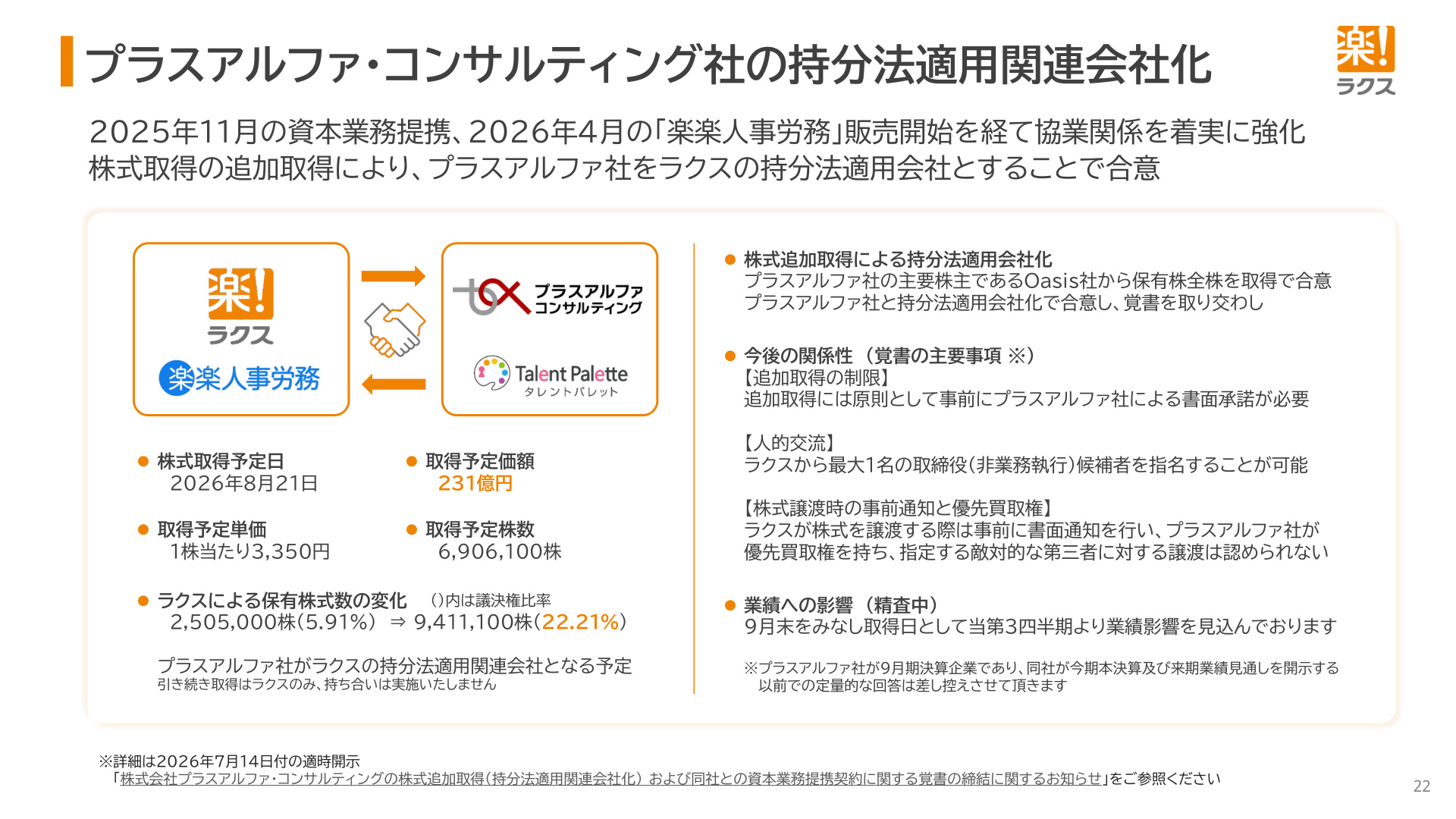
A particularly impactful measure is the equity-method affiliation of Plus Alpha Consulting Co., Ltd. (PAC) .
[Slide Commentary: Why this data is important]
This slide illustrates the core of RAKUS's growth alliance strategy . The company agreed to acquire additional shares of PAC for approximately 23.1 billion yen (6,906,100 shares), raising its voting rights ratio to 22.21% and making it an equity-method affiliate. The goal is to deepen cross-selling and functional integration between RAKUS's "RAKURAKU Jinji Romu" and PAC's talent management system, "Talent Palette." Accounting-wise, PAC's performance is scheduled to be reflected in the P/L as equity-method investment profit/loss from 3Q FY2027, which is of extreme importance as a mid-to-long-term driver for non-operating income .
In addition, the company has executed a series of strategic investments to expand its share in the back-office SaaS market, such as a capital and business alliance with ROBOT PAYMENT Inc. (reorganizing "RAKURAKU Saiken Kanri" by receiving OEM supply of "Seikyu Kanri Robo") and an investment in freee K.K. (voting rights ratio of 4.95%, acquisition cost of approx. 6.8 billion yen).
Financial Strategy, Funding Policy, and Full-Year Outlook
Financial Impact and Funding Policy
While investment plans totaling approximately 32.2 billion yen are underway, including investments in PAC and freee, the company plans to utilize cash on hand and borrowings from financial institutions. It is explicitly stated that "there are no plans for equity finance (dilution through new share issuance, etc.) at this time," adopting a financial strategy that avoids damaging existing shareholder value while aiming for a gradual reduction of debt through operating cash flow.
Full-Year Consolidated Earnings Forecast for FY2027
Regarding the full-year consolidated earnings forecast, as the detailed impact of the series of capital policies and the shift to equity-method accounting is currently under review, the initial plan (Revenue: 59,700 million yen, Operating Profit: 20,500 million yen, Net Profit Attributable to Owners of the Parent: 25,200 million yen) remains unchanged . The progress rate of operating profit at 1Q is 23.2% against the full-year plan (20,500 million yen). However, with the inclusion of PAC's equity-method investment profit/loss scheduled for the second half, the company plans to continue considering additional shareholder return measures alongside the completion of the forecast review.
Comprehensive Analysis and Future Outlook
The RAKUS revealed by the 1Q FY2027 earnings is in a phase that successfully balances "the transformation into a high-margin, high-growth cloud-native SaaS company through the divestiture of the IT Talent business" with "the expansion of its ecosystem through aggressive capital deployment."
While achieving a record-high profitability of 33.5% in operating profit margin, the company is boldly reinvesting the abundant cash and divestiture gains into generative AI implementation, major M&A (PAC), and alliances with other companies (ROBOT PAYMENT, freee). We look forward to the developments in RAKUS's next growth phase as it aims to establish an overwhelming position in the SaaS market.
This content is not intended as investment advice or a recommendation. Any opinions expressed are solely the personal views of each article.