


Comture (3844) Q1 FY2027 Earnings Analysis: One-off Impairment Charges, Strategic Resource Reallocation for the AI Era, and the New Mid-Term Management Plan

StockClub
Published: Aug 14, 2026, 10:31 AM
Sentiment Analysis

Comture Corporation (Securities Code: 3844) released its Q1 FY2027 earnings on August 14, 2026. While the company demonstrated steady revenue growth driven by business expansion and M&A, the quarter marked a significant turning point as it recorded a temporary net loss due to the partial decommissioning of internal core systems and a one-time impairment charge aimed at future profitability.
This report provides a comprehensive analysis of the earnings materials, covering financial highlights, factors behind operating profit fluctuations, the strategic rationale for the extraordinary loss, performance by new business segments, and the newly formulated Mid-Term Management Plan (FY2027–FY2029).
1. Q1 FY2027 Earnings Highlights and Profit Overview
In the first quarter (April–June 2026), revenue reached ¥9,553 million (+6.7% YoY) and gross profit was ¥1,912 million (+2.7% YoY) , securing growth in both top-line and gross profit. However, operating profit fell to ¥747 million (-13.7% YoY) , and ordinary profit declined to ¥759 million (-12.1% YoY) .
Furthermore, due to an impairment loss of ¥1,434 million recorded as an extraordinary loss following the partial decommissioning of internal core systems, the company reported a quarterly net loss attributable to owners of the parent of -¥516 million (compared to a profit of ¥571 million in the same period last year).
| Item (¥ million) | Q1 FY2026 | Q1 FY2027 | YoY Change | Key Drivers/Notes |
|---|---|---|---|---|
| Revenue | 8,957 | 9,553 | +6.7% | Consolidation of HIT, growth in Data & AI, and finance/government sectors |
| Gross Profit | 1,862 | 1,912 | +2.7% | Contribution from unit price improvements and business expansion |
| Operating Profit | 867 | 747 | -13.7% | Increase in labor costs and expenses related to new core system launch |
| Ordinary Profit | 863 | 759 | -12.1% | Linked to operating profit decline |
| Net Profit | 571 | -516 | - | Primarily due to ¥1,434 million in extraordinary losses |
| EBITDA | 997 | 989 | -0.7% | Cash generation capacity remains on par with the previous year |
On the revenue side, performance was driven by the consolidation of Human Interactive Technology (HIT), the expansion of Data & AI-related businesses , and deeper penetration into large-scale accounts in the finance and government sectors.
On the profit side, despite the benefits of business expansion and improved unit prices, operating profit declined due to rising labor costs and the burden of fixed costs, such as depreciation and operating expenses associated with the launch of the new core system.
2. Analysis of Operating Profit Fluctuations
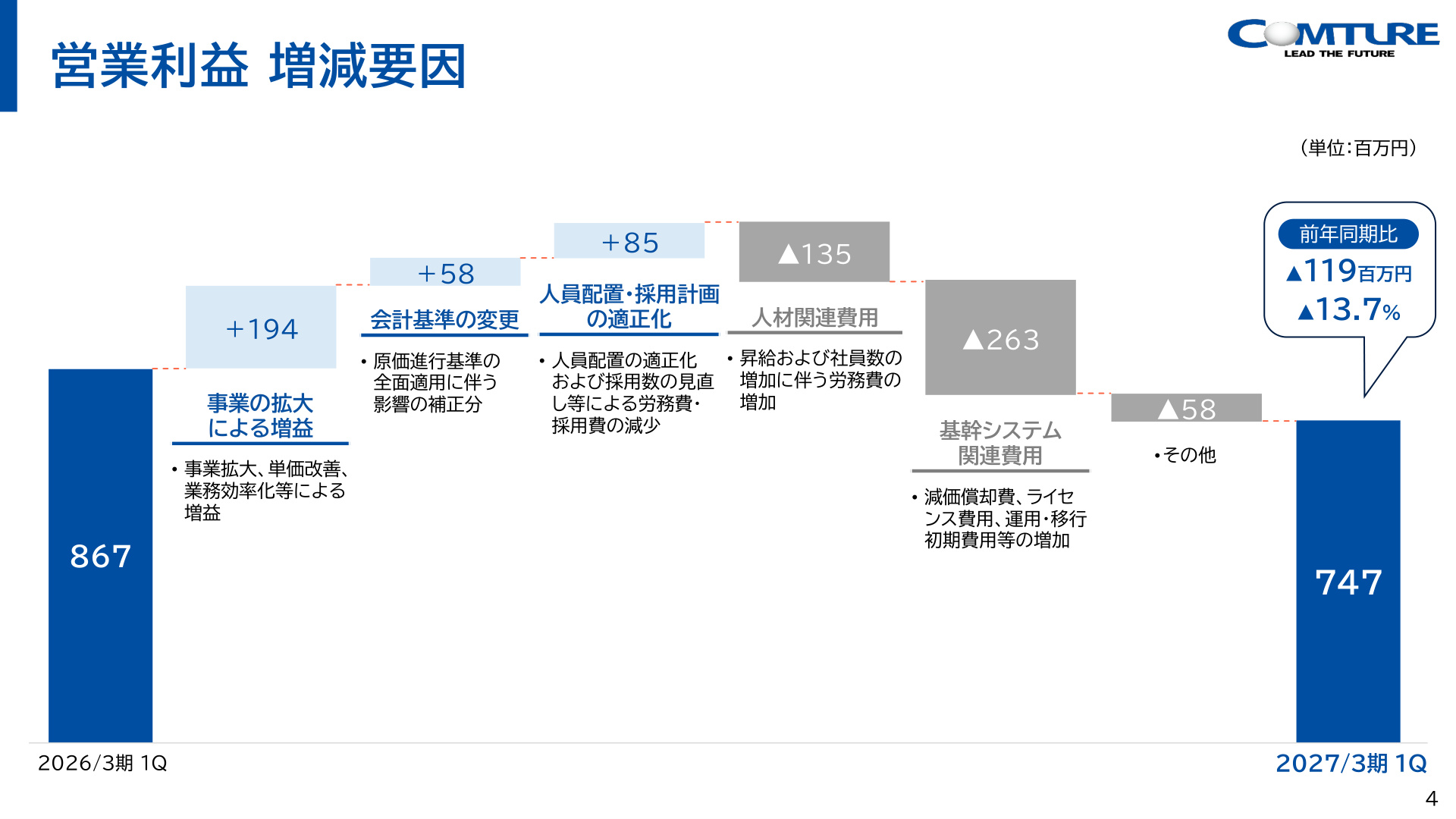
The ¥119 million decline (-13.7% YoY) in operating profit is characterized by a clear contrast between positive and negative factors.
[Why this slide is important/Meaning of the data]
The slide above (Page 4) is a critical waterfall chart showing the transition from the previous year's operating profit of ¥867 million to the current ¥747 million. It allows for an immediate understanding of how temporary and structural costs pressured profits despite the strengthening of the core business.
Specifically, the factors are broken down as follows:
- Profit growth from business expansion (+¥194 million) : Improved unit prices, operational efficiency, and larger project scales boosted profits.
- Change in accounting standards (+¥58 million) : Adjustment effect from the full application of the percentage-of-completion method.
- Optimization of staffing/hiring plans (+¥85 million) : Efficiency gains in labor and recruitment costs through hiring plan reviews.
- Increase in personnel-related expenses (-¥135 million) : Higher labor costs due to salary increases and headcount growth.
- Core system-related expenses (-¥263 million) : Significant impact from depreciation, license fees, and initial operation/migration costs for the new core system.
- Other expenses (-¥58 million)
As this analysis shows, while the core business's profitability is functioning well (+¥194 million), the two major cost factors— "Personnel investment (-¥135 million)" and "Core system-related expenses (-¥263 million)" —weighed down operating profit.
3. Recording of ¥1,434 Million Extraordinary Loss and Management Rationale
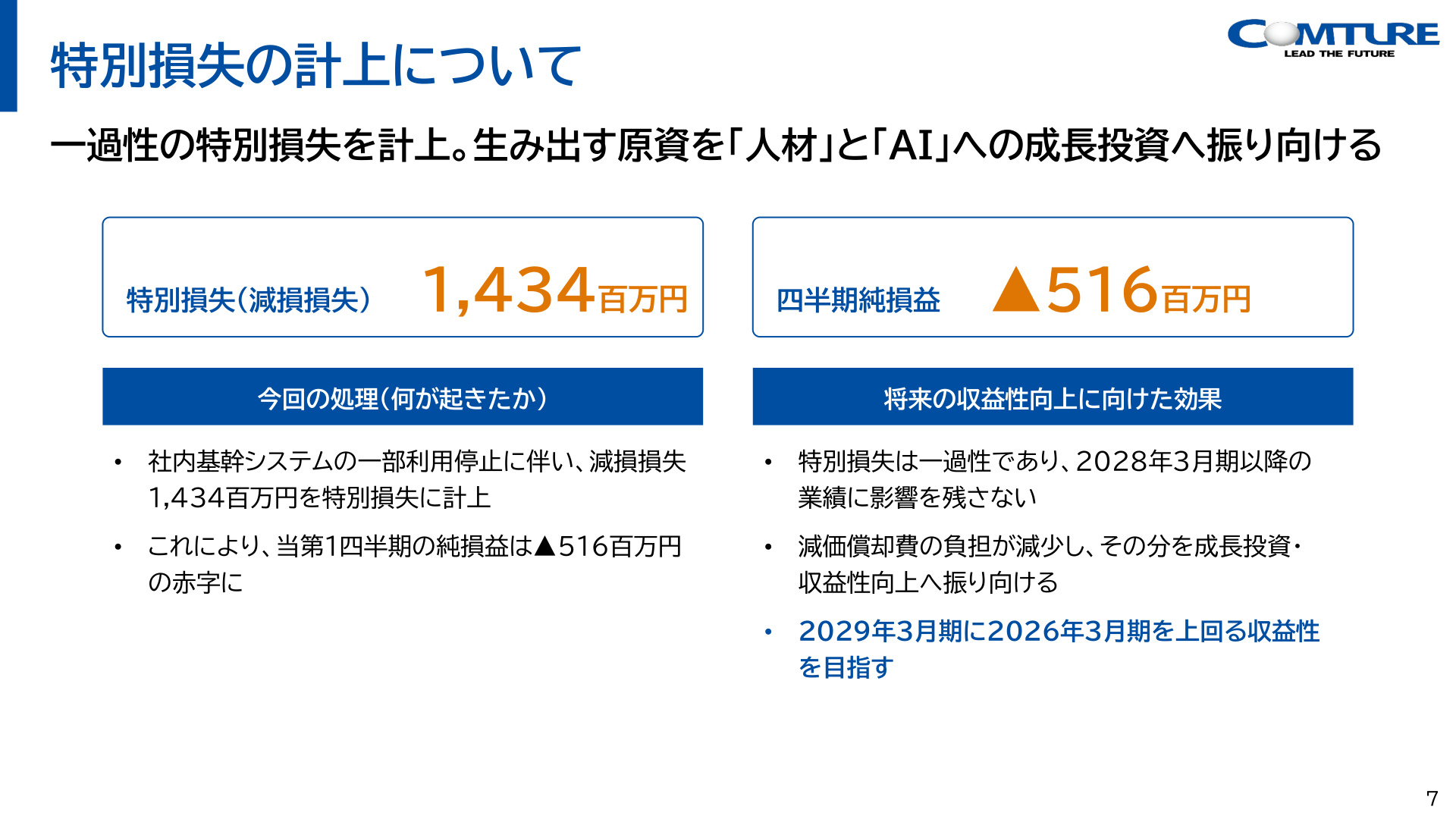
The most significant topic in this quarter's earnings is the ¥1,434 million impairment loss related to the partial decommissioning of the internal core system and the resulting net loss.
[Why this slide is important/Meaning of the data]
The slide above (Page 7) explains the management's determination for structural reform and the scenario for future profitability behind the seemingly negative "massive loss."
Comture transitioned to a new management structure in June 2026. Upon re-evaluating existing investment projects from a zero-base, the company determined that the internal core system, which had been in development for some time, "would not yield a return on investment exceeding the Weighted Average Cost of Capital (WACC)," leading to the decision to partially decommission it and execute an impairment charge.
This decision is summarized in three points:
- One-time loss processing : The impairment is a one-time event, cleaning up the balance sheet to ensure no negative impact on earnings from FY2028 onwards.
- Reduction of future burdens : By off-balancing the depreciation burden (the primary cause of the aforementioned -¥263 million) early, the company will significantly reduce future depreciation costs and improve future profit margins.
- Reallocation of resources to growth areas : Terminating system investments with low expected returns and redirecting capital and resources toward growth areas such as "AI investment," "Human capital investment (skill development)," and "Office integration."
This slide demonstrates a proactive exit strategy prioritizing capital efficiency (ROE/ROIC) rather than deferring losses to protect short-term figures.
4. Reorganization of Business Segments
To address the increasing sophistication of customer needs in the AI era, Comture has reorganized its five previous business divisions into three priority areas .
① Technology Area
- Overview : Supports customer value creation through Data & AI, multi-SaaS integration, and data infrastructure construction (Key products: Microsoft, Salesforce, Databricks, Snowflake, AWS, etc.).
- Q1 Performance : Revenue ¥3,693 million (+7.5% YoY) , Gross Profit ¥727 million (-2.5% YoY) .
- Analysis : While HIT consolidation and partnerships with SAS/Databricks grew, profit margins dipped slightly (19.7%) due to lost large-scale cloud projects, project delays, and a shortage of Project Managers (PMs).
② Business Transformation Support Area
- Overview : Provides end-to-end support for business transformation through consulting and ERP implementation based on industry expertise in finance and manufacturing (Key products: SAP, BIZ∫, etc.).
- Q1 Performance : Revenue ¥3,694 million (+9.6% YoY) , Gross Profit ¥757 million (+9.3% YoY) .
- Analysis : RPA solutions for credit guarantee associations and deeper relationships with financial institutions drove strong growth in both revenue and gross profit, maintaining a high profit margin of 20.5%.
③ Managed Services & Education Area
- Overview : Provides visualization, automation, and AI-driven enhancement of operations and maintenance, as well as IT talent development and training services.
- Q1 Performance : Revenue ¥2,165 million (+0.7% YoY) , Gross Profit ¥426 million (+0.9% YoY) .
- Analysis : While infrastructure projects for government agencies remained steady, growth was limited by a decline in private-sector operation services and fewer participants in new employee training.
5. Goals and Growth Strategy of the New Mid-Term Management Plan (FY2027–FY2029)
To adapt to the rapidly changing IT industry, Comture has adopted a rolling method for its mid-term management plan. A new three-year plan covering FY2027 to FY2029 has been announced.
[Why this slide is important/Meaning of the data]
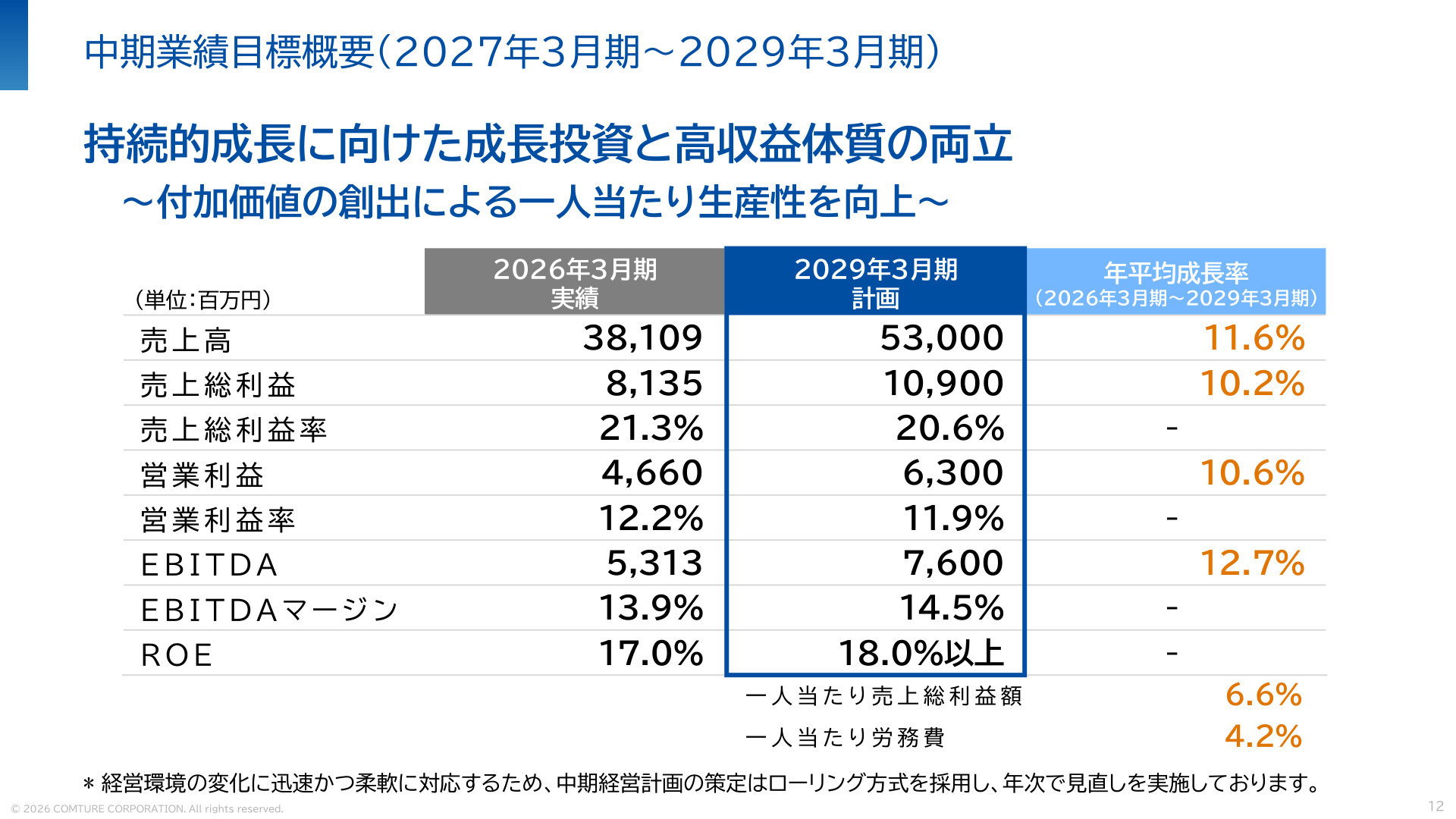
The slide above (Page 12) is the most important roadmap for investors, covering the growth targets and quantitative KPIs the company aims to achieve over the next three years.
Key numerical targets for the final year of the new plan, FY2029 , are as follows:
- Revenue : ¥38,109 million (FY2026) → ¥53,000 million ( CAGR 11.6% )
- Operating Profit : ¥4,660 million → ¥6,300 million ( CAGR 10.6% , Operating Margin 11.9% )
- EBITDA : ¥5,313 million → ¥7,600 million ( CAGR 12.7% , Margin 14.5% )
- ROE : 17.0% → 18.0% or higher (maintaining high capital efficiency)
Notably, the plan emphasizes not just scale (revenue growth) but also "improvement in productivity per employee." By setting the target growth rate for gross profit per employee (CAGR +6.6%) higher than the growth rate for labor costs per employee (CAGR +4.2%), the company aims to build a structure that increases profitability while absorbing rising labor costs.
Specific Growth Initiatives: "Data & AI FIRST" and "FDE-style Partnership Support"
The key to achieving these high growth targets is the transformation of the business model.
- Data & AI FIRST : Shifting from simple application development to building infrastructure that organizes and utilizes customer data to enhance value.
- FDE (Forward Deployed Engineer) Partnership Support : Moving away from traditional contract/SES-style project support to a high-value support model where engineers embed themselves in the customer's workplace to provide continuous support from problem definition to AI implementation and business transformation.
6. Full-Year FY2027 Earnings Forecast and Shareholder Return Policy
Following the recording of the extraordinary loss in Q1, Comture has revised its full-year FY2027 earnings forecast (revised August 14, 2026).
Revisions to Full-Year Forecast
- Revenue : ¥42,000 million (+10.2% YoY) No change
- Operating Profit : ¥4,700 million (+0.8% YoY) No change
- Ordinary Profit : ¥4,730 million (+0.4% YoY) No change
- Net Profit Attributable to Owners of the Parent : ¥2,250 million (-31.5% YoY) Revised down from previous forecast of ¥3,230 million
Regarding core business activities (revenue and operating profit), the company has maintained its initial forecast due to expected business expansion from Q2 onwards and a decrease in core system-related expenses. The downward revision in net profit is solely due to the inclusion of the ¥1,434 million impairment loss recorded in Q1.
Dividend Policy and Shareholder Returns
Backed by a stable financial base and high cash generation capacity, Comture has maintained its shareholder return stance even after the impairment charge.
- Annual Dividend Forecast : ¥52.00 per share (No change, +¥2.00 increase YoY)
- Quarterly Dividend System : Continuing the policy of four dividends per year (¥13.00 each) to reflect management stability.
- Shareholder Benefit Program : Offering highly convenient digital gifts (¥2,000 annually) to shareholders holding 300 shares or more. The company plans to maintain a high effective dividend payout ratio including these benefits.
7. Conclusion
Comture's Q1 FY2027 earnings results reflect a mix of "a temporary net loss due to one-time impairment charges" and **"steady expansion of the core business alongside proactive structural reform for the AI era."
Management's decision to promptly impair investments (internal core systems) that fell below WACC and reallocate those resources to growth areas like AI and human capital is a decision that contributes to long-term capital efficiency and accelerated growth.
As the company embarks on its new mid-term management plan with ambitious targets of ¥53 billion in revenue and an ROE of 18% or higher, the key focus for future growth will be how effectively it can execute its differentiation in the "Data & AI" domain and its shift to the FDE-style partnership support model.
This content is not intended as investment advice or a recommendation. Any opinions expressed are solely the personal views of each article.