


OKWAVE, Inc. FY2026 Full-Year Financial Deep Dive: Shifting to an Upfront Investment Phase and Rebuilding the Business Foundation via M&A

StockClub
Published: Aug 14, 2026, 10:30 AM
Sentiment Analysis
OKWAVE, Inc.'s FY2026 full-year financial results mark a clear departure from the company's previous austerity-driven management, signaling a definitive shift toward an upfront investment and aggressive growth phase aimed at future expansion.
This report extracts and analyzes key topics from the published financial briefing materials, providing a multi-faceted look at the company's overall performance, cost structure, segment trends, and financial foundation.
1. FY2026 Financial Highlights
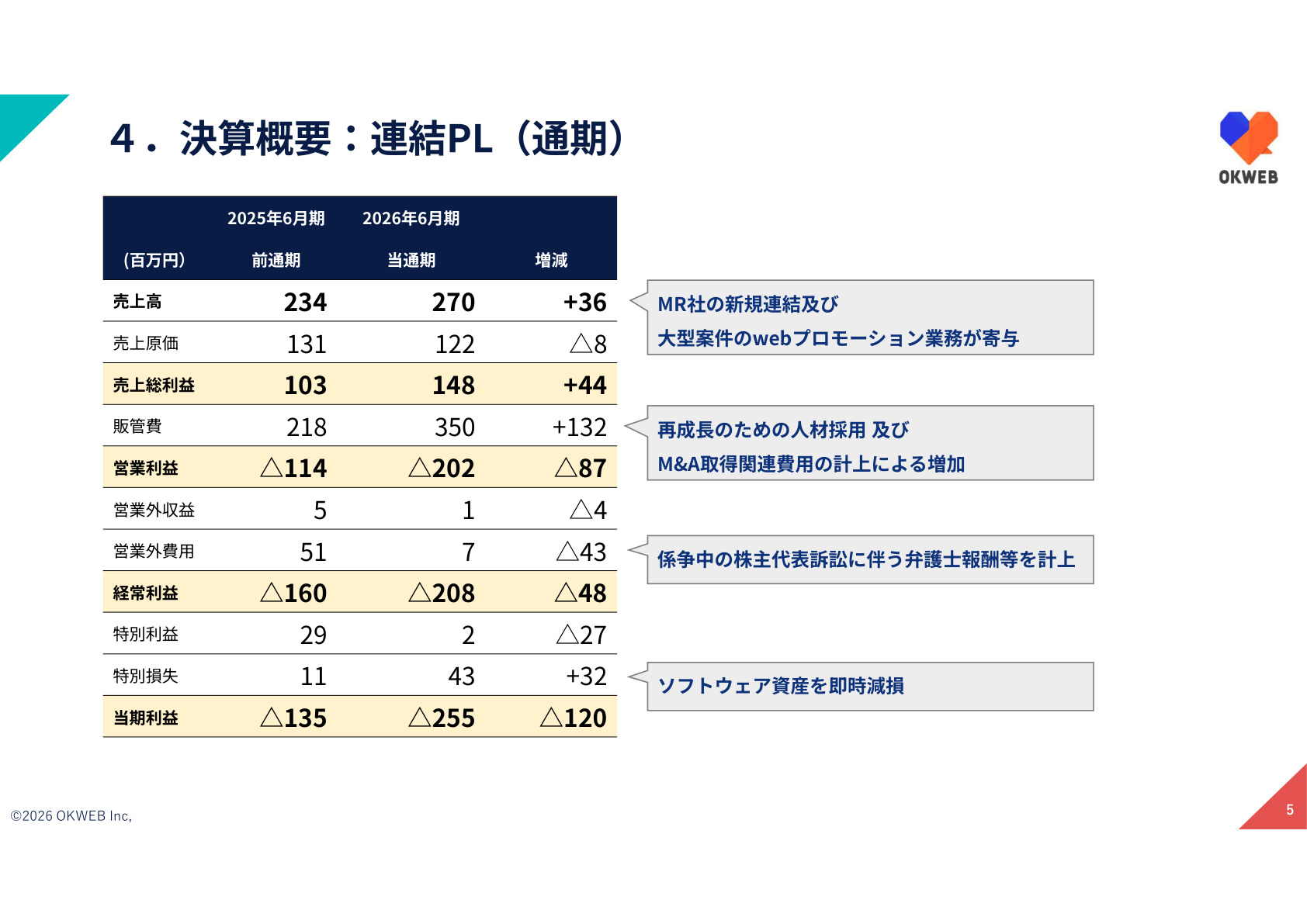
For the fiscal year (July 1, 2025 – June 30, 2026), the company achieved net sales of 270 million yen (up 36 million yen, or 15.4% YoY) and gross profit of 148 million yen (up 44 million yen, or 43.7% YoY) , marking a successful increase in both revenue and gross margins.
However, due to increased expenditures related to strengthening the organizational structure and rebuilding the business foundation for future growth, the company reported an operating loss of 202 million yen (compared to a 114 million yen loss in the previous year) , an ordinary loss of 208 million yen (compared to 160 million yen) , and a net loss of 255 million yen (compared to 135 million yen) , resulting in an expansion of the deficit.
Ten key management developments are highlighted below:
- Strategic Pivot : Transitioning from austerity to an aggressive management phase involving upfront investment.
- M&A (1) : Acquisition of all shares of Media Remake Co., Ltd. (MR), making it a consolidated subsidiary (consolidated in the P&L from Q2).
- M&A (2) : Acquisition of JINEN Co., Ltd. via share exchange, making it a consolidated subsidiary (consolidated in the BS at year-end).
- Redefining Core Products : Re-evaluating the service value of the community platforms (OKWAVE Plus, OKWAVE) and "GRATICA."
- Academic Collaboration : Implementing supervision for "GRATICA" by Professor Takashi Maeno of Musashino University (Well-being Studies).
- Resumption of Development Investment : Restarting system development to launch new features and services.
- Resumption of Hiring : Full-scale recruitment of talent ranging from member-level to executive-level staff.
- Top-line Growth : Revenue growth driven by the consolidation of MR and the acquisition of large-scale promotional projects.
- Improvement in Cost of Sales : Significant improvement in gross margin due to a reduction in cost of sales (122 million yen, down 8 million yen YoY).
- Liquidity and Extraordinary Losses : Maintaining 442 million yen in cash and deposits while executing an immediate impairment of software assets (43 million yen).
2. Structural Analysis of the Consolidated P&L
To grasp the full picture of the financial results, we examine the fundamental structure of the full-year P&L.
Why this slide is important
The slide above is critical as it clearly illustrates the contrast between the factors driving revenue growth and those expanding the deficit. It visualizes the data behind why operating profit and subsequent profit stages were suppressed despite growth in net sales and gross profit.
Background and Detailed Analysis
- Increase in Net Sales (270 million yen, +36 million yen) : The primary driver was the revenue contribution from the newly consolidated MR, alongside the successful acquisition and execution of large-scale web promotion projects in existing businesses.
- Reduction in Cost of Sales and Expansion of Gross Profit (148 million yen, +44 million yen) : With the cost of sales contained at 122 million yen (down 8 million yen YoY), the gross profit margin improved by 10.8 percentage points, rising from 44.0% to 54.8% . This was supported by acquiring high-unit-price clients and efficient project management.
- Surge in SG&A Expenses (350 million yen, +132 million yen YoY) : The primary cause of the expanded operating loss is the increase in SG&A expenses. This reflects the company's exit from the business contraction phase and active investment in recruitment costs for future growth and M&A-related expenses for MR and JINEN.
- Non-operating and Extraordinary Items : Non-operating expenses (7 million yen) include legal fees related to an ongoing shareholder derivative suit, while extraordinary losses (43 million yen) include an immediate impairment of software assets to proactively clear future risks.
3. Momentum and Investment Cycle in Quarterly Performance
Next, we track the quarterly trends in net sales and operating profit to assess current performance momentum and the impact of upfront investments.
Why this slide is important
This quarterly trend graph is essential because it consolidates data from the past three fiscal years (FY2024–FY2026), allowing for an immediate understanding of when the company began scaling revenue and at what point it resumed investment .
Background and Detailed Analysis
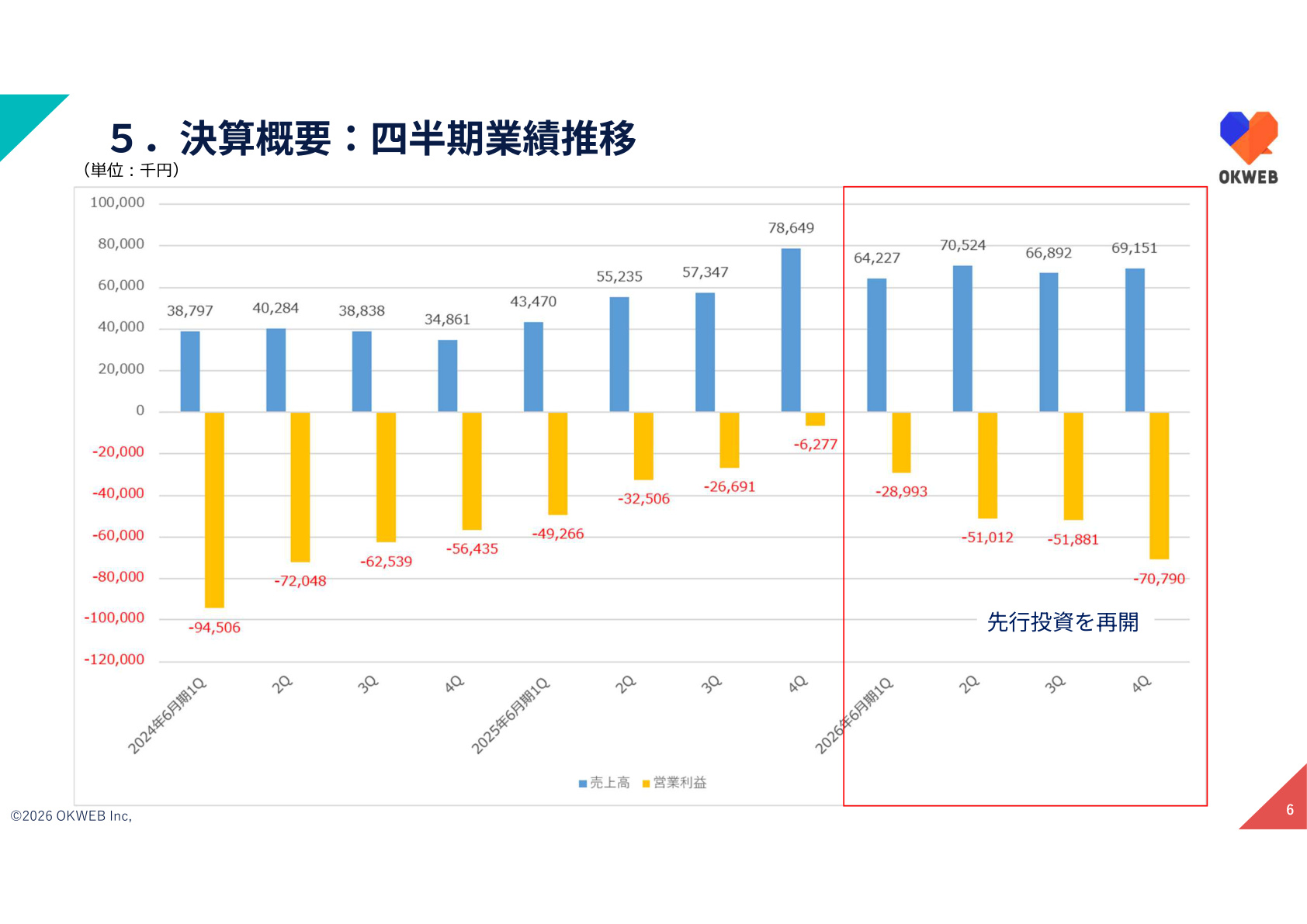
- Revenue Trend Shift : Quarterly sales in FY2024 hovered in the 30 million yen range, but began to expand in the second half of FY2025. In FY2026, sales remained stable at a high level of 60–70 million yen per quarter ( Q1: 64.22M, Q2: 70.52M, Q3: 66.89M, Q4: 69.15M ).
- Operating Profit and Scaling of Upfront Investment : In Q4 of FY2025, the operating loss narrowed to 6.27 million yen, briefly approaching break-even. However, following the policy shift in FY2026, the deficit expanded sequentially ( Q1: 28.99M, Q2: 51.01M, Q3: 51.88M, Q4: 70.79M ).
- Management Intent : This expansion in the deficit is not due to deteriorating performance, but is a direct reflection of strategic upfront investments , including the resumption of system development, new feature development, and expanded hiring to strengthen future competitiveness.
4. Service-Specific Revenue Trends and Organizational Structure
We also examine the breakdown of the revenue structure and the corresponding changes in personnel.
Why this slide is important
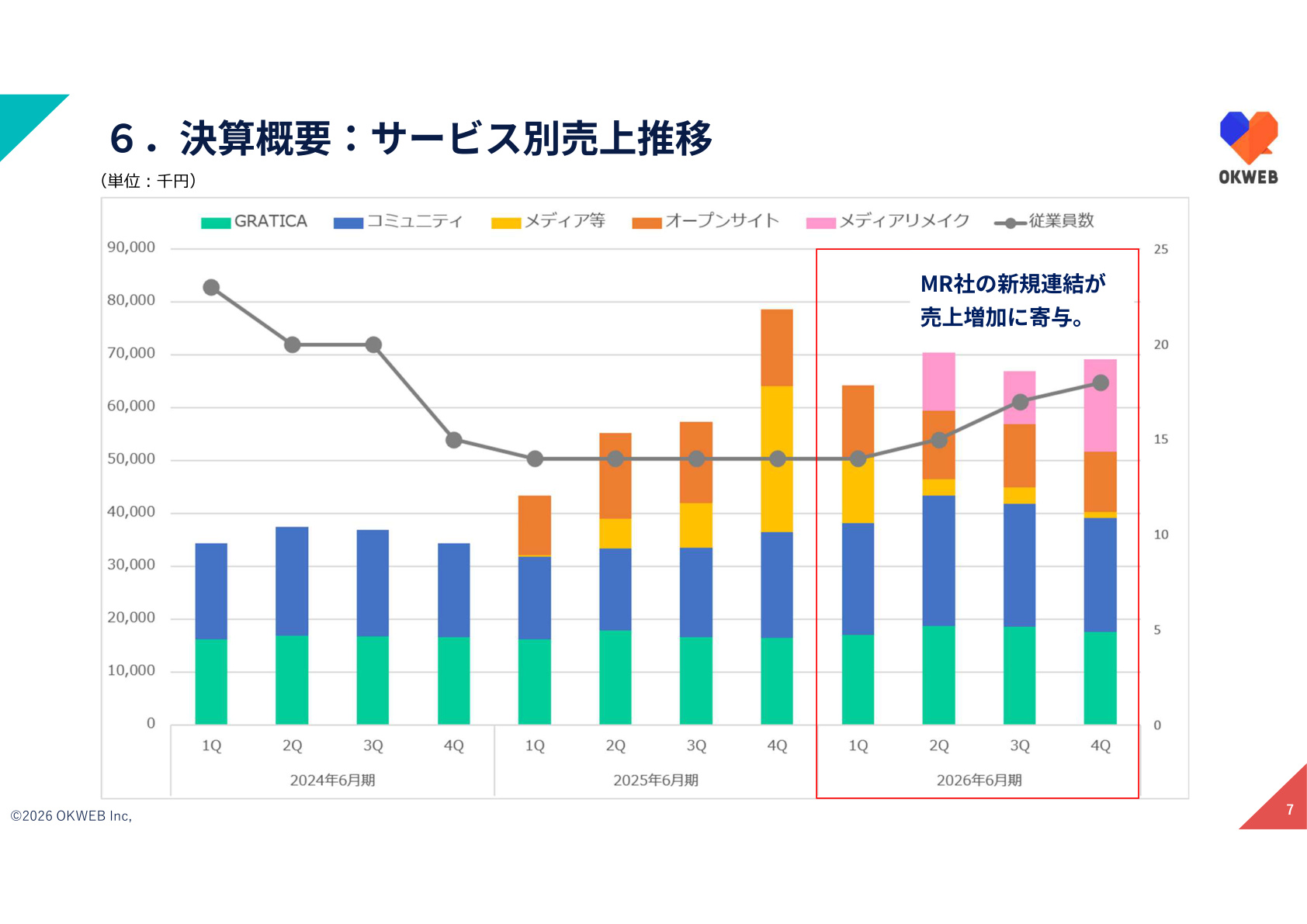
This slide is characterized by the overlay of changes in revenue composition for each business/service (GRATICA, Community, Media, etc., Open Site, Media Remake) with the trend in the number of employees shown on the right axis, demonstrating the link between portfolio diversification and organizational strengthening.
Background and Detailed Analysis
- Analysis by Service :
- GRATICA (Thanks Card Service) : Maintains a stable revenue base, with ongoing value enhancement from a well-being perspective under the supervision of Professor Maeno.
- Community (OKWAVE / OKWAVE Plus) : Continues to perform steadily as the company's core service.
- Media Remake (MR) : Newly added to revenue from Q2 FY2026, contributing to top-line growth as a new, cumulative growth axis .
- Employee Trends and Organizational Strengthening : The number of employees, which had shrunk to around 15 in FY2025, increased to 19 by Q4 FY2026 as hiring resumed. The company is recruiting not only at the member level but also at the executive level, steadily building the structure needed to drive product improvements and new service development.
5. Balance Sheet (BS) Analysis and Financial Position
We summarize the status of assets, liabilities, and net assets from the perspective of financial stability.
- Current Assets : 543 million yen (down 36 million yen from the previous year-end).
- Cash and Deposits : 442 million yen (down 99 million yen), maintaining liquidity to support ongoing operations and investment activities.
- Accounts Receivable : 32 million yen (up 15 million yen), due to new consolidation.
- Other : 68 million yen (up 47 million yen), including deposits to development companies.
- Fixed Assets : 1,174 million yen (up 29 million yen).
- Intangible Fixed Assets : 105 million yen (up 28 million yen), due to the emergence and increase of goodwill from the consolidation of MR and JINEN.
- Investments and Other Assets : 1,068 million yen (no change).
- Net Assets and Equity Ratio :
- Total Net Assets : 372 million yen (flat compared to the previous year-end).
- Shareholder Equity Trends : While there was a 256 million yen increase from capital increases and share exchanges, this was offset by the 255 million yen net loss, resulting in a largely flat position.
- Equity Ratio : 19.1% .
6. Summary and Future Outlook
FY2026 was a year in which OKWAVE, Inc. concluded its phase of financial stabilization and contraction, and aggressively pushed forward with "laying the foundation for renewed growth."
Key points to watch moving forward include :
- When the hired talent and resumed system development investments will bear fruit in the form of new feature/service launches and improved profitability of existing products.
- The extent to which synergies with Media Remake and JINEN will contribute to revenue and profit expansion.
- When the company can transition from the current deficit phase caused by upfront investment to a profitable growth trajectory .
We will continue to monitor how the seeds sown through strategic upfront investment and business acquisitions will shape the company's future growth story.
This content is not intended as investment advice or a recommendation. Any opinions expressed are solely the personal views of each article.