


enish Inc. FY2026 Q2 Earnings Deep Dive: Driving Business Structural Reform through AI-Powered Development Efficiency and DAT Strategy

StockClub
Published: Aug 14, 2026, 10:20 AM
Sentiment Analysis
1. Earnings Overview: Revenue Trends and Financial Foundation in the Investment Phase
enish Inc.'s performance for the second quarter of the fiscal year ending December 2026 (FY26 2Q) is positioned within a "growth investment phase," characterized by continued upfront investments in the development and pre-promotion of new titles, as well as the advancement of its DAT (Digital Asset Treasury) business.
FY26 2Q Cumulative and Quarterly Performance Highlights
For the cumulative FY26 2Q period (January to June 2026), consolidated results showed net sales of 925 million yen (down 22.5% YoY) and an operating loss of 542 million yen (compared to an operating loss of 384 million yen in the same period last year) . Net sales remained below the previous year's levels, reflecting the downward trend in existing titles.
However, looking at the 2Q accounting period (April to June 2026) in isolation, net sales were 449 million yen (down 5.7% QoQ) , and the operating loss was 263 million yen (an improvement of 14 million yen QoQ) , indicating a narrowing of the operating deficit compared to the previous quarter (1Q). This was supported by a reduction in the cost of sales to 547 million yen (down 11.6% QoQ).
Trends in Sales and Costs
Net sales have shown a gradual decline since peaking at 999 million yen in FY23 3Q, reaching 449 million yen in FY26 2Q. However, with the official release of the major new IP title Yowamushi Pedal: Resonance Pedals on July 23, 2026, the company has entered a phase where contributions to earnings are expected from FY26 3Q (July–September) onwards .
Regarding costs, total costs (cost of sales + SG&A) in FY26 2Q were contained at 713 million yen (a decrease of 42 million yen QoQ). The cost breakdown is as follows:
- Labor/Personnel Expenses : 145 million yen (maintaining a downward trend through the optimization of development resources)
- Payment Commissions (Cost of Sales) : 174 million yen
- Outsourcing Expenses : 86 million yen
- Advertising Expenses : 48 million yen (including pre-promotion costs for Pedals)
- Other : 260 million yen
Regarding the workforce, the company has undergone a phased structural reform from 234 employees in FY23 2Q to 126 employees (78 in Japan, 48 overseas) as of the end of FY26 2Q. An efficient structure is being established to maintain and provide high-quality services with limited development resources.
Balance Sheet and Financing Status
Financially, the company is securing cash on hand to support growth investments. The cash and deposits balance at the end of FY26 2Q recovered to 754 million yen (an increase of 192 million yen QoQ) . This is due to progress in financing, with 168 million yen raised by the end of June 2026 and 150 million yen in July, totaling 273 million yen (42.0% issuance absorption rate) . The funds raised are earmarked for expanding the game pipeline and growth investments in the DAT business. Total net assets are 787 million yen, maintaining an equity ratio of 57.5% .
2. Development Structural Reform: Leveraging AI Development Infrastructure and Shifting the Title Supply Model
enish is moving away from its traditional development structure, which relied on single hit titles, and is fully transitioning to a highly efficient multi-title simultaneous development system . The core of this transition is the proactive implementation of an AI development infrastructure .
Slide Explanation: Resource Reallocation Structure through AI Utilization
The slide above (P.10) illustrates the company's initiatives to improve development productivity and its resource allocation concept. Against the goal of a "60% reduction in man-hours," an approximate 40% reduction effect has been confirmed to date . As shown in the pie chart, development resource allocation is categorized into three areas:
- Tool Utilization (Standard Engine Features: 48%) : Standardizing and automating common functions such as login bonuses, announcements, season passes, and shops.
- Customization (Engine Extensions: 10%) : Expanding foundations for gacha, ADV (adventure parts), and profiles.
- Unique Title Features (42%) : Concentrating development resources on core elements that define the user experience, such as in-game actions, stage design, and character enhancement.
This structural reform enables significant reductions in development time and costs, facilitating a transition to a "continuous title supply model" capable of launching 3–4 IP titles per year .
Title Pipeline and Service Progress
The current pipeline consists of the following five titles:
- Yowamushi Pedal: Resonance Pedals: Officially launched on July 23, 2026. As a flagship title, it is expected to drive revenue growth by leveraging original key visuals and strong IP recognition.
- Yuru Camp: Everyone's Wacha Wacha! Camping Cook!: A camping action game currently being prepared for Nintendo Switch™, Steam®, and smartphones, featuring unique action mechanics focused on preparation.
- Seiyu Zoo Voiceful: Currently in development.
- Unannounced IP Titles (a) and (b) : Multiple projects with undisclosed details are currently in development.
Additionally, the fan-participation prediction platform "MIRAPICK" is under development, with plans to enhance user engagement through prediction communities and explore synergies with the DAT strategy.
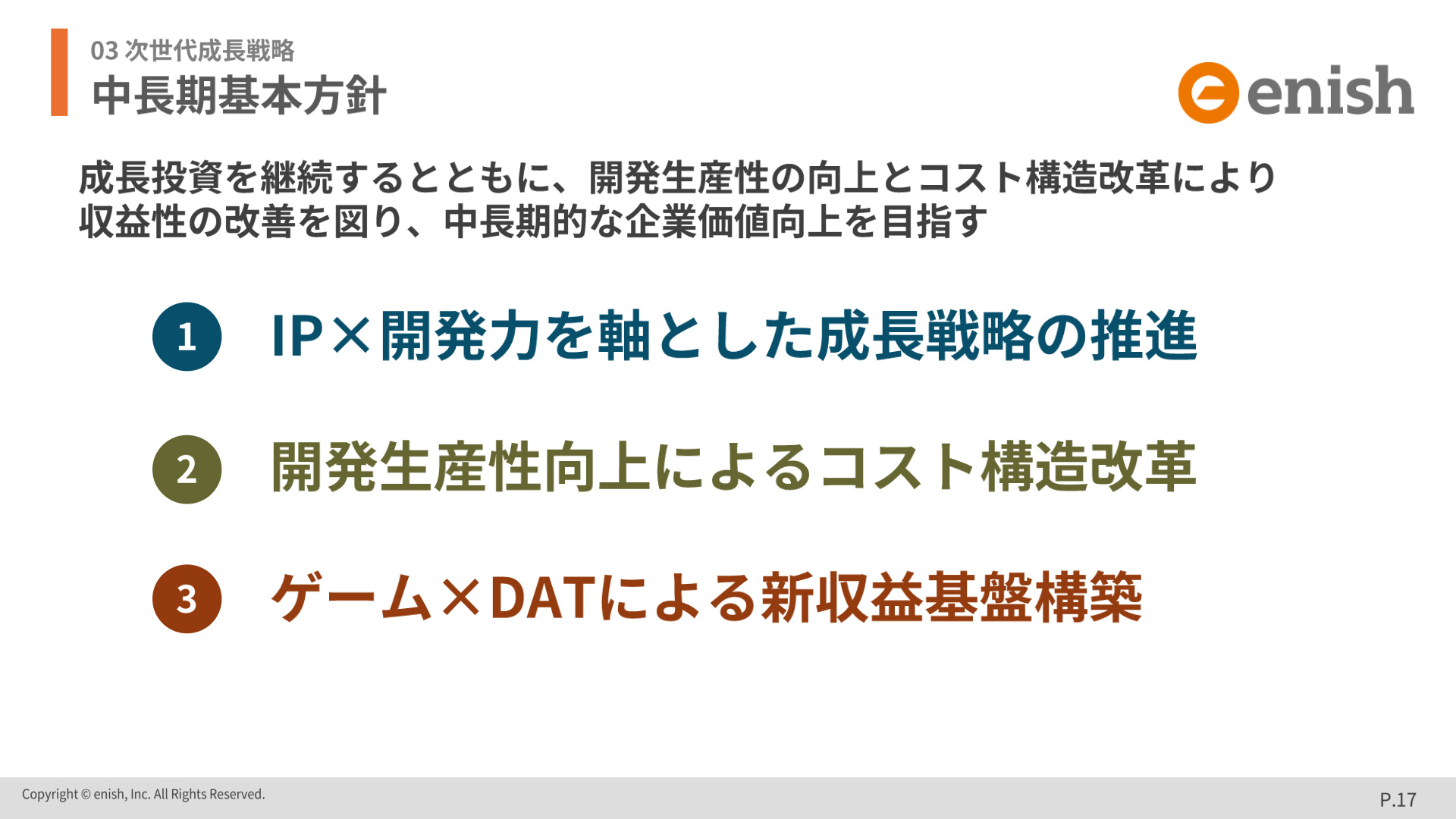
3. Next-Generation Growth Strategy: Integrating High-Efficiency Development with DAT (Digital Asset Treasury)
The company aims to evolve from a traditional mobile game business into a next-generation growth model that incorporates Web3 and cryptocurrency technology.
Slide Explanation: Qualitative Shift in the Growth Model
The slide above (P.18) outlines the company's strategic vision. The traditional business model of "large-scale long-term development," "domestic market focus," and "hit-dependency" was accompanied by high development costs and uncertainty. The new model shifts toward a circular reinvestment model ( AI ➔ Titles ➔ Revenue ➔ DAT ➔ Reinvestment ):
- High-efficiency development using AI to launch multiple titles with reduced risk.
- Connecting revenue generated from titles to the DAT (Digital Asset Treasury) strategy to improve asset management efficiency.
- Reinvesting returns into game development and ecosystem expansion.
Specific DAT Initiatives and External Partnerships
In the DAT business, the company has selected Solana (SOL) as its core asset and is rapidly building its business foundation:
- Collaboration with SOL Planet : Partnering with SOL Planet, which specializes in Solana infrastructure and ecosystem support, to advance income gain acquisition and management through staking and delegation.
- Launch of Official SNS "ENI Kishu" : Strengthening community formation by disseminating information on DAT progress and the Solana ecosystem.
- Investment in "SBI Crypto Fund I" : Decided to invest in the fund to gain access to promising investment opportunities in the crypto/Web3 space and expand its network of domestic and international operators.
4. New Revenue Foundation: "Game x DAT Ecosystem" and Shareholder Return Measures
To support long-term sustainable growth, the company is conceptualizing a "Game x DAT Ecosystem" that directly links the game business with the DAT business.
Slide Explanation: Circular Mechanism of Game Revenue and Crypto Asset Management
The slide above (P.20) illustrates the circular model connecting players, the game business, the DAT business, and the monthly distribution pool.
- Revenue Growth : Game revenue increases as players engage and make in-game purchases.
- Treasury Expansion : A portion of the generated revenue is allocated to the DAT business, expanding the financial foundation (treasury).
- Increase in Distribution Source : Results obtained from DAT management (staking, etc.) are accumulated in the "Monthly Distribution Pool (SOL)."
- Return and Retention : Returning accumulated assets to players and the community enhances game engagement and retention rates.
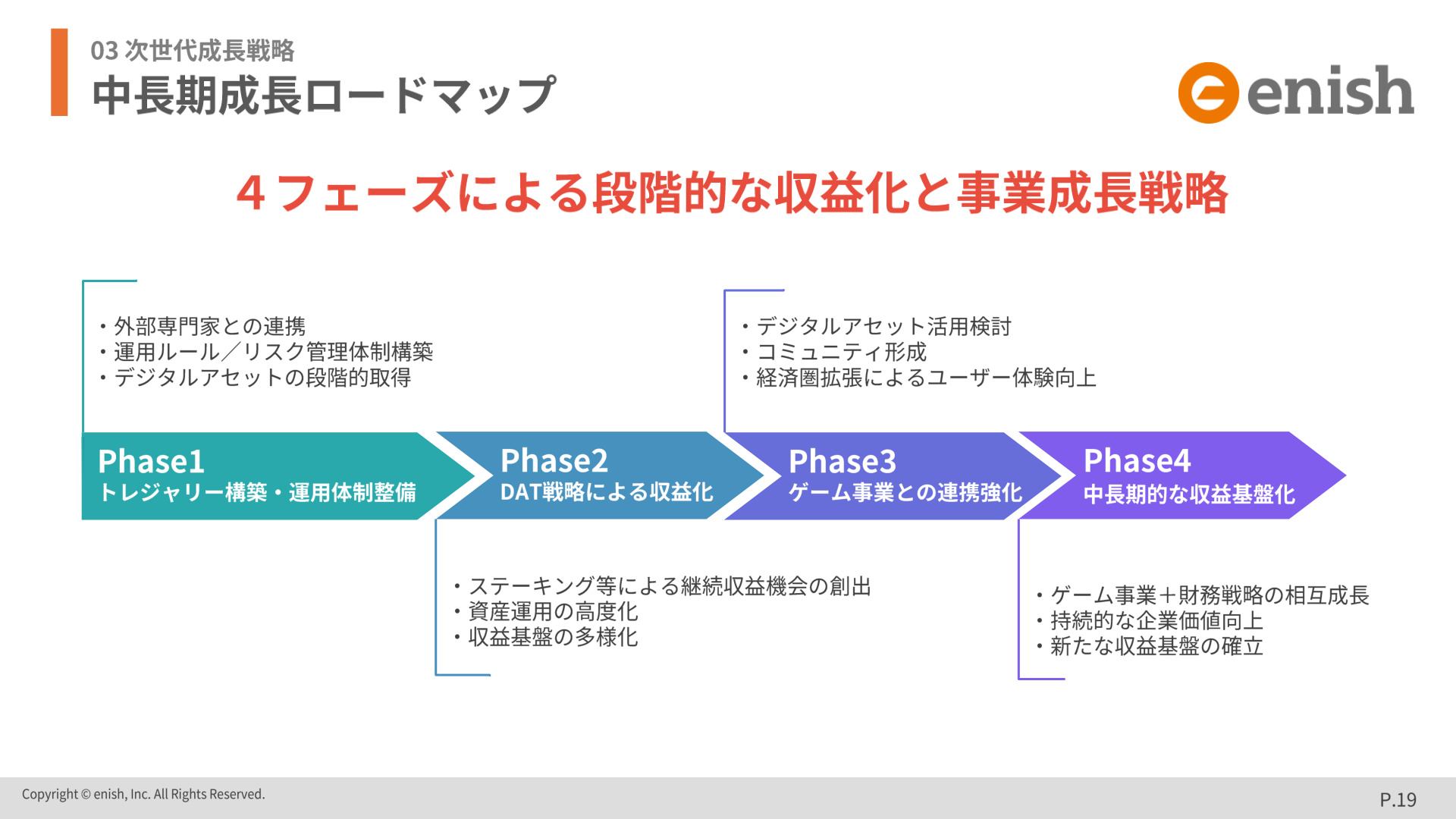
This ecosystem roadmap is planned in four phases, from Phase 1 (establishing management systems) to Phase 4 (establishing a long-term revenue base).
Introduction of Shareholder Benefit Program
To enhance shareholder returns and promote understanding of the DAT business, the company announced the introduction of a new shareholder benefit program :
- Eligibility : Shareholders holding 500 shares (5 units) or more as of the end of December 2026.
- Content : A lottery to award a total of 10 million yen worth of crypto assets (Bitcoin/SOL) .
- Timing : Based on the record date of the end of December 2026, with distribution scheduled for spring 2027.
This initiative aims to strengthen relationships with shareholders while providing an opportunity to experience the company's Web3 and DAT business firsthand.
5. Summary and Future Observation Points
enish's FY26 2Q earnings show that while the company continues to post losses due to upfront investments, it has reached a turning point where the results of structural reforms—such as a 40% reduction in man-hours through AI implementation , the establishment of a system to launch 3–4 IP titles annually, and the release of Yowamushi Pedal—are steadily emerging.
Key points to watch moving forward include the revenue contribution of the new release Pedals, ** adherence to the release schedule for titles in development , and the ** operational performance of the SOL-centric DAT business and its contribution to the ecosystem. Attention will be focused on how the combination of high-efficiency development and new financial strategies impacts future corporate value.
This content is not intended as investment advice or a recommendation. Any opinions expressed are solely the personal views of each article.