


In-Depth Earnings Analysis: General Oyster Q1 FY2027 – Structural Reforms Drive Profitability in Restaurant Operations and Growth Across All Segments

StockClub
Published: Aug 14, 2026, 10:12 AM
Sentiment Analysis
In-Depth Earnings Analysis: General Oyster Q1 FY2027 Results
1. Q1 FY2027 Earnings Summary: Revenue Growth Across All Segments and Significant Reduction in Operating Losses
General Oyster, Inc. reported consolidated financial results for the first quarter of the fiscal year ending March 2027, achieving revenue growth across all segments, including its core restaurant business. Net sales reached 989 million yen (up 29.2% year-on-year).
Regarding profitability, while the company continues to face headwinds from rising raw material costs and increased selling, general, and administrative expenses—including labor costs—efforts to improve the profitability of existing stores, streamline operations, and restructure the central kitchen (processing business) have proven effective. Consequently, the operating loss narrowed significantly to 26 million yen (compared to a 79 million yen loss in the same period last year). Furthermore, the ordinary loss was 27 million yen (compared to an 80 million yen loss last year) , and the quarterly net loss attributable to owners of the parent was 17 million yen (compared to a 71 million yen loss last year) , signaling steady progress in improving the company's earnings structure.
Looking ahead to the full-year forecast, the company anticipates a turnaround to an operating profit of 60 million yen , driven by further growth in the restaurant business in the second half and contributions from new areas such as the renewable energy business. With a planned full-year dividend of 10 yen per share , the company has established a clear roadmap toward financial recovery.
2. Analysis of Consolidated Performance and Profit Structure
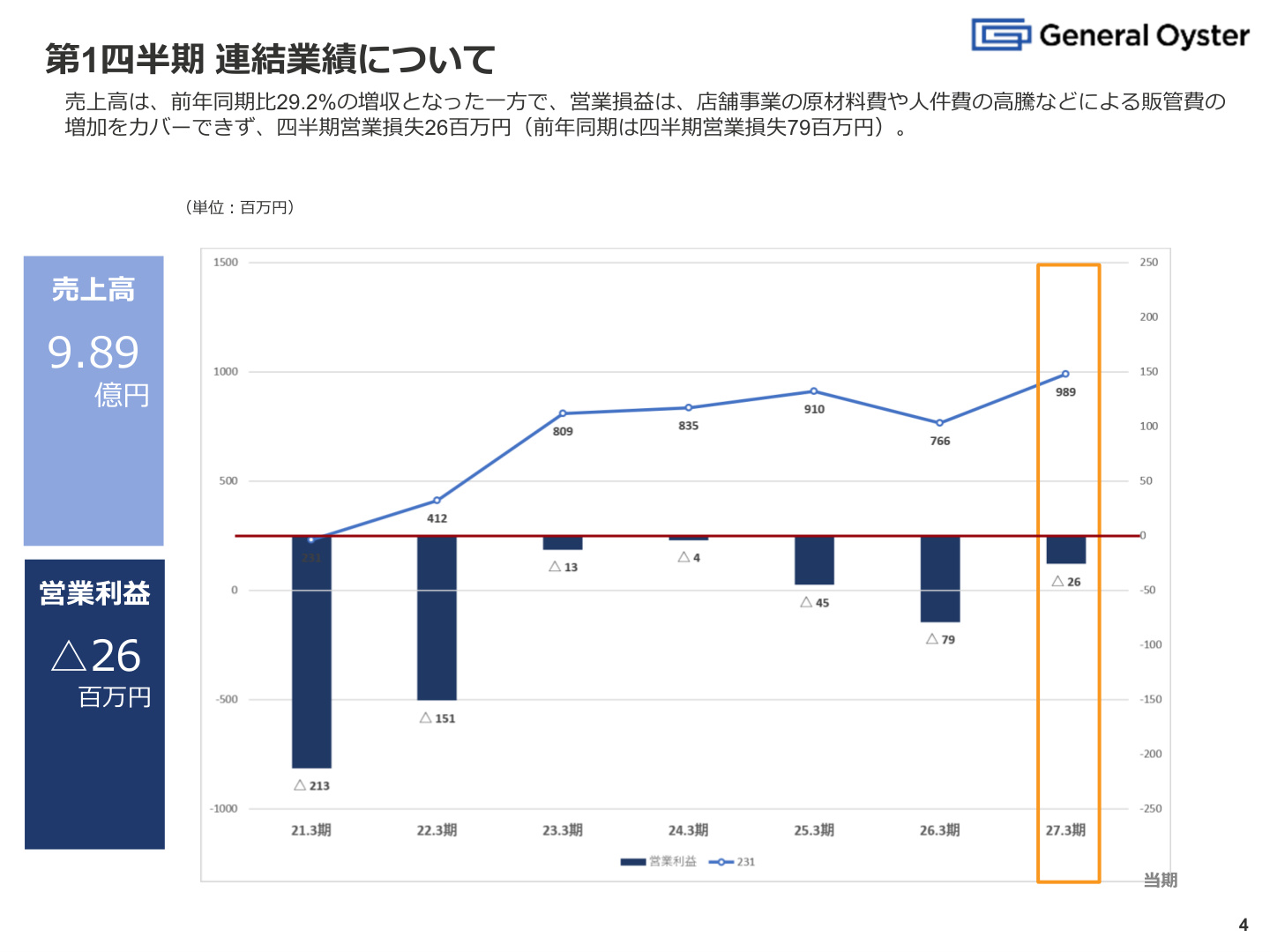
The following graph illustrates the trends in net sales and operating profit for the first quarter over the past several fiscal years.
Slide Commentary: Why This Performance Data is Crucial
The slide above (Page 3) provides vital visual evidence of the company’s mid-to-long-term top-line recovery trend and the trajectory of narrowing operating losses.
Compared to the fiscal years ending March 2021 (sales of 231 million yen, operating loss of 213 million yen) and March 2022 (sales of 412 million yen, operating loss of 151 million yen), which were heavily impacted by the COVID-19 pandemic, sales have seen a sharp recovery to the 800 million and 900 million yen levels following the lifting of movement restrictions. Despite a temporary dip to 766 million yen in the same period last year (Q1 FY2026), this quarter’s sales of 989 million yen mark the highest level for a first quarter in recent years.
In terms of operating profit, the company achieved a significant improvement of 53 million yen , moving from a loss of 79 million yen in the previous year to a loss of 26 million yen. In a market environment burdened by inflation and high raw material costs, the company did not merely increase sales; it improved gross profit to 659 million yen (up 29.2% year-on-year) through rigorous cost control and operational efficiency, leading to a dramatic reduction in operating losses.
3. Detailed Segment Performance Analysis
The company’s business is diversified, centered on its core "Restaurant Business," with additional segments including "Wholesale," "Processing," "Purification," "Renewable Energy," and "Other (E-commerce, etc.)." The performance by segment for this first quarter is as follows:
Slide Commentary: Results of Structural Reforms Indicated by Segment Data
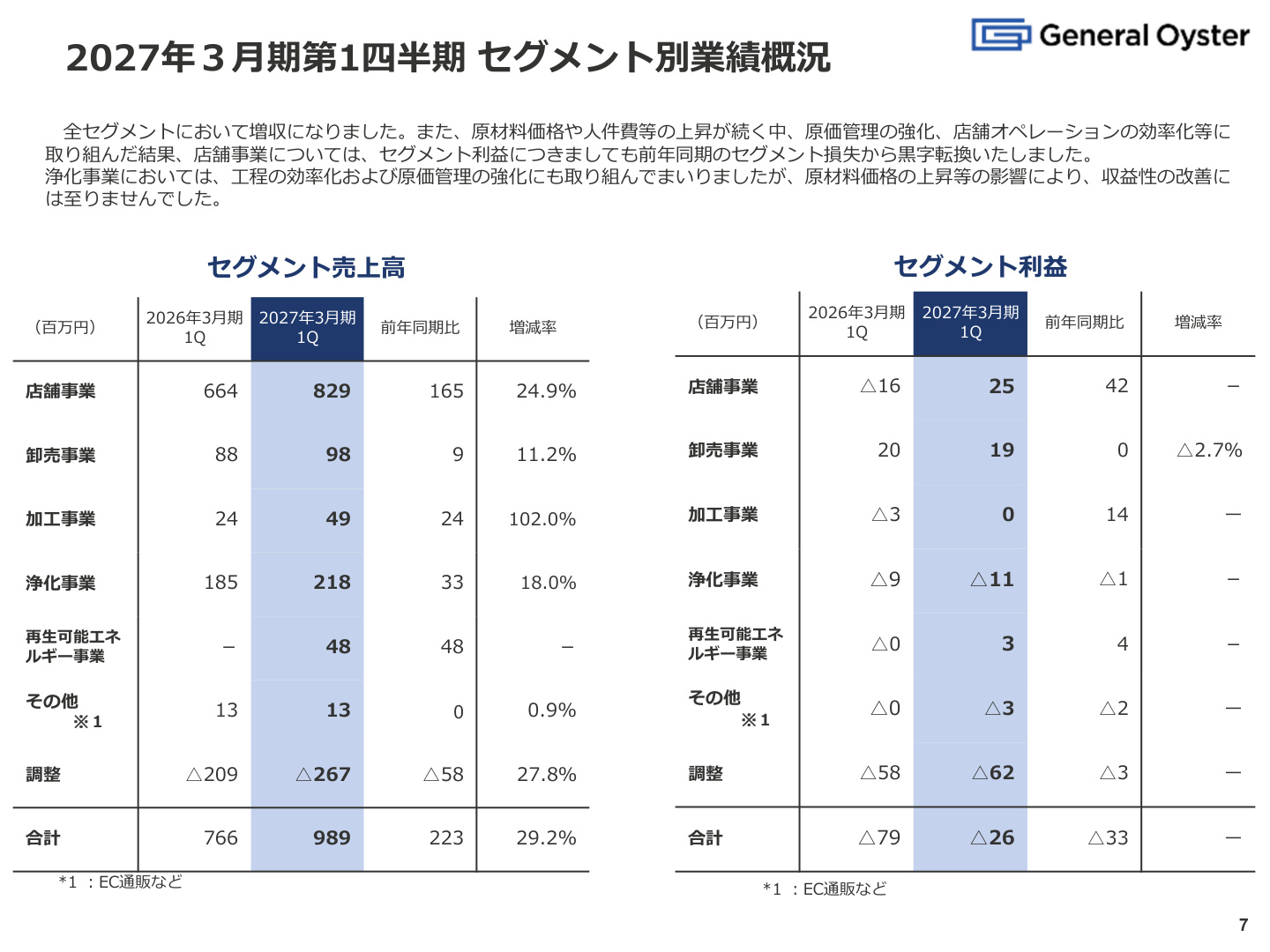
The slide above (Page 6) provides a snapshot of revenue fluctuations and segment profit trends, making it an invaluable resource for understanding how each business division contributes to earnings improvement.
The 29.2% overall revenue growth was driven by the core Restaurant Business (+24.9%), the Processing Business (+102.0%), and the new Renewable Energy Business (generating 48 million yen in sales). In terms of profit, the Restaurant Business’s turnaround from a 16 million yen loss in the previous year to a 25 million yen profit was the primary driver of earnings growth. Details for each major segment are as follows:
① Restaurant Business (Restaurant Chain Operations)
- Net Sales : 829 million yen (up 24.9% YoY)
- Segment Profit : 25 million yen (compared to a 16 million yen loss in the previous year; turnaround to profit )
- Operating Margin : 3.0%
- Number of Stores : 30 directly managed, 3 franchised (33 stores total)
Strengthened profitability of existing stores and the impact of new openings (e.g., "8TH SEA OYSTER Bar Wakayama" and "8TH SEA OYSTER Kitchen Toranomon") led to a substantial revenue increase of 165 million yen. The company offset rising raw material and labor costs through menu price optimization and operational efficiencies, achieving profitability. There were no net changes in store count during Q1, maintaining a stable base of 33 locations.
② Wholesale Business
- Net Sales : 98 million yen (up 11.2% YoY)
- Segment Profit : 19 million yen (down 2.7% YoY)
- Operating Margin : 20.1%
Revenue increased (+9 million yen) due to an expanded customer base, including restaurants and food service providers. However, rising raw material costs for oysters slightly pressured margins, causing segment profit to dip slightly from 20 million yen to 19 million yen, while still maintaining a high profit margin exceeding 20%.
③ Processing Business (Central Kitchen)
- Net Sales : 49 million yen (up 102.0% YoY)
- Segment Profit : 0 million yen (compared to a 13 million yen loss in the previous year; improvement to break-even )
The central kitchen strengthened its functions, specializing in processed goods for the restaurant business and franchises, as well as pasta production. Careful selection of product lines and a review of production systems resulted in a doubling of sales (+24 million yen) and a 14 million yen improvement in operating profit, successfully eliminating losses.
④ Purification Business (Oyster Purification and Quality Control)
- Net Sales : 218 million yen (up 18.0% YoY)
- Segment Profit : -11 million yen (compared to a -9 million yen loss in the previous year)
Despite efforts to optimize sales prices for directly managed stores and improve process efficiency, the segment saw a 1 million yen decline in profit to -11 million yen due to changes in the marine environment and rising energy and raw material costs. Strengthening cost management remains a key challenge.
⑤ Renewable Energy Business (New Business)
- Net Sales : 48 million yen (no record in the previous year)
- Segment Profit : 3 million yen (compared to a 0 million yen loss in the previous year)
- Operating Margin : 7.6%
In the renewable energy business, which the company entered in December 2023, sales and profit were recorded this quarter following the conclusion of sales contracts for solar power plants under development, confirming its role as a new pillar of revenue.
4. Financial Position and Balance Sheet (B/S) Analysis
Total assets at the end of the first quarter stood at 2,965 million yen , a decrease of 46 million yen from the end of the previous fiscal year (3,011 million yen).
- Current Assets : 1,590 million yen (down 11 million yen from the end of the previous fiscal year)
- Cash and deposits: 696 million yen (down 83 million yen)
- Accounts receivable: 245 million yen (up 15 million yen)
- Raw materials: 84 million yen (up 19 million yen)
- Non-current Assets : 1,375 million yen (down 34 million yen)
- Property, plant, and equipment: 981 million yen (down 21 million yen)
- Liabilities : 1,496 million yen (up 34 million yen)
- Current liabilities: 716 million yen (including 165 million yen in accounts payable)
- Non-current liabilities: 779 million yen (including 189 million yen in long-term loans)
- Net Assets : 1,469 million yen (down 78 million yen)
- Equity Ratio: 49.2%
Despite a decrease in cash and deposits, the equity ratio remains high at 49.2% , maintaining strong financial health for a food service company. The company continues to manage its balance sheet with careful consideration for future investments and working capital while ensuring sufficient liquidity.
5. Future Management Strategy and Full-Year Forecast for FY2027
The company is advancing management reforms through a dual approach of "defensive measures" and "offensive measures for renewed growth."
Key Initiatives and Progress
- Defensive Measures : Thorough cost control to reduce raw material and labor costs in the restaurant business (Progress: △).
- Offensive Measures :
- Revenue Expansion in Restaurant Business : Launching new brands and further strengthening profit structure (Progress: 〇).
- Earnings Contribution from Processing Business : Promoting central kitchen utilization for efficiency (Progress: 〇).
- Efficiency via IT : Promoting digitalization in store operations (Progress: 〇).
- Promotion of E-commerce, Wholesale, and Renewable Energy : Diversifying sales channels and expanding revenue (Progress: △).
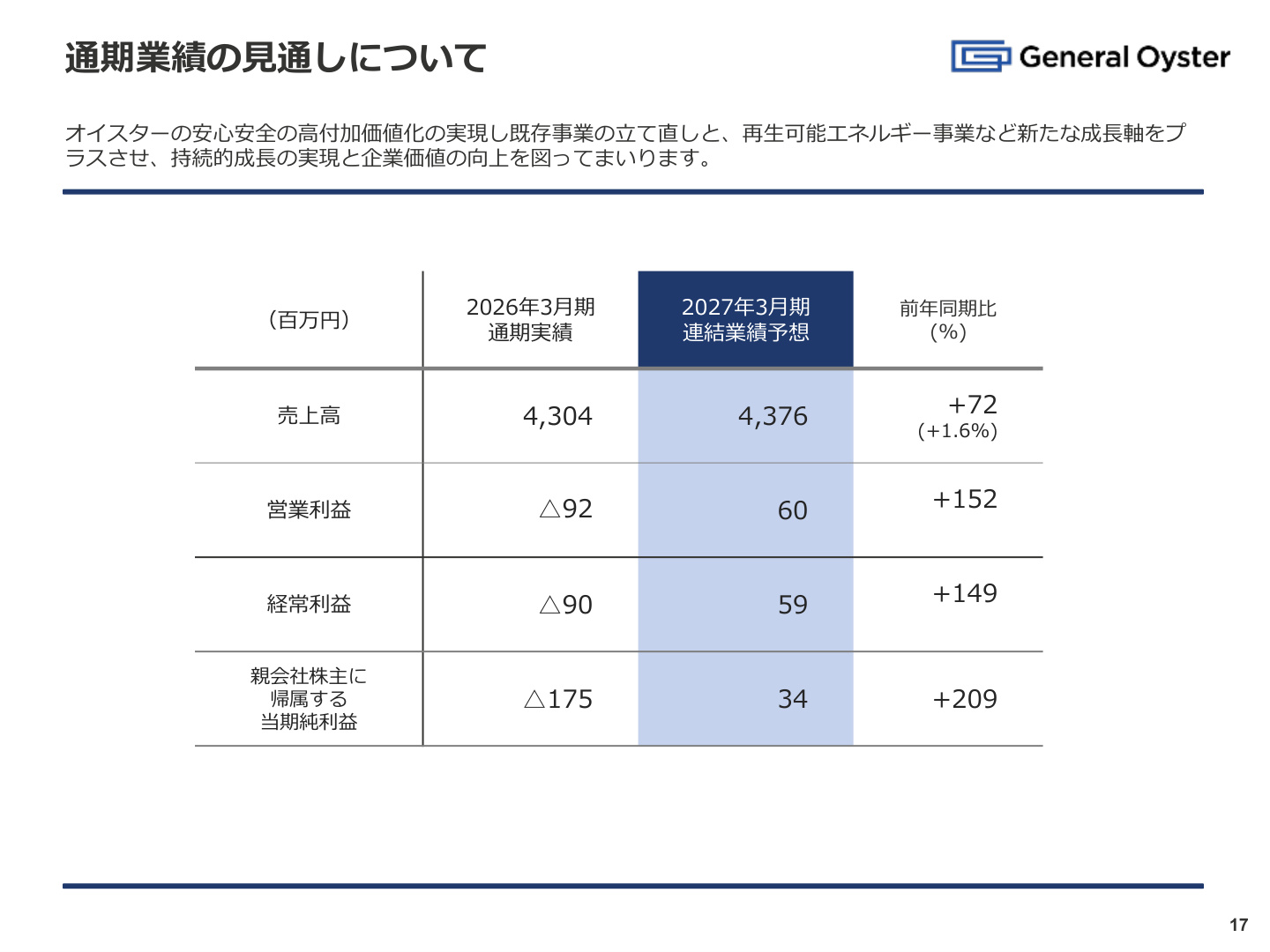
Based on these policies, the full-year consolidated earnings forecast is as shown in the slide below.
Slide Commentary: Scenario for Full-Year Profitability and Key Perspectives
The slide above (Page 16) outlines the company’s full-year earnings plan for FY2027. It is crucial for understanding the overall narrative of how the company intends to achieve a full-year turnaround following the reduction of losses in Q1.
- Full-Year Net Sales : 4,376 million yen (+1.6% YoY)
- Full-Year Operating Profit : 60 million yen (compared to a 92 million yen loss in the previous year; 152 million yen improvement)
- Full-Year Ordinary Profit : 59 million yen (compared to a 90 million yen loss in the previous year; 149 million yen improvement)
- Net Income Attributable to Owners of the Parent : 34 million yen (compared to a 175 million yen loss in the previous year; 209 million yen improvement)
While the operating loss stands at 26 million yen as of Q1, the company plans to expand earnings in the second half by leveraging the seasonality of the restaurant industry (peak demand in the second half and year-end/New Year periods), efficiency gains in the processing business, profit contributions from the renewable energy business, and control over average spend and customer traffic. The goal is to achieve a full-year operating profit of 60 million yen.
Furthermore, in line with the recovery trend, the company plans a full-year dividend of 10 yen per share , demonstrating its commitment to shareholder returns.
6. Conclusion
General Oyster’s Q1 FY2027 results demonstrate that structural reforms are beginning to yield tangible results amidst an inflationary environment, as evidenced by revenue growth across all segments (+29.2%) and the return to operating profit in the core restaurant business (25 million yen).
The company is taking a multi-faceted approach to external cost pressures—such as rising raw material and labor costs—by utilizing its central kitchen (processing business), optimizing pricing and menu composition, and creating new revenue streams in renewable energy. The foundation for full-year profitability is being established. Future quarterly reports will be closely watched to see how effectively these offensive and defensive measures contribute to margin expansion and whether the company remains on track to meet its full-year targets.
This content is not intended as investment advice or a recommendation. Any opinions expressed are solely the personal views of each article.