


Fruta Fruta (2586) Q1 FY2027 Earnings Analysis Report: Structural Transformation Through Supply Chain Strengthening and Global Market Expansion

StockClub
Published: Aug 14, 2026, 10:01 AM
Sentiment Analysis

Fruta Fruta (2586) Q1 FY2027 Earnings Analysis Report: Structural Transformation Through Supply Chain Strengthening and Global Market Expansion
Fruta Fruta Inc.'s Q1 FY2027 earnings (announced August 14, 2026) marked a start characterized by a decline in both revenue and profit. This was driven by a reactionary dip following the overheated acai boom of the previous year, alongside significant upfront investments aimed at meeting future demand. However, a deeper look into the internal structure reveals that the company is successfully transitioning from reliance on temporary trends to establishing acai as a "daily dietary habit," while steadily building a large-scale supply chain to capture global markets.
This report provides a multi-faceted analysis of the company's current performance, financial structure, overseas strategy, and mid-to-long-term growth story, centered on 10 key topics derived from the earnings materials.
1. Q1 Earnings Highlights: Profit Decline Due to Structural Reform and Upfront Investment
Performance for the first quarter was as follows: Net Sales of 524 million yen (down 51.0% YoY) , Operating Loss of 92 million yen (compared to a profit of 161 million yen in the same period last year) , Ordinary Loss of 75 million yen (compared to a profit of 154 million yen) , and Quarterly Net Loss of 75 million yen (compared to a profit of 132 million yen) .
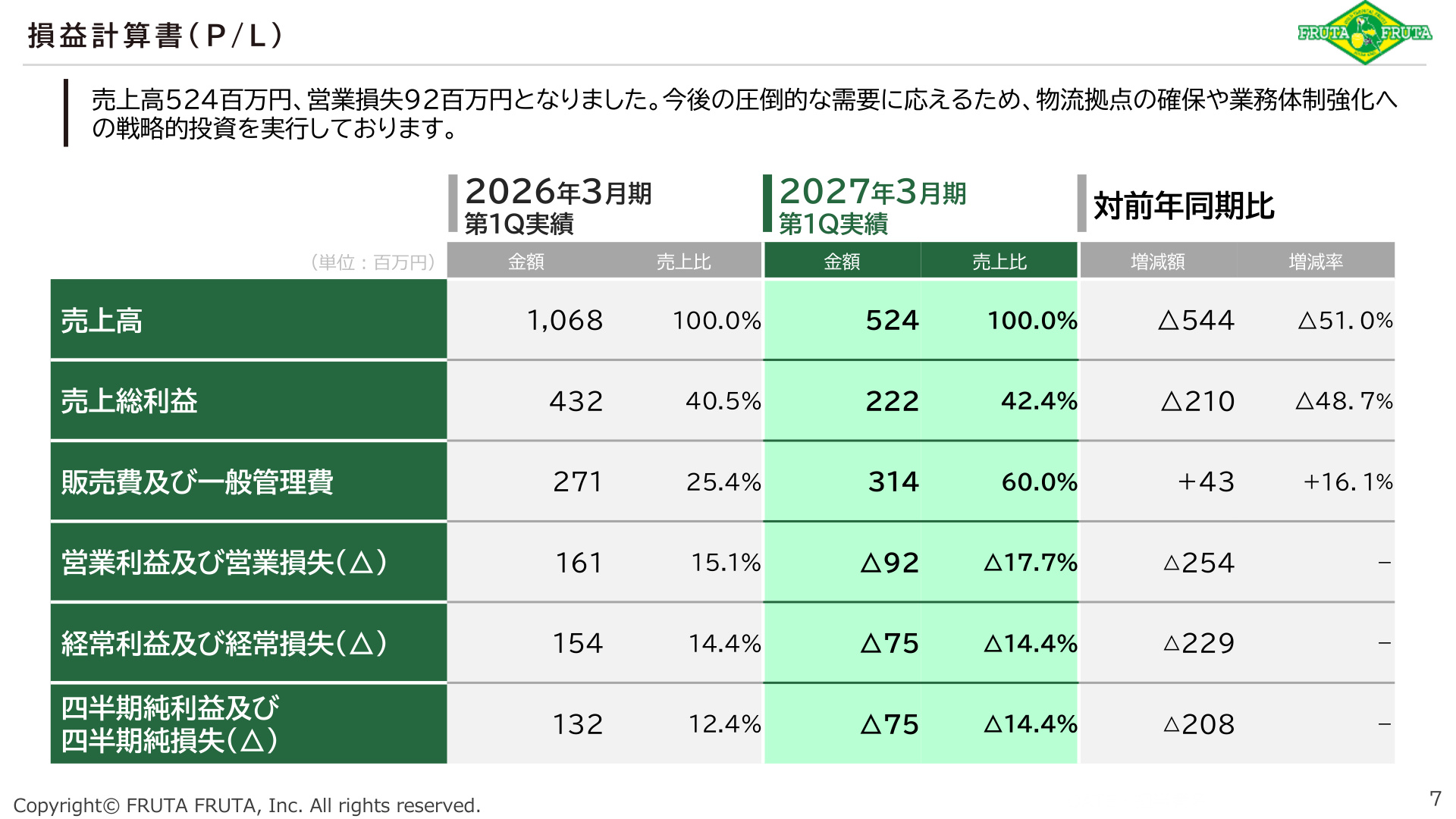
The primary factors for the decline in revenue and profit can be summarized in three points:
- Normalization of demand and inventory adjustments following the rapid acai boom in the previous year.
- Compression of gross profit margins due to strategic price suppression to prevent consumer pullback amid historical yen depreciation.
- Upfront costs for strengthening logistics and operational systems to solidify domestic and overseas supply chains, including China (e.g., 97 million yen in warehouse fees, 45 million yen in outsourcing fees).
While the results may appear challenging at first glance, they represent a structural preparation period intended to meet overwhelming future demand, with intentional upfront investments weighing on current profits.
2. Verification of the Shift from "Transient Boom" to "Daily Dietary Habit"
Despite a significant year-on-year decline, growth across all business segments is evident when compared to the Q1 FY2024 period , prior to the full-scale boom:
- Retail Business : 143 million yen → 195 million yen (approx. 36% increase)
- Food Service Business : 86 million yen → 254 million yen (approx. 195% increase)
- Direct Marketing (DM) Business : 39 million yen → 63 million yen (approx. 61% increase)
This proves that acai consumption is not merely a passing fad but is being elevated into a daily health habit for consumers.
3. Segment Trends and New Product/Channel Strategies
Business segment initiatives and status are as follows:
- Retail Division (Sales: 195 million yen) : Launched new products such as "Yogurt ni Kakeru Dake" (Just pour on yogurt) to expand into the yogurt aisle, and "Frozen Cut Pitaya" targeting acai bowl topping demand.
- Food Service Division (Sales: 254 million yen) : Focused on the stable operation of the company's B2B e-commerce site "BizWeb" and supplying raw materials to food manufacturers, aiming to increase brand awareness by featuring the company logo on packaging.
- DM Division (Sales: 63 million yen) : Expanded OMO (Online Merges with Offline) sales networks while curbing advertising costs through established search traffic.
- Overseas Division (Sales: 9 million yen) : Currently in the infrastructure development phase for full-scale operations.
4. Strengthening the Financial Base: A Robust B/S with a 94.2% Equity Ratio
The balance sheet (B/S) has been further strengthened by the exercise of the 14th series of stock acquisition rights.
- Cash and Deposits : 4.968 billion yen ( +252 million yen from the end of the previous fiscal year)
- Net Assets : 7.372 billion yen ( +294 million yen )
- Equity Ratio : 94.2% (+2.3 percentage points from the end of the previous fiscal year)
With ample liquidity on hand, the company maintains a resilient financial structure capable of supporting future overseas expansion and growth investments in facilities and supply networks.
5. Challenges in the Food Service Market and Differentiation Strategy
In the current B2B acai market, intensifying competition has led to the influx of low-quality products and price dumping. In response, Fruta Fruta is adopting a strategy to defend and enhance brand value by emphasizing the narrative of its high-quality, high-concentration acai produced via agroforestry (environment-creating agriculture) , leveraging traceability and safety as key weapons.
6. Full-Scale Entry into the Chinese Market and Launch of Cross-Border E-commerce
The most significant topic in the overseas strategy is the full-scale entry into the Chinese market , driven by its massive population and growing health consciousness.
In partnership with strategic partner Mogu Co., Ltd., the company has utilized China's unique bonded cold chain to open an official store on Tmall (July 2026) , China's largest premium e-commerce platform.
While overseas sales in Q1 were limited due to country risks such as temporary import suspensions, the completion of local infrastructure has set the stage for full-scale B2C sales centered on live commerce (social distribution) and B2B raw material supply to local cafe chains and the food service industry.
7. Changes to Shareholder Returns and "Evangelist" Strategy
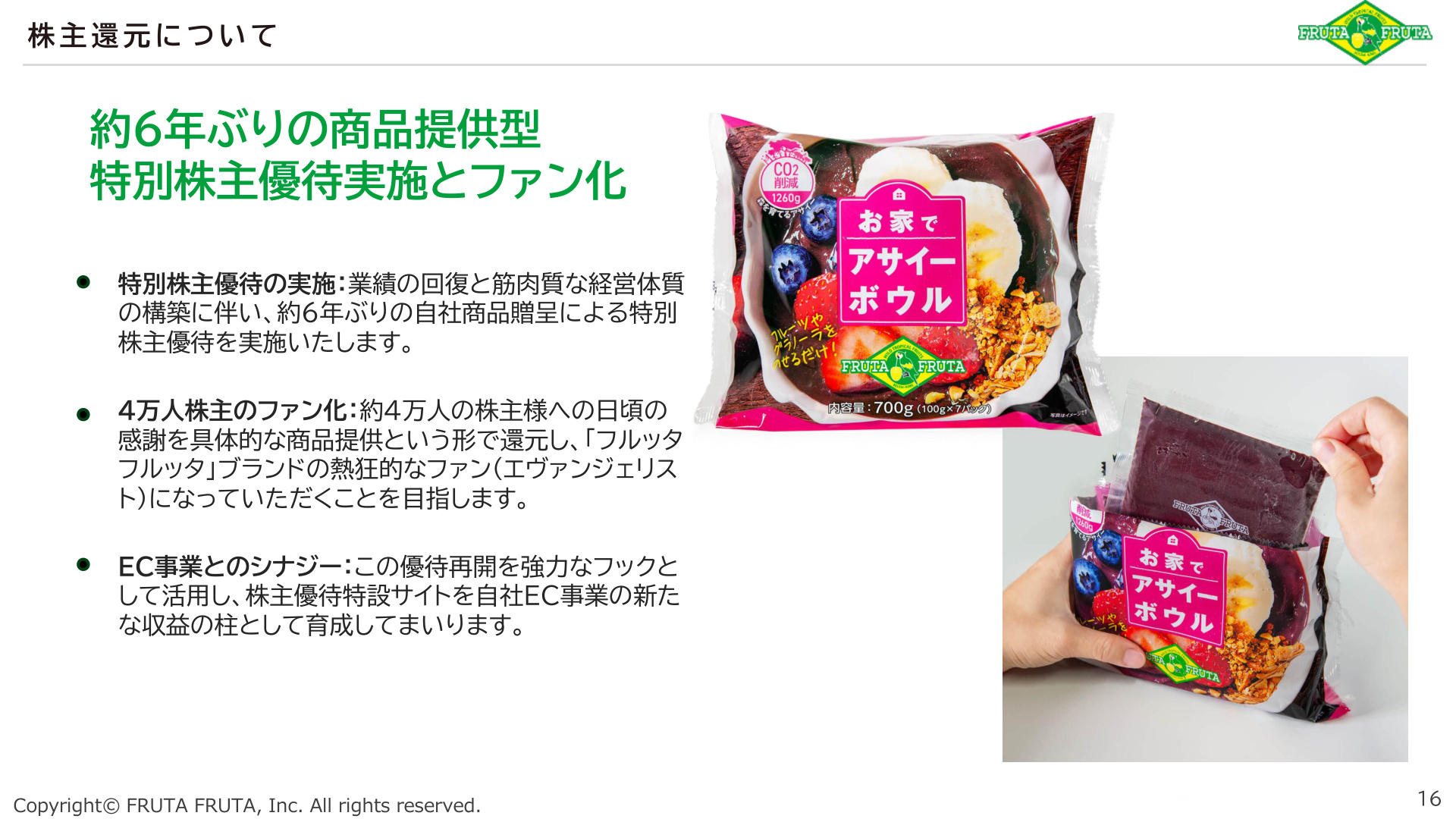
Reflecting the recovery trend and strengthened financial position, the company will implement a special shareholder benefit program (products worth 2,000 yen) for the first time in approximately six years. This is a marketing-linked return policy that goes beyond simple profit distribution; by having its approximately 40,000 shareholders experience the products directly, the company aims to cultivate enthusiastic fans (evangelists) and drive sales growth for its e-commerce business via a dedicated benefits website.
8. Mid-to-Long-Term Roadmap: Transitioning from Benefits to Dividends
Regarding shareholder return policy, while the current fiscal year focuses on building a fan base and activating e-commerce through special benefits, the company has announced a policy to shift to direct and flexible profit returns via "dividends" starting next fiscal year , coinciding with the transition to a stable profit-generation phase. The goal is to continuously enhance shareholder value funded by earnings growth from global expansion.
9. Exclusive Partnership with CAMTA and "Complete Division of Production and Sales"
The greatest strength supporting global expansion is the exclusive import contract with CAMTA (Cooperativa Agrícola Mista de Tomé-Açu) , the largest agricultural cooperative in Brazil.
Furthermore, the company has reached a strategic agreement with CAMTA on the "complete division of production and sales." By taking full responsibility for overseas market development—a role previously partially handled by the cooperative—Fruta Fruta can now execute strategic deployments into the global market with greater speed.
10. Future Earnings Outlook and 15,000-Ton Supply Target Over 5 Years
The full-year earnings forecast for FY2027 projects Net Sales of 3.4 billion yen (up 8.2% YoY) , Operating Profit of 170 million yen (up 80.0% YoY) , and Net Income of 100 million yen (up 20.3% YoY) , anticipating a return to profitability and growth for the full year.

As a metric for mid-to-long-term scaling, the company has formulated a plan to increase the cumulative supply of acai from CAMTA to 15,000 tons over the next five years . This supply scale is equivalent to a business foundation capable of generating 10 billion yen in sales, serving as the supply chain backbone to reliably capture explosive global demand.
Summary
Fruta Fruta's Q1 FY2027 was a period of temporary earnings adjustment due to the cooling of the domestic boom and upfront investments. However, backed by a robust financial position with an equity ratio of 94.2% , the company is steadily laying the groundwork to leap from a single enterprise into a "global sustainable food platform" through initiatives such as the full-scale launch of Chinese e-commerce via Tmall , a plan to install 50 unmanned robotic stores (vending machines) , and the establishment of a 15,000-ton supply system with CAMTA .
This content is not intended as investment advice or a recommendation. Any opinions expressed are solely the personal views of each article.