

![[In-Depth Analysis] Ai Robotics Q1 FY2027 Earnings: A Strategic Pivot to Retail Wholesale and the Path to Mid-to-Long-Term Growth](https://news-images.stock-club.net/market_news/images/247A/140120260814521003/slide_eyecatch_en_d993a18c.webp)
[In-Depth Analysis] Ai Robotics Q1 FY2027 Earnings: A Strategic Pivot to Retail Wholesale and the Path to Mid-to-Long-Term Growth

StockClub
Published: Aug 14, 2026, 09:59 AM
Sentiment Analysis

The Q1 FY2027 earnings report for Ai Robotics Inc. (Ticker: 247A) marks a pivotal turning point as the company aggressively accelerates its business model transformation from a direct-to-consumer (DTC) e-commerce focus to a hybrid model centered on retail wholesale .
This report provides an in-depth analysis of the company’s current performance dynamics, the transformation of its distribution structure, the competitive advantages driven by its proprietary AI system, and its mid-to-long-term growth strategy aimed at achieving a market capitalization of 1 trillion yen, based on 10 key topics extracted from the earnings presentation.
1. Q1 FY2027 Earnings Highlights and Overview
In the first quarter (cumulative), the company recorded explosive top-line growth, with net sales reaching 11,075 million yen (+146.1% YoY) . Conversely, the company reported an operating loss of 531 million yen (compared to a profit of 18 million yen in the same period last year).
While the swing to an operating loss may appear striking at first glance, Adjusted EBITDA , a key indicator of cash-generating ability, remained firmly in the black at 113 million yen (+315.0% YoY) . This profit structure reflects the upfront investments and temporary transition costs associated with the large-scale shift from an e-commerce-only model to a retail wholesale model.
2. Analysis of Profit/Loss Factors: The Truth Behind Distribution Transformation Costs
The following slide details the factors behind the significant year-on-year decline in operating profit.
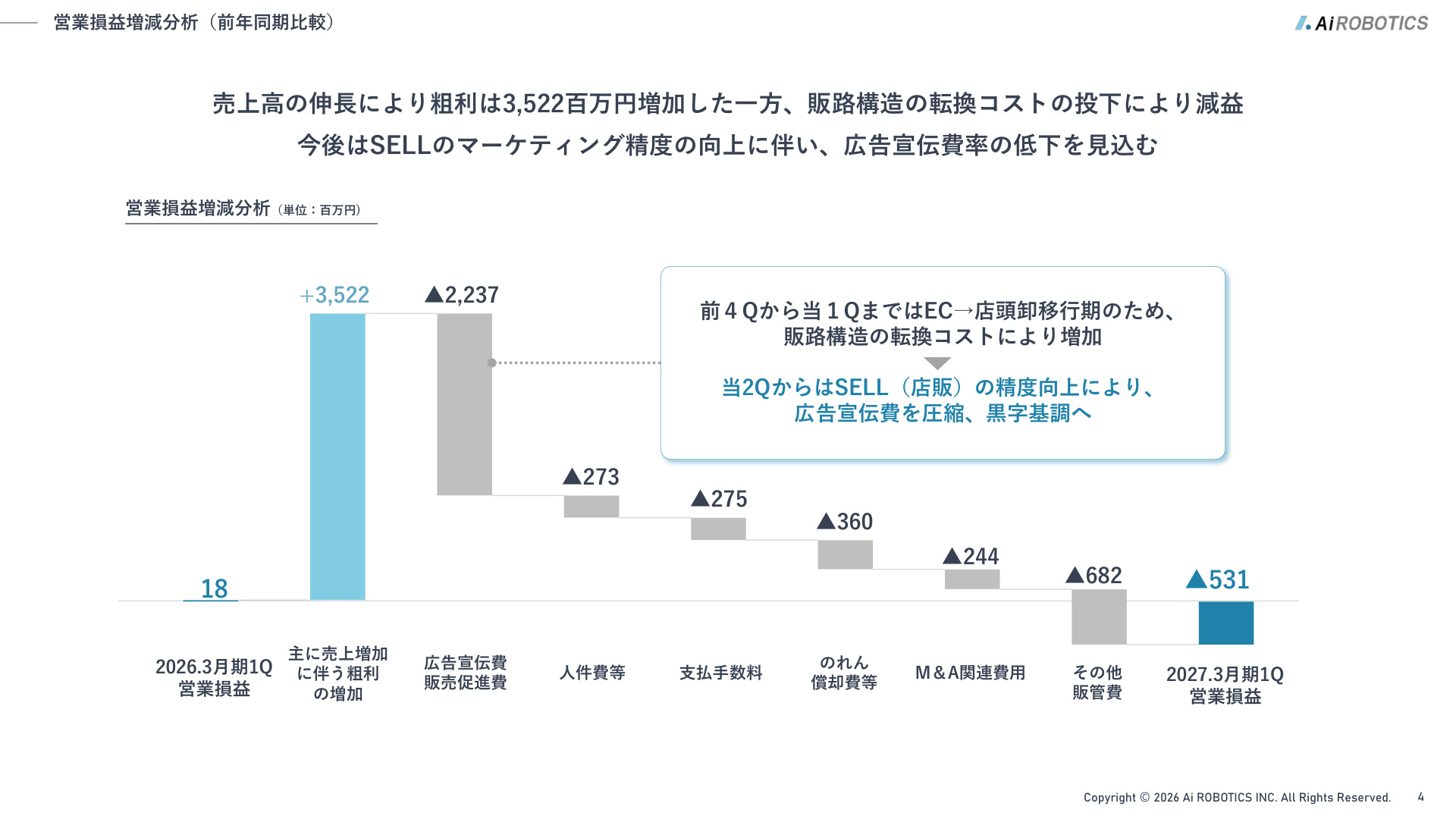
This slide provides the most critical data to explain that the current operating loss is not due to business deterioration, but is a temporary phenomenon resulting from clear strategic investments .
In line with the surge in sales, gross profit increased significantly by 3,522 million yen . However, this was offset by an increase in the following expenses:
- Advertising and Sales Promotion Expenses: -2,237 million yen (for brand awareness and initial promotions related to the retail wholesale shift)
- Amortization of Goodwill: -360 million yen (accounting expenses related to M&A)
- M&A Related Expenses: -244 million yen
- Personnel Costs, Payment Commissions, and Other SG&A: -1,230 million yen in total
The primary cause of the loss was the concentration of marketing investments and shelf-space acquisition costs from Q4 of the previous fiscal year into Q1 to accelerate "sell-out" at retail locations. Crucially, the company plans to rapidly recover to profitability from Q2 onwards as the advertising-to-sales ratio declines through improved retail marketing precision powered by its proprietary AI system, "SELL."
3. June Monthly Operating Profit and H2-Weighted Profit Structure
Although the cumulative quarterly results show a loss, monthly trends reveal a dramatic shift. After heavy upfront investments in April 2026 (-1,205 million yen) and May (-314 million yen), the company achieved a strong turnaround to an operating profit of 987 million yen in June alone .
The company’s business model is inherently weighted toward the second half of the fiscal year due to retail shelf-reset cycles, negotiation timelines, and shipping patterns. In fact, in the previous fiscal year (FY2026), 81.5% of full-year operating profit was concentrated in the second half (Q3-Q4) . The completion of upfront investments related to the structural shift by Q1, combined with the proven high profitability in June, represents significant progress toward achieving the full-year plan.
4. Radical Shift in Sales Composition by Channel and Brand
The progress of the company’s multi-brand, multi-channel strategy is evident in the following data on sales composition by channel and brand.
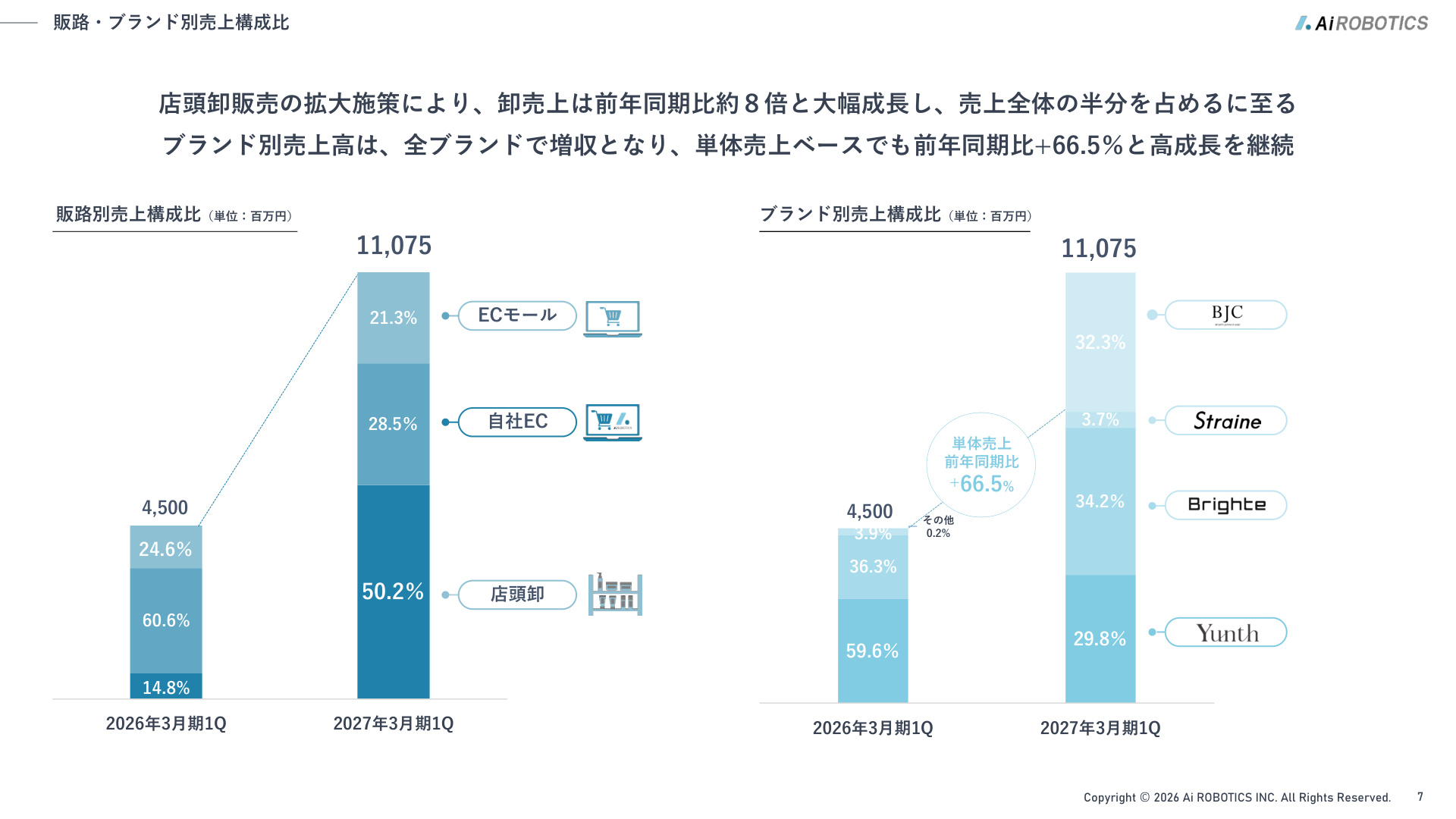
The most important takeaway from this slide is the dramatic shift in channel composition :
- Retail wholesale sales composition jumped from 14.8% in the same period last year to 50.2% (sales volume increased approximately 8-fold).
- Direct e-commerce composition converged from 60.6% to 28.5% , completing the diversification of channels and risk hedging.
By brand, the company has moved away from reliance on specific products, further diversifying its portfolio:
- Yunth : Sales of 3,295 million yen (+22.8% YoY). 29.8% of total sales.
- Brighte : Sales of 3,785 million yen (+131.7% YoY). Now a core brand at 34.2% of total sales.
- Straine : Sales of 408 million yen (+131.1% YoY). Currently establishing its position as a new line.
- BJC : Sales of 3,580 million yen. A new pillar accounting for 32.3% of the total following its integration into the group.
5. Expansion of Retail Distribution and Improvement in Sales Per Store (Sell-out)
The number of stores carrying the flagship skincare brand "Yunth" has expanded from approximately 10,300 in the same period last year to approximately 16,600 . With the target number of domestic stores (variety shops, drugstores, electronics retailers, etc.) estimated at approximately 36,830, the distribution rate remains at 45.1%, leaving significant room for further expansion .
Furthermore, the company is not merely increasing store counts but is strengthening large-scale dedicated fixture installations and end-cap displays at electronics retailers (e.g., Yodobashi Camera) and discount stores (e.g., Don Quijote). This strategy aims to maximize sell-out through the capture of inbound demand and tax-free sales.
6. Cross-Selling and Unit Price Increase Model via SKU Expansion
To enhance profitability in retail wholesale, the company strictly adheres to a "non-cannibalizing product design" strategy.
By continuously launching new, complementary SKUs —such as sheet masks, the newly released cushion foundation, and the "Deep Boost" penetration facial device—to purchasers of its flagship serum, the company is expanding its shelf space. This establishes a cycle that encourages cross-buying by consumers and increases the average purchase price per customer .
7. Unrivaled Product Development Speed and Productivity via AI System "SELL"
The core strength of Ai Robotics, as symbolized by its name, is its proprietary AI system, "SELL."
"SELL" detects trends in real-time from social media and purchasing data, synchronizing and automating everything from demand forecasting and product planning to package design generation and advertising optimization. This has enabled the company to shorten the period from market research to product launch from the 12–24 months typical in the cosmetics industry to just 3–6 months (a 4x increase in speed) .
Driven by this technological foundation, the company achieves formidable labor productivity, with sales per employee of 816 million yen and an operating profit margin of 13.0% (both significantly outperforming competing D2C and cosmetics companies).
8. Progress in PMI (Post-Merger Integration) and Group Synergies
Synergy creation with the newly acquired BJC is also progressing smoothly.
By injecting the company’s advanced e-commerce marketing expertise into BJC products, BJC’s monthly e-commerce mall sales have surged 2.66 times since joining the group (compared to April 2026) . The company has achieved results such as dominating top categories during major events like Rakuten’s "Super SALE" and Amazon’s "Prime Day." Furthermore, preparations for mutual cross-selling, which involves supplying Brighte products to BJC’s professional salon network, are complete.
9. Full-Scale Entry into Overseas Markets and Global Expansion
In parallel with establishing its foundation in the domestic market, the company is accelerating its overseas expansion.
For "Yunth," in addition to its presence in approximately 10 countries, primarily in Southeast Asia, the company has decided to begin distribution in Malaysia, Singapore, and Australia. "Straine" is also expanding into the U.S., Indonesia, and other markets. The company has set a goal to increase its overseas sales ratio from 7.4% in FY2026 to over 20.0% by FY2029 .
10. Mid-to-Long-Term Growth Strategy: The "1 Trillion Yen Market Cap Plan" for FY2029
The following growth strategy slide illustrates the long-term scale and growth trajectory the company is aiming for.
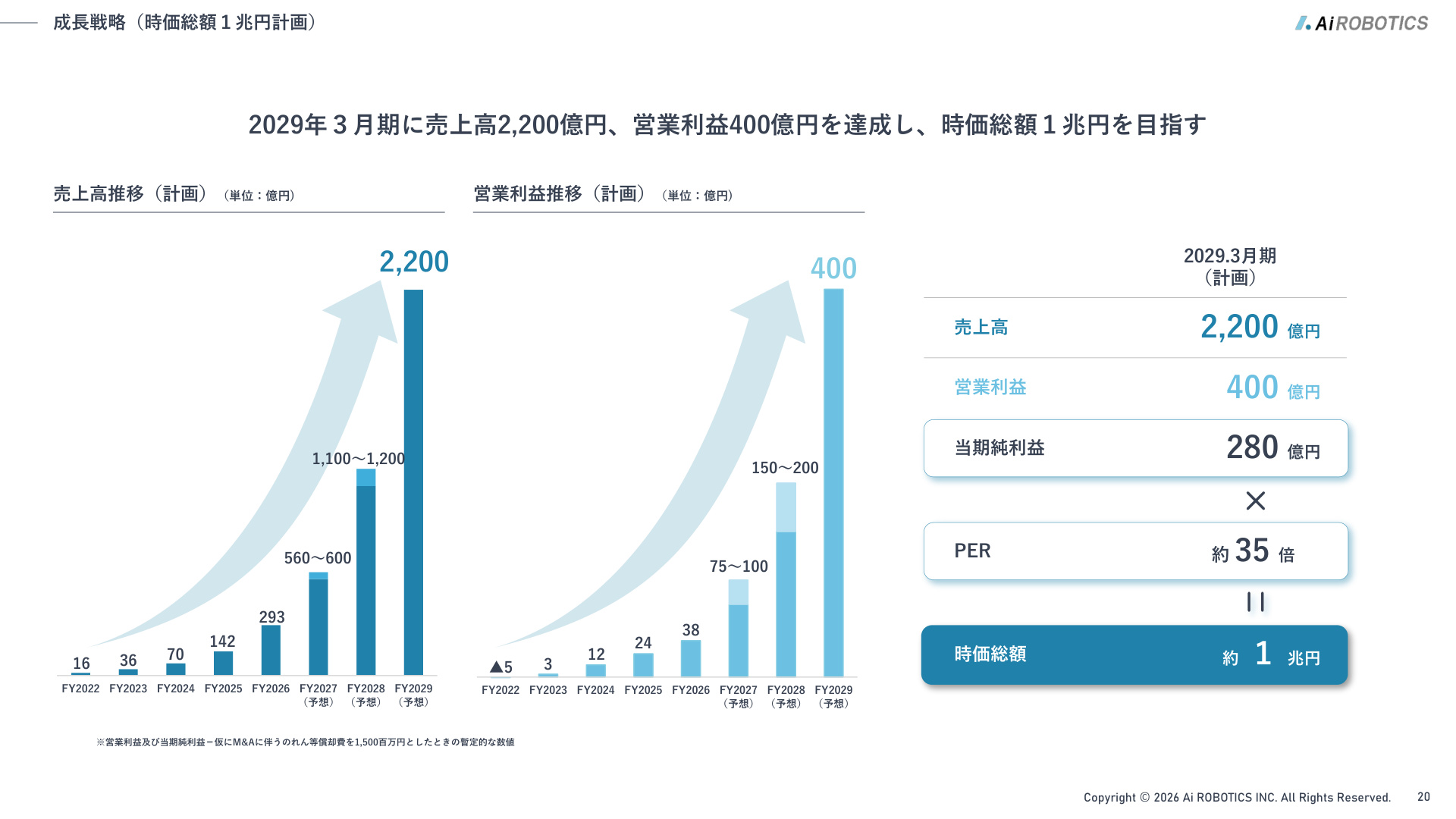
This slide represents the most critical long-term commitment, symbolizing the company’s mid-to-long-term ambition and vision.
The company has mapped out a high-level growth roadmap to achieve 220 billion yen in sales and 40 billion yen in operating profit (28 billion yen in net profit) by FY2029 , aiming for a market capitalization of 1 trillion yen (assuming a P/E ratio of approximately 35x) .
This plan is intended to be achieved not only through organic growth but through the following "three-pronged multiplication" strategy:
- Expansion of existing brands through overseas growth and continuous new product launches
- Rapid creation of new brands utilizing "SELL"
- M&A strategy to acquire brands with sales of 5 billion yen or more and advanced AI technologies
Conclusion: Earnings Overview and Future Outlook
In summary, Ai Robotics’ Q1 FY2027 earnings report demonstrates that behind the surface-level operating loss, the company has completed the foundation for explosive future growth through "structural transformation from e-commerce to retail wholesale," "multi-branding," and "successful PMI."
How the profitability demonstrated by the approximately 1 billion yen operating profit in June alone will be reflected in the figures during the H2-weighted period from Q2 onwards, and whether the acceleration of new product launches and global expansion powered by the AI "SELL" proceed at the planned pace, will be the critical observation points for assessing the company’s future outlook.
This content is not intended as investment advice or a recommendation. Any opinions expressed are solely the personal views of each article.