


Will Smart FY2026 Q2 Earnings Analysis: A Growth Story Driven by Platform Shift and Strengthened Financial Foundation

StockClub
Published: Aug 14, 2026, 09:57 AM
Sentiment Analysis

This report provides a comprehensive analysis of the FY2026 Q2 earnings of Will Smart Inc. (Securities Code: 175A), based on the company's published financial results. We examine the performance highlights, the structural reasons for the second-half weighting, the strengthening of the financial base, and the progress of the proprietary platform strategy.
1. FY2026 Q2 Earnings Summary and Full-Year Outlook
For the first half (cumulative) of the fiscal year ending December 2026, the company reported net sales of 328 million yen (down 9.1% YoY), an operating loss of 168 million yen (compared to a 168 million yen loss in the same period last year), an ordinary loss of 170 million yen , and a net loss of 173 million yen .
While the results may appear to show a decline in revenue and persistent operating losses, the company has maintained its full-year earnings forecast (net sales of 1,150 million yen, operating profit of 50 million yen) . Although the progress rate for net sales at the end of the first half stands at 28.5% , this is due to the company's business structure, where revenue recognition is heavily concentrated in the second half.
| Item | FY2026/12 2Q Actual | Full-Year Forecast | Progress Rate | (Ref) FY2025/12 2Q Actual |
|---|---|---|---|---|
| Net Sales | 328 million yen | 1,150 million yen | 28.5% | 361 million yen |
| Operating Profit | △168 million yen | 50 million yen | — | △168 million yen |
| Ordinary Profit | △170 million yen | 50 million yen | — | △153 million yen |
| Net Profit | △173 million yen | 40 million yen | — | △153 million yen |
2. Why is Revenue Weighted Toward the Second Half? Analysis of Structural Factors
The significant increase in revenue during the second half is primarily driven by the delivery and revenue recognition timing of "Logistics DX" and "Bus Terminal-related projects."
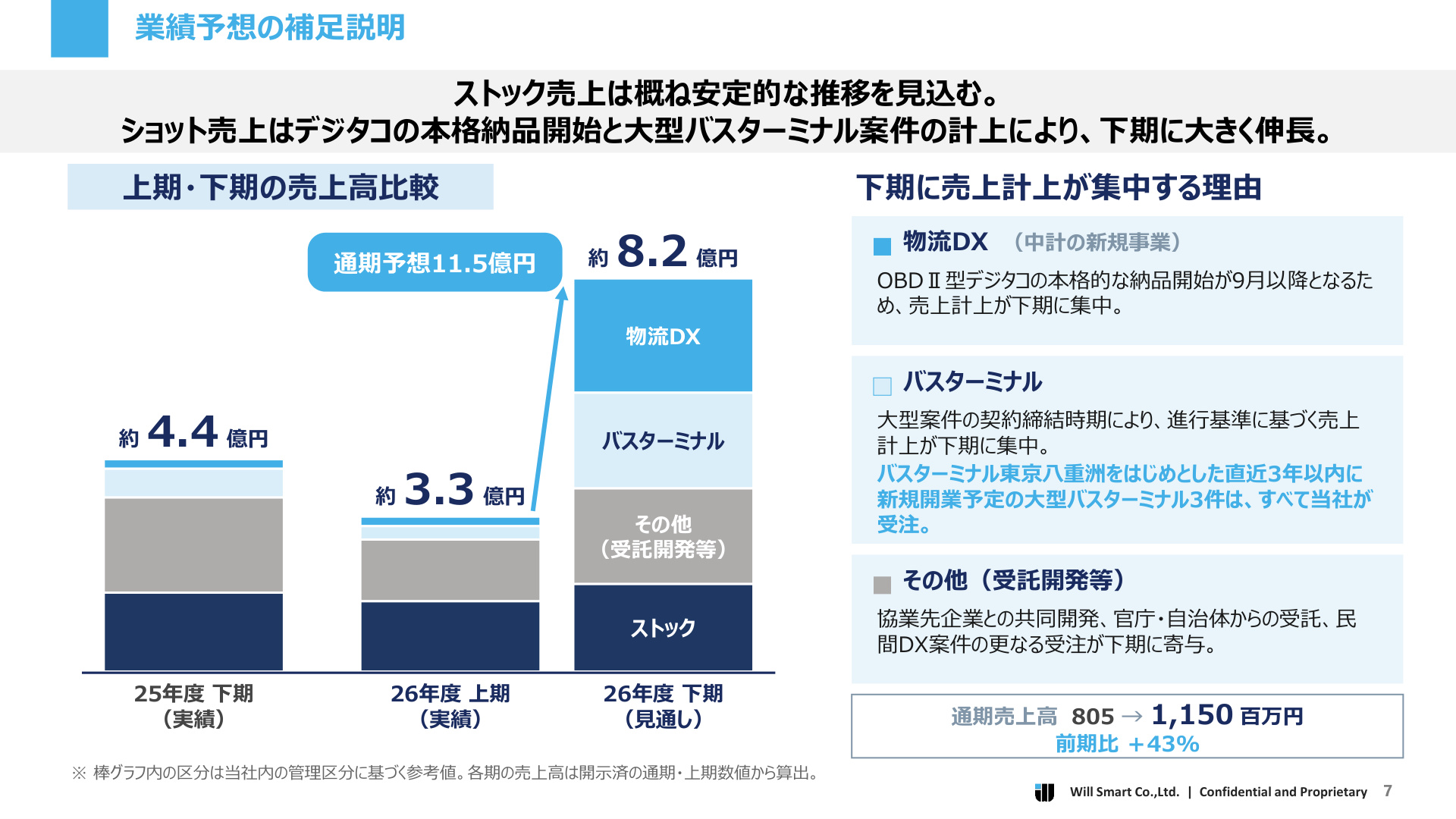
As shown in the figure above, against the first-half net sales of approximately 330 million yen , the second-half outlook projects a substantial increase to approximately 820 million yen . The main reasons for this second-half weighting are as follows:
- Full-scale rollout of Logistics DX (New Business) : Full-scale delivery of OBD II-type digital tachographs is scheduled to begin from September onwards , concentrating related revenue in the second half.
- Percentage-of-completion method for large bus terminal projects : The company has secured all three major bus terminal projects scheduled to open within the next three years, including Bus Terminal Tokyo Yaesu . Revenue recognition based on progress and delivery criteria will contribute to the second half.
- Monetization of contract development and commissioned projects : Deliveries and inspections for joint development projects with partners, as well as projects for government agencies, municipalities, and private-sector DX, are scheduled to be concentrated in the second half.
Compared to the previous year's performance (440 million yen in 2H FY2025), the company is planning a significant leap to approximately 820 million yen in 2H FY2026, consistent with its planned revenue shift from the first to the second half.
3. Dramatic Strengthening of Financial Foundation: Capital and Business Alliance with Zenrin and Third-Party Allotment
On June 1, 2026, the company completed a third-party allotment of shares totaling approximately 450 million yen to strengthen its financial base and accelerate growth investments aimed at achieving its medium-term management plan.
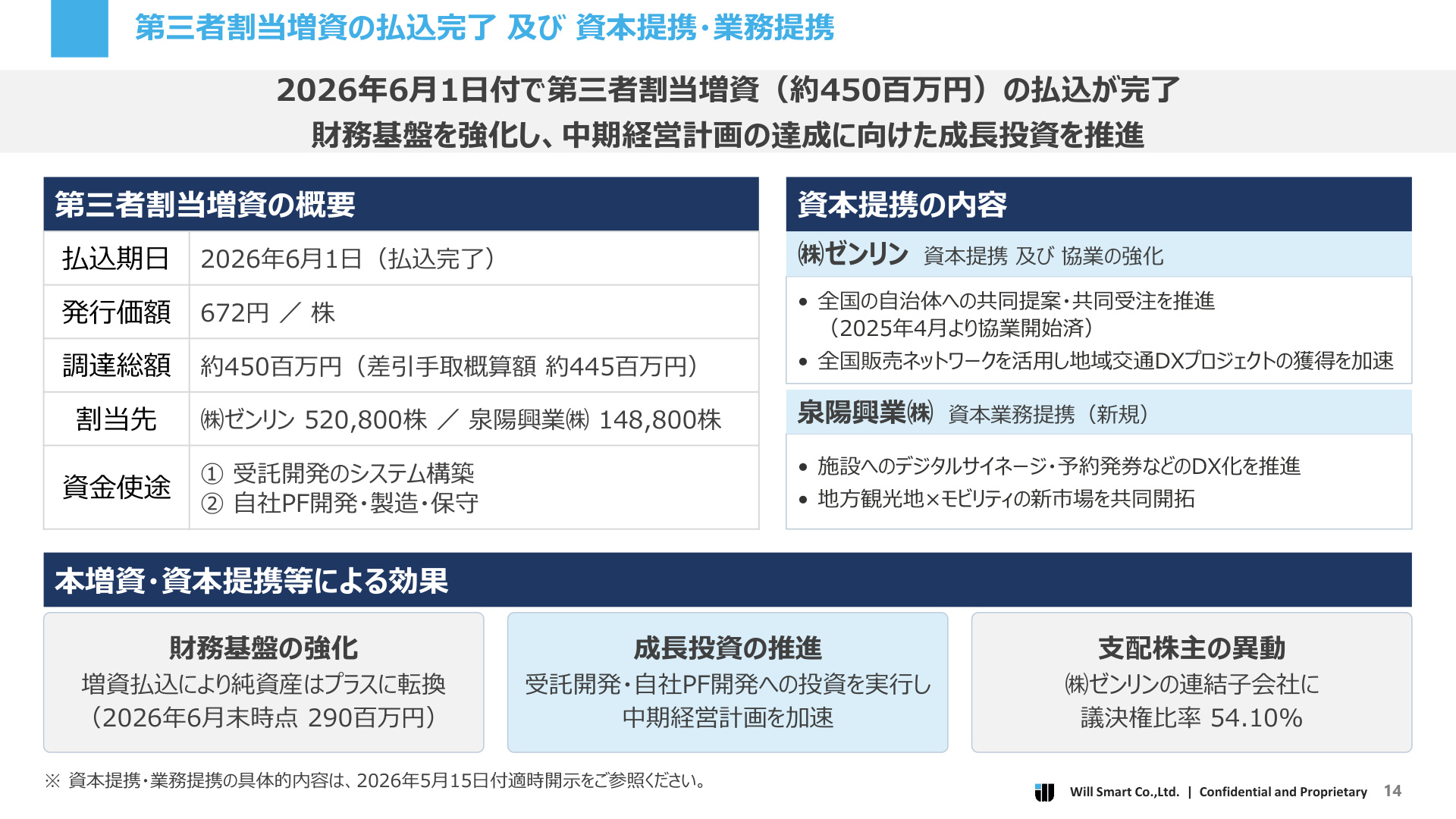
Key points of this capital increase and business alliance are summarized as follows:
- Change in Parent Company and Strong Backing : Zenrin Co., Ltd. subscribed to 520,800 shares, becoming the parent company (consolidated subsidiary) with a 54.10% voting interest. Collaboration with Zenrin, which possesses a strong network of municipalities and transport operators nationwide, will accelerate the acquisition of regional transport DX projects.
- Recovery of Financial Soundness : With the 450 million yen capital injection, net assets as of the end of June 2026 turned to a positive 290 million yen (resolving capital deficiency and expanding equity capital) , significantly improving financial health.
- Clarification of Use of Funds : The raised capital will be focused on system construction for contract development and the development, manufacturing, and maintenance of high-margin proprietary platforms (in-house PF) .
4. Trends in Key KPIs: Account Numbers and Stock Revenue
During this period of business model transformation, changes are emerging in the company's key KPIs.
① Number of Transactions (Accounts)
Due to the conclusion of temporary projects related to the Osaka-Kansai Expo and a strategic withdrawal from simple general distribution systems and EV-related projects (transformation of customer structure), the number of existing accounts temporarily decreased (79 companies in 2Q FY2026). However, with new customer acquisitions in bus terminal projects and logistics DX via partners, the company expects a recovery to 90 companies by the end of the fiscal year.
② Trends in Stock Revenue
Stock revenue for 2Q FY2026 was 146 million yen . While aiming to supplement this through expanded transactions with existing customers, the company envisions a scenario where stock revenue derived from proprietary platforms will accumulate in earnest from FY2027 onwards , as logistics DX and regional transport DX products are released sequentially.
5. Core of Growth Strategy: "Proprietary Platform Strategy" and "Will-Fleet"
The core of the company's medium-term management plan, "2030 Beyond 100" (targeting 3 billion yen in sales and 350 million yen in operating profit by FY2030), is the "shift from contract development to proprietary platforms." The company aims for a virtuous cycle model that packages industry expertise gained through contract development into proprietary platforms, elevating them into high-margin stock revenue.
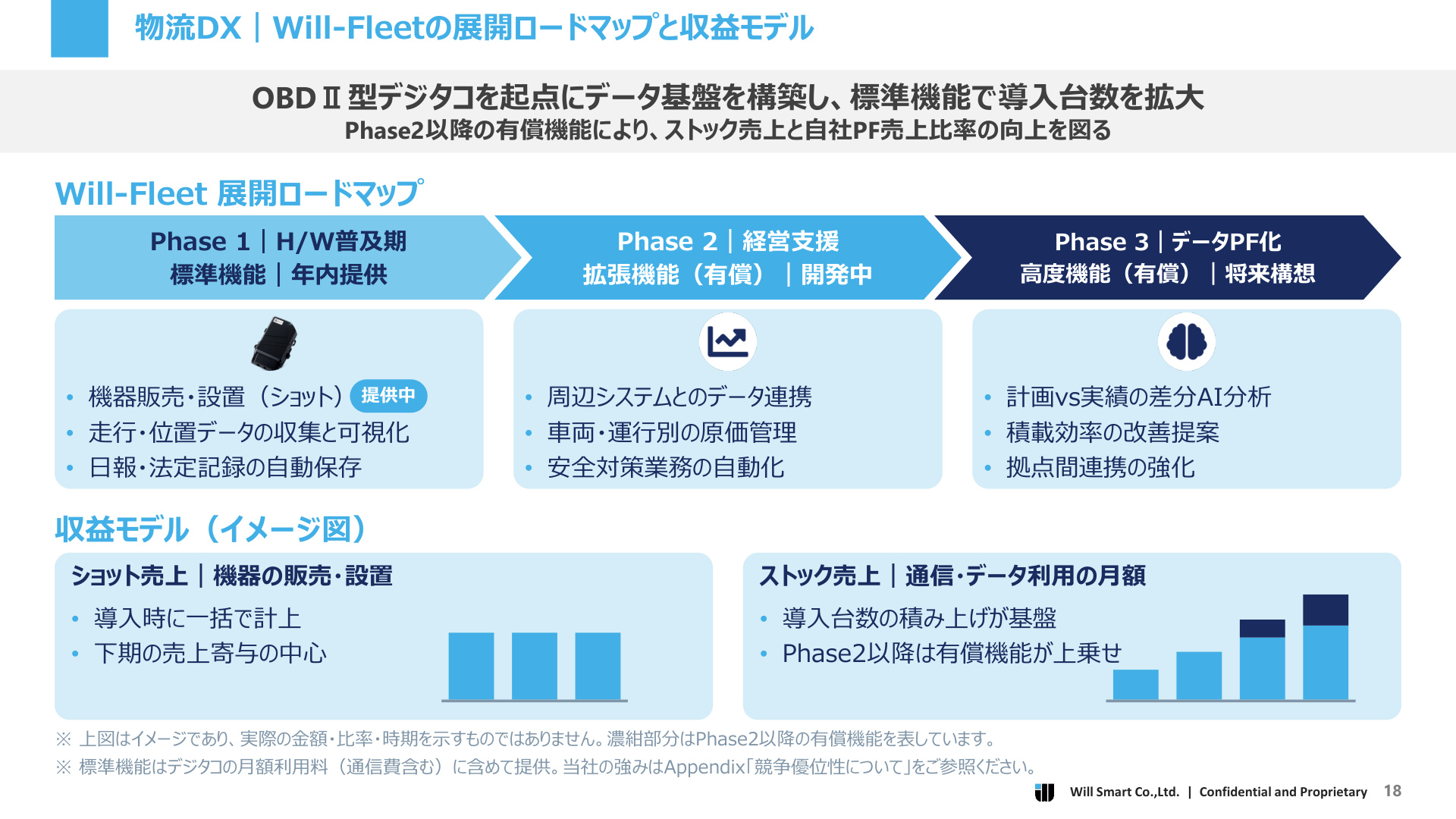
An iconic product driving this initiative is "Will-Fleet" in the logistics DX field.
Three-Phase Rollout of Will-Fleet
- Phase 1 (H/W Adoption Phase) : Starting with Japan's first OBD II-type digital tachograph , the company will rapidly expand the number of units installed through hardware sales (shot revenue) and monthly communication/data usage fees (stock revenue).
- Phase 2 (Management Support Phase) : The company will offer extended functions such as cost management by operation and automation of safety measures for a fee, increasing the unit price of stock revenue.
- Phase 3 (Data Platform Phase) : The company will deploy high-value-added models using advanced features such as AI-driven variance analysis between plans and actual results, and proposals for improving loading efficiency.
Furthermore, in the regional transport DX field, the company has begun developing a "Core System Package for the Bus Industry (related to COMmmONS)" that complies with the bus operation standardization specifications promoted by the Ministry of Land, Infrastructure, Transport and Tourism, positioning it as the second pillar of its proprietary platform strategy alongside logistics DX.
6. Accelerating Development Speed via AI-Driven Development
To further accelerate the expansion of its proprietary platform lineup, the company has introduced AI-driven development . By leveraging AI in the implementation and testing stages, engineers with industry expertise aim to achieve the following:
- Reduced Development Lead Time : Improving product launch speed through the automation of implementation and testing.
- Standardized Development Quality : Turning know-how into organizational assets and reducing the risk of defects.
- Scaling Independent of Personnel Increases : Efficiently scaling development capabilities and improving profit margins.
Through this, the company plans to expand its proprietary platform lineup at a pace exceeding the assumptions made during the formulation of the medium-term management plan.
7. Conclusion and Future Focus Points
Although the progress rate in the FY2026 Q2 earnings appears low, the results clearly demonstrate the groundwork for growth, characterized by a "second-half weighted order structure," "strengthened financial foundation through the alliance with Zenrin," and a "shift toward proprietary platforms led by Will-Fleet."
Key points to watch moving forward include: (1) The certainty of achieving the 820 million yen second-half sales target and the delivery of Will-Fleet digital tachographs from September onwards, (2) the materialization of municipal and regional transport DX projects utilizing Zenrin's sales network, and (3) the pace of improvement in the stock revenue ratio.
This content is not intended as investment advice or a recommendation. Any opinions expressed are solely the personal views of each article.