


Green Monster (157A) FY2026 Full-Year Earnings Analysis: Structural Business Transformation via M&A and Comprehensive Investment for Future Growth

StockClub
Published: Aug 14, 2026, 09:56 AM
Sentiment Analysis

Green Monster, Inc. (TSE Growth: 157A) concluded its FY2026 full-year earnings as a pivotal year marked by a structural transformation of its business portfolio . The company successfully offset the headwinds faced by its core experiential investment learning business with the rapid expansion of its asset formation support business, driven by strategic M&A.
This report provides a comprehensive analysis of the company's performance summary, segment-specific status, financial foundation, and growth narrative for the fiscal year ending June 2027, centered on 10 key topics derived from the earnings materials.
1. FY2026 Full-Year Earnings Highlights and Profit Trends
For the fiscal year ended June 2026, the company reported consolidated net sales of 1,921 million yen (down 4.3% YoY) , an operating loss of 276 million yen (compared to a 123 million yen profit in the previous year), and a net loss attributable to owners of the parent of 375 million yen .
While the shift to an operating loss may appear to be a significant turning point for a company that has maintained a growth trend, it is underpinned by a strategic review of advertising operations in response to changes in the existing business environment, as well as the booking of proactive upfront investments and M&A-related expenses for future growth. To grasp the overall financial performance and segment-specific changes, we refer to the financial highlights slide.
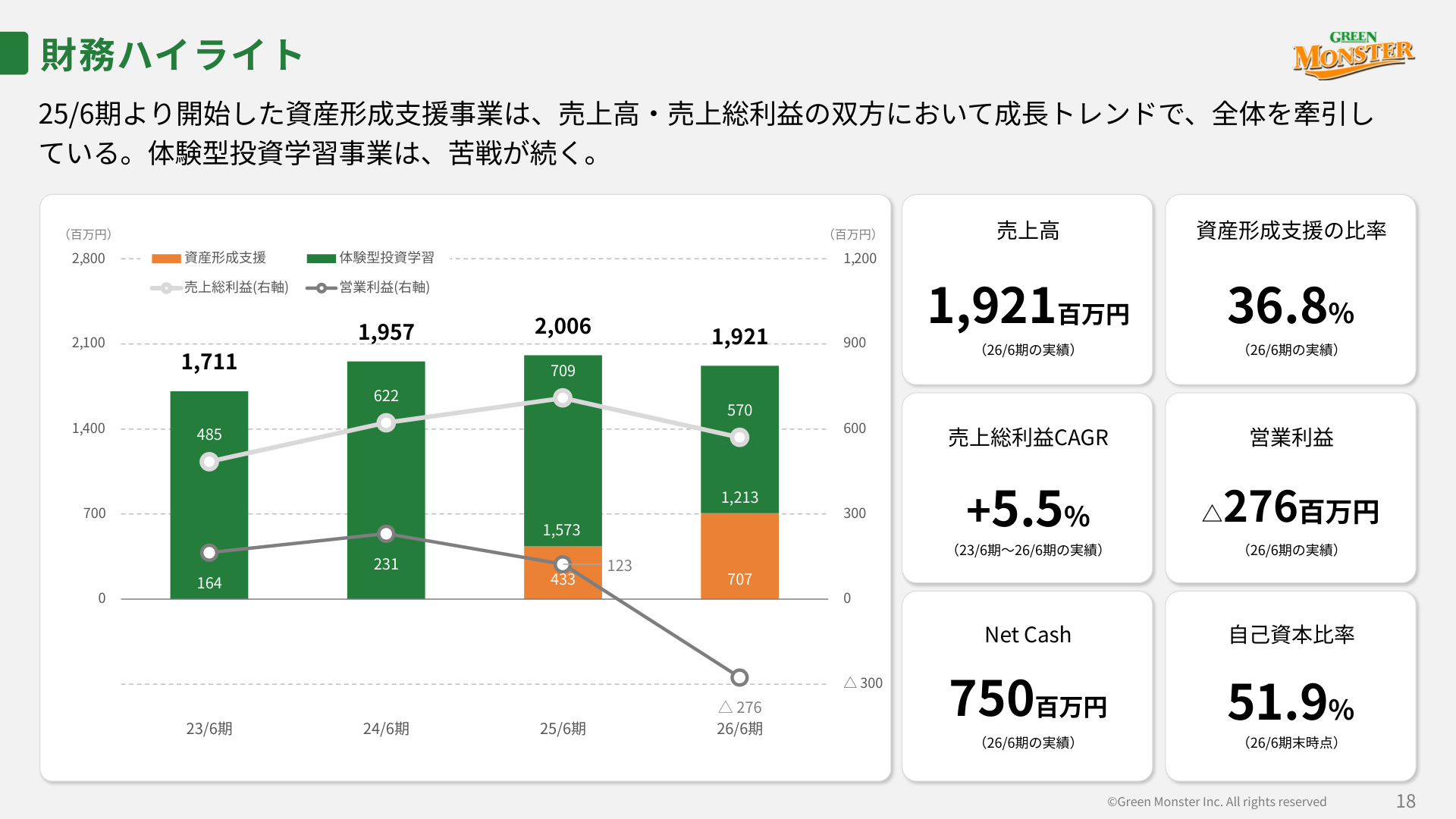
【Significance and Background of Slide 17】 This slide provides critical data for an overview of sales and profit trends from FY2023 to FY2026, as well as financial health. It clearly shows that while the Experiential Investment Learning Business (shown in green) saw a decline in sales (from 1,573 million yen in FY2025 to 1,213 million yen in FY2026), the Asset Formation Support Business (shown in orange) grew rapidly from 433 million yen to 707 million yen. Despite the operating loss, the company maintains a robust financial foundation to continue aggressive investment, with Net Cash of 750 million yen and an equity ratio of 51.9% .
2. Business Composition and Diversification of the Business Model
Green Monster was previously a company centered on a single business providing investment simulation apps. Today, it has evolved into a two-segment structure: the "Experiential Investment Learning Business" and the "Asset Formation Support Business."
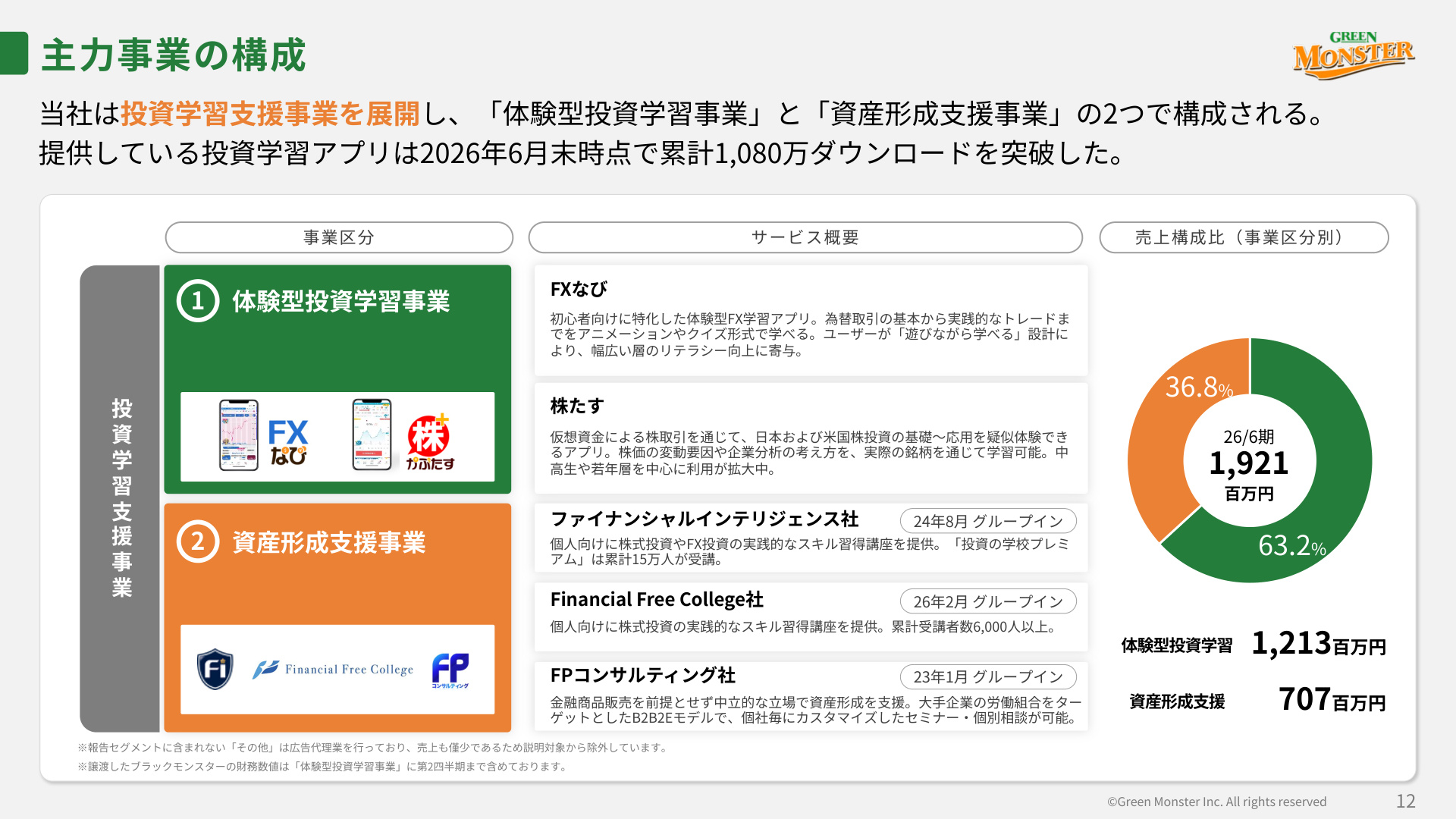
【Significance and Background of Slide 11】 This slide illustrates the evolution of the company's business model and sales composition (FY2026) . In addition to the Experiential Investment Learning Business, which accounts for 63.2% (1,213 million yen) of the total, the Asset Formation Support Business, newly built through M&A, has expanded to 36.8% (707 million yen). As shown in the company history, since its IPO in March 2024, the company has transformed into a comprehensive investment learning and asset formation platform that attracts customers through experiential apps and provides practical support through schools and consulting.
3. Experiential Investment Learning Business: App Trends and KPI Analysis
In the Experiential Investment Learning Business ( net sales of 1,213 million yen, down 22.9% YoY ), performance varied by product:
- Kabutasu : A simulation app for Japanese and US stocks. User acquisition progressed steadily, achieving record-high sales. Product strength has also improved, including the acquisition of a patent for the practical financial program "Kabu-Pre."
- FX Navi : A foreign exchange simulation app. It continued to struggle due to external factors such as changes in the advertising market and declining user acquisition efficiency.
Although the primary KPI, the number of investment debut support cases, remained flat at 8,833 (4Q FY2026), the average revenue per unit recovered to 29,342 yen due to changes in the composition ratio. To prevent unnecessary loss expansion, the company has shifted from aggressive advertising to an efficiency-oriented cost control policy , laying the groundwork for profit recovery. Notably, the cumulative number of series app downloads has surpassed 10.8 million , maintaining its value as a powerful customer touchpoint.
4. Asset Formation Support Business: Leapfrog Growth via M&A Strategy
The primary growth engine in this fiscal year was the Asset Formation Support Business ( net sales of 707 million yen, up 63.3% YoY ). The company has executed proactive M&A and is creating synergies with its newly acquired subsidiaries:
- Financial Intelligence, Inc. (FI) (Joined in Aug 2024): Provides practical stock and FX courses for individuals.
- Financial Free College, Inc. (FFC) (Joined in Feb 2026): Operates a stock investment school. Contributed to consolidated results for four months in FY2026.
- FP Consulting, Inc. (Joined in Jan 2023): Develops BtoBtoE (employee-focused) life planning and asset formation consulting.
PMI (Post-Merger Integration) is progressing steadily through the expansion of collaborative customer acquisition that does not rely on advertising and an increase in seminar-based contracts.
5. Transformation of the Cash Conversion Cycle (CCC)
The expansion of the Asset Formation Support Business has brought about not only sales growth but also a reform of the company's cash flow structure . The traditional Experiential Investment Learning Business was a "delayed cash collection" model where funds were spent upfront on app development and advertising before referral fees were earned. In contrast, the newly added school businesses operate on a "prepayment model" (upfront tuition payment) . This has led to a steady accumulation of order backlogs and a significant shortening of the group-wide CCC , signaling a shift toward higher-quality, cash-focused management.
6. Analysis of Fixed Costs, One-time Expenses, and Financial Health
One of the factors contributing to the operating loss in FY2026 is the change in the cost structure. In addition to increased personnel and commission expenses due to the new consolidation of companies like FFC, approximately 20 million yen in one-time costs related to financing were recorded. Impairment-like factors regarding acquisition efficiency in the experiential business and upfront system/organizational infrastructure costs also had an impact.
However, the financial foundation remains extremely solid. The company maintains Net Cash of 750 million yen (cash on hand minus interest-bearing debt) and a high equity ratio of 51.9% , providing a sufficient buffer for immediate business operations and further growth investments.
7. FY2027 Full-Year Earnings Plan and Growth Scenario
The company has disclosed its full-year plan for the fiscal year ending June 2027 .
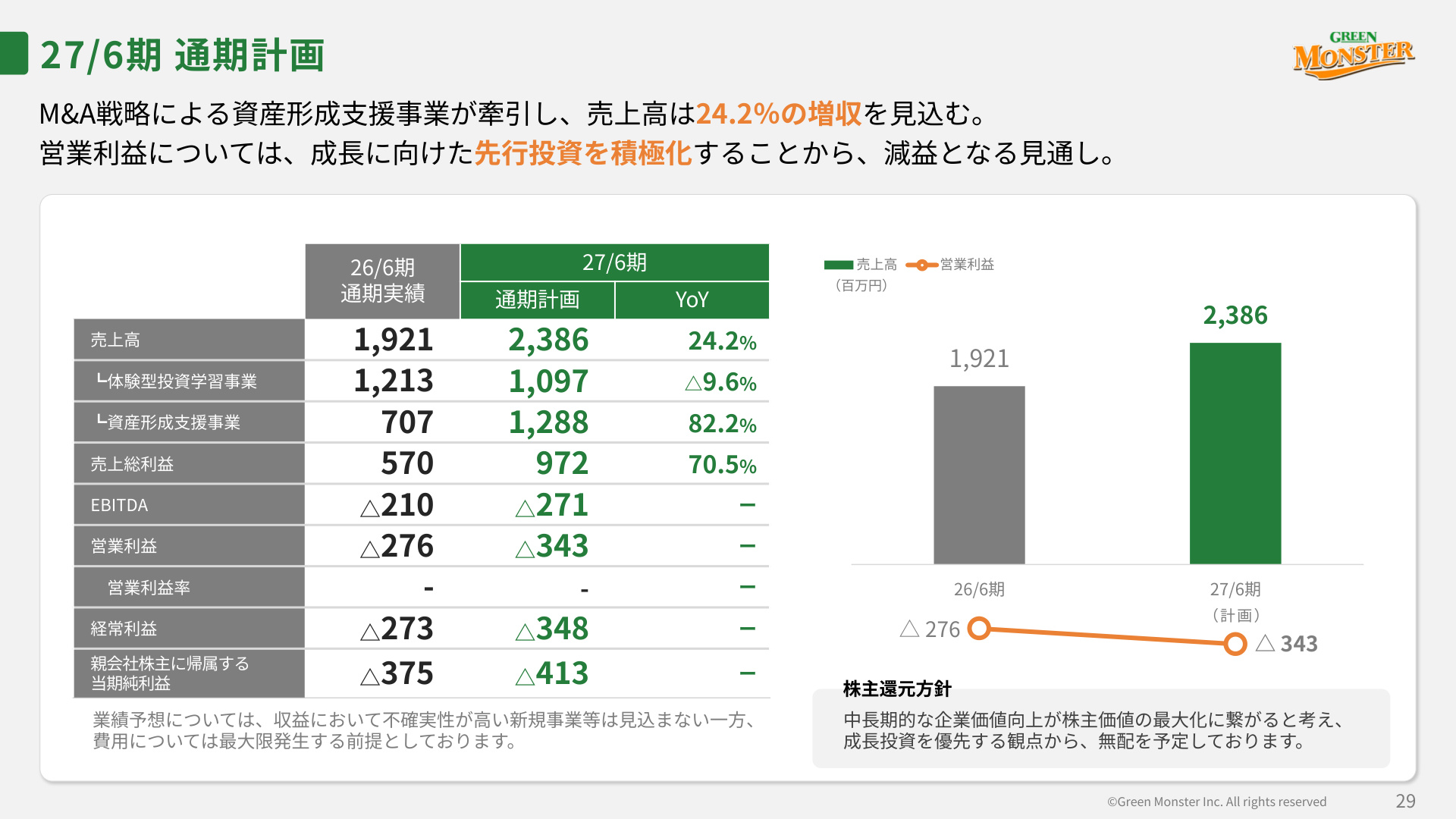
【Significance and Background of Slide 28】 This slide presents key target figures indicating the company's stance for the next fiscal year. It anticipates significant sales growth, with consolidated net sales of 2,386 million yen (up 24.2% YoY) . In particular, the Asset Formation Support Business is planned to grow rapidly to 1,288 million yen (up 82.2% YoY) , accounting for more than half of group sales. While an operating loss of 343 million yen is expected, this reflects a policy of prioritizing future investment by booking maximum expenses under strict assumptions that exclude sales from new businesses with high revenue uncertainty.
8. Future Third Growth Engine: "Financial AI and Blockchain Business"
To maximize corporate value over the medium to long term, the company is preparing a third business pillar: the "Financial AI and Blockchain Infrastructure Business." In addition to establishing overseas bases such as a Hong Kong subsidiary, the company is promoting research and verification in the Web3, finance, and financial AI technology sectors. A timeline has been drawn to execute proactive development investments using funds and profits during FY2027, aiming for full-scale revenue contribution from FY2028 onwards .
9. Shareholder Return Policy and Capital Efficiency
The company plans to remain non-dividend (prioritizing growth investment) for FY2027. Based on the judgment that medium- to long-term improvement in corporate value leads to the maximization of shareholder value, generated cash and raised funds will be preferentially allocated to new business development in areas like financial AI and blockchain, as well as the pursuit of large-scale M&A opportunities in the asset formation support business.
10. Summary of Green Monster's Earnings Overview
In summary, the FY2026 earnings show that Green Monster is steadily shifting the axis of its revenue structure from an "experiential app-based customer acquisition foundation" to "monetization through asset formation schools and consulting via M&A."
While short-term profit and loss may continue to face headwinds due to changes in the existing app environment and upfront investment costs, the company is steadily progressing toward accelerating the growth trend toward annual sales exceeding 2.3 billion yen , improving cash flow through prepayment-based business models , and sowing seeds for future options in financial AI and blockchain .
This content is not intended as investment advice or a recommendation. Any opinions expressed are solely the personal views of each article.