


INCLUSIVE Holdings Q1 FY2027 Earnings Analysis: Charting the Path to Profitability by FY2028 through Structural Reform and AI Integration

StockClub
Published: Aug 13, 2026, 11:39 AM
Sentiment Analysis

INCLUSIVE Holdings Q1 FY2027 Earnings Analysis: Charting the Path to Profitability by FY2028 through Structural Reform and AI Integration
INCLUSIVE Holdings Co., Ltd. (Securities Code: 7078) announced its Q1 FY2027 financial results on August 13, 2026. The company is currently undergoing a dramatic transformation, moving away from its traditional reliance on labor-intensive media operations toward a high-value-added, scalable business structure centered on "Food, Space, and Regional Revitalization."
This report provides a comprehensive analysis of the company's earnings, based on the released supplementary materials, covering the results of its revenue structure improvements, segment-specific progress, company-wide AI implementation strategies, and the future outlook following the change in the fiscal year-end.
1. Overview of Management Reform and Transformation Story
Previously, the company operated a labor-intensive, low-margin business model focused on the media sector. It is now driving a fundamental management overhaul. While strategically exiting unprofitable projects, the company is concentrating its management resources on high-margin areas such as "SaaS-based Local Government DX," "IP Creation," and "High-Value-Added E-commerce."
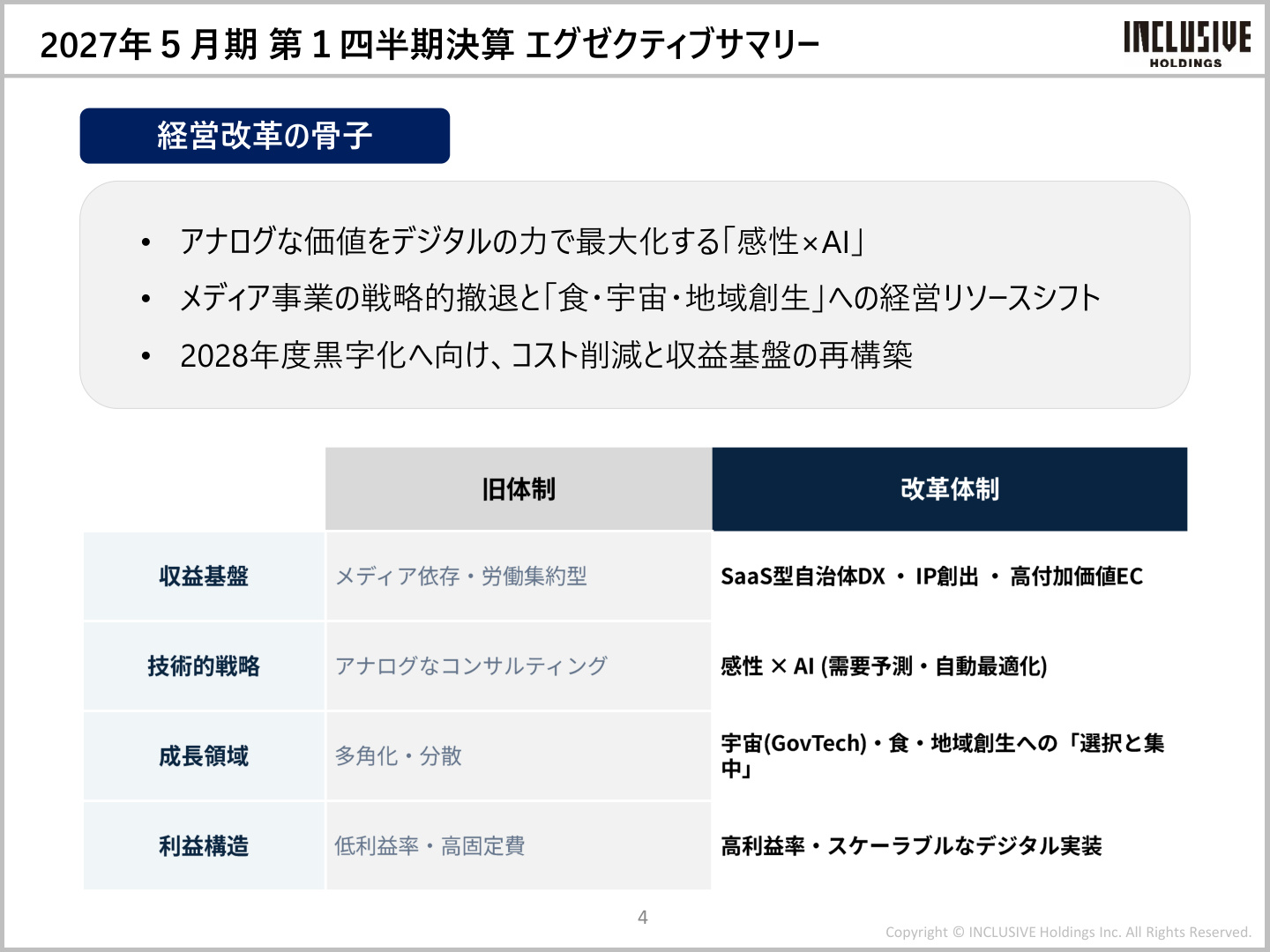
Slide Commentary: Core Pillars of Management Reform
This slide is a critical conceptual diagram illustrating the "Before and After" of the company's ongoing reforms. Addressing the challenges of the old regime— "Media-dependent, labor-intensive" and "Low-margin, high-fixed-cost" —the new structure introduces a technical axis of "Sensibility x AI (Demand Forecasting & Automated Optimization)" and narrows its growth focus to "Space (GovTech), Food, and Regional Revitalization." The core of this reform lies not merely in cost reduction, but in reconstructing a high-margin, scalable business structure through the digital implementation of products.
2. Q1 FY2027 Consolidated Earnings Highlights
Consolidated results for the first quarter (April 1, 2026 – June 30, 2026) showed a decline in revenue, but confirmed a dramatic improvement in the profit structure .
- Net Sales : ¥1,009 million (Down ¥26 million / 2.5% YoY)
- Operating Profit/Loss : -¥121 million (Improvement of +¥67 million YoY)
- EBITDA : -¥98 million (Improvement of +¥67 million YoY)
- Net Profit/Loss Attributable to Owners of Parent : -¥69 million (Improvement of +¥72 million YoY)
The decline in net sales was planned, resulting from the strategic downsizing and withdrawal from unprofitable media-related projects. Conversely, driven by fundamental cost-cutting measures and the company-wide AI strategy, the company achieved significant reductions in losses across all profit metrics (operating profit, EBITDA, and net profit), with improvements ranging from approximately ¥67 million to ¥72 million. The results are progressing in line with the initial full-year forecast.
3. Segment Performance and Key Business Topics
Performance and strategic progress in the company's key segments for Q1 are as follows:
(1) Brand Consulting Business
- Net Sales : ¥560 million (Down 18.3% YoY)
- Segment Profit : ¥47 million (Compared to a -¥109 million loss in the same period last year, an improvement of +¥157 million )
Revenue declined as the company pushed for strategic withdrawals from unprofitable media projects to minimize the impact of the overall media industry downturn. However, thanks to the steady performance of large-scale, high-margin brand consulting projects and the containment of fixed costs and cost of sales, the segment achieved a significant turnaround to profitability.
(2) Food-Related Business
- Net Sales : ¥446 million (Up 27.7% YoY)
- Segment Profit : -¥27 million (Improvement of +¥44 million YoY)
In the food sector, centered on "Shimogamo Saryo," AI-driven initiatives for demand forecasting and digital marketing yielded early results, leading to exceptionally strong e-commerce performance. Physical store operations, targeting both local customers and overseas high-net-worth individuals, also captured customer needs and contributed to revenue growth. Through thorough efficiency measures, such as optimizing raw material procurement, the segment loss was significantly reduced compared to the same period last year.
(3) Space-Related Business (GovTech / Agriculture DX)
- Net Sales : ¥1.9 million (Compared to ¥0 in the same period last year)
- Segment Profit : -¥8.2 million (Change of -¥1.2 million YoY)
The "Space-Related Business," which provides satellite data consulting and farmland management support to local governments, has transitioned from the initial investment phase to a full-scale monetization phase.
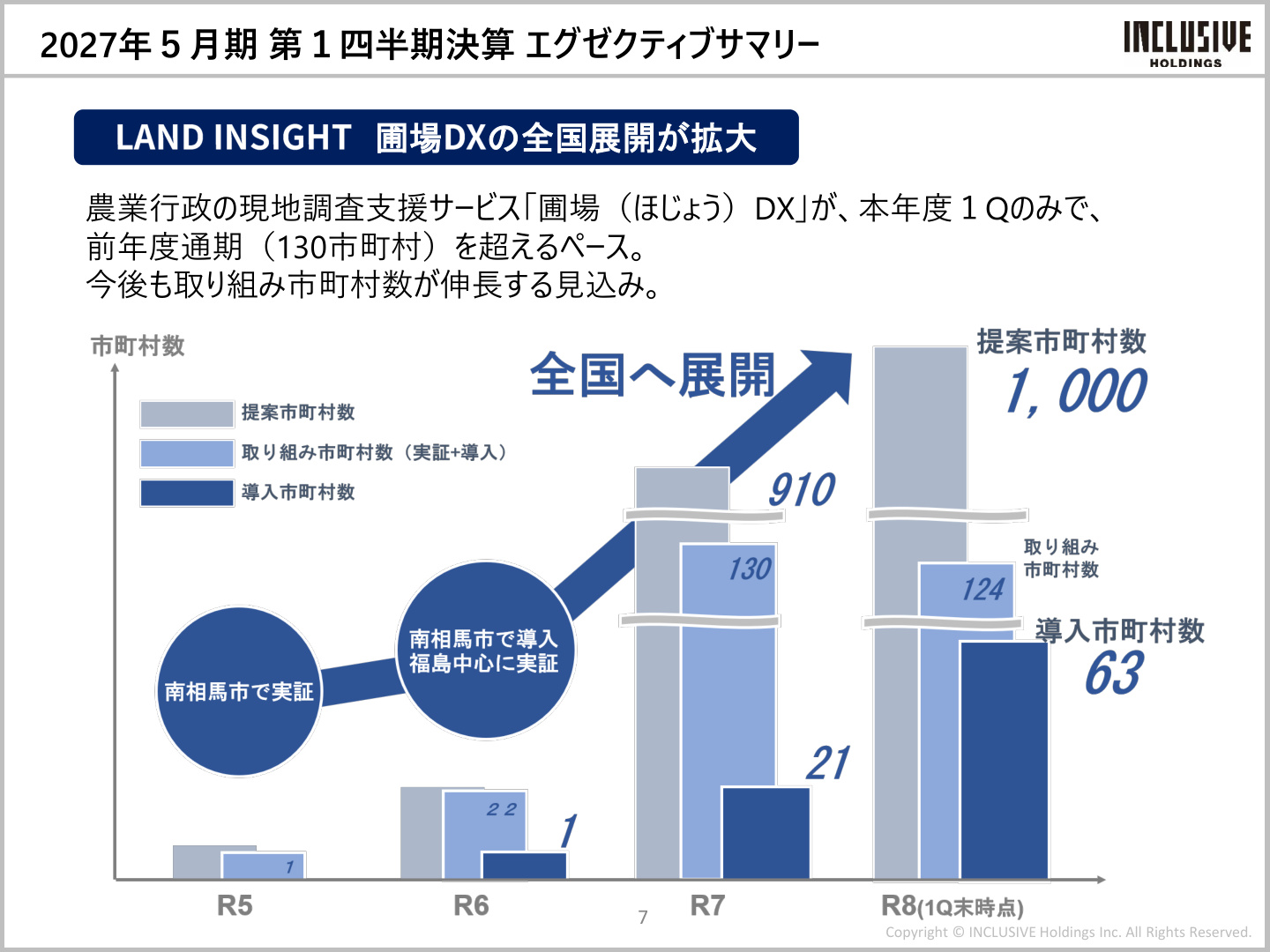
Slide Commentary: Nationwide Expansion of LAND INSIGHT Farmland DX
This slide demonstrates the dramatic growth pace of "LAND INSIGHT (Farmland DX)," the core product of the company's space-related business. This service, which uses satellite data and AI analysis to reduce the labor required for agricultural field surveys, is expanding at an astonishing speed, having nearly matched the entire previous fiscal year's achievements (130 municipalities) in just the first quarter (124 municipalities). The number of municipalities using the paid service has surged to 63 , with proposals currently underway for 1,000 additional municipalities. This is key data proving that the business has moved beyond mere proof-of-concept and is accelerating its nationwide rollout as a stock-based, standardized SaaS-type local government DX solution.
4. Company-wide AI Specialization Strategy and "AOI Project"
The company has set a roadmap to implement "Sensibility x AI" as a common foundation across all business areas. In Q1, the "Shimogamo Saryo AOI Project" was announced for the food-related business.
This project is an AI data infrastructure that autonomously collects and analyzes customer behavior and external data to feed back into demand forecasting, inventory optimization (production management), and data-driven product development. Phase 1 is scheduled for release in August 2026, which is expected to further accelerate e-commerce revenue growth and gross margin improvement in the food sector.
Furthermore, by introducing AI across the company—including AI-automated analysis of satellite data in the space business and automation and governance monitoring for back-office operations —the company is building a scalable management structure that can expand performance while minimizing human resource requirements.
5. Change in Fiscal Year-End and Full-Year Earnings Outlook
The company has changed its group-wide fiscal year-end from March 31 to May 31 . Consequently, FY2027 will be an irregular 14-month fiscal period (April 1, 2026 – May 31, 2027).
The purpose of this change is to unify the fiscal years within the group to improve operational efficiency, as well as to level out and optimize the impact of seasonal factors on the performance of subsidiaries (particularly food-related businesses affected by year-end and New Year demand), thereby enabling more accurate investment decisions.
FY2027 (14-month irregular period) Consolidated Earnings Forecast
- Net Sales : ¥5,918 million
- Adjusted EBITDA : -¥114 million
- Operating Profit/Loss : -¥176 million
- Ordinary Profit/Loss : -¥148 million
- Net Profit/Loss Attributable to Owners of Parent : -¥167 million
Due to the 14-month irregular period, net sales will increase by approximately ¥1.09 billion compared to a standard 12-month forecast. While incorporating expenses related to structural reforms, the company expects to maintain the underlying trend of improvement in operating and ordinary profit/loss.
6. Milestones to Profitability and Mid-term Vision
The company has outlined a clear scenario for returning to profitability following its structural reforms.
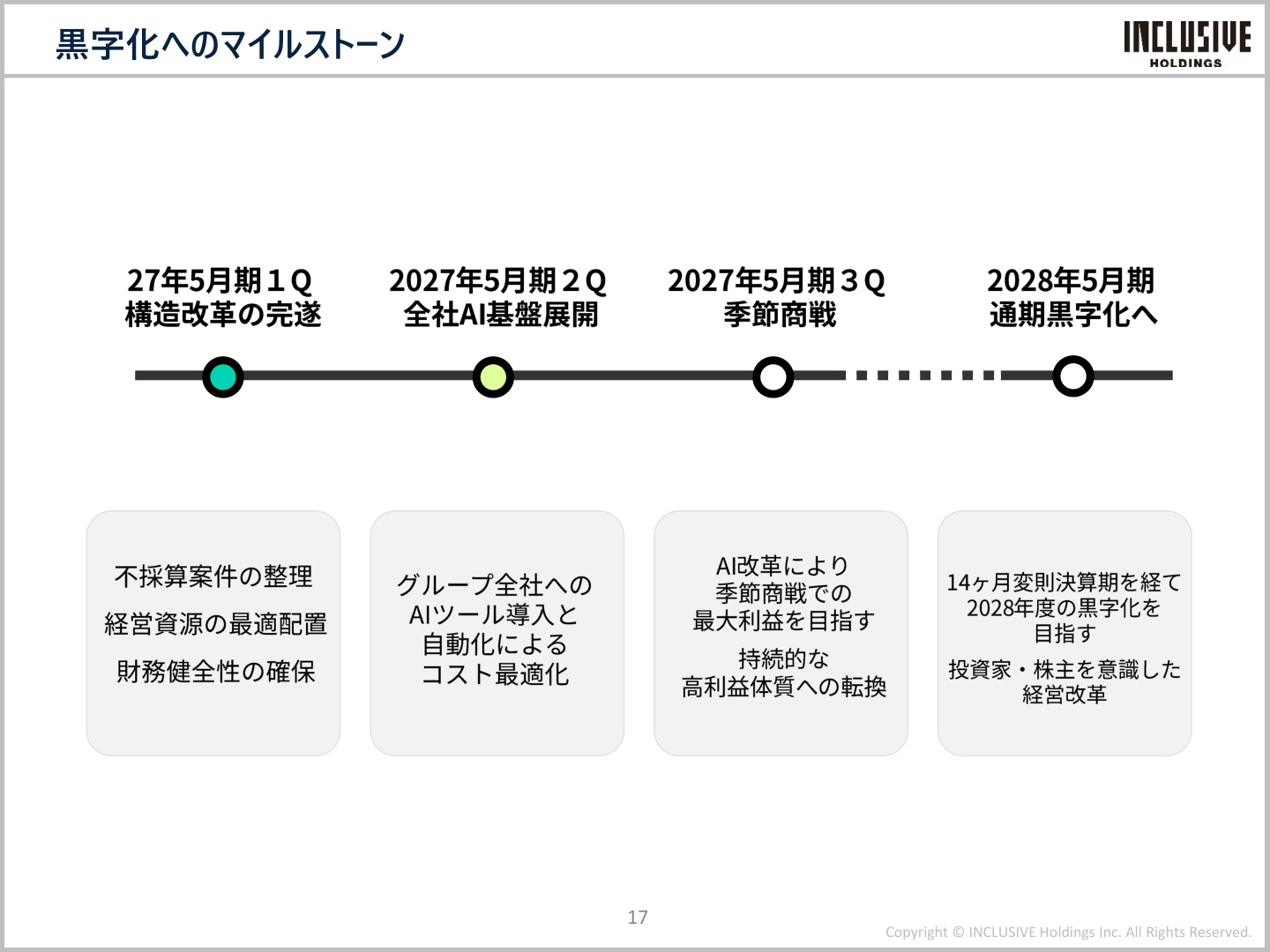
Slide Commentary: Milestones to Profitability
This slide shows the timeline for the company to achieve full-year profitability in FY2028 :
- Q1 FY2027 : Completion of the cleanup of unprofitable projects and structural reform (Achieved)
- Q2 FY2027 : Cost optimization through the introduction of AI tools and automation across the entire group
- Q3 FY2027 : Maximizing profits during the peak seasonal period by leveraging the results of AI reform
- FY2028 : Achieving full-year profitability through a sustainable, high-profit structure following the 14-month irregular fiscal period.
Thus, a concrete roadmap for turning profitable by FY2028 has been clearly presented, with phased steps to solidify the revenue base.
7. Conclusion
INCLUSIVE Holdings' Q1 FY2027 financial results clearly demonstrate the success of its structural reform, shifting the focus from pursuing sales volume to "profitability and high value-added operations."
Despite a transitional decline in revenue due to the downsizing of unprofitable media businesses, the company is steadily progressing toward its next growth phase through significant improvements in profit indicators , the turnaround of the brand consulting business , the explosive adoption of "LAND INSIGHT" by local governments , and company-wide AI implementation, including the "Shimogamo Saryo AOI Project."
Attention will now focus on how the strengthening of its profit structure, as it completes the reconstruction of its management foundation during this 14-month irregular fiscal period, will bear fruit toward achieving full-year profitability in FY2028.
This content is not intended as investment advice or a recommendation. Any opinions expressed are solely the personal views of each article.