

LTS, Inc. (6560) Q2 FY2026 Earnings Analysis: DX Consulting Drives Record-High H1 Operating Profit; Company Announces Transition to Standard Market and Enhanced Shareholder Returns

Sentiment Analysis
This report provides a multi-faceted analysis of the Q2 FY2026 financial results for LTS, Inc. (Tokyo Stock Exchange Prime, Securities Code: 6560), based on the company's official earnings presentation. We examine performance trends, segment-specific developments, human capital and client metrics, the change in market segment, and the updated shareholder return policy.
1. Q2 FY2026 (First Half) Consolidated Financial Highlights
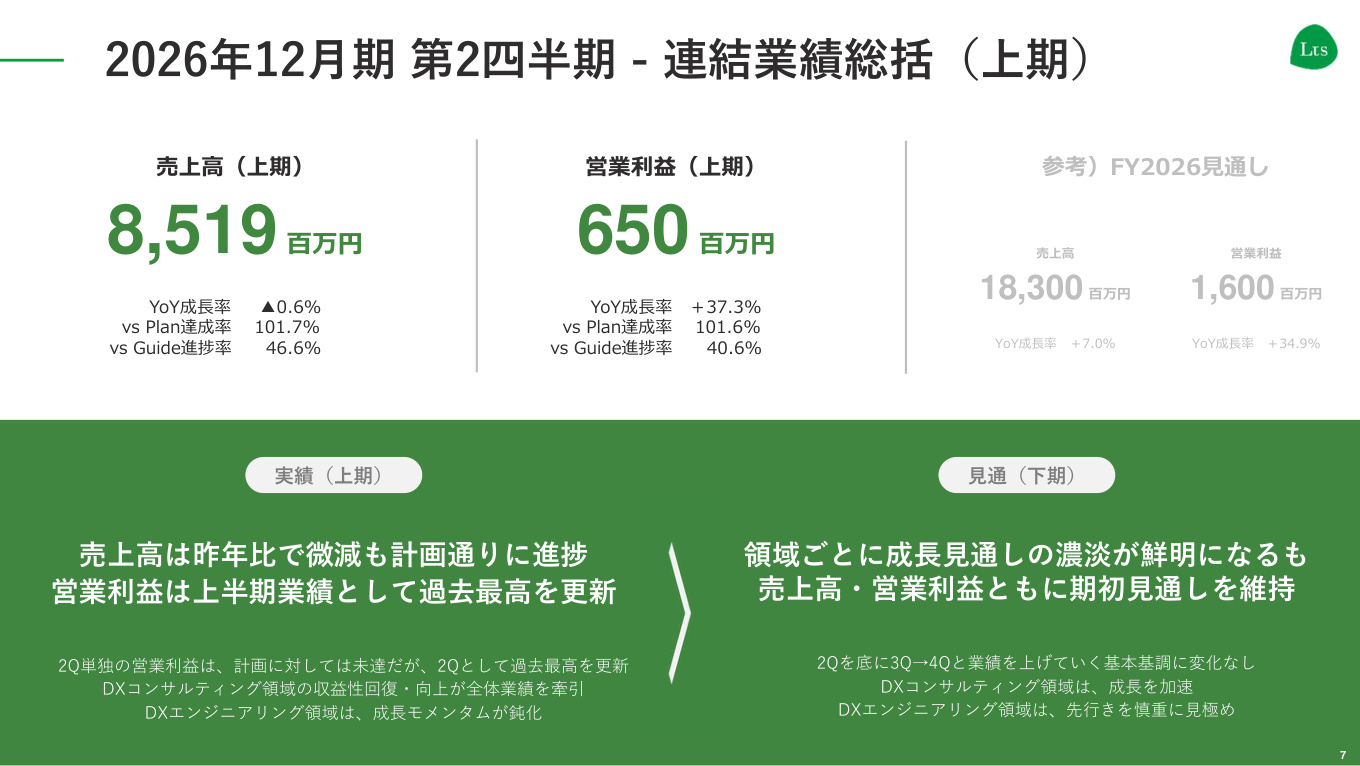
For the first half of the fiscal year ending December 2026, LTS reported net sales of 8,519 million yen (down 0.6% YoY), operating profit of 650 million yen (up 37.3% YoY), ordinary profit of 706 million yen (up 34.4% YoY), and net income attributable to owners of the parent of 506 million yen (up 123.2% YoY).
Rationale for Slide Selection and Data Commentary
The slide above (page 7) provides the most critical overview of the H1 performance. While net sales remained largely flat (a slight decrease) YoY due to factors such as the exclusion of consolidated subsidiaries, the shift toward high-value-added projects and improved profitability in the DX consulting segment drove operating profit to a record high for the first half . Progress against the full-year forecast (net sales of 18,300 million yen, operating profit of 1,600 million yen) stands at 46.6% for sales and 40.6% for operating profit, tracking generally in line with company expectations.
2. Analysis of Operating Profit Drivers
The significant 176 million yen (+37.3%) increase in operating profit, rising from 473 million yen in the same period last year to 650 million yen, is attributed to clear structural factors:
- Expansion of Gross Profit (+231 million yen) : The primary driver was a substantial improvement in gross margin within the core DX consulting segment, resulting from the synergy between maintained/improved utilization rates and higher average unit prices.
- Optimization of SG&A Expenses (+54 million yen increase) : While growth-related investments such as recruitment costs (+15 million yen) and rent (+8 million yen) increased, these were partially offset by lower personnel costs due to the turnover of sales staff (-19 million yen) and the completion of certain goodwill amortization (-12 million yen).
As a result, the operating profit margin improved by 2.1 percentage points to 7.6% (from 5.5% in the same period last year), demonstrating a steady recovery in earning power.
3. Segment Trends and Challenges
LTS operates four service areas within its Transformation Service business. The first half saw mixed results across these segments.
Rationale for Slide Selection and Data Commentary
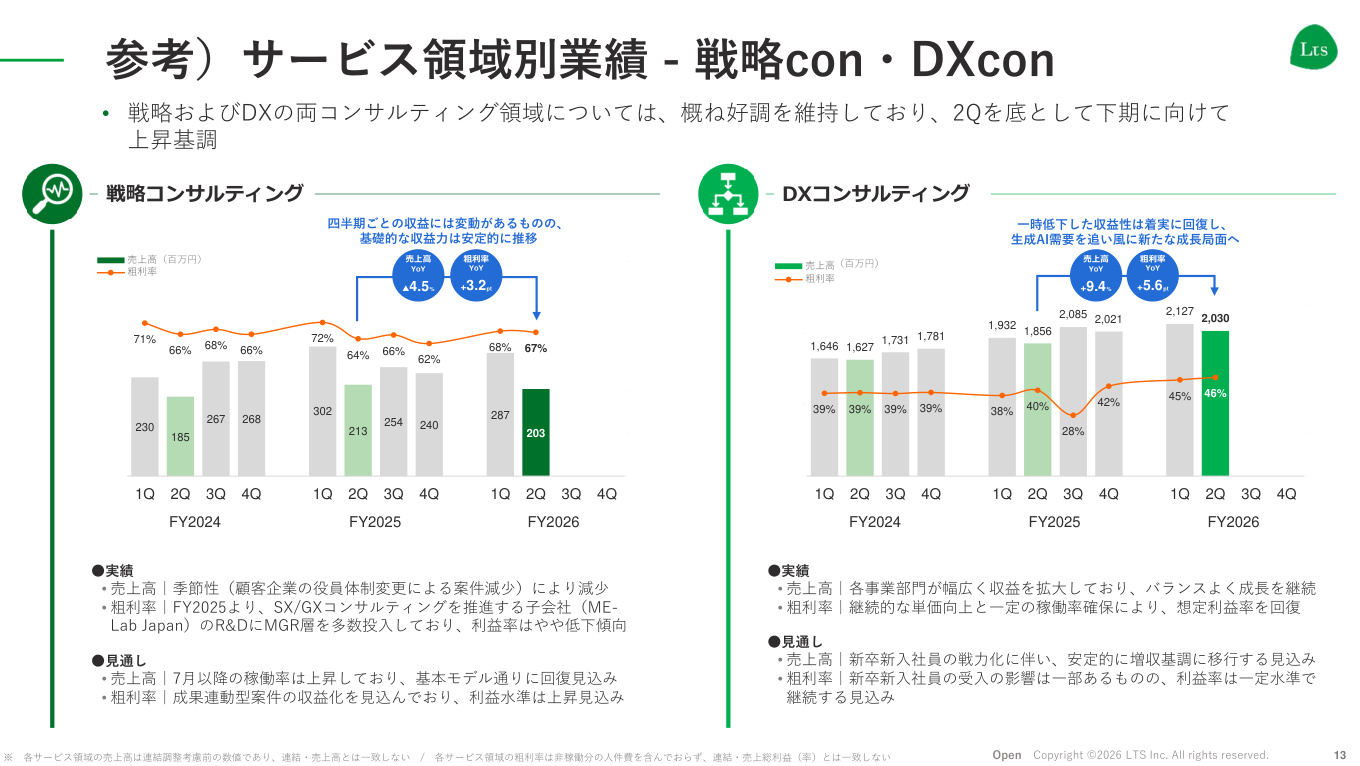
The slide above (page 13) is a key document illustrating the trends in "Strategy Consulting" and "DX Consulting," the core areas driving the company's growth. As the data shows, DX consulting revenue grew 9.4% YoY to 2,030 million yen, with the gross margin recovering strongly to 46% (+5.6pt YoY) . The company is successfully capturing corporate DX demand and needs related to generative AI utilization.
Details for each segment are as follows:
- Strategy Consulting : Revenue of 203 million yen (down 4.5% YoY). While revenue saw a slight decline due to seasonality and project transitions following changes in client management structures, the gross margin remains at a very high level of 67% .
- DX Consulting : Revenue of 2,030 million yen (up 9.4% YoY). This segment is a powerful growth driver, supported by the effective deployment of new graduates and high utilization rates.
- DX Engineering : Revenue of 1,253 million yen (down 11.9% YoY), gross margin of 29% (-4.8pt YoY). Amid structural reforms aimed at shifting toward high-value-added areas, performance temporarily lagged due to the emergence of unprofitable projects and a decrease in total work volume.
- Platform & Agent : Revenue of 888 million yen (down 14.0% YoY), gross margin of 19% (+0.9pt YoY). While consultant dispatching is on a recovery trend, demand for partner SES remains cautious.
4. Human Capital and Client Base Expansion
In terms of "human capital" and "client relationships," which are the sources of the company's sustainable growth, a shift from quantitative expansion to qualitative optimization and high-value-added services is underway.
- Consolidated Front-line Staff Trends : The number of front-line staff at the end of Q2 was 911 (an increase of 29 YoY). While the company is actively hiring experienced professionals, primarily for consultant roles (423 staff), it is taking a selective approach to hiring for engineering roles (488 staff) by factoring in the impact and utilization of generative AI.
- Client Relationship Metrics (LTV Maximization) : The average revenue per client for LTS on a non-consolidated basis is 20.6 million yen , a steady increase from the same period last year (19.3 million yen) and FY2021 (14.8 million yen). Furthermore, the revenue dependency on the top 20 clients has gradually declined from 83% in FY2021 to 71% (FY2025 average), forming a balanced revenue structure that avoids excessive reliance on specific clients.
5. Transition to the Tokyo Stock Exchange "Standard Market"
A major corporate topic in this earnings announcement is the disclosure of the application to transition from the Prime Market to the Standard Market .
Rationale for Slide Selection and Data Commentary
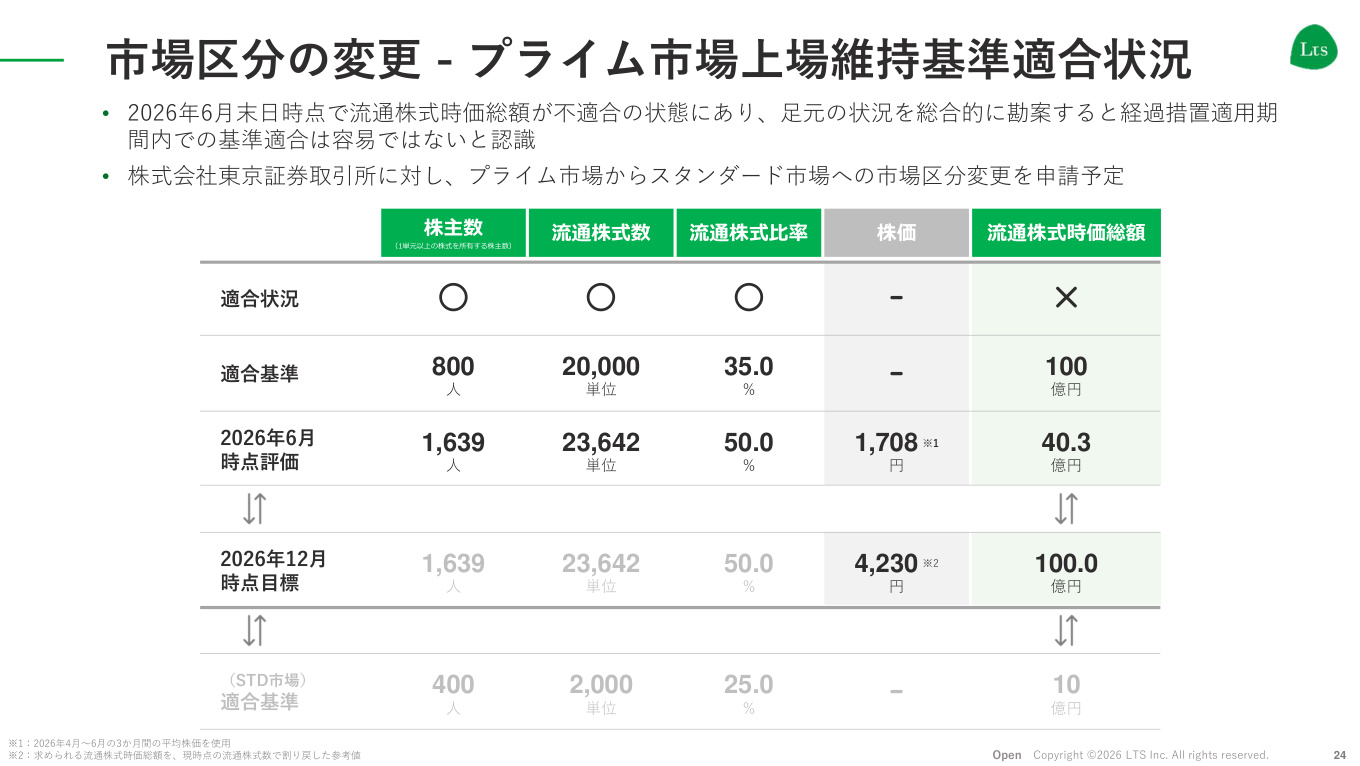
The slide above (page 24) outlines the status of compliance with listing maintenance criteria and the specific process for the market segment change. As of the end of June 2026, the company's market capitalization of tradable shares was 4.03 billion yen , falling short of the 10 billion yen requirement for the Prime Market. While other requirements such as the number of shareholders, number of tradable shares, and the ratio of tradable shares were met, the company concluded that meeting the Prime Market criteria would be difficult, considering current stock price trends and the transition period. Consequently, it decided to initiate procedures to move to the Standard Market .
The company stated that the negative impact on business and client presence due to this change would be limited. Moving forward, it plans to further strengthen IR/SR initiatives and reconstruct its mid-term growth strategy with an eye toward a potential future re-listing on the Prime Market.
6. Financial Soundness and Enhanced Shareholder Returns
To mitigate the temporary impact on stock supply and demand resulting from the market segment change and to enhance shareholder value, the company has announced a clear capital policy and shareholder return measures.
- Recovery of Equity Ratio : Against total assets of 9,978 million yen, net assets reached 5,117 million yen, with the equity ratio recovering to 50.1% (from 48.8% at the end of the previous fiscal year and 46.6% in the same period last year). Net cash of 1,544 million yen has been secured, indicating excellent financial health.
- Dividend Increase Plan : The annual dividend for the fiscal year ending December 2026 is planned at 40.0 yen per share (year-end lump-sum dividend), an increase of 5 yen from the previous fiscal year. This is expected to result in a dividend payout ratio of 16.8% (based on the plan).
- Share Buyback : At the Board of Directors meeting on August 13, 2026, the company resolved to acquire its own shares up to a maximum of 120,000 shares (2.72% of total issued shares) for a total of 200 million yen (acquisition period: August 14, 2026, to January 29, 2027), demonstrating a commitment to improving EPS and stabilizing stock supply and demand.
7. Outlook for the Second Half and Summary of Growth Story
For the second half of the fiscal year ending December 2026, the company has maintained its full-year consolidated earnings forecast (net sales of 18,300 million yen, operating profit of 1,600 million yen) . While operating profit typically hits a low in Q2 (April–June) due to costs associated with new graduate training, the company maintains that there is no change to the fundamental trend of performance expansion through Q3 and Q4.
[Summary] LTS's Q2 earnings results prove that its shift from pursuing rapid scale expansion to a high-profitability structure (margin improvement) is yielding steady results. While addressing transitional challenges such as structural reforms in the engineering segment and the move from the Prime to the Standard Market, the company has clearly demonstrated a robust financial foundation and a commitment to shareholder returns, backed by strong demand in its core consulting business.
This content is not intended as investment advice or a recommendation. Any opinions expressed are solely the personal views of each article.