


Earnings Deep Dive: QPS Institute (4894) Q1 FY2027 Results: The Full Growth Story Behind 'ReHeart®' Reimbursement, Drug Pricing, and Upward Full-Year Guidance

StockClub
Published: Aug 13, 2026, 11:11 AM
Sentiment Analysis
1. Overview and Significance of the Earnings Report
The Q1 FY2027 earnings report for QPS Institute, Inc. (Securities Code: 4894) marks a pivotal milestone, signaling the company's clear transition from a "research and development phase" to a "commercialization and monetization phase."
The most significant development in this report is the insurance reimbursement and drug price determination (53.2 million JPY per sheet) for the company's flagship iPS cell-derived cardiac patch, "ReHeart®," alongside a substantial upward revision of the full-year earnings forecast. Consequently, the previously undisclosed full-year revenue forecast has been set at 540 million JPY , and the projected ordinary loss has been significantly narrowed from the initial forecast of -1.4 billion JPY to -580 million JPY.
This report provides a comprehensive analysis of the company's performance, financial foundation, pipeline progress, mass-cultivation technology, and global expansion strategy, centered on 10 key topics extracted from the earnings materials.
2. Analysis of Q1 FY2027 Consolidated Results and Financial Position
Performance Highlights and Factor Analysis
In Q1 FY2027, the company reported revenue of 1 million JPY (compared to 85 million JPY in the same period last year), an operating loss of -333 million JPY (vs. -196 million JPY), an ordinary loss of -321 million JPY (vs. -199 million JPY), and a quarterly net loss attributable to owners of the parent of -317 million JPY (vs. -200 million JPY).
The decline in revenue is attributed to the timing of contract revenue from the CDMO business, which was recorded in the same period last year. Meanwhile, Selling, General and Administrative (SG&A) expenses increased to 334 million JPY (+107 million JPY year-on-year). While total R&D expenses were contained at 210 million JPY (down from 235 million JPY in the previous year), the net R&D expense increased to 208 million JPY (+103 million JPY year-on-year) due to the reduction in joint research development income (from -130 million JPY to -2 million JPY) following the acquisition of conditional and time-limited manufacturing and marketing approval for ReHeart®.
Financial Foundation and Cash Position
Regarding financial health—one of the most critical metrics for biotech ventures—QPS maintains an exceptionally strong position. As of the end of Q1, the company held 3,323 million JPY in cash and deposits , accounting for 69.1% of total assets (4,811 million JPY). With an equity ratio of 91.1% (net assets of 4,457 million JPY), the company demonstrates a management policy that keeps short-term liquidity risk extremely low.
Furthermore, the company is steadily executing capital investments, including an increase in inventory (+117 million JPY) for storing ReHeart® cardiomyocytes and investments in a pilot-scale plant at Nakanoshima Qross (+161 million JPY in property, plant, and equipment), ensuring solid progress toward commercialization.
3. Upward Revision of Full-Year Forecast: Trajectory Toward Profitability
The upward revision of the full-year consolidated earnings forecast, announced on July 28, 2026, has fundamentally altered the company's earnings outlook.
Significance of the Revision and Background Data
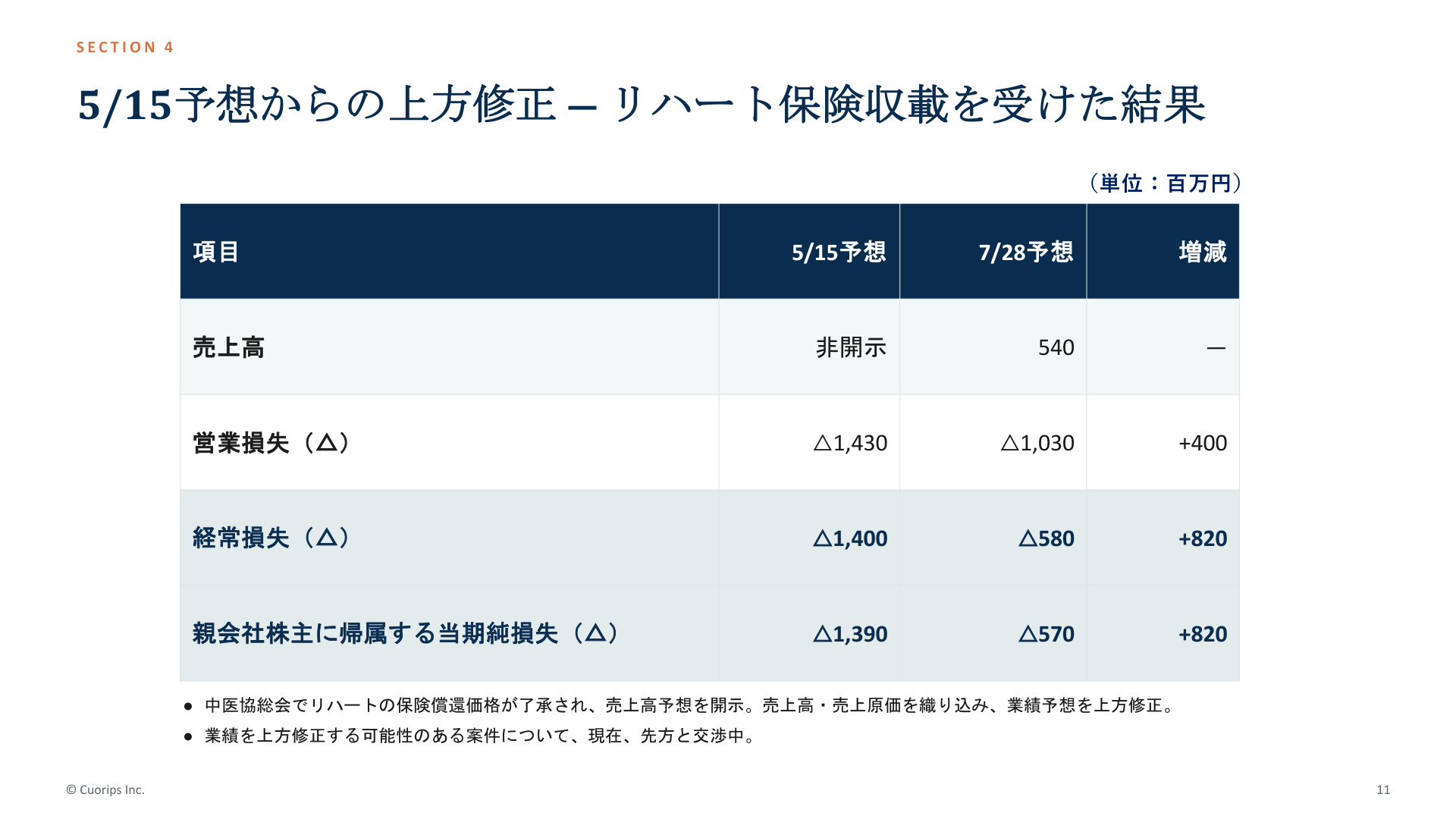
As shown in the slide above (Page 9), the full-year revenue forecast, which was undisclosed as of May 15, has been newly set at 540 million JPY . Furthermore, significant revisions have been made to the profit and loss figures:
- Operating Loss : -1,430 million JPY → -1,030 million JPY (+400 million JPY improvement)
- Ordinary Loss : -1,400 million JPY → -580 million JPY (+820 million JPY improvement)
- Net Loss : -1,390 million JPY → -570 million JPY (+820 million JPY improvement)
The four primary factors driving this upward revision are:
- Revenue recognition from the domestic launch of "ReHeart®" : Product sales are expected to be recorded following the start of transplant procedures at medical institutions from September onwards.
- Reduction in R&D expenses : As ReHeart® transitions from the development stage to the commercialization stage, R&D expenses directly related to the product have decreased.
- Restructuring of joint research agreements : Adjustments to contract structures following regulatory approval.
- Expected receipt of Regenerative Medicine CDMO subsidies : Subsidies from the Ministry of Economy, Trade and Industry (METI) are significantly boosting ordinary and net income.
Compared to the previous fiscal year (revenue of 212 million JPY, ordinary loss of -1,028 million JPY), the company expects a revenue increase of 328 million JPY and a reduction in ordinary loss by 448 million JPY , demonstrating rapid progress toward profitability.
4. Insurance Reimbursement for "ReHeart®" and Domestic Roadmap
At the heart of QPS's growth story is "ReHeart®," the world's first iPS cell-derived regenerative medicine product.
Insurance Reimbursement Price Structure and Market Impact
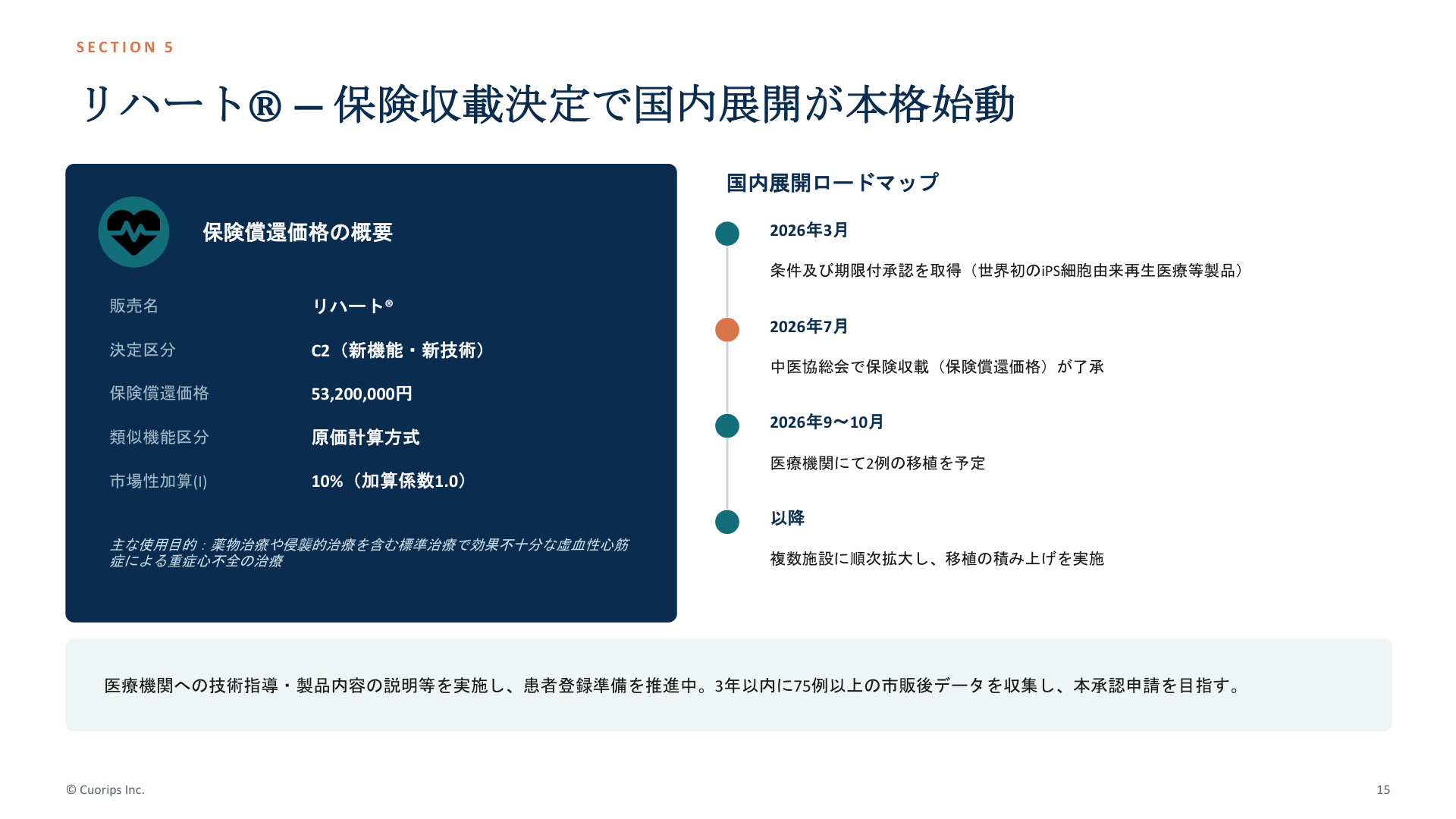
Slide 13 summarizes the insurance reimbursement price for ReHeart® approved by the Central Social Insurance Medical Council (Chuikyo) and the roadmap for domestic expansion.
[Overview of Insurance Reimbursement Price]
- Product Name : ReHeart®
- Classification : C2 (New Function/New Technology)
- Reimbursement Price : 53,200,000 JPY (per product)
- Similar Function Classification : Cost Calculation Method
- Marketability Premium (I) : 10% (Premium coefficient 1.0)
- Primary Indication : Treatment of severe heart failure due to ischemic heart disease where standard treatments, including pharmacotherapy and invasive procedures, are insufficient.
The high reimbursement price of 53.2 million JPY was granted based on its evaluation as a groundbreaking new technology (C2 category) and the application of a 10% marketability premium, reflecting its value as an innovative treatment option for patients with severe heart failure.
Domestic Deployment Schedule and Path to Full Approval
- March 2026 : Obtained conditional and time-limited approval.
- July 2026 : Insurance reimbursement (53.2 million JPY) approved by Chuikyo.
- September–October 2026 : First and second transplants scheduled at designated medical institutions.
- Thereafter : Sequential expansion of transplant facilities and accumulation of cases.
- Plan for Full Approval : Aiming to collect and analyze post-marketing data for 75 or more cases within 3 years to apply for full approval.
By generating revenue through actual clinical use starting in September, the company enters a true commercialization stage. The clinical data accumulated will serve as the foundation for future full approval and the expansion of the target patient population.
5. Three Growth Drivers and Technological Innovation
QPS is pursuing three growth drivers to ensure sustainable growth beyond the single ReHeart® product.
Driver 1: Path to Profitability and Enhanced Earnings Power
Full-scale domestic sales of ReHeart® (price: 53.2 million JPY) will be accompanied by accelerated patient recruitment and partnerships with major overseas hospitals. The company also aims to improve gross margins by optimizing in-house manufacturing and reducing costs.
Driver 2: Development of Next-Generation Products
- Catheter Delivery Technology : Joint development with Asahi Intecc Co., Ltd. for acute myocardial infarction. Following successful Proof of Concept (PoC) in small animals, the project is advancing to large animal trials. With an estimated potential demand of 3,000 cases per year (10% of the 30,000 annual domestic patients), catheter-based delivery is less invasive than open-chest surgery and allows for repeat dosing.
- In-vivo Regenerative Factor Inducers (YS Series) : Regenerative medicine drug discovery targeting the liver, colon, and lungs (e.g., COPD, pulmonary hypertension). The company is advancing joint research with universities and entering full-scale licensing discussions with major pharmaceutical firms.
- 2nd Generation Overseas iPS Cardiac Patch : Developing a next-generation patch optimized for global markets through joint research with Stanford University.
Driver 3: Mass-Cultivation Technology and CDMO Foundation
CDMO Business Importance
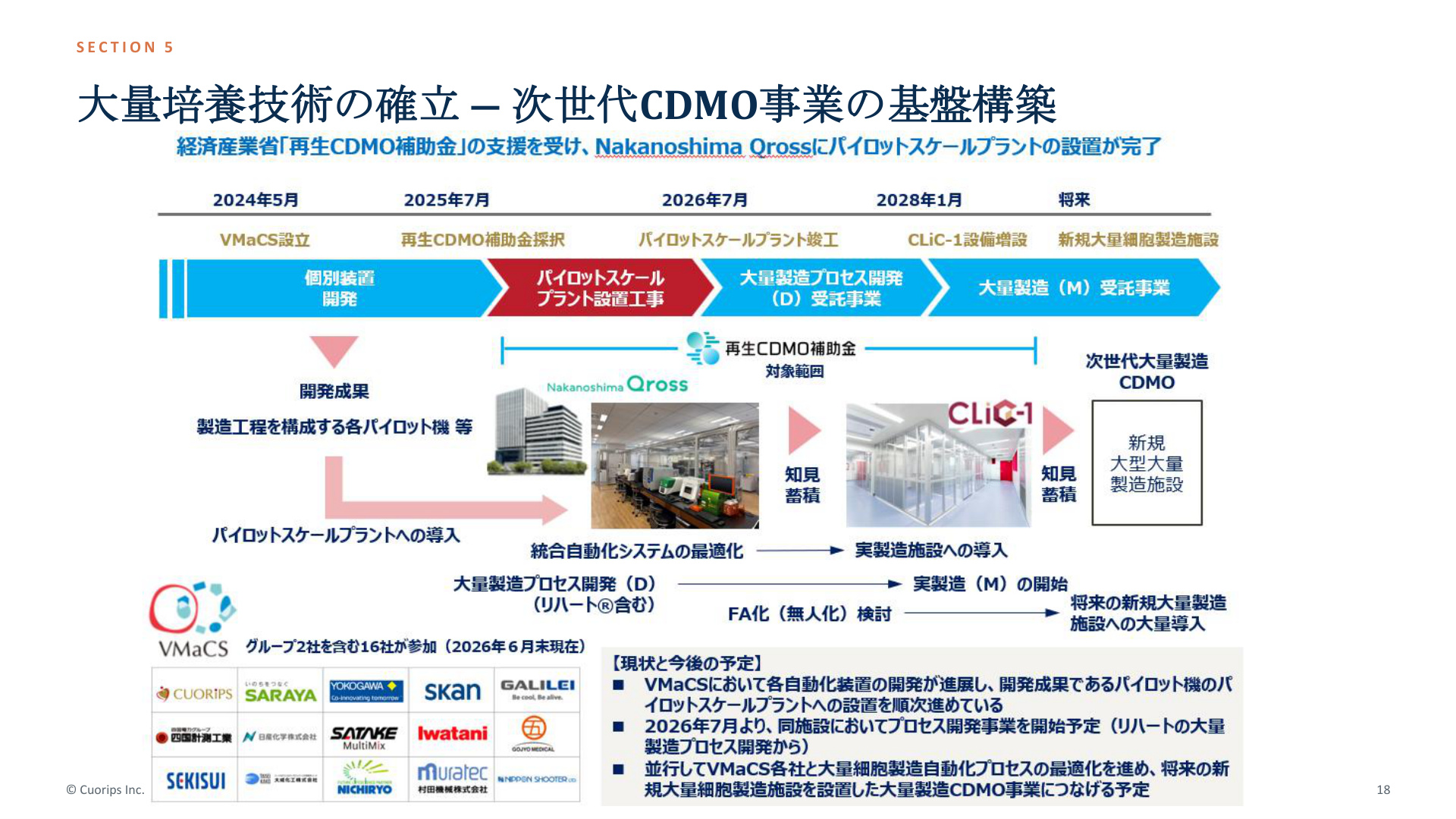
Slide 16 illustrates QPS's solution to the industrialization of regenerative medicine: "mass production and automation."
Supported by a METI subsidy, the company completed the installation of a pilot-scale plant at "Nakanoshima Qross" in Osaka in July 2026.
- VMaCS Consortium : A 16-company joint development framework including Yokogawa Electric, Saraya, Skewn, Galilei Panel Create, and Sekisui Chemical.
- Automation and Unmanned Manufacturing (FA) : Progressing from individual equipment development to pilot plant integration and system optimization.
- Expansion into CDMO Business : Commenced development of mass-manufacturing processes (D-stage) for ReHeart® in July 2026. The company aims to evolve into a next-generation mass-manufacturing CDMO (M-stage) , providing contract manufacturing services to other companies.
This strategy not only reduces internal costs but also establishes a new revenue stream as a CDMO platform in the regenerative medicine sector.
6. Global Expansion and the Osaka Startup Ecosystem
QPS is targeting global markets from the outset.
Academic Recognition and Global Validation
Research on "catheter-based cardiac organoid transplantation" received the Paul Dudley White International Scholar Award at the American Heart Association (AHA) BCVS 2026 in Boston, proving the company's technological superiority and safety on the international stage.
International Partnerships
Leveraging the Nakanoshima Qross global network, the company is negotiating with:
- USA : Joint research with Stanford University.
- Australia : Negotiations for market entry with local ANZ firms.
- Indonesia : Ongoing discussions with the Minister of Health.
- UAE/Middle East : Selection of local partners.
- Expo Legacy : Technology exhibition at the "Resona EXPO Re:Future" event in August 2026.
As a core company in the Osaka "Future Medical Startup Ecosystem," QPS is leading open innovation through industry-academia collaboration and international investment.
7. Conclusion and Outlook
The Q1 FY2027 earnings report confirms that QPS (4894) has moved to the forefront of commercialization in the iPS cell sector.
[Key Takeaways]
- ReHeart® pricing (53.2 million JPY) and the start of commercial revenue from September.
- Significant upward revision of full-year guidance (Ordinary loss improved from -1.4 billion JPY to -580 million JPY; 540 million JPY revenue target).
- Strong financial sustainability with 3,323 million JPY in cash and a 91.1% equity ratio.
- Establishment of CDMO infrastructure via the pilot plant.
- Robust pipeline (Catheter delivery, YS series) and international recognition.
Moving forward, key focus areas will include the number of ReHeart® transplants, progress toward the 75-case registration goal within three years, and the acquisition of new CDMO contracts.
This content is not intended as investment advice or a recommendation. Any opinions expressed are solely the personal views of each article.