

Solasia Pharma: Deep Dive into H1 FY2026 Financial Results and Pipeline Development

StockClub
Published: Aug 13, 2026, 11:06 AM
Sentiment Analysis
This report provides an objective and detailed analysis of the H1 FY2026 financial results and business development progress of Solasia Pharma K.K. (Securities Code: 4597), based on official disclosures.
This report is structured to provide a comprehensive understanding of the company's current financial position, sales trends of its core products, and the progress of its development pipeline (particularly SP-05), which is critical to its future corporate value.
1. Overview of H1 FY2026 Financial Results and Revenue Recognition Timing
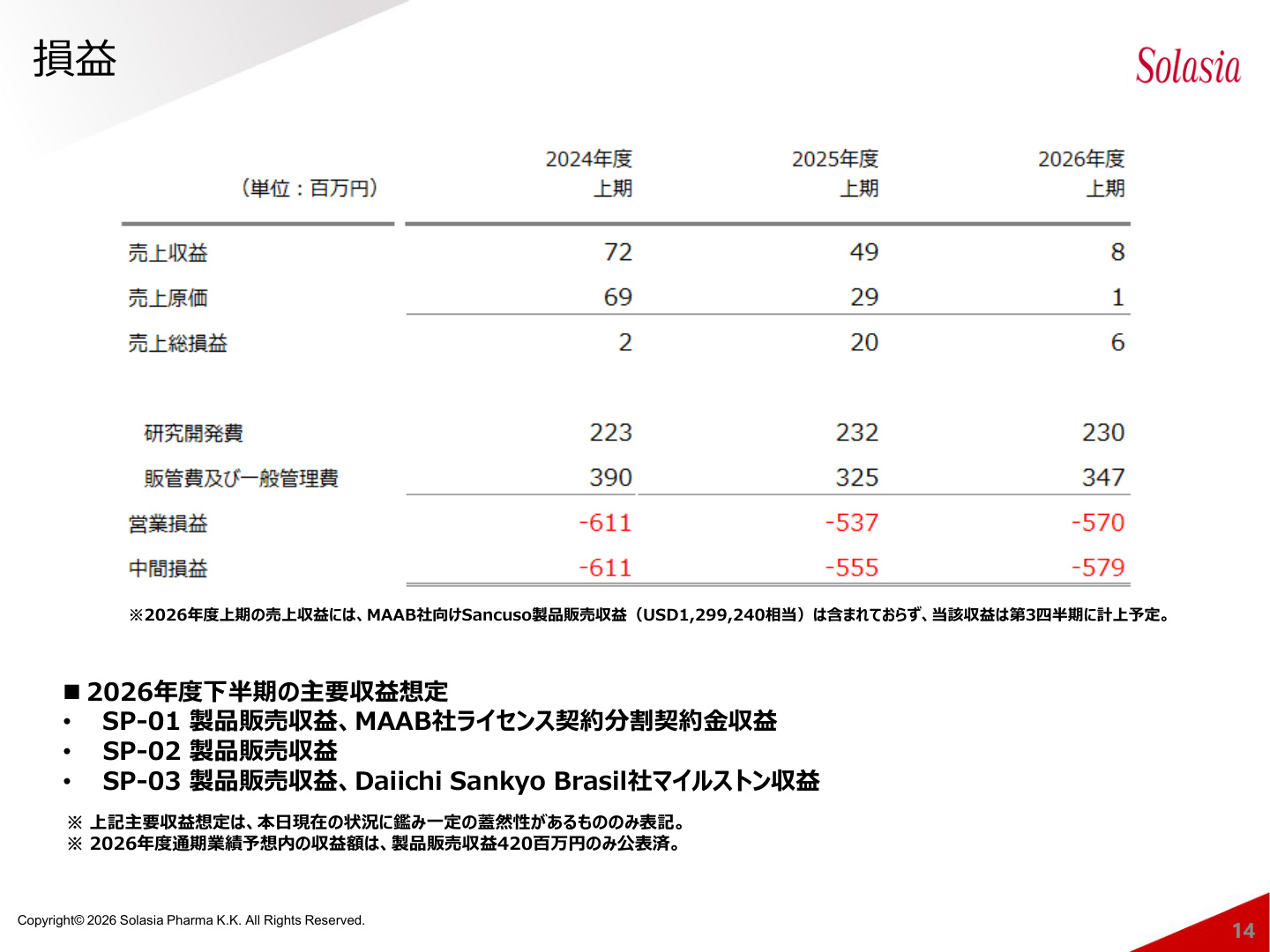
For the first half of the fiscal year ending December 2026, Solasia Pharma reported consolidated net sales of 8 million JPY , an operating loss of 570 million JPY , and a net loss of 579 million JPY . Compared to the same period in the previous year (net sales of 49 million JPY, operating loss of 537 million JPY) and the year before that (net sales of 72 million JPY, operating loss of 611 million JPY), net sales appear to have declined significantly.
Why H1 Net Sales Remained at a Low Level
As indicated in the "Profit and Loss" slide above, net sales for the first half totaled only 8 million JPY. However, this does not reflect a stagnation in business operations, but rather a timing lag in revenue recognition .
Regarding its flagship transdermal antiemetic "Sancuso® (SP-01)," the company entered into a licensing agreement in January 2026 granting exclusive manufacturing and marketing rights in China to MAAB. Product shipments to MAAB were completed during the second quarter, and the receipt of product sales proceeds (USD 1,299,240, equivalent to approximately 130–190 million JPY) was also finalized. However, because certain documentation procedures associated with the change in sales partners were not completed by the end of June, the accounting recognition of this revenue was deferred to the third quarter (second half) of 2026 (procedures are expected to be completed by August).
Revenue Structure for the Second Half and Full-Year Outlook
The company expects to record the following major revenues in the second half of FY2026:
- SP-01 (Sancuso®) : Product sales revenue and installment payments from the MAAB licensing agreement.
- SP-02 (Darvias®) : Product sales revenue.
- SP-03 (episil®) : Product sales revenue and milestone payments from Daiichi Sankyo Brasil.
The publicly disclosed full-year earnings forecast for FY2026 projects product sales of 420 million JPY , with revenue heavily weighted toward the second half.
2. Major Pipeline Portfolio and Global Expansion
The company specializes in oncology and supportive care, maintaining a pipeline of five assets: three marketed products and two in development.
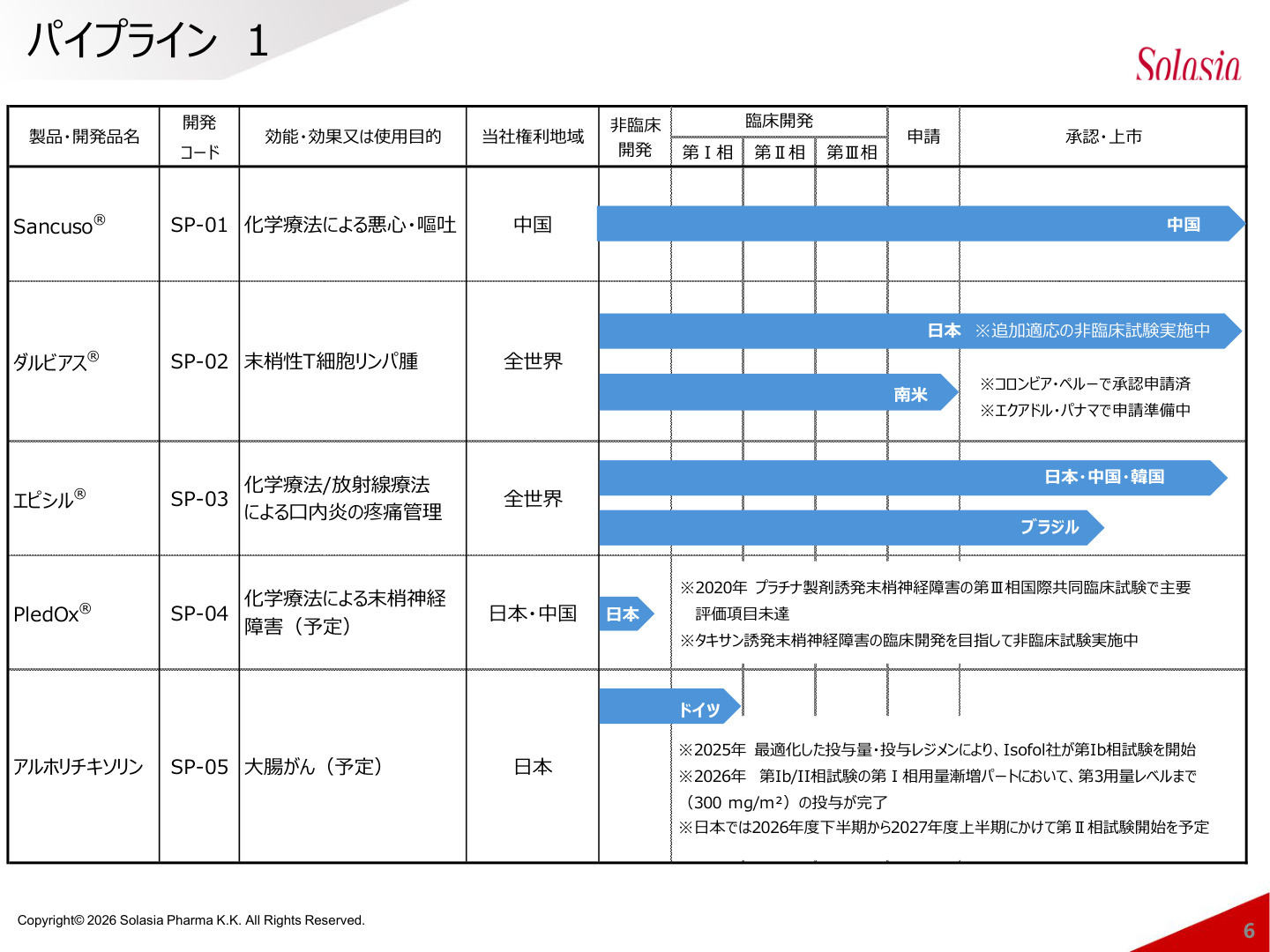
As shown in the pipeline list in the slide above, the company’s products and development assets are strategically positioned based on target regions and development stages.
Overview and Recent Progress of Each Product
-
Sancuso® (SP-01 / Transdermal Antiemetic)
- Indication : Prevention of chemotherapy-induced nausea and vomiting (CINV).
- Features : The only 5-HT3 receptor antagonist patch that provides 5 days of efficacy with a single application. Listed in the Chinese Society of Clinical Oncology (CSCO) guidelines.
- Progress : MAAB began sales in China in April 2026. The possibility of local production in China by MAAB is currently under consideration.
-
Darvias® (SP-02 / Antineoplastic Agent, Organic Arsenic)
- Indication : Relapsed or refractory peripheral T-cell lymphoma (PTCL).
- Features : An organic arsenic compound with lower toxicity and a relatively lower incidence of severe side effects compared to inorganic arsenic.
- Progress : Collaborative research with domestic university laboratories and Chinese CROs continues, focusing on elucidating the mechanism of action of darinaparsin and conducting non-clinical studies for new indications (other hematological and solid cancers). Discussions with potential new licensing partners are underway.
-
episil® (SP-03 / Medical Device, Oral Liquid)
- Indication : Pain management and protection for oral mucositis caused by chemotherapy and radiation therapy.
- Features : Forms a protective barrier within 5 minutes of application, with effects lasting for 8 hours. Operates in a segment with no direct competitors.
- Progress : A licensing agreement was signed with Daiichi Sankyo Brasil in August 2025. In July 2026, the notification number was published by the Brazilian Health Regulatory Agency (ANVISA), enabling sales. The product is scheduled to launch under the name "epifilm" in the fourth quarter. Discussions for expansion into the Middle East and Southeast Asian markets are also in progress.
-
PledOx® (SP-04 / Intracellular Superoxide Dismutase Mimetic)
- Planned Indication : Chemotherapy-induced peripheral neuropathy (CIPN).
- Progress : In addition to platinum-induced neuropathy, non-clinical studies (animal models and 2D cell models) are being conducted for taxane-induced peripheral neuropathy. Partnership negotiations, including rights for China, are ongoing.
3. Key Pipeline: Restructuring SP-05 (arfolitixorin) and Strategy for Enhancing Corporate Value
SP-05 (arfolitixorin) plays the most central role in the future enhancement of Solasia Pharma's corporate value.
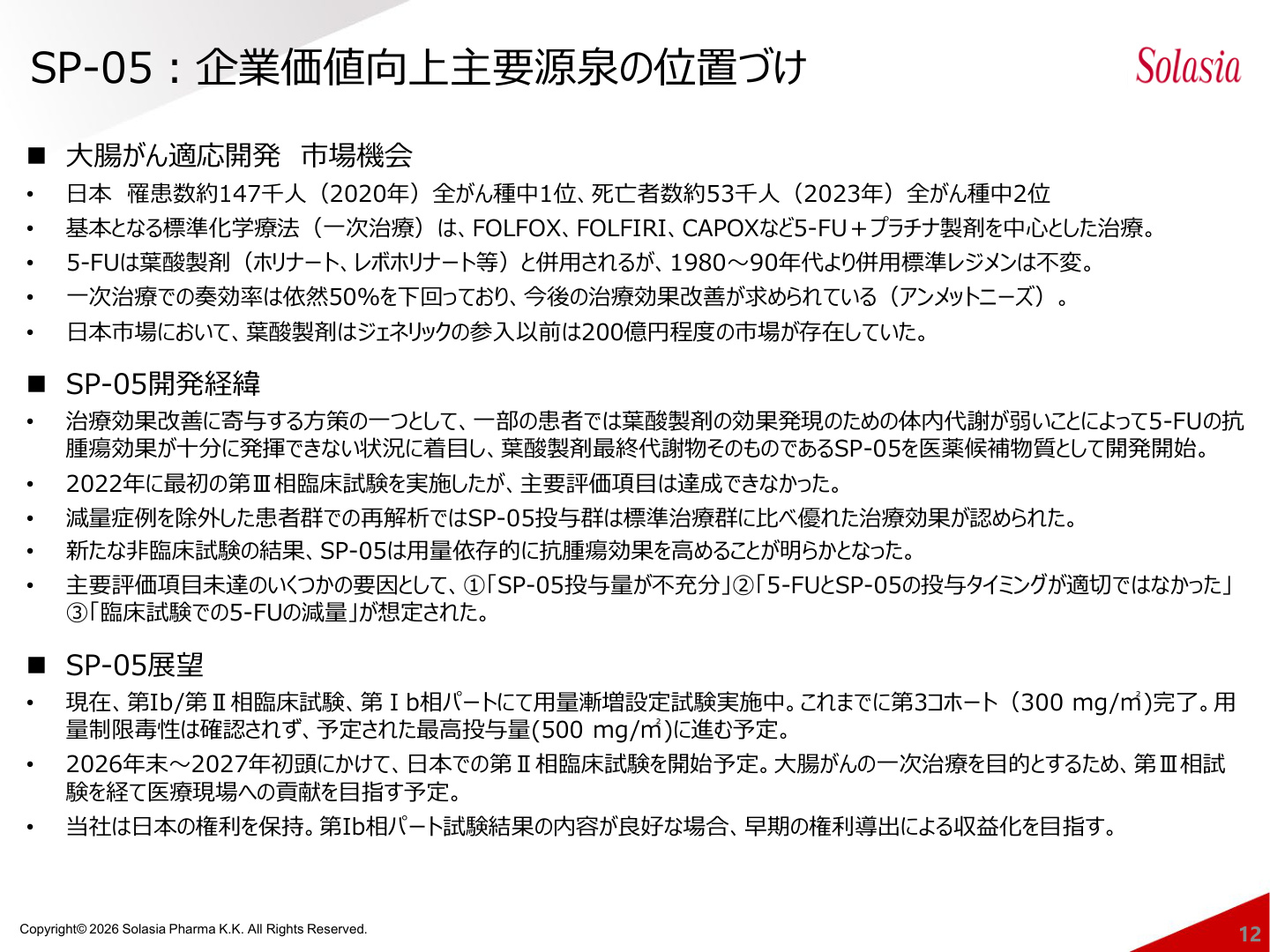
Unmet Medical Needs in the Colorectal Cancer Market and the Positioning of SP-05
In Japan, colorectal cancer is a major market, with approximately 147,000 patients (1st among all cancers) and 53,000 deaths (2nd among all cancers). Standard first-line chemotherapy for colorectal cancer has utilized regimens combining 5-FU and platinum agents (such as FOLFOX) alongside folates (leucovorin, levoleucovorin, etc.) since the 1980s and 90s.
However, the objective response rate (ORR) in first-line treatment remains below 50%, creating a strong demand for improved therapeutic efficacy. Historically, the Japanese folate market was valued at approximately 20 billion JPY before the entry of generics, representing a highly attractive market opportunity.
Past Challenges and New Strategy Based on Scientific Validation
SP-05 is the "final active metabolite of folate" that does not require metabolic conversion in the body, and it works by maximizing the antitumor effects of 5-FU. Although the Phase III clinical trial (AGENT study) completed in 2022 failed to meet its primary endpoint, detailed subsequent data analysis revealed the following factors:
- Insufficient dosage of SP-05.
- Inappropriate timing of 5-FU and SP-05 administration.
- Unanticipated dose reductions of 5-FU outside the study protocol.
It was confirmed that in the per-protocol population and in patients who did not undergo 5-FU dose reduction, SP-05 demonstrated statistically significantly higher efficacy (ORR) compared to the control group (levoleucovorin).
Current Progress and Future Roadmap
The company is currently conducting a Phase Ib/II clinical trial aimed at dose optimization. In the dose-escalation part of the Phase Ib study, administration up to the third dose level (300 mg/m²) was completed, and no dose-limiting toxicities (DLT) were observed. Consequently, a step-up to the planned maximum dose (500 mg/m²) has been approved.
- H2 2026 – Early 2027 : Isofol is scheduled to begin the overseas Phase II part, and Solasia Pharma plans to initiate a Phase II clinical trial in Japan .
- Commercialization Strategy : The company holds exclusive rights in Japan and aims to monetize the asset through early out-licensing based on positive data from the Phase Ib part.
4. Securing Capital and Financial Foundation
As an R&D-driven biotech venture, the company is focused on securing funding and stabilizing its financial base to continue development investments.
In February 2026, the exercise of stock acquisition rights issued in April 2025 was completed, resulting in total funding of 1,718 million JPY . This has established a framework to meet capital requirements for advancing SP-05 clinical trials, non-clinical research for other pipelines, and global expansion. R&D expenses for the interim period were 230 million JPY (232 million JPY in the same period last year), and SG&A expenses were 347 million JPY (325 million JPY in the same period last year), demonstrating disciplined cost control while advancing development.
5. Summary and Future Outlook
While Solasia Pharma's H1 FY2026 net sales appeared low on the surface, this was a temporary accounting shift due to procedural delays, and the results confirm the underlying business progress and revenue recognition expected for the second half.
Key points to watch moving forward include:
- Short-term perspective : The reliable recording of Sancuso® sales and licensing fees in the third quarter, and the performance impact of the launch of episil® in the Brazilian market.
- Mid-to-long-term perspective : Confirmation of safety for the flagship asset SP-05 (arfolitixorin) at the maximum dose of 500 mg/m², the start of the domestic Phase II trial in Japan from H2 2026, and the success of early out-licensing negotiations.
The company continues to build a stable cash-generating structure through existing products while maximizing the value of its development pipeline, centered on SP-05.
This content is not intended as investment advice or a recommendation. Any opinions expressed are solely the personal views of each article.