

![[Kudan] Q1 FY2027 Earnings Deep Dive: Transition to High-Margin Software and Business Progress in the Physical AI Market](https://news-images.stock-club.net/market_news/images/4425/140120260812518179/slide_eyecatch_en_0f2ba0c1.webp)
[Kudan] Q1 FY2027 Earnings Deep Dive: Transition to High-Margin Software and Business Progress in the Physical AI Market

StockClub
Published: Aug 13, 2026, 11:00 AM
Sentiment Analysis
This report provides a comprehensive analysis of the Q1 FY2027 (April–June 2026) earnings results for Kudan Inc. (Securities Code: 4425), covering the company's performance highlights, growth strategy for shifting its revenue structure, segment-specific progress, and medium-to-long-term outlook.
1. Q1 FY2027 Earnings Highlights and Profit Structure Analysis
Kudan’s Q1 FY2027 results reflect a period where the company achieved increased gross profit and a narrowed operating loss, despite a year-on-year decline in revenue . The specific financial figures and comparisons to the previous year are as follows:
- Net Sales : ¥112 million (Previous Q1: ¥168 million, down ¥56 million YoY)
- Operating Profit : -¥148 million (Previous Q1: -¥245 million, loss narrowed by ¥97 million)
- Ordinary Profit : -¥70 million (Previous Q1: -¥229 million, loss narrowed by ¥159 million)
- Quarterly Net Profit : -¥71 million (Previous Q1: -¥230 million, loss narrowed by ¥159 million)
- Adjusted Operating Profit : -¥148 million (Previous Q1: -¥230 million, loss narrowed by ¥82 million)
The reasons for the revenue decline and the primary factors behind the improved profitability are detailed in the slide below.
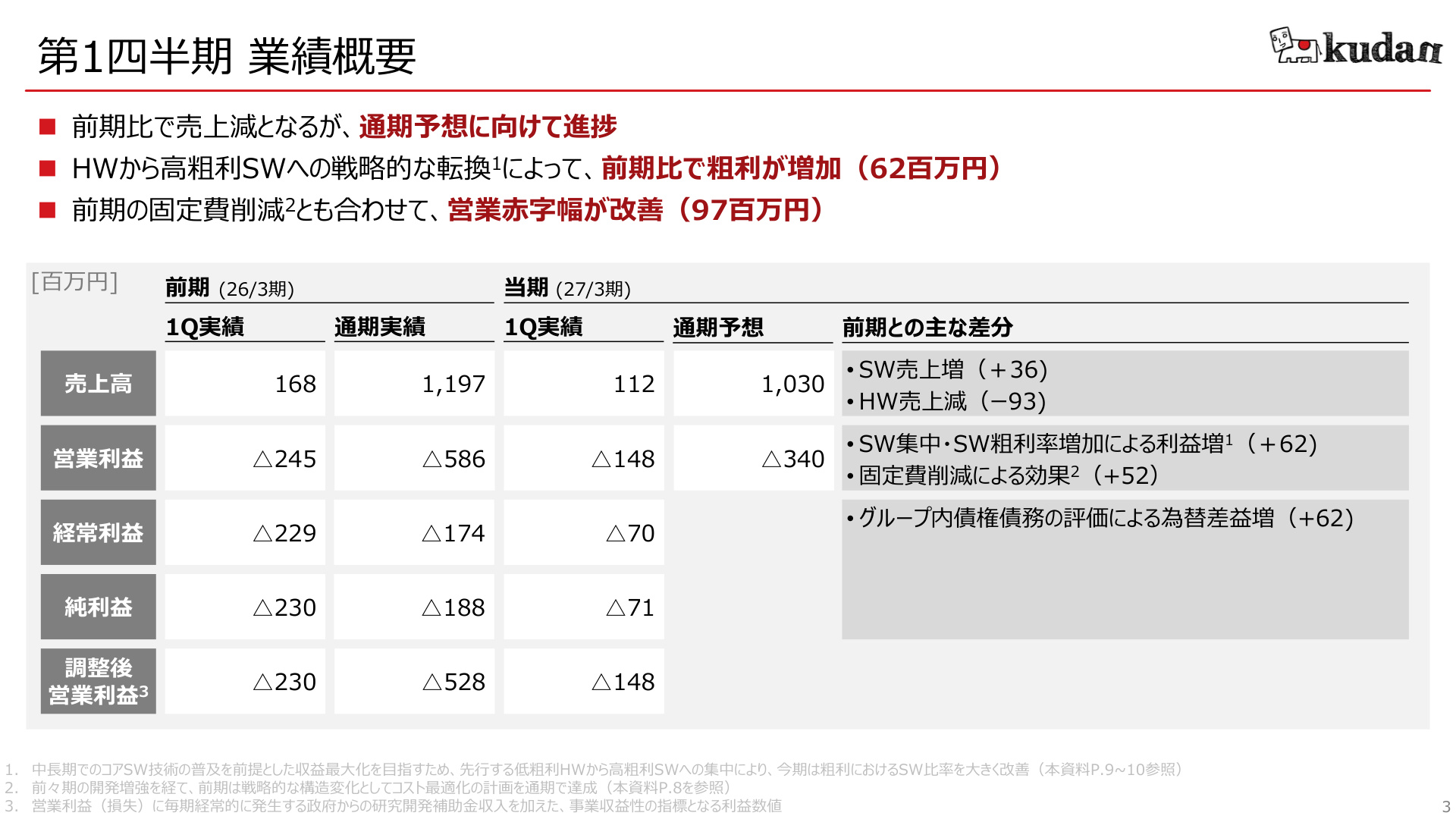
This slide is critical for understanding the structural background behind the significant profit improvement despite the decline in sales. Key factors include:
- Revenue Variance Analysis : While software (SW) sales increased by ¥36 million , hardware (HW) sales decreased by ¥93 million , resulting in an overall decline in revenue. However, since HW sales are inherently low-margin, the shift away from HW dependency toward SW sales has contributed to improved profitability.
- Profit Improvement Factors : Strategic focus on high-margin SW areas led to a ¥62 million increase in gross profit. Additionally, fixed cost reduction measures implemented in the previous fiscal year (organizational optimization and streamlining of non-core technologies) contributed a ¥52 million benefit , helping to narrow the operating loss by ¥97 million.
- Drivers for Ordinary and Net Profit : An increase in foreign exchange gains (up ¥62 million ) related to the valuation of intercompany receivables and payables further accelerated the narrowing of losses in ordinary and net profit.
Progress against the full-year forecast (Net Sales of ¥1,030 million , Operating Profit of -¥340 million ) is currently tracking in line with the company's plan.
2. Transformation of the Revenue Model: Focus on High-Margin Software (SW)
Previously, Kudan promoted "HW packages" combining hardware and software to facilitate market entry and technical verification. Starting this fiscal year, the company is transitioning from using HW sales as a "hook" for customer acquisition to a full-scale shift toward high-margin SW solution verification and SW license sales .
The company’s SW-focused strategy and the trend/target for the SW ratio in gross profit are as follows:
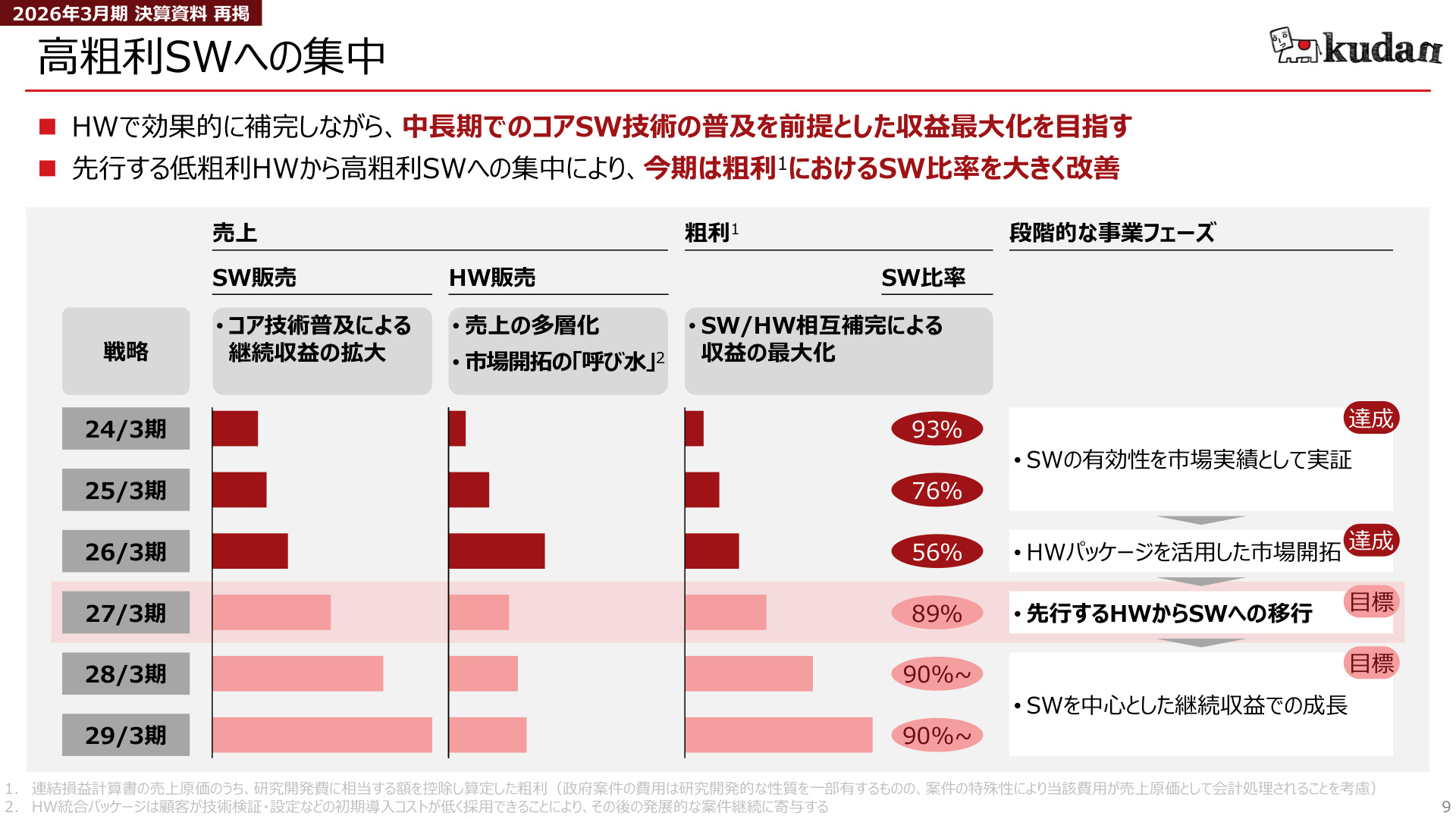
As shown in the slide above, the company's revenue structure is entering a clear phase of transformation:
- Historical Context : From FY2024 (93%) to FY2026 (56%), the company was in a market development phase using HW packages, during which the SW ratio in gross profit temporarily declined due to the increase in HW sales.
- Current Fiscal Year (FY2027) Target : The company plans to encourage migration from previously provided HW, aiming to raise the SW ratio in gross profit to 89% .
- Medium-to-Long-Term Target (FY2028 and beyond) : The goal is to maintain an SW ratio of 90% or higher , aiming for high business growth and profitability through recurring revenue centered on high-margin SW licenses.
Note that the adjustment to the full-year sales forecast for this fiscal year stems from the accelerated shift to SW in the previous fiscal year (FY2026), which resulted in some HW package sales ( +¥97 million ) being recorded in advance. This is a one-time impact and is described as part of the qualitative improvement process toward profitability in the coming fiscal years.
3. Optimization of Cost Structure and Sustainable Development
In parallel with improving profitability, fixed cost optimization is underway. In FY2025, fixed costs expanded to ¥1,170 million due to development enhancements for new technology areas. However, in FY2026, the following measures were implemented:
- Fixed Cost Reduction (Organizational Optimization) : -¥170 million
- Development Cost Optimization (Freezing/Outsourcing Review of Non-Core Tech) : -¥50 million
As a result, annual fixed costs at the start of FY2027 were contained at ¥950 million . This fiscal year, the company plans to invest an additional ¥100 million in sustainable organizational expansion to further strengthen core technologies (spatial perception and Physical AI), operating with an optimized cost structure of ¥1,050 million per year.
4. Segment Progress: Digital Twin (Kudan PRISM)
In the digital twin sector, development centered on the company’s spatial perception solution, "Kudan PRISM," is accelerating.
Business Highlights and KPI Trends
- Expansion of Customer Base : The number of customers is expected to grow by +150% (2.5x) year-on-year.
- Global Expansion : The company is expanding its reach, with projects planned in 10 countries, primarily in Europe , this fiscal year.
- Key Commercialization Progress : Technology adoption in Log build’s construction solution "Log Walk," national infrastructure projects by Eastern European government agencies, energy facility management in German regional infrastructure, and adoption by major European facility management firms.
- Disaster Prevention/Response : In collaboration with Japanese government agencies and municipalities, the company is conducting field verification of disaster prevention digital twins (damage assessment and analysis).
Technical Advantages (Differentiation from Conventional 3D Point Clouds)
Conventional 3D point cloud methods have faced limitations in practical use, such as "massive data size," "insufficient AI recognition accuracy," and "difficulty in integrating with existing systems." In contrast, "Kudan PRISM" fuses photorealistic display with a real-world understanding AI engine (semantic 3D recognition) to provide human-level spatial cognition, rapidly advancing DX in facility management and infrastructure inspection.
5. Segment Progress: Mobile Robotics and Government-Led Projects
In the mobile robotics sector, the evolution of autonomous navigation base technology and the expansion of global projects are progressing.
Business Highlights and Project Expansion
- Increase in Projects : The number of projects is expected to surge by +250% (3.5x) year-on-year.
- Technological Evolution : The company is moving from traditional mathematical methods to the implementation of advanced Physical AI models , strengthening its market-leading position for future hybrid model construction.
- Global Industry-Academia-Government Collaboration : Participation in "MIRMI" (one of Germany's largest industry-academia-government projects) and expanded collaboration with the VDMA (German Mechanical Engineering Industry Association), Bavarian state innovation agencies, and Innovate UK.
Leading Role in Domestic Government Projects
One of the most notable topics in the domestic market is Kudan's participation as a lead player in a large-scale national project supported by the government.
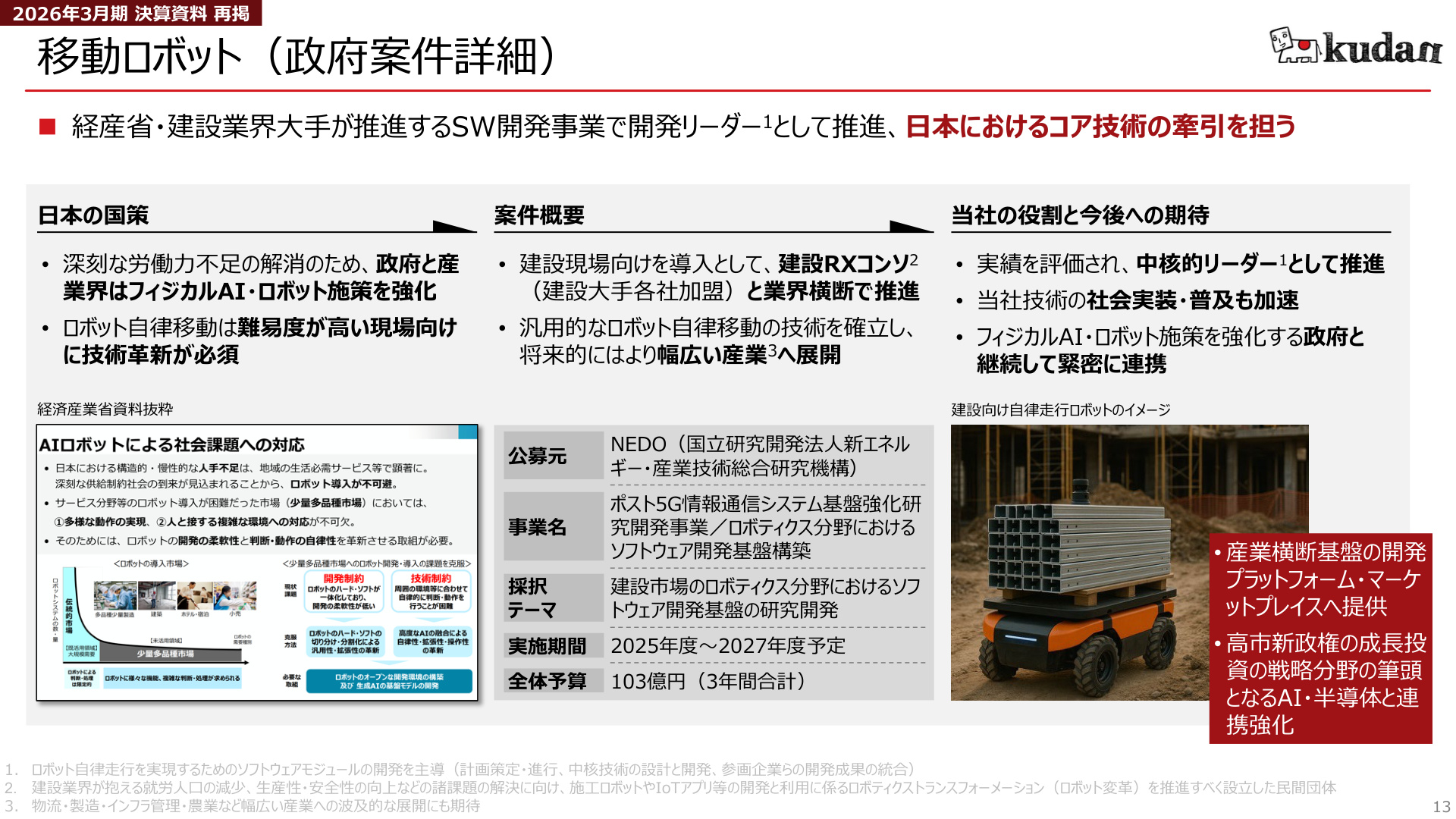
This slide serves as critical evidence that Kudan's technology is directly linked to solving Japan's national policy and industrial challenges.
- Project Overview : Kudan was selected for the "Post-5G Information and Communication System Infrastructure Enhancement R&D Project / Construction of Software Development Infrastructure in the Robotics Field" by NEDO (New Energy and Industrial Technology Development Organization).
- Project Scale : The total budget amounts to ¥10.3 billion over three years, focusing on R&D for software development infrastructure in the construction robotics field (FY2025–FY2027).
- Kudan's Role : In collaboration with the "Construction RX Consortium," which includes major construction firms, Kudan is leading the establishment of general-purpose robot autonomous navigation technology. This infrastructure is planned to be provided as a cross-industry co-creation marketplace in the future, serving as a powerful foothold for the industry standardization of Kudan's technology.
6. Medium-to-Long-Term Growth Scenario and Outlook for the Physical AI Market
Kudan's target market is expanding from "AI without embodiment" (limited to simple data acquisition and learning) to "Physical AI with embodiment" that acts autonomously in industrial sites and real-world spaces. The mobile robotics market is estimated to reach ¥300 trillion globally by 2040, with the majority of this market consisting of complex environments—such as mixed indoor/outdoor spaces and complex 3D structures—that require next-generation spatial perception technology.
Through its accumulated technical track record, strategic shift to high-margin SW, and cost optimization, the company has outlined the following roadmap:
- FY2026 (Previous Year) : Completion of structural reform and cost optimization for the shift to high-margin SW.
- FY2027 (Current Year) : Profitability optimization through focus on high-margin SW and significant narrowing of losses.
- FY2028 and beyond : Business growth with high profitability and achievement of sales expansion and profitability as the Physical AI market enters a full-scale boom.
In summary, Kudan's Q1 FY2027 earnings report demonstrates that the company is not merely experiencing a revenue decline during a transition period, but is steadily advancing its high-margin revenue model, reducing fixed costs, and penetrating the market through national projects and global initiatives.
This content is not intended as investment advice or a recommendation. Any opinions expressed are solely the personal views of each article.