

Photosynth (4379) Q2 FY2026 Earnings Analysis: A Dual Scenario of Re-accelerating Top-line Growth and Enhanced Profitability

StockClub
Published: Aug 13, 2026, 10:58 AM
Sentiment Analysis

Photosynth Inc.'s financial results for the second quarter of the fiscal year ending December 2026 demonstrate a significant re-acceleration in revenue growth, driven by increased large-scale orders for its flagship 'Akerun' service and strong sales performance by its subsidiary, MIWA Akerun Technologies, which specializes in smart locks for residential use. The company delivered robust results, with all profit metrics significantly exceeding the previous year's performance.
This report provides a comprehensive analysis of the company's earnings highlights, key KPI trends, mid-to-long-term growth strategies, and technological development initiatives based on the disclosed financial materials.
1. Q2 FY2026 Earnings Highlights and Full-Year Progress
In the second quarter (April–June), the company achieved revenue of 1.033 billion yen, a 32.3% increase year-on-year (YoY) , marking a record-high revenue for a single quarter. Gross profit reached 741 million yen, up 23.1% YoY , maintaining a high gross margin exceeding 70% .
Regarding profitability, despite continued aggressive investment for future growth, the company achieved substantial profit growth, with operating profit rising 61.9% YoY to 80 million yen and adjusted EBITDA increasing 65.7% YoY to 192 million yen.
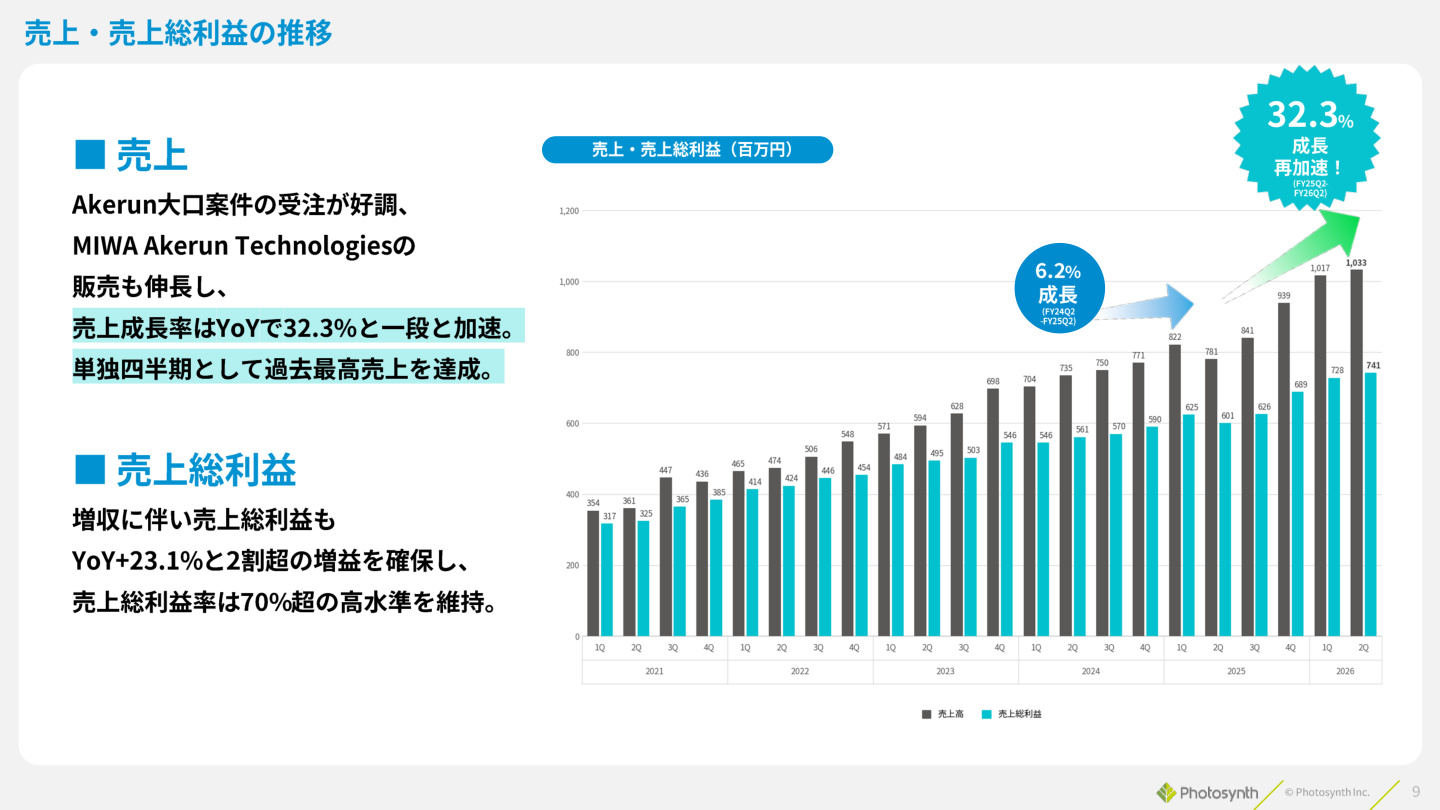
As illustrated in the "Revenue and Gross Profit Trends" slide above, the company's revenue growth rate, which hovered between 6% and 15% YoY from 2024 to 2025, has further accelerated to 32.3% YoY in Q2 2026. For a company with a stock-based business model, this sharp upward trajectory in top-line growth is a critical development for future recurring revenue accumulation.
Progress against the full-year plan for the first half (January–June) is as follows:
- Revenue : 2,050 million yen ( 50.5% progress against the 4,062 million yen full-year target)
- Adjusted EBITDA : 386 million yen ( 53.7% progress against the 720 million yen full-year target)
- Operating Profit : 173 million yen ( 72.4% progress against the 240 million yen full-year target)
- Ordinary Profit : 179 million yen ( 74.8% progress against the 240 million yen full-year target)
- Net Income Attributable to Owners of Parent : 177 million yen ( 60.3% progress against the 295 million yen full-year target)
Given the company's second-half-weighted stock business structure , where revenue accumulates toward the end of the fiscal year, the 72.4% progress in operating profit at the end of the first half indicates a highly favorable position for achieving its full-year targets.
2. Deepening Customer Base and Key KPIs: ARPU Growth and Low Churn
High-quality improvements are also evident in the key metrics supporting the company's growth model: ARR (Annual Recurring Revenue) , ARPU (Average Revenue Per User) , and Churn Rate .
- ARR : 3.50 billion yen ( +15.5% YoY )
- Recurring Revenue Ratio : 84.2%
- Number of Contracted Companies : 5,755
- ARPU : 50,542 yen ( +13.4% YoY )
- Churn Rate : 1.04% (0.87% excluding customer-initiated churn)
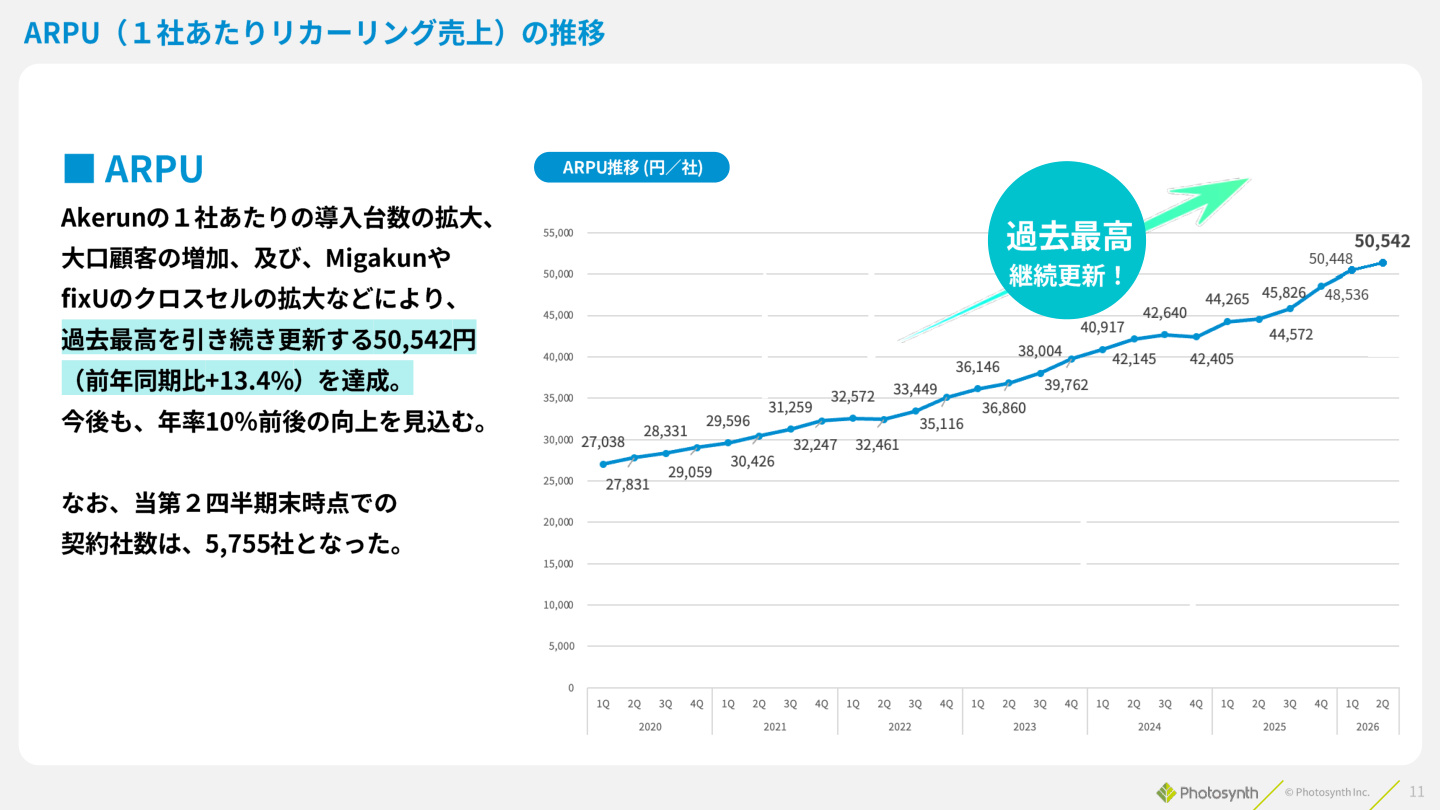
The "ARPU Trends" graph in the slide above clearly demonstrates that the company's strategy to increase unit prices is steadily materializing. ARPU has grown from 27,038 yen in Q1 2020 to a record high of 50,542 yen in Q2 2026.
This expansion in ARPU is driven by three main factors:
- Increased number of Akerun units per company : Growth in bulk installations for large-scale offices and multi-site operations.
- Acquisition of large-scale clients : Progress in adoption as a standard infrastructure within major corporations.
- Strengthened cross-selling : Increased attachment rates for services such as the facility management service "Migakun" and the customer management/payment system "fixU."
Regarding the churn rate, while there was a temporary uptick to 1.04% this quarter due to a large-scale cancellation in "Migakun," the actual churn rate excluding customer-initiated factors (downsizing, closure, bankruptcy) remained at an extremely low level of 0.87%. The company expects to maintain a stable churn rate of around 1% by strengthening ties with large-scale clients and promoting infrastructure integration via APIs.
3. Mid-to-Long-Term Growth Scenario and 'Rule of X' Targets
As a quantitative goal for its mid-term management plan, the company aims to re-accelerate revenue growth to 20%–30%. Specifically, it targets 5.8 billion to 7.5 billion yen in revenue and 1.16 billion to 1.5 billion yen in adjusted EBITDA by the fiscal year ending December 2028.
In terms of the "Rule of X" (Revenue Growth Rate + Adjusted EBITDA Margin), a metric used to measure the efficiency and growth of SaaS and HESaaS (Hardware Enabled Software as a Service) companies, Photosynth sets a minimum target of achieving the "Rule of 40" by FY2028 , with sights set on the "Rule of 50" level through M&A and strategic alliances.
- FY25 Actual : 29% (15% revenue growth + 14% EBITDA margin)
- FY26 Plan : 38% (18% revenue growth + 20% EBITDA margin / 33–35% on an organic basis)
- FY28 Target : 40% organic achievement (20% revenue growth + 20% EBITDA margin) + up to 50% via M&A, etc.
Having entered a phase where economies of scale in the revenue structure are taking effect, the shift toward a "harvest period" —where top-line growth and margin expansion occur simultaneously—is becoming increasingly clear.
4. Progress on Growth Strategies: Sales Expansion, Packaging, and Physical AI
Updates on the company's three core growth strategies are as follows:
① Market Development (Accelerated Expansion of Akerun)
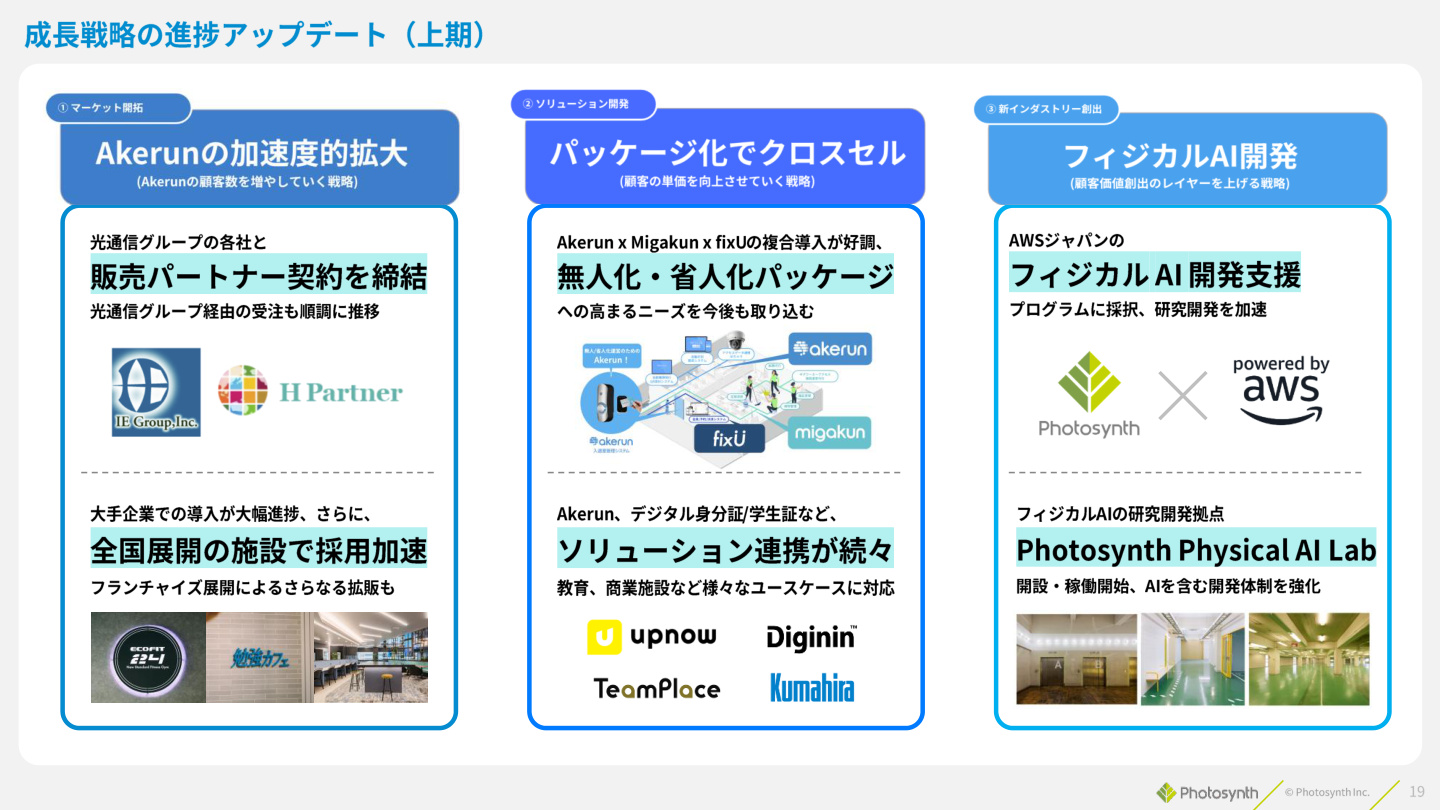
In addition to strengthening its direct sales force, the company has signed sales partnership agreements with various companies within the Hikari Tsushin Group , successfully expanding orders through indirect sales channels. Furthermore, adoption by nationwide chain stores and franchise facilities, such as "ECoFIT24" and "Benkyo Cafe," is accelerating.
② Solution Development (Cross-selling via Packaging)
Beyond simple key management, the company is successfully deploying "Unmanned/Labor-saving Packages" that combine access control (Akerun), facility management (Migakun), and store management/payment (fixU). This enables the company to capture the demand for unmanned store and space operations in a single package, leading to higher unit prices and increased customer stickiness.
③ New Industry Creation (Physical AI Development)
The company has launched the "Photosynth Physical AI Lab" as a next-generation growth foundation. Furthermore, by being selected for the AWS Japan "Physical AI Development Support Program," it has dramatically strengthened its capabilities in spatial data analysis and AI model construction. The company is steadily making upfront investments to provide new value by leveraging dynamic data of people and objects in physical spaces.
5. Competitive Environment and Market Positioning
The company's competitive advantage in the corporate smart lock market is robust. As many legacy competitors have shifted to the home (BtoC) sector or exited the market, direct competition in the corporate market is on a downward trend (easing competitive environment).
Photosynth has built high barriers to entry by focusing its investments on corporate requirements, such as API integration with attendance management systems, ISMS compliance, and high durability and stability. As a result, it has secured an absolute position in the market, achieving four No. 1 rankings, including "No. 1 in number of smart lock installations" and "No. 1 in number of users of cloud-based access control systems."
6. Conclusion
Photosynth's Q2 FY2026 earnings report demonstrates the strength of its business growth across all aspects, including the re-acceleration of revenue growth to 32.3% YoY , 72.4% progress toward the full-year operating profit target , and the expansion of ARPU to 50,542 yen.
In addition to organic growth in existing businesses, the company has built a solid foundation for long-term corporate value enhancement through strengthened sales partnerships, unit price increases via unmanned packages, and advanced initiatives in the Physical AI domain.
This content is not intended as investment advice or a recommendation. Any opinions expressed are solely the personal views of each article.