

In-Depth Earnings Report: GMO Commerce (410A) H1 FY2026: A Growth Story Accelerated by Consolidation and the New 'GMO Store AIO' AI Service

StockClub
Published: Aug 13, 2026, 10:43 AM
Sentiment Analysis
GMO Commerce Inc.'s financial results for the first half of the fiscal year ending December 2026 were exceptionally strong, with both revenue and profit at all levels showing steady growth and reaching record highs. This report extracts 10 key topics that investors should focus on from the published earnings presentation materials, providing a detailed analysis of performance highlights, the results of 'team-building' through M&A, innovative new initiatives in the AI sector, and the upwardly revised full-year earnings forecast and growth strategy.
1. H1 FY2026 Earnings Overview and Key KPI Trends
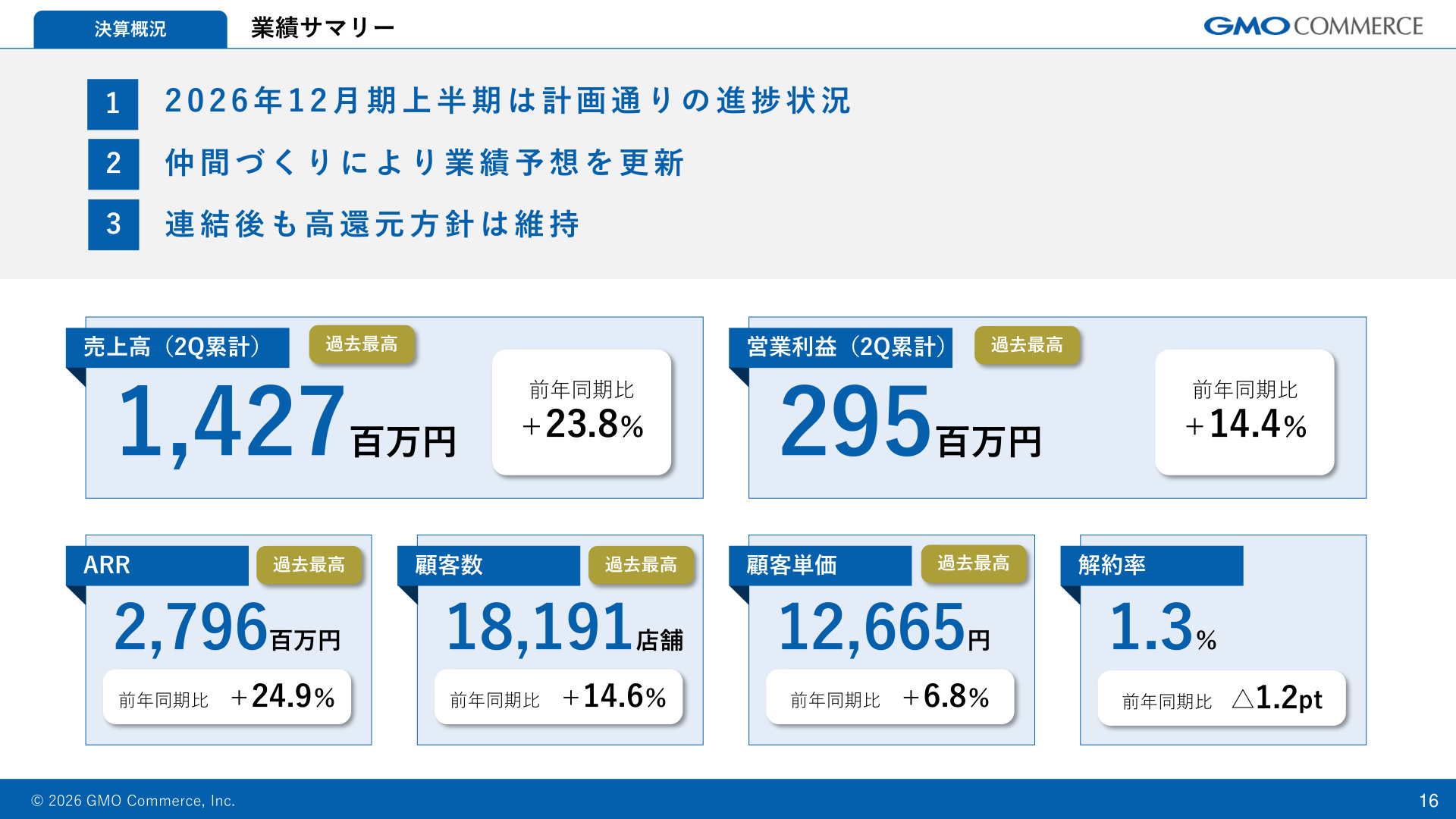
For the first half of the fiscal year ending December 2026 (cumulative), revenue reached 1,427 million yen (+23.8% YoY) , operating profit was 295 million yen (+14.4% YoY) , ordinary profit was 296 million yen (+14.6% YoY) , and quarterly net profit was 206 million yen (+20.2% YoY) . Progress against the non-consolidated plan stands at 46%–48% for revenue and all profit lines, indicating a steady trajectory driven by the expansion of the stock-based revenue model that forms the foundation of the business.
[Significance and Data Analysis of the Slide Above]
This slide serves as an executive summary covering the most critical indicators for the H1 FY2026 earnings. It visually organizes not only accounting revenue and profit but also key KPIs that demonstrate the health of the SaaS/stock-based business model (ARR, number of customers, ARPU, and churn rate), all of which have reached record highs or are at exceptionally strong levels. Specifically, ARR (Annual Recurring Revenue) reached 2,796 million yen (+24.9% YoY) , confirming a robust expansion in leading indicators for future revenue. The number of client stores stands at 18,191 (+14.6% YoY) , and ARPU is 12,665 yen (+6.8% YoY) , demonstrating that both the expansion of the customer base and upselling are functioning effectively. Furthermore, the churn rate is maintained at a low level of 1.3% (-1.2pt YoY) , significantly outperforming the domestic BtoB SaaS industry average (approx. 3.01%), which proves high customer satisfaction and a solid revenue base.
Looking at quarterly revenue trends, Q2 alone reached 717 million yen , marking eight consecutive quarters of revenue growth . The acquisition of large-scale chains, expansion through sales partners, and cross-selling to existing customers are yielding steady results. The operating profit margin for Q2 was 19.2%, with a stable annual average margin of 21.3% . While continuing to invest in growth such as personnel costs, the SG&A-to-revenue ratio has improved to 50% (a significant improvement from 60% in the same period last year) .
2. 'Team-Building' Strategy: Consolidation of GMO Digital Lab and Its Impact
The company has identified 'team-building' as a major pillar of its growth strategy. As part of this, GMO Digital Lab Co., Ltd. was consolidated as a group subsidiary effective July 1, 2026 .
GMO Digital Lab is a company with industry-leading achievements, primarily targeting SMBs, through its 'GMO Omise App' and its house money/electronic gift certificate service for local governments and stores, 'GMO Digital Pay.' The company has 84 employees (as of March 2026) and possesses a highly compatible customer base and product strength. The impact of this consolidation on performance and key KPIs is significant. By being included in the scope of consolidation from the second half of 2026, the following quantitative synergies are expected:
- Increase in ARR : +500 million yen expansion in ARR through the addition of key products.
- Increase in Paid Contracts : +2,600 paid contracts, primarily among SMBs.
- Improvement in ARPU : Average unit price to increase by +500 yen (to the 15,000 yen level) through mutual cross-selling and service integration.
- Churn Rate Suppression : -0.2% improvement in churn rate due to increased satisfaction and the compounding of service value.
Regarding the standalone performance outlook for GMO Digital Lab, it recorded revenue of 505 million yen and operating profit of 43 million yen in the first half of FY2026, with direct contributions to consolidated performance expected from the second half onward.
3. New Growth Engine in the AI Era: 'GMO Store AIO' and Marketing Platform Transformation
To adapt to changes in market structure, the company is rapidly driving business transformation centered on AI. We are transitioning from the era of 'searching via search engines' to an era where generative AI, such as 'ChatGPT' and 'Gemini,' proposes recommended stores and products to users .
To capture this market shift, the company launched a new service, 'GMO Store AIO (Artificial Intelligence Optimization),' on July 1, 2026 .
[Significance and Data Analysis of the Slide Above]
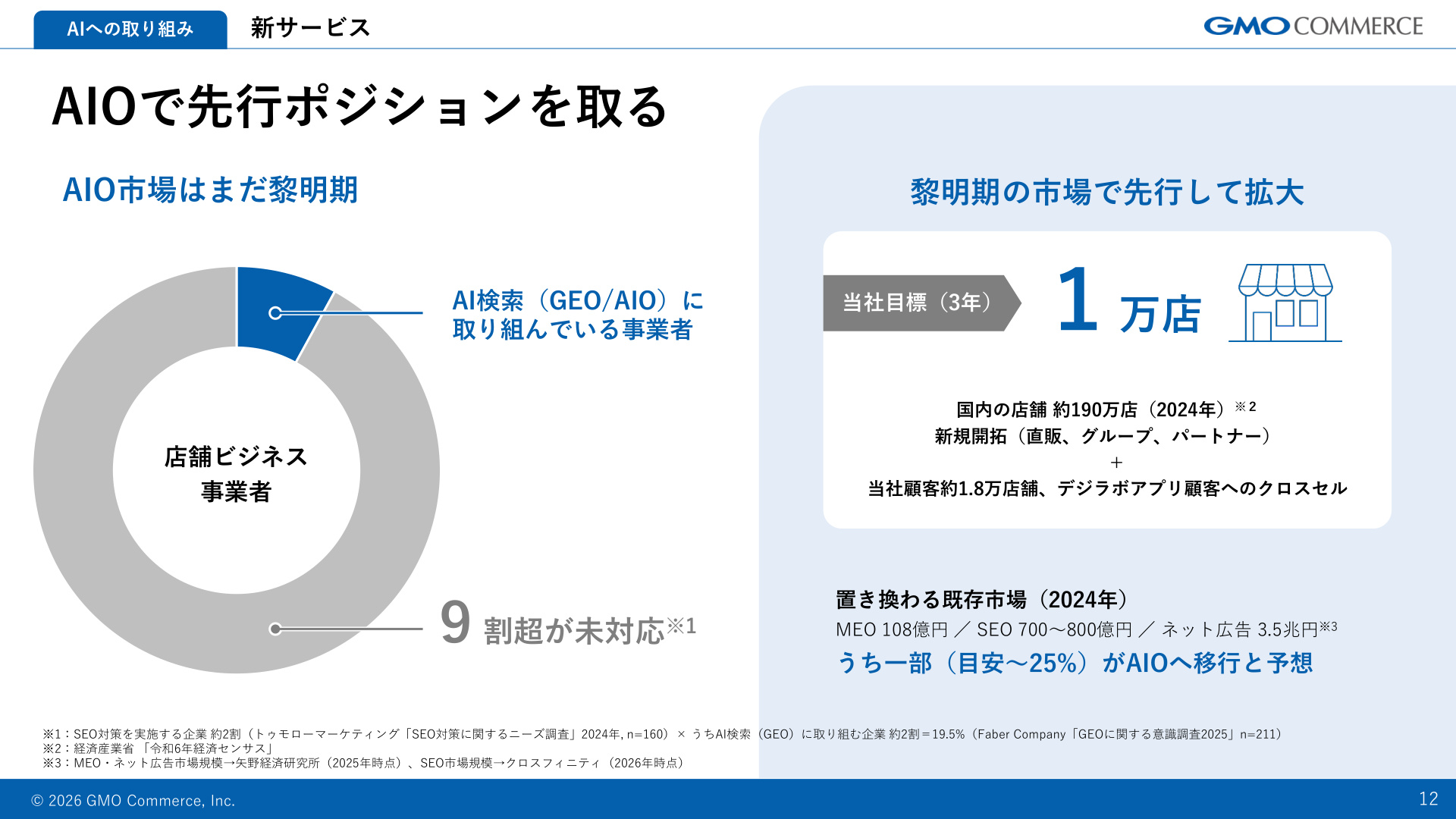
This slide is a crucial strategic diagram showing the company's positioning and growth potential in the 'AIO (AI Optimization/Generative AI Search Optimization) market' that it is newly entering. Currently, only about 10% of store business operators are taking measures for AI search (GEO/AIO), meaning over 90% remain unaddressed (an untapped market) . As parts of the existing MEO (10.8 billion yen), SEO (70-80 billion yen), and online advertising (3.5 trillion yen) markets are expected to shift rapidly to AIO, the company is establishing a first-mover position while the market is still in its infancy. As shown on the right side of the slide, the company has set a clear quantitative goal of '10,000 store installations in 3 years.' Its overwhelming advantage, which competitors cannot easily replicate, is the ability to deploy powerful cross-selling to its existing ~18,000 store customers and GMO Digital Lab's app customers, in addition to direct sales and partner development.
'GMO Store AIO' handles AI-based store status diagnosis, AI-oriented review generation, and automatic generation/optimization of websites for AI, automatically providing a mechanism for stores to be selected as 'recommended' by generative AI recommendation algorithms. Furthermore, in existing products, the company is building an AI-era marketing platform covering all four areas: 'Discovery, Purchase, Retention, and Data Infrastructure,' through initiatives such as the renewal of the AI recommendation engine in 'GMO Marketing Connect' and MCP (Model Context Protocol) support/AI agent integration for 'GMO Omise App.'
4. Upward Revision of Full-Year FY2026 Consolidated Earnings Forecast and Shareholder Returns
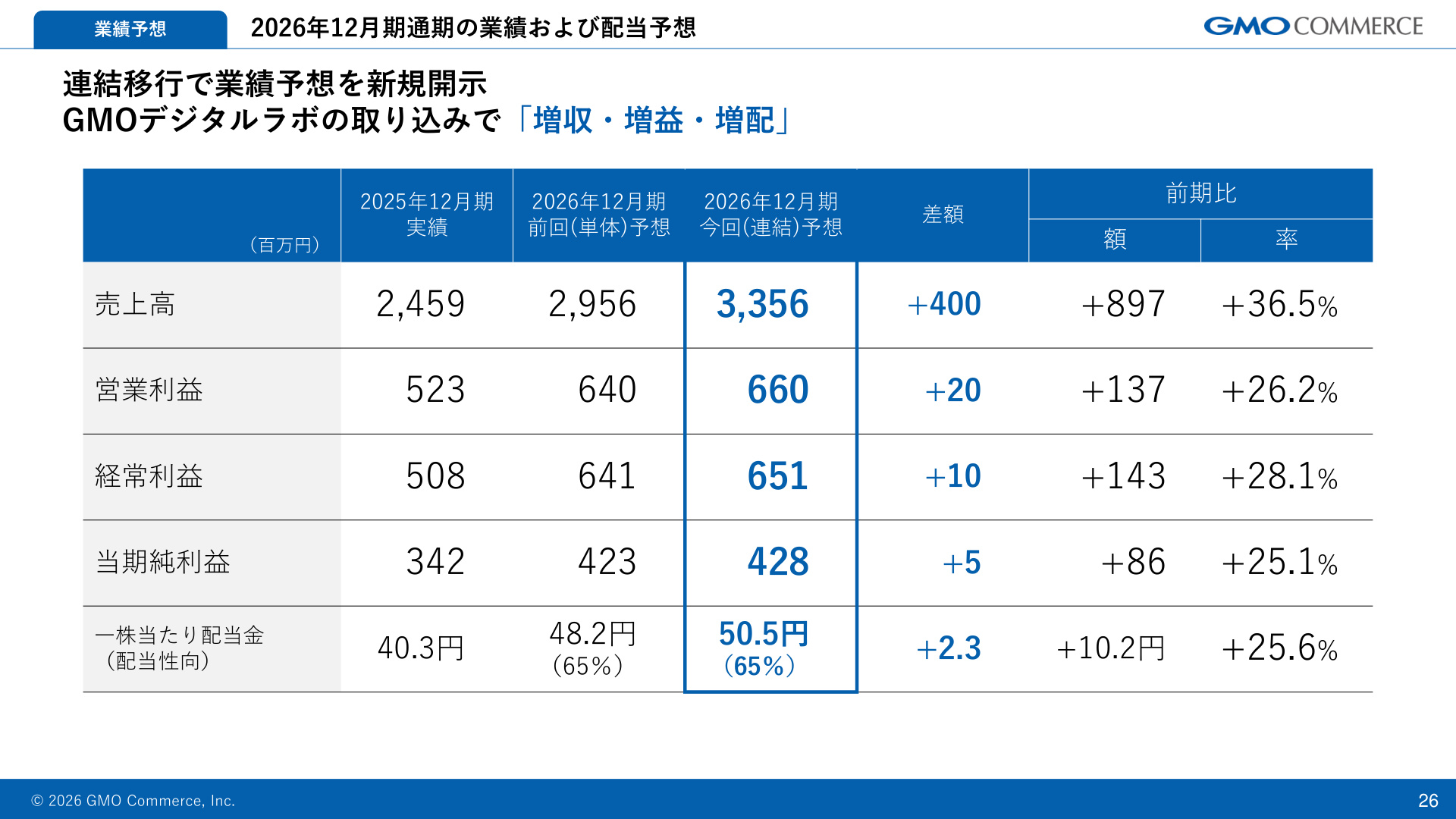
With the consolidation of GMO Digital Lab, the company has transitioned its full-year FY2026 earnings forecast from a non-consolidated to a consolidated basis and made a new disclosure (effectively an upward revision) .
[Significance and Data Analysis of the Slide Above]
This slide shows the full picture of the consolidated earnings forecast and dividend forecast for the fiscal year ending December 2026 , incorporating the consolidation of GMO Digital Lab (contributing from the second half). It clearly demonstrates in figures how the results of M&A are immediately reflected in performance and shareholder returns. Compared to the previous (non-consolidated) forecast, revenue is expected to increase by 400 million yen to 3,356 million yen (+36.5% YoY) , operating profit by 20 million yen to 660 million yen (+26.2% YoY) , ordinary profit to 651 million yen (+28.1% YoY), and net profit to 428 million yen (+25.1% YoY), indicating significant growth in both revenue and profit. Of particular note is the strengthening of shareholder returns. In line with the upward revision, the annual dividend per share has been adjusted upward from the previous 48.2 yen to 50.5 yen (+10.2 yen increase, +25.6% YoY) . The company maintains a high-level return policy of 'the higher of a 65% dividend payout ratio or an 8% DOE,' demonstrating its commitment to promptly returning the fruits of growth from consolidation to shareholders. Regarding the financial base, cash and deposits as of the end of June 2026 were 3,326 million yen (+418 million yen from the end of the previous fiscal year) , and the equity ratio remains high, providing sufficient cash flow generation to balance growth investment with high-level shareholder returns.
5. Mid-to-Long-Term Growth Strategy and FY2028 Roadmap
The 'Customer Touchpoint DX Market' targeted by the company is expected to expand from 505.1 billion yen in 2023 to 945.1 billion yen (approx. 1.8x) by 2030 . The company aims for '3x or more growth,' significantly outpacing this market growth speed. As a mid-to-long-term growth trajectory (ARR expansion measure), the company is promoting a two-pronged strategy of 'Base Growth' and 'Upside' :
- Base Growth : Deepening existing businesses (acquiring large chains, increasing unit prices, maintaining low churn rates) and penetrating new AI services like 'GMO Store AIO.'
- Upside : Aggressive M&A (team-building) such as GMO Digital Lab and the creation of group synergies.
Through this, the company has set a high target for its mid-term plan, 'FY2028 Plan: 24,000 stores × 16,000 yen ARPU = ARR of 4.5 billion yen or more.'
Summary
GMO Commerce's H1 FY2026 earnings results were impressive, highlighting that in addition to the strong growth of its core stock business, the company has secured both short-term and mid-to-long-term growth engines through 'scale expansion via the consolidation of GMO Digital Lab' and 'first-mover advantage in the AI search market via the launch of GMO Store AIO.' The company continues to adhere to a management policy that emphasizes capital efficiency and shareholder returns, such as implementing dividend increases alongside significant revenue and profit growth plans, and its future business development remains a point of keen interest.
This content is not intended as investment advice or a recommendation. Any opinions expressed are solely the personal views of each article.