


Shikoku Chemicals Holdings: Q2 FY2026 Earnings & Mid-Term Plan Revision Deep Dive Report

StockClub
Published: Aug 13, 2026, 10:42 AM
Sentiment Analysis
Shikoku Chemicals Holdings: Q2 FY2026 Earnings & Mid-Term Plan Revision Deep Dive Report
Based on the Q2 FY2026 earnings supplementary materials for Shikoku Chemicals Holdings (Securities Code: 4099), this report provides a comprehensive analysis of performance trends, segment-specific results, upward revisions to full-year forecasts, and the latest investment plans under the long-term vision "Challenge 1000."
1. Q2 Cumulative Performance Highlights: Record-High Mid-Term Profits
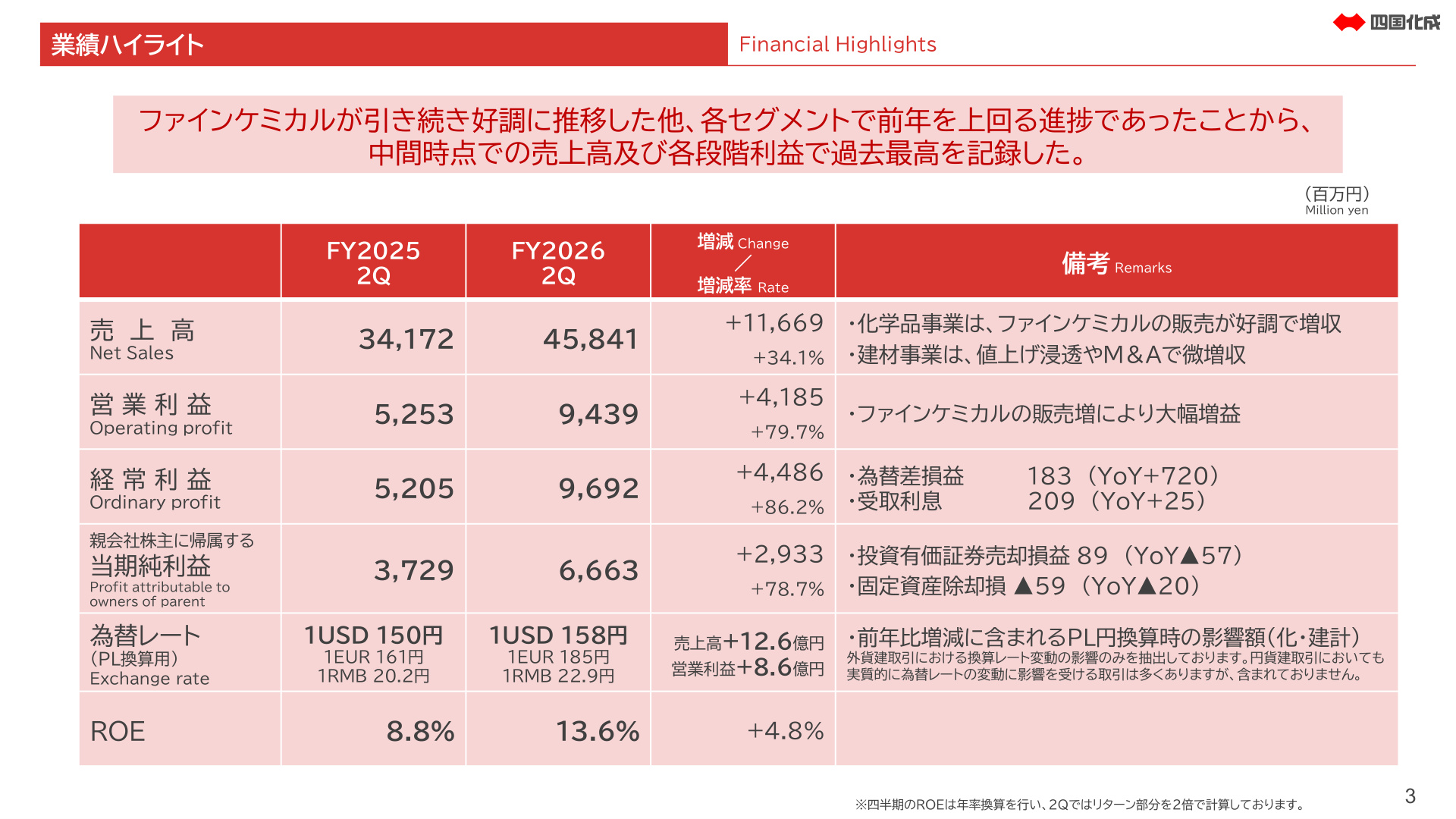
During the first half of the fiscal year, Shikoku Chemicals Holdings achieved record-high mid-term results across all profit levels, driven by strong sales in its core Fine Chemicals segment and solid progress across all business units.
- Net Sales : ¥45.841 billion (+34.1% YoY)
- Operating Profit : ¥9.439 billion (+79.7% YoY)
- Ordinary Profit : ¥9.692 billion (+86.2% YoY)
- Profit Attributable to Owners of Parent : ¥6.663 billion (+78.7% YoY)
- ROE (Annualized) : 13.6% (+4.8pt from 8.8% in the previous year)
- Foreign Exchange Impact : Due to the weaker yen (PL conversion rate of 1 USD = 158 JPY, etc.), net sales included a positive impact of +¥1.26 billion , and operating profit included +¥0.86 billion .
[Slide Commentary: Significance of Performance Highlights]
Slide 3 (PAGE_2) above is the most fundamental and critical slide, clearly illustrating the overwhelming growth trajectory and leap in profitability achieved by Shikoku Chemicals Holdings. It is particularly notable that not only did net sales grow by over 30%, but operating profit surged approximately 1.8 times from ¥5.253 billion in the same period last year to ¥9.439 billion. This proves that the growth was not merely due to currency tailwinds (¥0.86 billion contribution to operating profit), but that the high marginal profit ratio of high-value-added fine chemical products powerfully boosted the group's overall profitability.
2. Factors Behind Operating Profit Fluctuations and Segment Overview
The significant increase in operating profit of +¥4.185 billion (+79.7% YoY) is primarily attributed to the following factors:
① Breakdown of Profit Drivers
- Increased Sales of Fine Chemical Products (Positive) : +¥4.931 billion , serving as the primary engine for profit growth.
- Higher Gross Margin and Sales Growth in Chemicals Business (Positive) : +¥0.325 billion from margin improvement and +¥0.146 billion from sales growth.
- Building Materials Business Trends : While sales saw a slight increase due to price pass-throughs and M&A in wall materials, rising aluminum ingot prices (cost increase of approx. +¥0.332 billion ) and higher logistics costs ( ▲¥0.03 billion ) kept profits flat or under pressure.
- SG&A and Upfront Investment (Negative) : Increased SG&A expenses including human capital investment (wage hikes, training, etc., approx. +¥0.32 billion ) and higher R&D expenses ( ▲¥0.171 billion ) reflect proactive growth investments.
② Business Segment Status
- Inorganic Chemicals : Strong exports of insoluble sulfur to Asia. The new consolidation of Timuraya , acquired in Q1, contributed approx. ¥2.5 billion in additional sales.
- Organic Chemicals : Increased demand for "Neochlor" pool disinfectants during the peak season, plus the consolidation effect of Timuraya ( approx. ¥0.8 billion in additional sales).
- Fine Chemicals (Functional Materials/Electronic Chemicals) : Strong demand for resin curing agents (imidazole) and a significant surge in AI-related demand led to exceptionally strong sales of " GliCAP ," a process material for advanced semiconductors.
- Building Materials : Despite volume declines due to the sluggish housing market, the company secured a slight increase in sales through previous price hikes and M&A in the wall materials sector.
3. Upward Revision of Full-Year Consolidated Earnings Forecast for FY2026
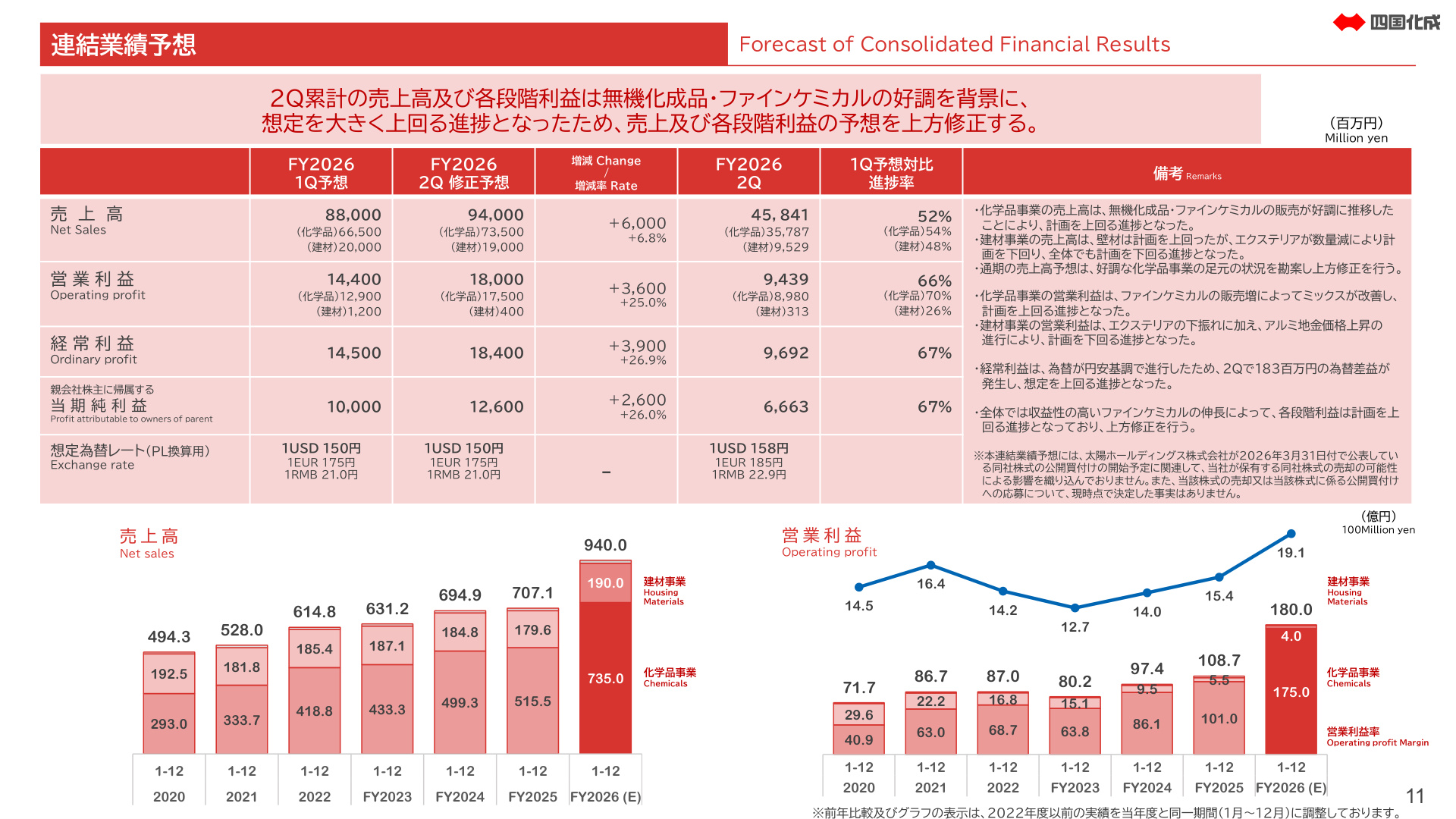
Following better-than-expected performance in Inorganic Chemicals and Fine Chemicals during the first half, the full-year consolidated earnings forecast has been revised upward across the board.
- Net Sales : Previous forecast ¥88.0 billion → Revised forecast ¥94.0 billion (+¥6.0 billion / +6.8%)
- Operating Profit : Previous forecast ¥14.4 billion → Revised forecast ¥18.0 billion (+¥3.6 billion / +25.0%)
- Ordinary Profit : Previous forecast ¥14.5 billion → Revised forecast ¥18.4 billion (+¥3.9 billion / +26.9%)
- Profit Attributable to Owners of Parent : Previous forecast ¥10.0 billion → Revised forecast ¥12.6 billion (+¥2.6 billion / +26.0%)
[Slide Commentary: Implications of the Upward Revision]
Slide 11 (PAGE_10) above is one of the most significant topics in this earnings announcement. The breakdown of the revision by segment is noteworthy. While the operating profit forecast for the Chemicals business was significantly increased from ¥12.9 billion to ¥17.5 billion (+¥4.6 billion), the Building Materials business was revised downward from ¥1.2 billion to ¥0.4 billion due to rising costs and sluggish exterior demand. This contrast clearly highlights the company's rapid structural shift toward a high-profitability portfolio centered on the Chemicals business, particularly Fine Chemicals directly linked to AI and semiconductors.
4. Management Focused on Cost of Capital and Stock Price (BS Management and Capital Efficiency)
The Shikoku Chemicals Group is promoting BS management that balances proactive growth investment with improved capital efficiency.
- ROE and PBR Trends : ROE has surged to an annualized 13.6% , significantly exceeding the market's expected cost of equity (7–8%). Consequently, PBR has seen a significant valuation increase from 1.25x at the end of FY2025 to 2.96x at the end of Q2 FY2026 .
- ROIC by Business : The Chemicals business achieved an extremely high ROIC of 30.3% (up from 21.1% at the end of FY2025), while the Building Materials business remained at 4.7% , making profitability improvement in the latter a key management challenge.
- Cash Efficiency : To reduce surplus funds, the company is utilizing CMS (Cash Management Systems) and commitment lines to keep liquidity within three months of sales, while selling/redeeming investment securities to reallocate capital to business assets.
5. Major Update to Long-Term Vision "Challenge 1000" (STAGE 3 Plan)
The company has fundamentally revised and expanded its performance targets and investment plans for "STAGE 3," which concludes in FY2029.
① Upward Revision of Profit Plan
Reflecting strong demand for Fine Chemicals, the final-year (FY2029) outlook has been increased.
- Net Sales Target : Previous ¥100 billion → Revised ¥115 billion (+¥15 billion)
- Operating Profit Target : Previous ¥15 billion → Revised ¥18 billion (+¥3 billion)
- Sales Target by Business (FY2029) :
- Inorganic Chemicals: ¥20 billion (Expansion of sustainable insoluble sulfur)
- Organic Chemicals: ¥27 billion (Expansion of BtoC products, etc.)
- Fine Chemicals: ¥33 billion (+¥13 billion upward revision from initial plan; support for GliCAP/semiconductor materials via Sakaide plant operations)
- New Businesses: ¥12 billion (+¥2 billion upward revision; synergy with Timuraya and M&A)
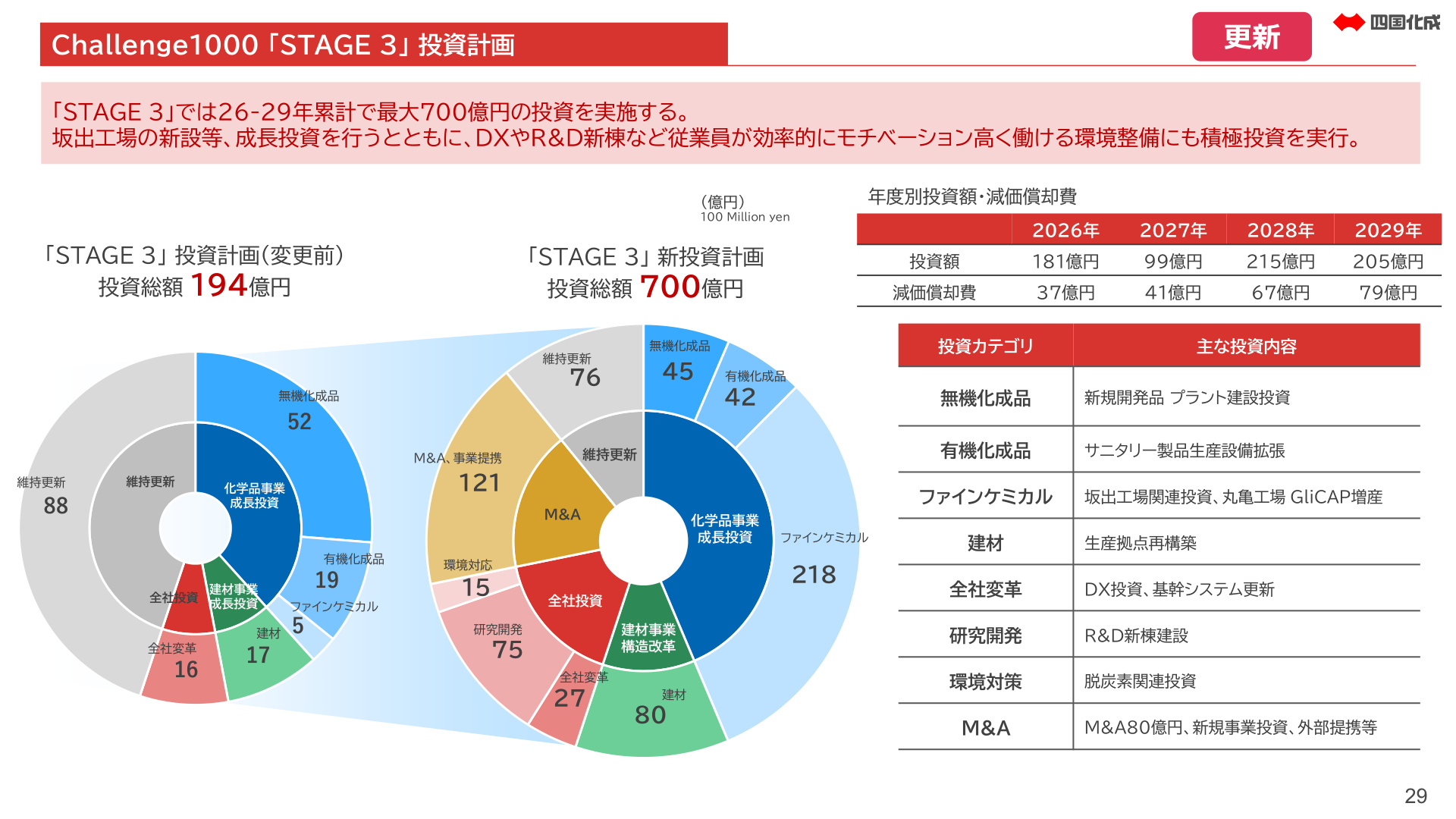
② Massive Expansion of Investment Plan (¥19.4 billion → ¥70 billion)
To capture growth opportunities, the investment budget has been dramatically expanded from the original plan.
[Slide Commentary: Strategic Background of the ¥70 Billion Investment Plan]
Slide 29 (PAGE_28) above is a highly impactful slide symbolizing the future growth potential of Shikoku Chemicals Holdings. Compared to the initial "STAGE 3" investment plan (¥19.4 billion), the new plan demonstrates a commitment to executing up to ¥70 billion in growth investments—a roughly 3.6-fold increase . The breakdown includes ¥21.8 billion for chemical production facilities (Sakaide plant construction, Marugame plant GliCAP expansion, etc.), ¥12.1 billion for M&A and new business investments (including ¥8 billion for M&A), ¥7.5 billion for R&D (including a new R&D building), and ¥1.5 billion for decarbonization/environmental initiatives. While temporary increases in depreciation are expected due to these upfront investments, the company is clearly prioritizing EBITDA-based growth and a leap in performance from 2030 onward.
6. Shareholder Return Policy and Summary
① Shareholder Return Policy
The company has set a clear return policy for the duration of its long-term vision:
- Dividend Payout Ratio : 30%
- Total Return Ratio : 50%
- DOE (Dividend on Equity) : 3%
- Annual Dividend Forecast per Share : ¥40 (¥15 interim, ¥25 year-end; a de facto dividend increase from the adjusted ¥27.5 in the previous year).
- By combining flexible share buybacks to reduce surplus capital, the company aims for sustainable growth in EPS and DPS.
② Summary and Future Focus
In its Q2 FY2026 earnings, Shikoku Chemicals Holdings recorded record-high results, driven primarily by the explosive growth of the Fine Chemicals business and the M&A effect of Timuraya . Furthermore, the significant upward revision of full-year forecasts and the expansion of the "STAGE 3" investment plan to ¥70 billion demonstrate that the company is building a formidable competitive advantage in high-value-added markets such as AI and semiconductor materials. Moving forward, the progress of large-scale investments, including the Sakaide plant, and the speed of profitability improvement measures in the Building Materials business will be key points to watch.
This content is not intended as investment advice or a recommendation. Any opinions expressed are solely the personal views of each article.