


【ULURU FY2027 Q1 Earnings Analysis】 Govtech Segment Drives Significant EBITDA Growth; Detailed Progress on Growth Strategy and Mid-to-Long-Term Targets

StockClub
Published: Aug 13, 2026, 10:38 AM
Sentiment Analysis

ULURU Co., Ltd.'s financial results for the first quarter (1Q) of the fiscal year ending March 31, 2027, demonstrate robust growth in its core Govtech segment and improved profitability across the group. Below is a multi-faceted analysis and commentary on the earnings highlights, segment performance, cost and profit trends, and mid-to-long-term growth strategies, based on the disclosed materials.
1. FY2027 Q1 Earnings Summary and Full-Year Progress
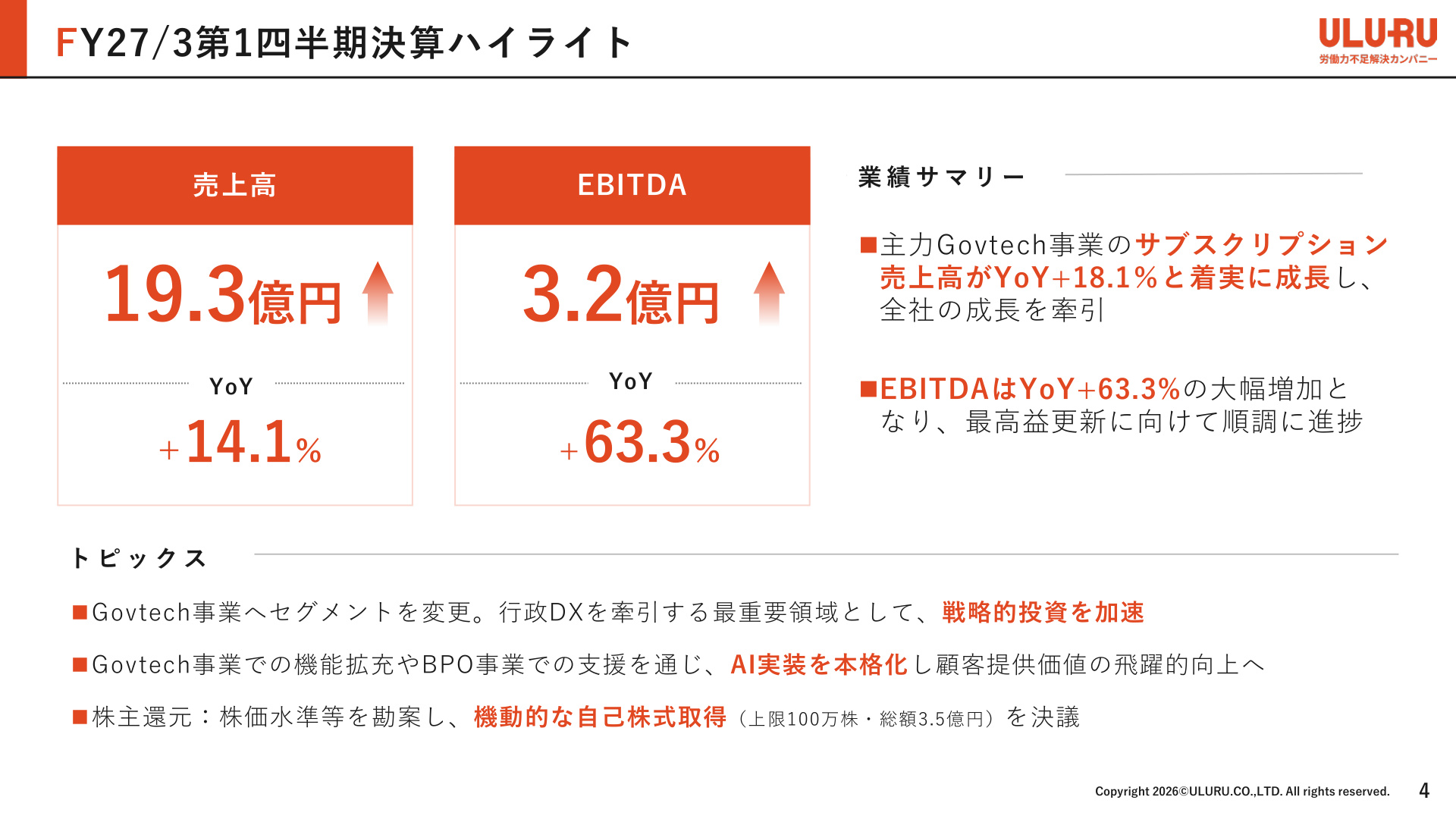
Consolidated results for the first quarter were as follows: Net Sales of ¥1,939 million (+14.1% YoY) , EBITDA of ¥329 million (+63.3% YoY) , Operating Profit of ¥232 million (+80.6% YoY) , Ordinary Profit of ¥259 million (+92.4% YoY) , and Net Profit Attributable to Owners of the Parent of ¥169 million (-12.1% YoY) . The decline in net profit is attributable to one-time tax effects related to a merger in the previous fiscal year; the underlying earning power of the core business (at each profit level) shows significant growth.
【Significance and Background of the Slide Above】
The slide above (FY27/3 Q1 Earnings Highlights) summarizes the key figures symbolizing a strong start to the fiscal year. The primary takeaway is that while maintaining a 14.1% YoY growth in net sales , the profit indicator, EBITDA, surged by 63.3% YoY . This is the result of increased Average Revenue Per User (ARPU) in core services, effective cost control across business units, and the consolidated impact of M&A. Furthermore, the company has implemented a segment change to the Govtech business , which drives administrative DX, signaling an acceleration in strategic investment.
Progress Against Full-Year Forecasts
Progress rates against the full-year plan (Net Sales: ¥9,100 million, EBITDA: ¥1,530 million, Operating Profit: ¥1,120 million, Net Profit: ¥780 million) are as follows, indicating a very smooth start in line with initial expectations:
- Net Sales Progress : 21.3% (vs. 21.9% in the same period last year)
- EBITDA Progress : 21.5% (vs. 15.8% in the same period last year)
- Operating Profit Progress : 20.8% (vs. 13.8% in the same period last year)
- Net Profit Progress : 21.7% (vs. 26.1% in the same period last year; actual progress excluding tax effects is at a high level)
In particular, the progress rates for EBITDA and operating profit significantly exceed those of the same period last year, putting the company on a favorable trajectory to achieve record-high profits for the full year.
2. Segment Reorganization and the Growth Story of the Core "Govtech Business"
Starting this fiscal year, the company has reorganized its business segments into "Govtech Business," "BPO Business," and "Other Businesses" to more clearly demonstrate progress in its most critical areas to investors and stakeholders.
Govtech Business Performance and KPI Trends
The Govtech business (formerly the NJSS business) is the company's core operation, providing infrastructure for bidding information for government agencies and local municipalities, and boasts high profitability. 1Q results are as follows:
- Net Sales : ¥1,018 million (+13.6% YoY)
- EBITDA : ¥473 million (+5.8% YoY)
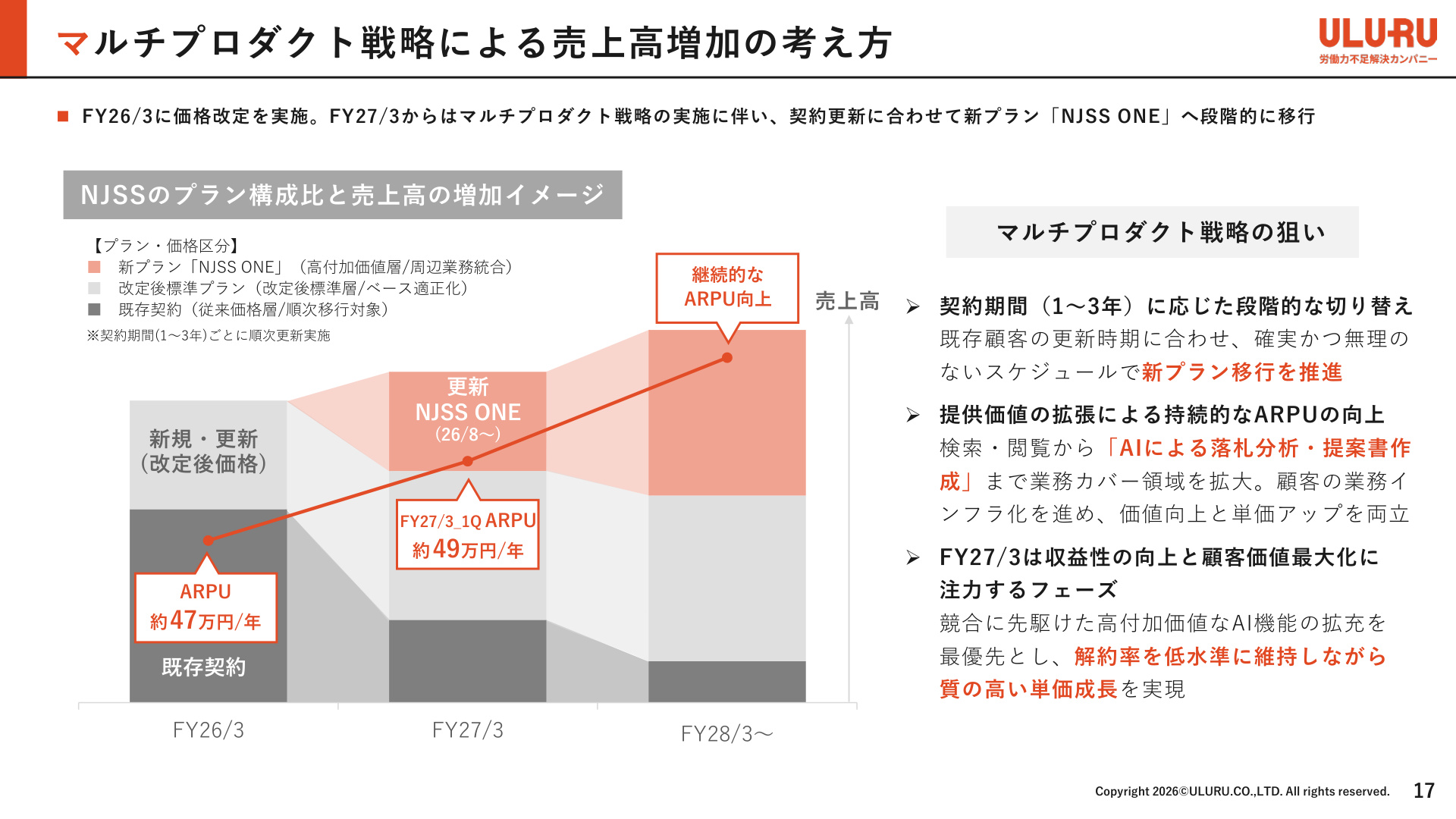
- Annualized ARPU : ¥497,000 (+13.8% YoY)
- Number of Paid Contracts : 8,155 (+3.6% YoY)
- NJSS Churn Rate : 1.44% (maintaining a low level compared to 1.49% in the same period last year)
【Significance and Background of the Slide Above】
This slide (Concept of Revenue Growth through Multi-Product Strategy) explains the core logic of how the Govtech business will achieve sustainable high growth. Following the price revisions of the previous fiscal year, the company is now transitioning to the new "NJSS ONE" plan. "NJSS ONE" is not merely a price adjustment; it is a strategy to package and provide high-value-added AI features such as "AI-powered bid analysis" and "proposal creation assistance." By transitioning users gradually upon contract renewal, the company has established a structure that steadily increases annualized ARPU to ¥497,000 while keeping the churn rate at a low level of 1.44%.
3. Trends in BPO Business and Other Businesses (fondesk/Photo)
BPO Business: Progress in Line with a 4Q-Weighted Plan
- Net Sales : ¥315 million (-4.8% YoY)
- EBITDA : ¥0 million While there is a year-on-year decline in sales and profit, this is due to the business structure where large-scale project revenue is concentrated in the fourth quarter (4Q), and performance is in line with the initial plan . Preparations are underway to realize "BpaaS (Business Process as a Service)" by fusing AI and human expertise, such as the launch of "ULURU AI Bridge," an AI adoption support service for enterprises.
Other Businesses: fondesk and Photo Business Drive Profit Margin Improvement
- fondesk (Telephone Answering Service)
- Net Sales : ¥306 million (+10.3% YoY)
- EBITDA : ¥71 million
- Number of Paid Contracts : 6,314 (+10.3% YoY)
- Profit margins expanded significantly due to strict cost control. Foundations are being laid for the release of an AI operator (beta version) and a price revision scheduled for October 2026.
- Photo Business (en-photo, OurPhoto, YSS)
- Net Sales : ¥294 million (+56.5% YoY)
- EBITDA : ¥43 million
- Achieved significant growth in both sales and profit, driven by increased revenue per nursery school for en-photo (¥32,268, +7.0% YoY), an increase in the number of photo shoots for OurPhoto (4,966, +15.6% YoY), and the consolidated impact and operational improvements of Yokohama Sogo Shashin (YSS), which was acquired through M&A.
4. Analysis of EBITDA Variance and Cost Structure
The significant increase in 1Q EBITDA of +¥128 million (from ¥201 million to ¥329 million) is due to the steady expansion of gross profit.
- Increase in Gross Profit : +¥204 million (primarily +¥116 million in Govtech and +¥60 million in the Photo business)
- Increase in Personnel Expenses : -¥62 million (including +¥34 million for headcount increases in Govtech)
- Increase in Advertising Expenses : +¥13 million (overall efficiency achieved by reducing advertising costs for fondesk by ¥63 million while investing ¥39 million in Govtech)
- Increase in Other Expenses : -¥28 million (communication costs, system-related outsourcing fees, etc.)
While intensively allocating growth investments (personnel and advertising) to the priority Govtech business, the company has achieved a balance of highly disciplined investment and profit expansion by thoroughly optimizing costs in other areas. The number of full-time employees reached 320 (+38 YoY), with organizational management conducted while balancing hiring pace and productivity.
5. Mid-to-Long-Term Growth Strategy and Capital Allocation
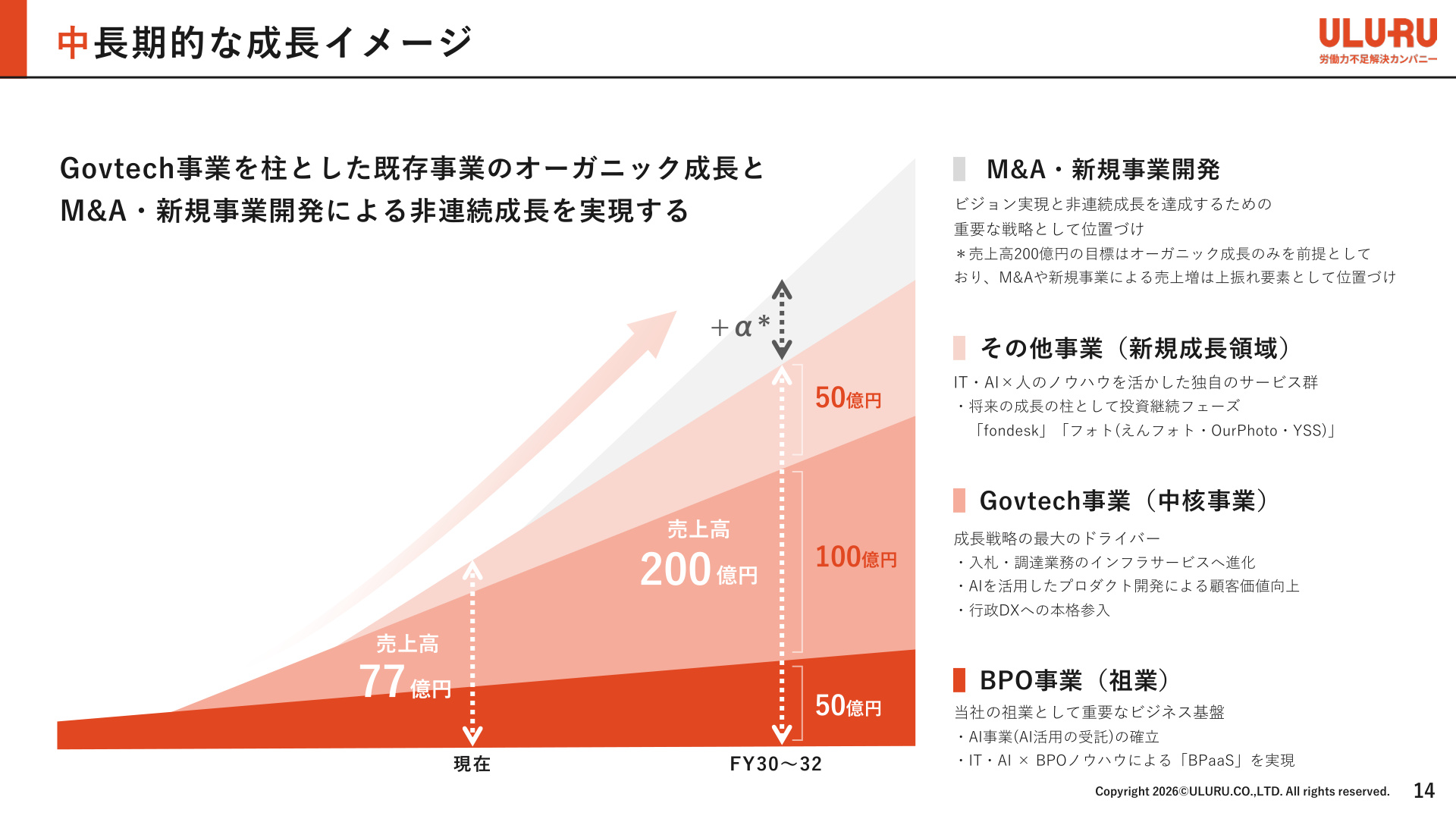
As a company dedicated to "solving labor shortages," ULURU has set forth a long-term vision and financial targets.
【Significance and Background of the Slide Above】
This slide (Mid-to-Long-Term Growth Image) is a key document showing the long-term growth trajectory and business portfolio structure the company aims for. The company has set ambitious mid-to-long-term financial targets of ¥20 billion in net sales and ¥3-4 billion in EBITDA for FY30/3 to FY32/3 . This goal is planned to be achieved through organic growth alone, totaling ¥20 billion across the Govtech business (¥10 billion) , BPO business (¥5 billion) , and Other businesses (¥5 billion) , with further upside (+α) targeted through M&A and new business development. It depicts a world where the core Govtech business acts as the primary growth driver, while each business creates synergies to become "infrastructure for labor."
M&A, AI Utilization, and Shareholder Return Policy
- M&A Strategy
- Backed by a strong financial foundation with over ¥4 billion in net cash , the company is actively considering M&A deals in the range of ¥300 million to ¥5 billion per transaction. It aims for non-continuous growth by executing acquisitions and roll-ups in the Govtech, BPO, fondesk, and Photo domains.
- AI Utilization Strategy
- The company is promoting the maximization of productivity and customer value through three axes: AI implementation in its own products (SaaS+AI), "ULURU AI Bridge" for enterprises, and internal AI utilization.
- Shareholder Return
- The company maintains a progressive dividend policy , planning to increase the dividend to ¥4.3 per share for FY27/3, up from ¥4.0 per share in FY26/3 (targeting a payout ratio of 15% or higher).
- Furthermore, considering stock price levels, the company has flexibly executed a share buyback of up to 1 million shares for a total of ¥350 million (resolved in May 2026), demonstrating a proactive stance toward improving capital efficiency and returning value to shareholders.
Conclusion
In its FY2027 Q1 earnings, ULURU clarified its concentrated investment and growth story for the Govtech business through segment reorganization, achieving high profit growth. Multi-faceted measures—including ARPU improvement through the transition to "NJSS ONE," profitability improvements across group businesses, disciplined cost control, and flexible shareholder returns—are bearing fruit. Progress toward the mid-to-long-term financial targets (¥20 billion in net sales, ¥3-4 billion in EBITDA) is extremely smooth.
This content is not intended as investment advice or a recommendation. Any opinions expressed are solely the personal views of each article.