

![[In-Depth Analysis] Ubicom Holdings Q1 FY2027 Earnings: Structural Shift to AI-Driven Development and Synergies from Medical M&A](https://news-images.stock-club.net/market_news/images/3937/140120260812518639/slide_eyecatch_en_122f78bc.webp)
[In-Depth Analysis] Ubicom Holdings Q1 FY2027 Earnings: Structural Shift to AI-Driven Development and Synergies from Medical M&A

StockClub
Published: Aug 13, 2026, 10:36 AM
Sentiment Analysis
Ubicom Holdings, Inc. (Securities Code: 3937) has released its financial results for the first quarter of the fiscal year ending March 31, 2027 (April–June 2026). The results demonstrate a robust performance, with major indicators—net sales, operating profit, and ordinary profit—significantly reaching record highs for a first quarter . These figures underscore the successful activation of the company's two primary growth engines: the transition to "AI-driven development" and the market-wide expansion of its medical business through M&A.
Below is an in-depth analysis of the earnings, growth strategy, KPI trends, and segment-specific initiatives, organized into 10 key topics.
1. Consolidated Earnings Highlights: Record-Breaking Performance in Key Profit Metrics
In the first quarter, consolidated net sales reached ¥1,744 million (+17.5% YoY) , operating profit hit ¥410 million (+30.9% YoY) , and ordinary profit stood at ¥395 million (+25.0% YoY) , marking record highs for a first quarter across all metrics.
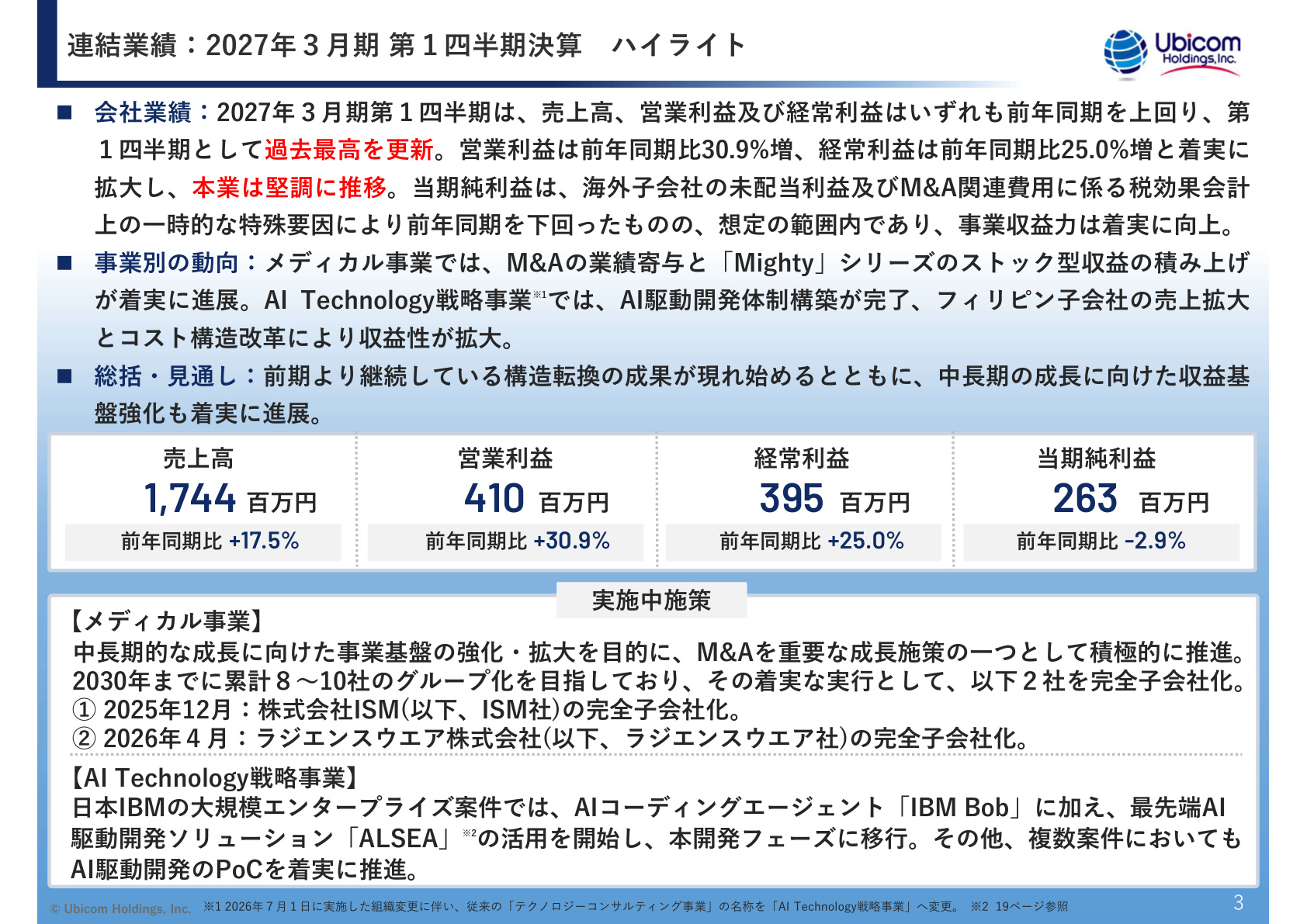
As shown in the highlight slide above, both core business segments performed steadily, driving significant growth in the top line and operating profit, which reflects the company's fundamental earning power. While net profit attributable to owners of the parent was ¥263 million (-2.9% YoY) , slightly below the previous year, this is an expected fluctuation due to temporary and special factors , such as tax effect accounting related to undistributed earnings of overseas subsidiaries and M&A-related expenses. The underlying profitability of the business remains exceptionally strong.
2. Analysis of Profit Structure and Margin Quality
The operating profit margin has risen from 21.1% to 23.5% compared to the same period last year, clearly quantifying the improvement in the profit structure. This is driven by two factors:
- Medical Business : Despite incurring goodwill amortization and PMI (Post-Merger Integration) costs following the acquisition of a new subsidiary (Radiance Ware), the company absorbed these costs through the accumulation of recurring revenue, achieving record profits.
- AI Technology Strategy Business : The shift toward AI-driven development has significantly contributed to margin expansion through improved development efficiency and cost structure reform.
3. Medical Business: Robust Customer Base for the High-Margin "Mighty" Series
The foundation of the medical business is the "Mighty" series, a core solution for medical institutions provided via an AI-subscription model. In the medical industry, system investment is accelerating due to physician work-style reforms, revisions to medical service fees, and the promotion of medical DX (Medical DX Reiwa Vision 2030).
As of the first quarter, the number of "Mighty" series installations has reached 23,157 nationwide, maintaining a steady expansion pace of approximately 1,000 units per year. The company has established an overwhelming position with an approx. 50% market share among hospitals with 20 or more beds , while maintaining an impressive churn rate of 0.4% (99.6% retention rate) .
4. M&A Strategy and Acceleration of Nationwide Expansion in the Medical Business
Ubicom Holdings aims to integrate 8 to 10 community-based medical agencies into its group between 2025 and 2030. As the first phase, ISM (Kyushu area) was acquired in December 2025, followed by the second phase, Radiance Ware (Tokyo metropolitan/Northern Kanto area), in April 2026.
Previously, approximately 95% of "Mighty" series sales were handled by external agencies. By bringing these agencies into the group, the company is realizing the following synergies:
- Capturing agency margins through direct sales (margin improvement)
- Resolving the acquisition targets' challenges—specifically the shortage of electronic medical record (EMR) implementation support staff—by deploying Ubicom's consulting expertise
- Expanding cross-selling to existing medical institution clients (approx. 475 for Radiance Ware and over 800 for ISM)
5. Structural Improvement of LTV and CAC through M&A Strategy
The following slide illustrates how this M&A strategy is dramatically changing the unit economics of the business.
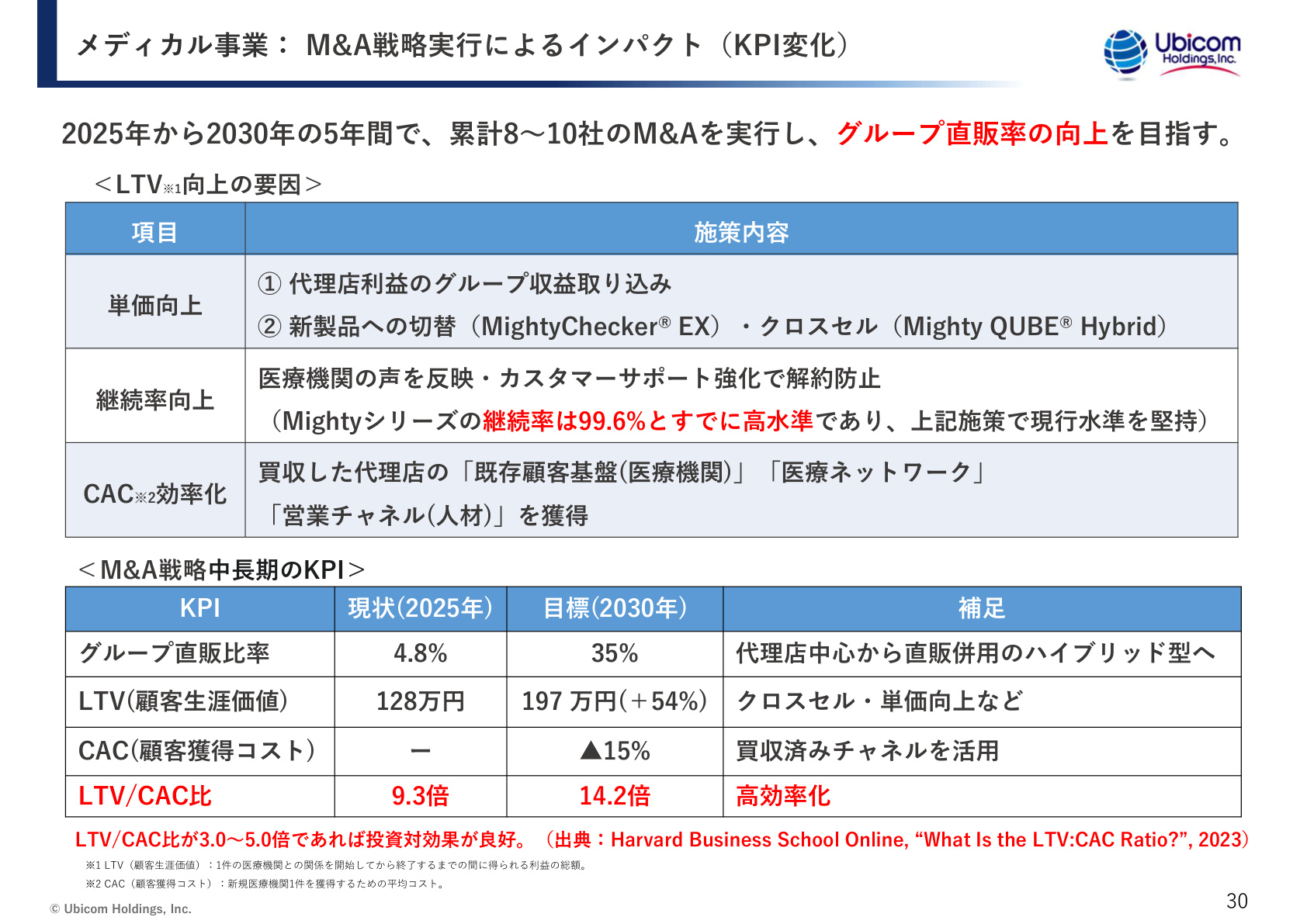
The data in this slide shows that the increase in the group's direct sales ratio through acquisitions goes beyond mere scale expansion. Specifically, the following KPI improvements are planned and underway from 2025 to 2030:
- Group Direct Sales Ratio : From 4.8% to 35%
- LTV (Lifetime Value) : From ¥1.28 million to ¥1.97 million (+54%) (driven by cross-selling and higher unit prices)
- CAC (Customer Acquisition Cost) : Reduced by 15% through the utilization of acquired channels
- LTV/CAC Ratio : Significant increase from 9.3x to 14.2x (generally, 3.0x–5.0x or higher is considered excellent)
This structure creates high investment efficiency by leveraging the customer bases of acquired companies to cross-sell high-margin proprietary software.
6. AI Technology Strategy Business: Moving Beyond the "Man-Month" Model to "AI-Driven Development"
In the AI Technology Strategy Business (formerly Technology Consulting; net sales of ¥1,090 million, +5.2% YoY; operating profit of ¥183 million, +57.0% YoY), a historic business model transformation is underway.
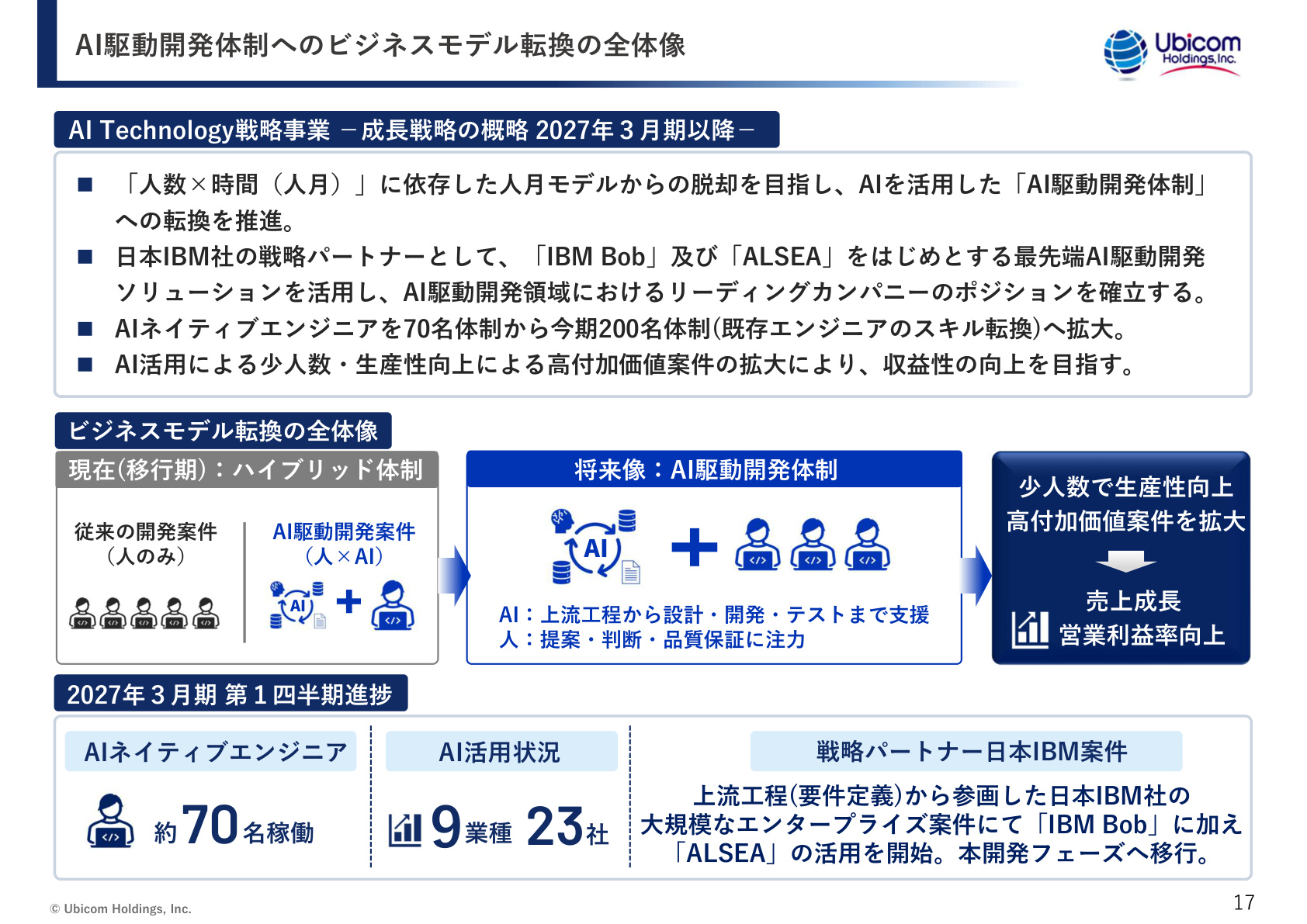
The traditional IT development style relies on "number of engineers × time (man-months)," where revenue growth requires increasing headcount. In contrast, the company's "AI-Driven Development System" incorporates AI engineering tools into the development process (requirements definition, design, coding, testing, etc.), enabling a small team to achieve overwhelming productivity.
As shown in the slide, despite reducing the number of engineers by approximately 80 compared to the previous year, the company achieved record-high sales and profits through high-value-added work by AI-native engineers (approx. 70 currently active, with plans to expand to 200 this fiscal year) and improved project turnover. This clearly demonstrates that the shift from a "man-month dependent" model to a "value/outcome-based" model is bearing fruit.
7. Elevating Global Hubs (Philippine Subsidiary) into "Profit Centers"
The company's Philippine subsidiary has evolved from a "mere offshore development hub (cost center)" into a "Global AI Profit Center" that provides advanced AI solutions. As a result of expanding direct contracts with overseas clients, particularly in the US healthcare sector, and implementing cost structure reforms through AI-driven development, the Philippine subsidiary's operating profit grew by 36.5% YoY to ¥141 million .
8. Strengthening Partnership with IBM Japan and Launching "ALSEA"
A major factor accelerating the growth of the AI Technology Strategy Business is the strong strategic partnership with IBM Japan .
For large-scale enterprise projects with IBM Japan, the company has begun utilizing the cutting-edge AI-driven development solution "ALSEA" (AI Lifecycle Shared Engineering Artifacts) in addition to the "IBM Bob" AI coding agent, moving into the main development phase. By using ALSEA to have AI learn and retain know-how and standard rules for large-scale development, the company is achieving both improved development accuracy and reduced man-hours, establishing a system for high-unit-price, lump-sum orders starting from the upstream process (requirements definition, etc.).
9. Shareholder Return Policy: Maintaining Stable Dividends and Enhancing Returns Linked to Performance
The company has set a medium-to-long-term dividend payout ratio target of 50% or more . Based on the FY2026 dividend (¥40 per share, 54.4% payout ratio), the company will maintain a basic stable dividend policy of ¥25 per share for FY2027, while demonstrating a proactive stance by adding performance-linked dividends based on earnings progress. This approach seeks an appropriate balance between growth investment and shareholder returns while maintaining a healthy cash position.
10. Full-Year Forecast and Medium-to-Long-Term Outlook Toward 2030
For the full fiscal year ending March 31, 2027, the company forecasts net sales of ¥7,383 million (+23.2% YoY) , operating profit of ¥1,511 million (+15.9% YoY) , ordinary profit of ¥1,520 million (+18.1% YoY) , and net profit of ¥1,056 million (+18.4% YoY) .
Notably, these forecasts are conservative and do not fully incorporate the upside potential from the commercialization of AI-driven development projects in the AI Technology Strategy Business, leaving room for upward revision . With the dual pillars of organic growth plus continuous M&A in the medical business and margin improvement through AI-driven development, this quarter marks a successful start toward the medium-to-long-term vision of achieving ¥2,300 million in operating profit by the fiscal year ending March 2028.
This content is not intended as investment advice or a recommendation. Any opinions expressed are solely the personal views of each article.