


Ceres Inc. Q2 FY2026 Earnings Deep Dive Report

StockClub
Published: Aug 13, 2026, 10:31 AM
Sentiment Analysis

【Earnings Deep Dive Report】 Ceres Inc. Q2 FY2026 Earnings Analysis
Ceres Inc. (Securities Code: 3696) reported a highly positive and transformative set of results for the second quarter of the fiscal year ending December 2026 (January–June 2026). The performance was driven by the stellar growth of its core point site business, improvements in the financial services segment, and the announcement of large-scale shareholder returns following a planned divestment of equity holdings. This report extracts and analyzes 10 key topics from the earnings presentation materials, providing a detailed breakdown of the company's current performance and its long-term growth trajectory.
1. Executive Summary and H1 Consolidated Performance Highlights
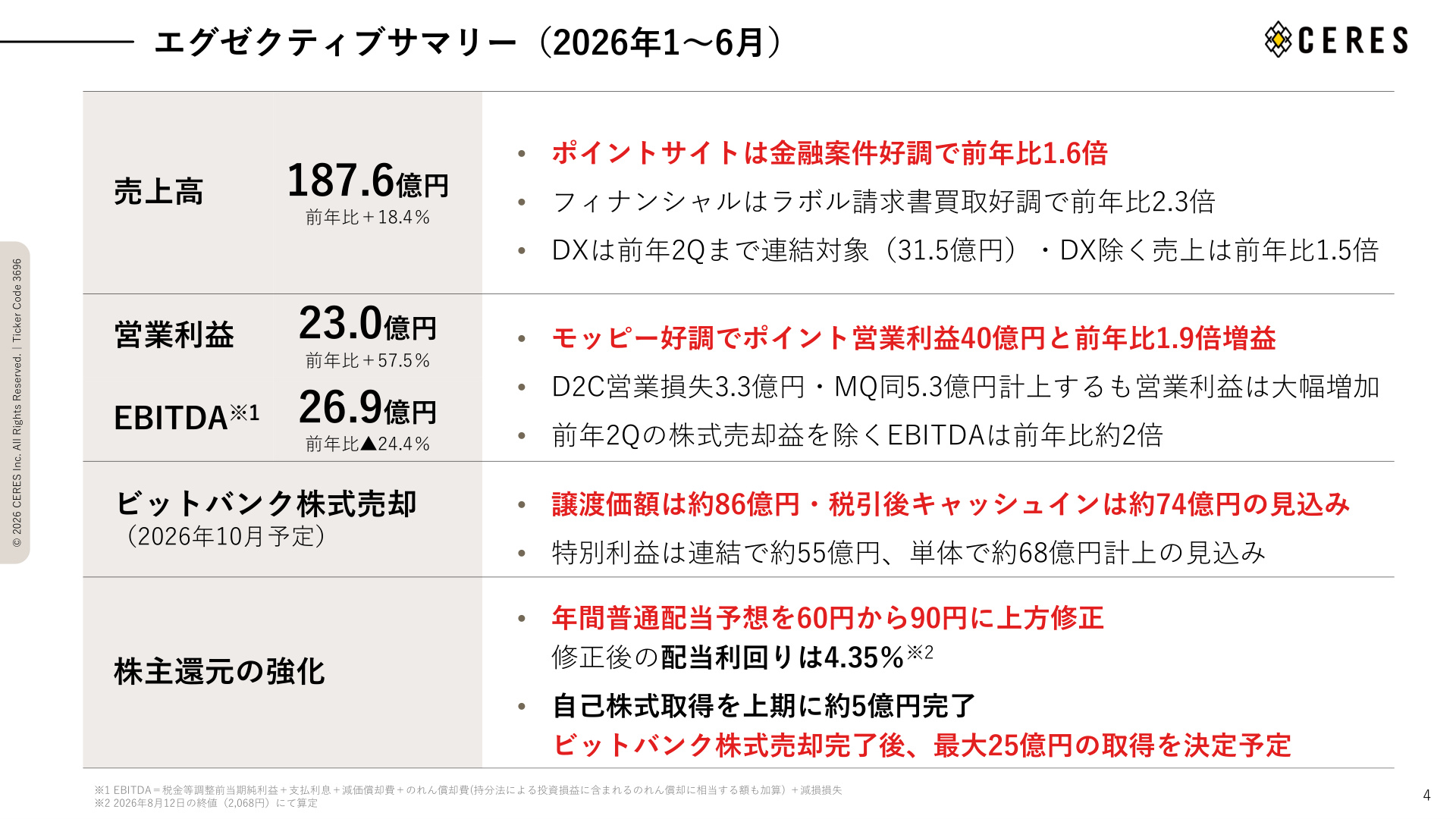
For the first half of the fiscal year ending December 2026, the company achieved significant growth in both revenue and profit: net sales of 18.76 billion yen (+18.4% YoY) , operating profit of 2.30 billion yen (+57.5% YoY) , and ordinary profit of 1.96 billion yen (+84.2% YoY) .
【Significance and Background of Slide 4 (PAGE_3)】
This executive summary slide is a high-value snapshot condensing the most critical points of these earnings. Regarding performance, it highlights that the point site business grew 1.6x YoY due to surging demand for financial services, while the financial services segment, anchored by the invoice factoring service "Labol," expanded 2.3x YoY. Notably, the company successfully absorbed the negative impact of excluding Yumemi (DX business) from its consolidated results, which was part of the group in the same period last year, indicating that the underlying growth rate is accelerating. Furthermore, the slide outlines the full scope of the company's capital strategy: the sale of bitbank shares , which is expected to generate approximately 8.6 billion yen in transfer value and 7.4 billion yen in post-tax cash inflow, alongside a corresponding upward revision of the annual dividend forecast to 90 yen and a new share buyback program of up to 2.5 billion yen .
2. Segment Performance and Analysis of Variance
(1) Mobile Service Business: Dominance of "Moppy" and Rapid Expansion of AD.TRACK
Total sales for the Mobile Service business reached 17.43 billion yen (+14.2% YoY) , with an operating profit of 3.55 billion yen (+27.7% YoY) . Excluding the impact of the DX business (Yumemi) divestment (which contributed 3.15 billion yen in sales and 590 million yen in operating profit in the same period last year), the underlying growth shows a 44.0% increase in sales and a 1.6x increase (+62.8%) in operating profit , demonstrating exceptionally strong momentum.
- Rapid Growth in Point Business : The point business alone reached 15.25 billion yen in sales (+60.9% YoY) and 4.05 billion yen in operating profit (+94.1% YoY) . The primary driver was a significant increase in advertising demand for financial products—such as bank accounts, brokerage accounts, and credit cards—fueled by rising domestic interest rates, the penetration of the new NISA program, and the ongoing shift toward cashless payments.
- Moppy User Base and ARPU Growth : The flagship point site "Moppy" maintained a high ARPU (Average Revenue Per User) of 846 yen , supported by a steady increase in active members.
- AD.TRACK Hits Record High : The group's affiliate platform, "AD.TRACK," achieved record-high transaction volume of 9.10 billion yen (2.0x YoY) in the first half, driven by strengthened integration with Moppy and Point Income.
(2) D2C Business Challenges and Outlook
Conversely, the D2C business, which handles products like "Pitsole," struggled with sales of 2.21 billion yen (-15.9% YoY) and an operating loss of 330 million yen (compared to an operating profit of 170 million yen in the same period last year). The results were impacted by lower advertising efficiency, inventory valuation losses (approx. 200 million yen), and goodwill impairment (approx. 110 million yen). However, the company is working to improve profitability from the second half onward by internalizing performance-based advertising through its proprietary platform, AD.TRACK.
(3) Financial Services Business: Achieving Profitability with Labol
Sales in the Financial Services segment surged to 1.34 billion yen (+126.0% YoY) . While the segment still recorded an operating loss of 440 million yen , this is a significant improvement from the 590 million yen loss in the same period last year. Notably, the freelance factoring service " Labol " performed strongly, achieving operating profitability on a standalone basis . The growth in Labol is effectively offsetting the impact of the sluggish crypto market on the "Mercury" crypto exchange.
3. Significant Upward Revision of Full-Year Forecasts
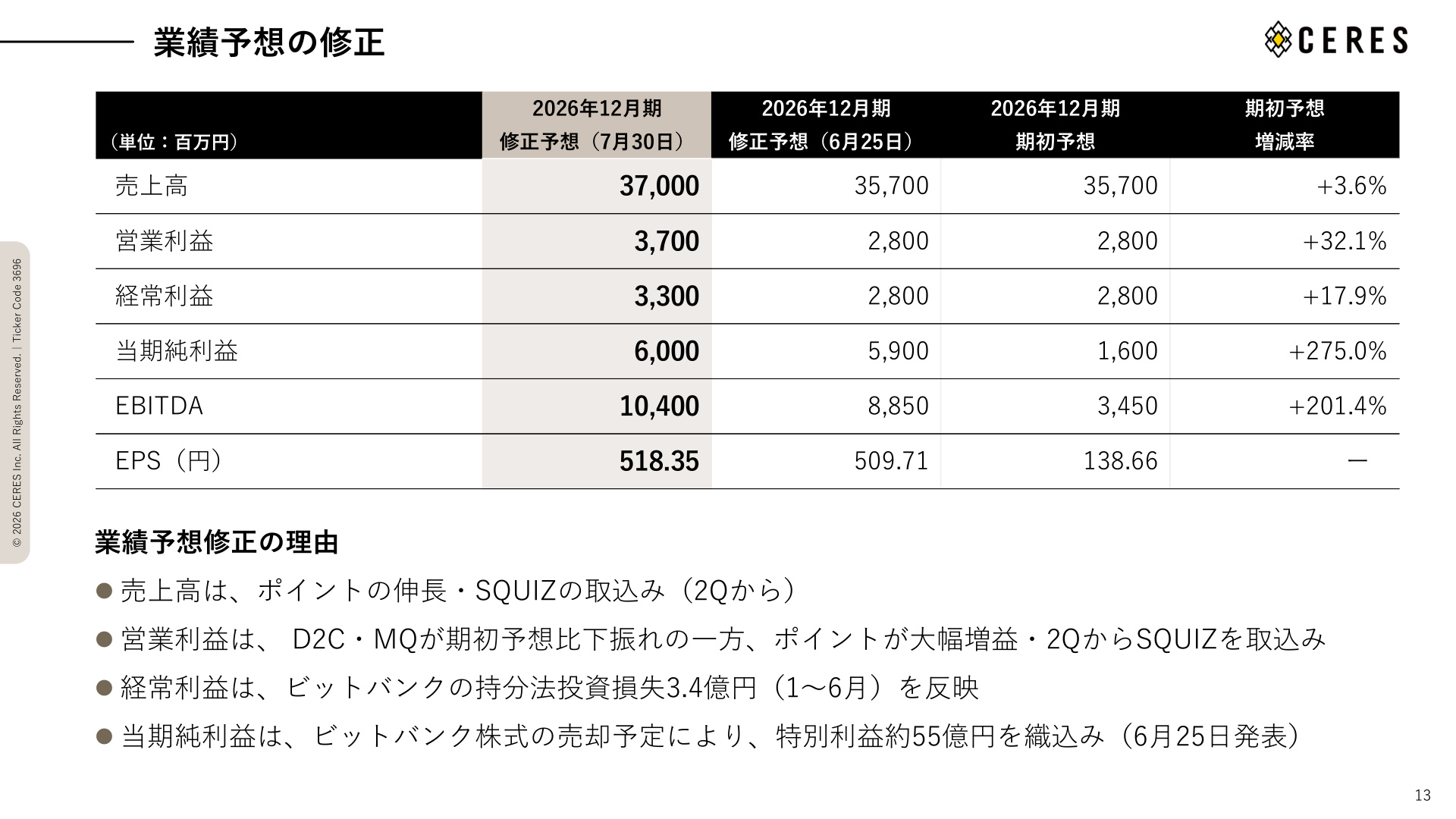
Based on the strong first-half performance and the planned share sale, the company has significantly revised its full-year consolidated earnings forecast for the fiscal year ending December 2026.
【Significance and Background of Slide 13 (PAGE_12)】
Slide 13 illustrates the company's robust growth trajectory. Compared to the initial forecast, net sales have been raised to 37.0 billion yen (+3.6%) , operating profit to 3.7 billion yen (+32.1%) , ordinary profit to 3.3 billion yen (+17.9%) , and net income to 6.0 billion yen (+275.0%) . This slide is crucial because the upward revision is not merely driven by the "gain on sale of equity-method affiliate shares" (extraordinary income), but is underpinned by a substantial profit increase in the core point business (operating profit revised to 6.25 billion yen, +38.9% vs. initial forecast) . The figures clearly demonstrate the strength of the core business, where the point segment is more than compensating for the underperformance in D2C and crypto assets. In terms of progress, the company is on a very steady track, with a 62.2% progress rate for operating profit and 59.7% for ordinary profit against the revised full-year targets as of Q2.
4. bitbank Share Sale and Strategic Capital Allocation
A landmark event for the company's structural reform and future growth is the sale of shares in bitbank, Inc. , an equity-method affiliate (scheduled for October 2026).
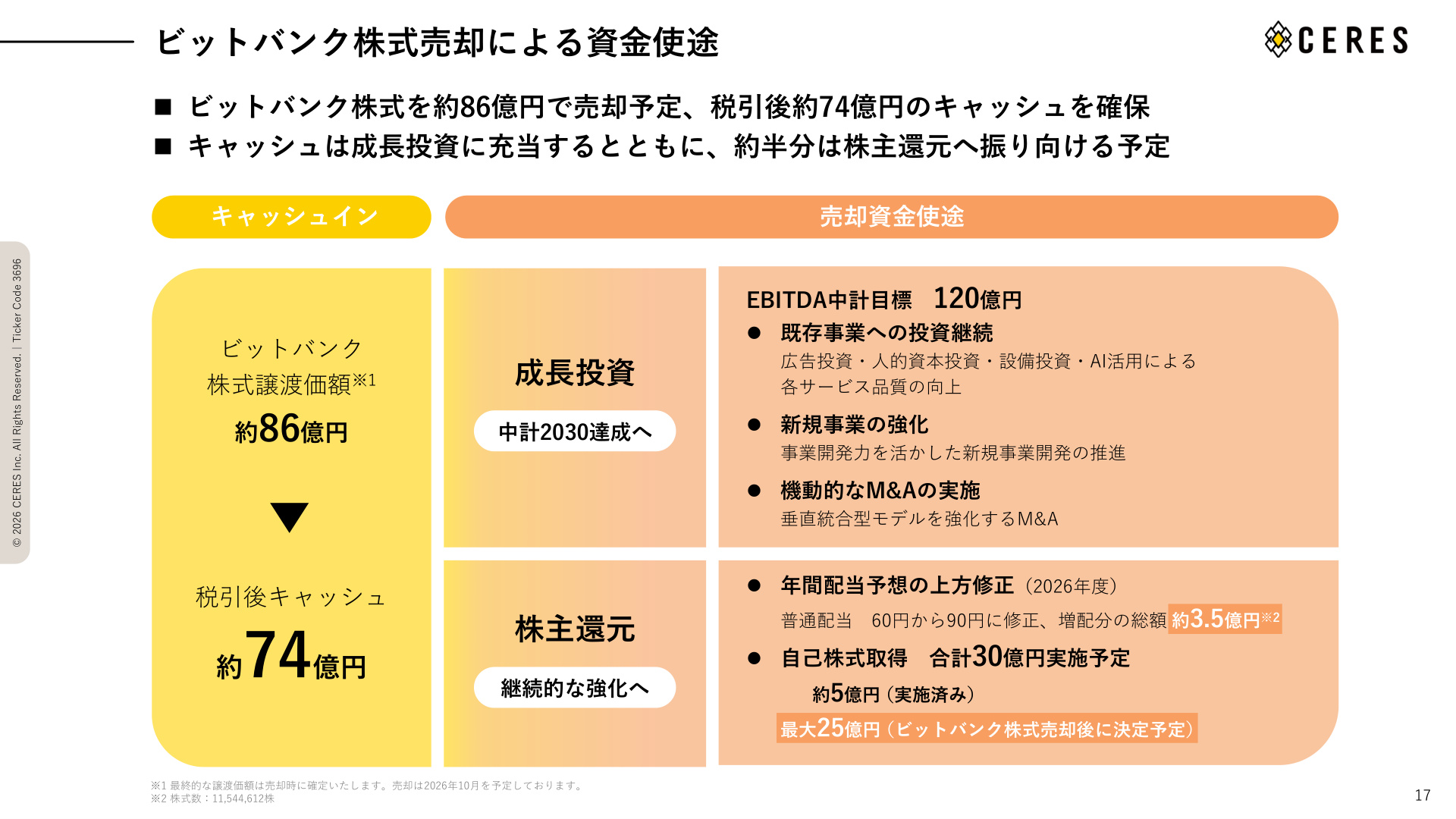
- Scale and Cash Inflow : The transfer value is approximately 8.6 billion yen , with an expected net cash inflow of approximately 7.4 billion yen after taxes. An extraordinary gain of approximately 5.5 billion yen is expected to be recorded.
- Use of Proceeds : The proceeds will be optimally allocated toward future growth investments and shareholder returns.
【Significance and Background of Slide 17 (PAGE_16)】
Slide 17 presents the capital allocation strategy for the massive cash inflow from the bitbank sale. Rather than simply retaining the proceeds, the company has clearly committed to two pillars: "Growth Investment (to achieve the 2030 Mid-Term Plan)" and "Shareholder Returns." Growth investments will be directed toward AI integration in existing media, advertising, new business development, and M&A to strengthen the vertically integrated model. For shareholder returns, the company aims to maximize ROE and shareholder value by allocating funds to a dividend increase of approximately 350 million yen and a share buyback program of up to 3 billion yen , demonstrating a clear commitment to capital efficiency.
5. Aggressive Enhancement of Shareholder Return Policy
Following the asset sale and strong core performance, the company is implementing its highest level of shareholder returns to date.
- Dividend Increase : The annual ordinary dividend forecast has been raised from the initial 60 yen to 90 yen (a significant 30 yen increase) . The revised dividend yield reaches 4.35% (based on the closing price on August 12, 2026).
- Large-Scale Share Buybacks : In addition to the 500 million yen buyback already executed in the first half, the company plans to authorize a share buyback of up to 2.5 billion yen following the completion of the bitbank sale. This brings the total annual buyback to approximately 3 billion yen , with a total return amount (including dividends) expected to reach approximately 4.04 billion yen .
6. Long-Term Growth Story Toward Mid-Term Management Plan 2030
The company's "Mid-Term Management Plan 2030" has become significantly more attainable following these earnings and the secured capital.
- 2030 Targets :
- Net Sales: 60 billion yen (2025-2030 CAGR 15.1% )
- EBITDA: 12 billion yen (2025-2030 CAGR 17.4% )
- ROE: Consistently maintain over 15%
- Business Portfolio Strategy :
- Point Business : The primary profit pillar, targeting 35 billion yen in sales and 6 billion yen in EBITDA.
- D2C Business : Restructuring the profit model to reach 15 billion yen in sales and 2 billion yen in EBITDA.
- Financial Services Business : Expanding to 10 billion yen in sales and 4 billion yen in EBITDA, driven by Labol, to become the second profit pillar.
The company intends to continue refining its "vertically integrated model" —which encompasses media, agency (AD.TRACK), and D2C operations—to improve profit margins and strengthen its competitive advantage.
7. Conclusion
Ceres' Q2 FY2026 earnings demonstrate that its core business is exceptionally strong, driven by the overwhelming growth of the point business . Furthermore, the 7.4 billion yen in cash secured from the bitbank share sale provides powerful support for long-term growth investments and generous shareholder returns, including a 90 yen annual dividend and a 3 billion yen share buyback program . These results confirm that the company is executing a clear vision and capital allocation strategy toward achieving its Mid-Term Management Plan 2030.
This content is not intended as investment advice or a recommendation. Any opinions expressed are solely the personal views of each article.