

![[In-Depth Analysis] Phindex Inc. (3649) H1 FY2026 Earnings: Solid Foundations in Medical DX and Progress on Future Growth Engines](https://news-images.stock-club.net/market_news/images/3649/140120260813519350/slide_eyecatch_en_824b5d49.webp)
[In-Depth Analysis] Phindex Inc. (3649) H1 FY2026 Earnings: Solid Foundations in Medical DX and Progress on Future Growth Engines

StockClub
Published: Aug 13, 2026, 10:28 AM
Sentiment Analysis

The H1 FY2026 earnings for Phindex Inc. , a company boasting a high market share in systems for medical institutions, have been released. This report provides a detailed analysis of current performance, segment-specific trends, the background of upfront investments, and mid-to-long-term growth scenarios based on the earnings presentation materials.
1. H1 FY2026 Earnings Highlights and Progress
For the first half of the fiscal year ending December 2026, consolidated results were as follows: Net Sales of 3,145 million yen (+0.6% YoY) , Operating Profit of 888 million yen (-7.0% YoY) , Ordinary Profit of 922 million yen (-6.4% YoY) , and Net Income Attributable to Owners of the Parent of 560 million yen (-18.2% YoY) .
Progress against the full-year plan (Net Sales of 6,209 million yen, Operating Profit of 1,829 million yen) stands at 50.7% for net sales and 48.6% for operating profit , indicating that performance is generally tracking in line with initial projections.
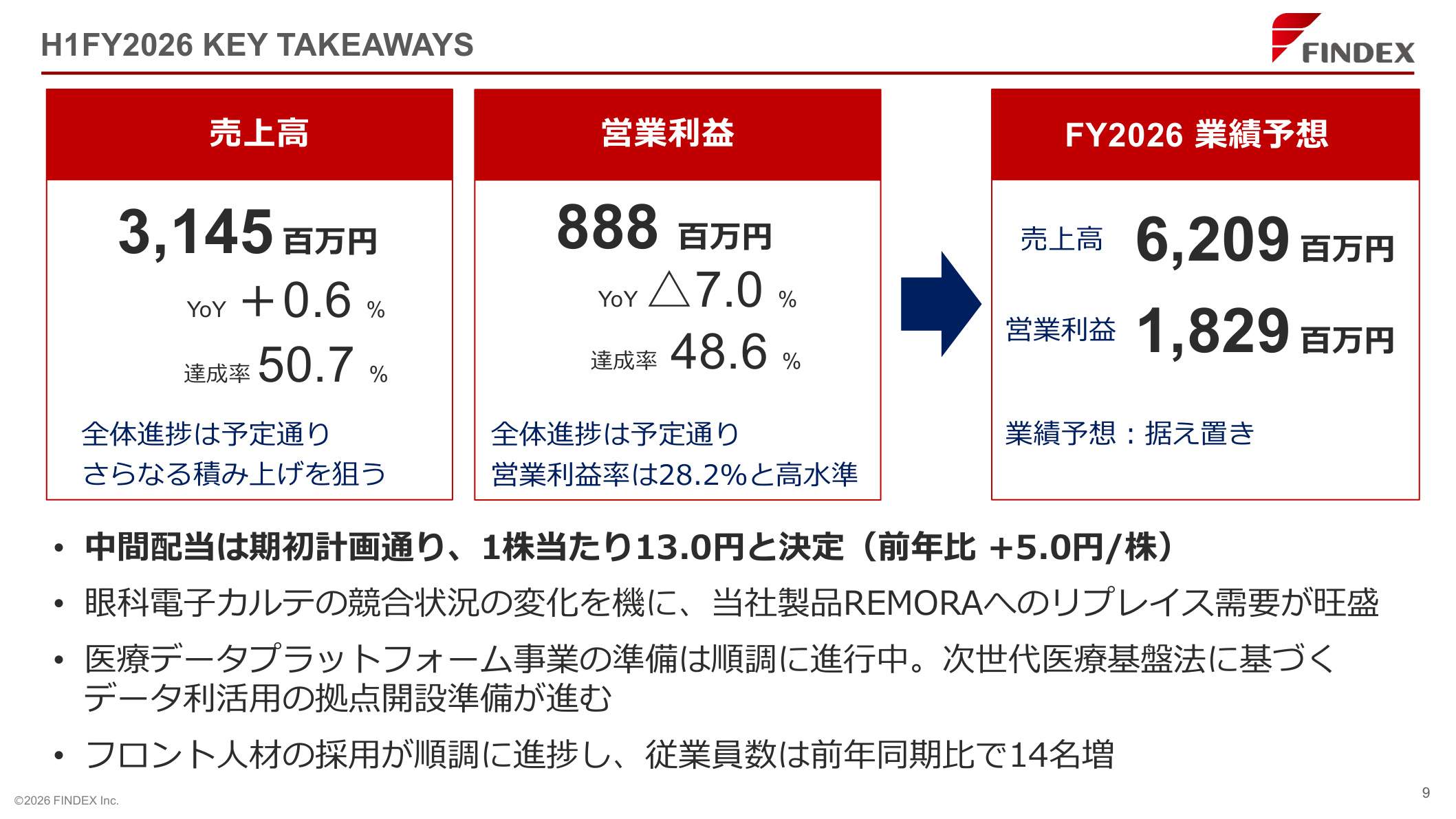
The slide above summarizes the key management indicators and topics for this earnings release. This slide is critical because it clearly demonstrates that while net sales remain robust, the year-on-year decline in operating profit is not due to structural deterioration, but rather to proactive upfront investments aimed at future business expansion.
Furthermore, an interim dividend of 13.0 yen per share was declared (a dividend increase of 5.0 yen compared to the same period last year). While maintaining the full-year forecast, the company is clearly strengthening its shareholder return stance. On the business front, the company is successfully capturing replacement demand for its ophthalmology electronic medical record (EMR) system, " REMORA ," amid a changing competitive landscape, and preparations for its medical data platform business under the Next-Generation Medical Infrastructure Act are proceeding smoothly.
2. Analysis of Operating Profit Fluctuations and Order Trends
The 7.0% year-on-year decline in operating profit is attributed to clear cost allocations:
- Sales Factor : +13 million yen (profit boost from increased sales)
- Gross Margin Factor : +19 million yen
- SG&A Factor : -99 million yen (increased costs)
The breakdown of the increase in SG&A expenses (+9.2% YoY) is primarily due to the following three factors:
- Strengthening of the operational foundation through the renewal of the internal ERP system .
- Expansion of security investments to address information leaks and cyberattacks.
- Aggressive hiring of front-line personnel focused on sales and implementation support (the number of employees increased by 14 compared to the same period last year).
While these weigh on short-term profits, they are strategic expenditures aimed at building infrastructure and strengthening the organization to handle future increases in projects.
Meanwhile, order backlog , a leading indicator of future sales, reached 1,693 million yen at the end of Q2 , marking a record high on a quarterly basis. Despite some timing shifts in the implementation of large-scale projects, project acquisition itself remains steady, providing a buffer for performance in the second half and beyond.
3. Segment Performance and Business Trends
Phindex's business is composed of three segments: "Medical Business," "Public Business," and "Health Tech Business."
① Medical Business (Core Stable Growth Foundation)
- Net Sales : 2,908 million yen (+1.8% YoY, 53.3% progress against full-year plan)
- Operating Profit : 945 million yen (+1.0% YoY)
- Operating Margin : 32.5%
The company's products are used in approximately 80% of domestic university hospitals and approximately 40% of large-scale hospitals (400+ beds), creating high barriers to entry. Recently, there has been a surge in replacement demand from competitors for the " REMORA " EMR system for clinics, exceeding expectations. Additionally, with the spread of cloud services like " CocktailAI " and " PiCls Connect ," the ratio of stock revenue (maintenance and cloud usage fees) in the medical segment has improved to 31.9% (up from 29.8% in the same period last year).
② Public Business (DX for Local Governments and Public Institutions)
- Net Sales : 173 million yen (-29.1% YoY, 41.3% progress against full-year plan)
- Operating Profit : 27 million yen (-77.6% YoY)
The segment saw a decline in both sales and profit due to the reactionary drop from large-scale projects recorded in the previous fiscal year and increased personnel costs. However, the company continues to steadily accumulate successful bids for its public document management solution, " DocuMaker Office ," among small-to-medium-sized municipalities, with the total number of users reaching 49,848 . Revenue from the usage-fee model is also showing a steady upward trend.
③ Health Tech Business (New Growth and Creation Area)
- Net Sales : 65 million yen (+150.2% YoY, 19.1% progress against full-year plan)
- Operating Profit : -85 million yen (loss narrowed from -105 million yen in the previous year)
Despite sluggish domestic sales of the visual field testing device " GAP ," the segment achieved significant sales growth and a narrowing of losses, contributed by spot revenue from consulting and contract development in the medical data platform business. For GAP, the company plans a 50-unit lot shipment for overseas markets in the second half (Q3).
4. Next-Generation Growth Pillar: Outline of the Medical Data Platform Business
The medical data platform business is the area Phindex is focusing on most as its new revenue pillar.
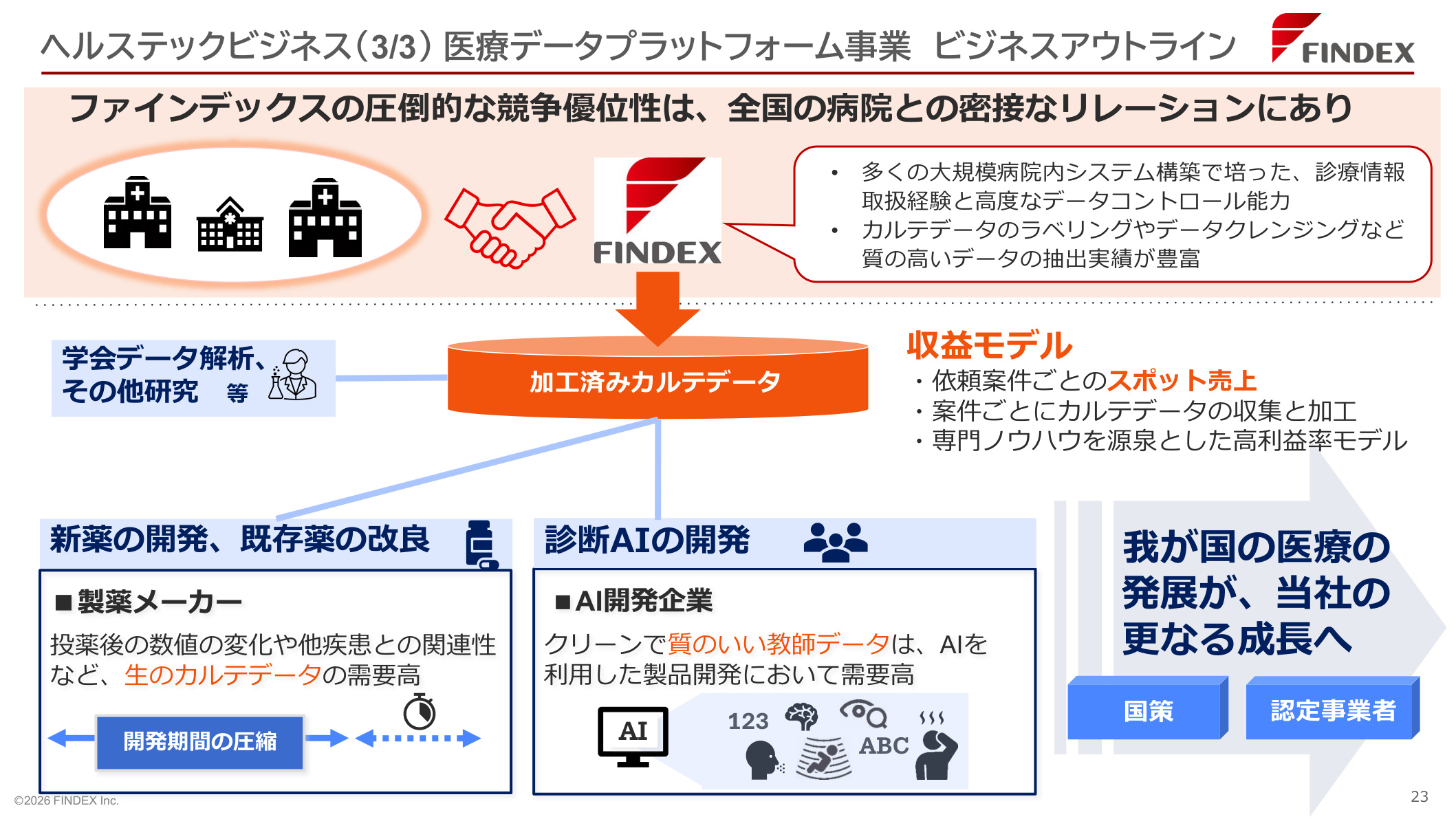
The slide above is a conceptual diagram showing the structure and competitive advantages of the company's medical data platform business. This slide is critical because it illustrates how the close relationships with large-scale hospitals and advanced data processing know-how, cultivated over many years, are being elevated into a high-margin new business model.
Medical data within EMRs is not standardized and cannot be used by pharmaceutical manufacturers or AI development companies as is. The company possesses the technical capability and authorization to perform labeling and cleansing (data formatting) of medical record data, building an infrastructure to safely provide processed data.
- For Pharmaceutical Manufacturers : Shortening development periods and improving accuracy for post-marketing surveillance and new drug development.
- For AI Development Companies : Providing high-quality training data necessary for diagnostic AI.
By riding the wave of the national policy on medical data utilization (Next-Generation Medical Infrastructure Act) and collaborating with certified operators, the company is advancing the full-scale deployment of this business (starting in 2025), with expectations for high profitability from both stock and spot revenue.
5. Mid-to-Long-Term Growth Vision and Shareholder Return Policy
The company has unveiled a long-term performance plan leading up to 2030 and a robust return policy.
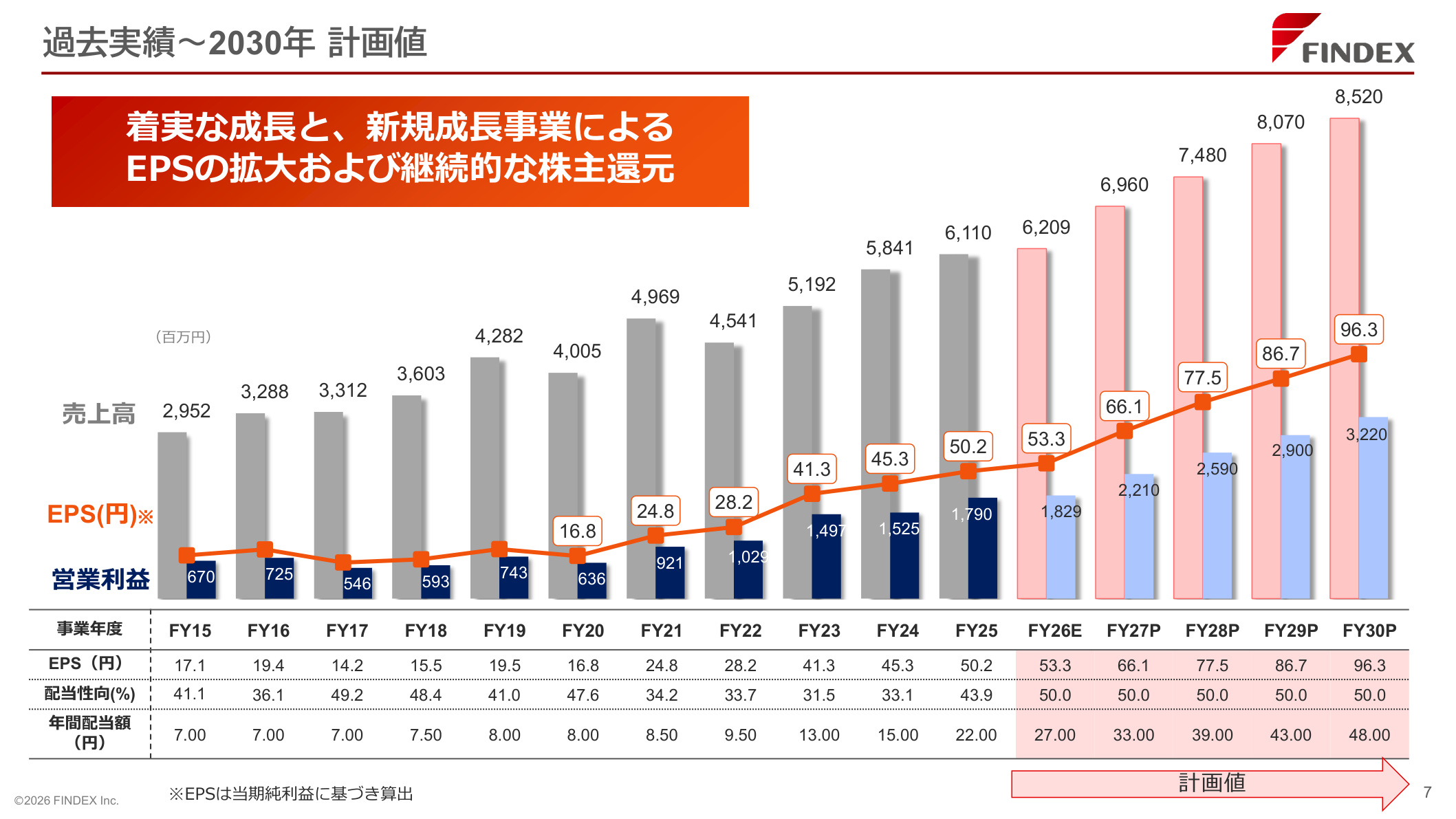
The slide above is a comprehensive growth roadmap showing the historical and projected trends for net sales, operating profit, and EPS through 2030. This slide is important because it presents the overall long-term story: reinvesting cash generated from the stable earnings base of existing medical systems (annual operating margin over 30%) into new businesses such as public, healthcare, and medical data, thereby increasing EPS from 41.3 yen in 2023 to 96.3 yen by 2030.
- 2030 Targets : Net Sales of 8,520 million yen , Operating Profit of 3,220 million yen , EPS of 96.3 yen
- Shareholder Return Policy : Targeting a 50.0% dividend payout ratio , with a minimum DOE (Dividend on Equity) of 8.5% .
- Annual Dividend Trend : The forecast for the fiscal year ending December 2026 is 27.00 yen/share (13 yen interim, 14 yen year-end). If the plan proceeds as expected, dividends are scheduled to be increased in stages to 48.00 yen/share by 2030.
6. Conclusion
Phindex's H1 FY2026 earnings results show that while the company is making upfront investments for the future , such as internal infrastructure and personnel expansion, the core medical business is providing a solid foundation, allowing the company to successfully meet its interim targets.
Although the increase in SG&A expenses is temporarily pressuring profit margins in the short term, various elements supporting mid-to-long-term growth are falling into place, including a record-high order backlog , expanding demand for the "REMORA" EMR , full-scale overseas shipments of GAP , and the launch of the medical data platform business . Future developments, where the robust earning power of existing businesses combines with the scaling of new ventures, are highly anticipated.
This content is not intended as investment advice or a recommendation. Any opinions expressed are solely the personal views of each article.