


In-Depth Earnings Analysis: ZenmuTech (338A) H1 FY2026 – Prioritizing Growth Investment and H2-Weighted Revenue, with Strong ZVD Expansion and a Path Toward Secret Computing PaaS

StockClub
Published: Aug 13, 2026, 10:20 AM
Sentiment Analysis

ZenmuTech Co., Ltd. (TSE Growth: 338A) reported H1 FY2026 financial results that fell short of internal targets for both revenue and profit at all levels. However, this was primarily due to the deferral of large-scale project orders to Q4 and front-loaded investments in personnel and development to drive future growth. Consequently, the full-year guidance (Revenue: 1,080 million JPY, Operating Profit: 161 million JPY) remains unchanged.
The company’s flagship solution, "ZENMU Virtual Drive (ZVD)," continues to grow steadily, up 32.5% year-on-year , driven largely by subscriptions. Simultaneously, the company is systematically transitioning its business model to transform its advanced secret computing solution, "QueryAhead®," into a PaaS-based, recurring revenue model .
This report provides an in-depth analysis of the financial background, solution-specific performance, business topics, and the company's mid-to-long-term growth strategy.
1. Earnings Highlights and H2-Weighted Progress
The consolidated financial results for the first half (H1) of the fiscal year ending December 2026 are as follows:
- Revenue : 305 million JPY (+0.3% YoY)
- Gross Profit : 270 million JPY (+2.3% YoY)
- Operating Profit/Loss : △99 million JPY (vs. △24 million JPY in the same period last year)
- Ordinary Profit/Loss : △79 million JPY (vs. △18 million JPY in the same period last year)
- Net Profit/Loss : △60 million JPY (vs. △13 million JPY in the same period last year)
H1 revenue remained flat year-on-year. This is attributed to the reactionary decline from a one-time, government-led project in Q1 of the previous year, as well as the postponement of projects originally scheduled for Q2 into Q4. Furthermore, the operating loss widened due to an increase in SG&A expenses to 369 million JPY (+28.2% YoY). This was primarily driven by personnel expansion (increasing by 4 to a total of 40 employees) to strengthen the sales structure, higher outsourcing costs for product enhancement, and one-time expenses related to listing and organizational development.
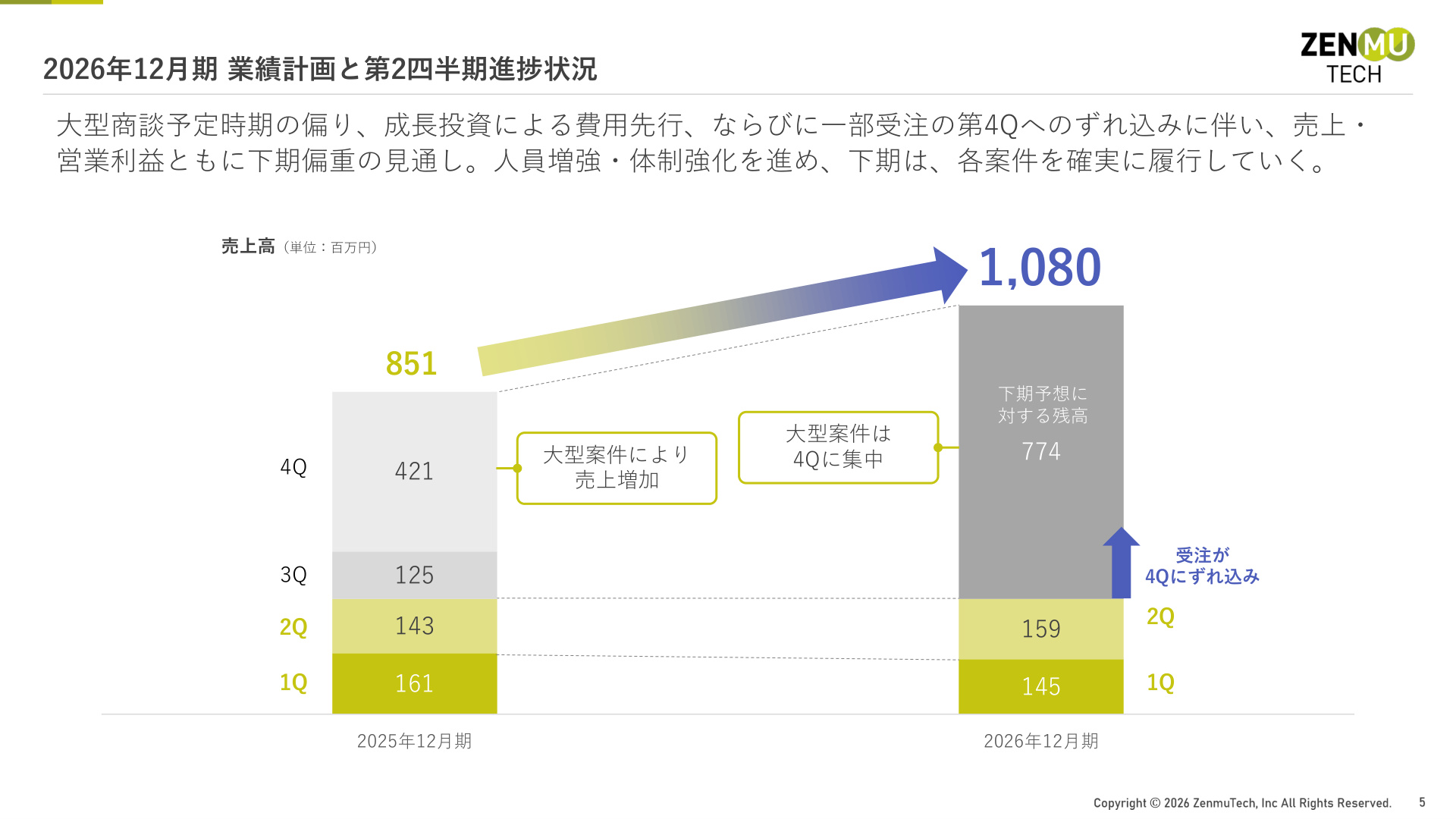
[Analysis of Slide 5: Importance of H2 Weighting]
This slide clearly illustrates the background of the company's heavily Q4-weighted revenue structure . The company maintains a full-year revenue target of 1,080 million JPY (+26.8% YoY), with an H1 progress rate of approximately 28.2%. While this may appear low at first glance, the company has a track record from FY2025 where approximately half of its annual revenue was concentrated in Q4 (421 million JPY in Q4 alone). The current plan is based on a seasonal pattern where revenue and profit surge in the second half (particularly Q4) , driven by the concentration of large-scale deals and order intake.
2. Revenue Trends by Solution: Strong Growth in Flagship ZVD
A breakdown by solution reveals that the company's business foundation is being steadily strengthened.
- ZENMU Virtual Drive (ZVD) : 257 million JPY (+32.5% YoY, 84.2% of total revenue)
- QueryAhead® (Secret Computing) : 29 million JPY (△67.0% YoY, 9.5% of total revenue)
- ZENMU Engine : 12 million JPY (△4.3% YoY, 4.2% of total revenue)
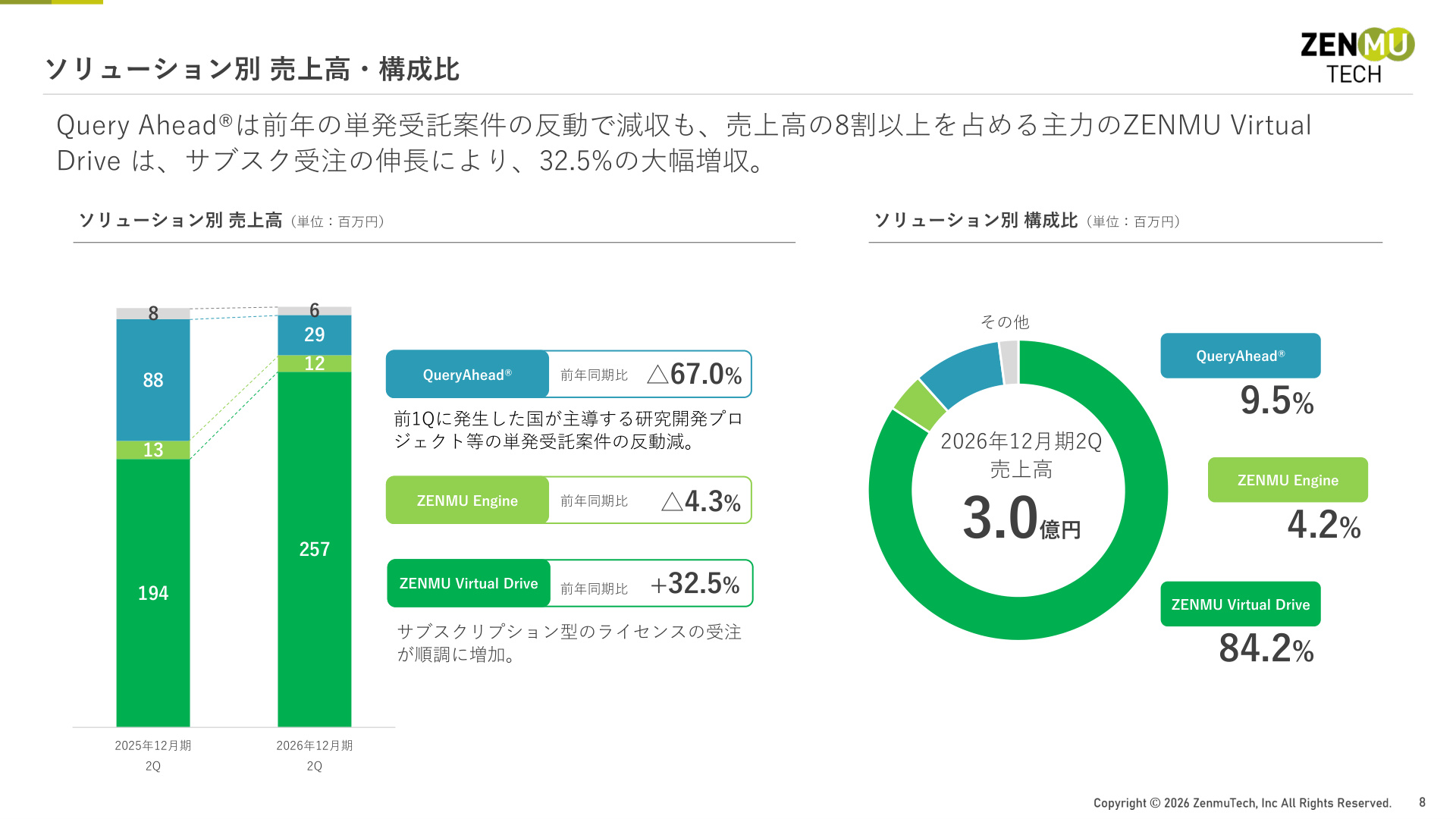
[Analysis of Slide 8: Qualitative Shift in Revenue]
This slide symbolizes the qualitative change in the company's revenue base . The flagship "ZENMU Virtual Drive," which accounts for over 80% of total revenue , recorded a significant 32.5% increase in revenue as subscription license contracts grew steadily. Meanwhile, the sharp decline in QueryAhead® is due to the reactionary effect of a large-scale, one-time project in the same period last year. In short, ZVD, the company's growth engine, remains robust, confirming that the portfolio shift from project-based to stock-based revenue is progressing.
3. Accumulation of Stock Revenue and High Customer Retention
The company's strengths lie in its high ratio of stock revenue and extremely low churn rate.
- Stock Revenue Ratio : 69.3% as of Q2 (110 million JPY out of 159 million JPY in revenue is stock-based)
- Total ZVD Licenses : 126,072 (up from 107,309 in the same period last year)
- Breakdown: Subscription contracts 46,024 (36.5%), Maintenance contracts 80,048 (73.5%)
- Actual Churn Rate : 0.4% (excluding the impact of large customers switching to perpetual licenses)
Because ZVD, which performs data obfuscation and decentralized management, is deeply integrated into customer IT infrastructure, it features extremely low churn risk. This steady accumulation of stock revenue provides the underlying strength to support operating losses during this phase of front-loaded investment.
4. Core Growth Strategy: Transitioning "QueryAhead®" to a PaaS-based Recurring Model
The most critical element for ZenmuTech's long-term explosive growth is the business model transformation of its secret computing solution, "QueryAhead®."
Previously, QueryAhead® relied heavily on flow revenue from government-related projects, which created bottlenecks such as tying up engineering resources in specific large-scale developments and low revenue predictability (a characteristic of one-time, labor-intensive business models).
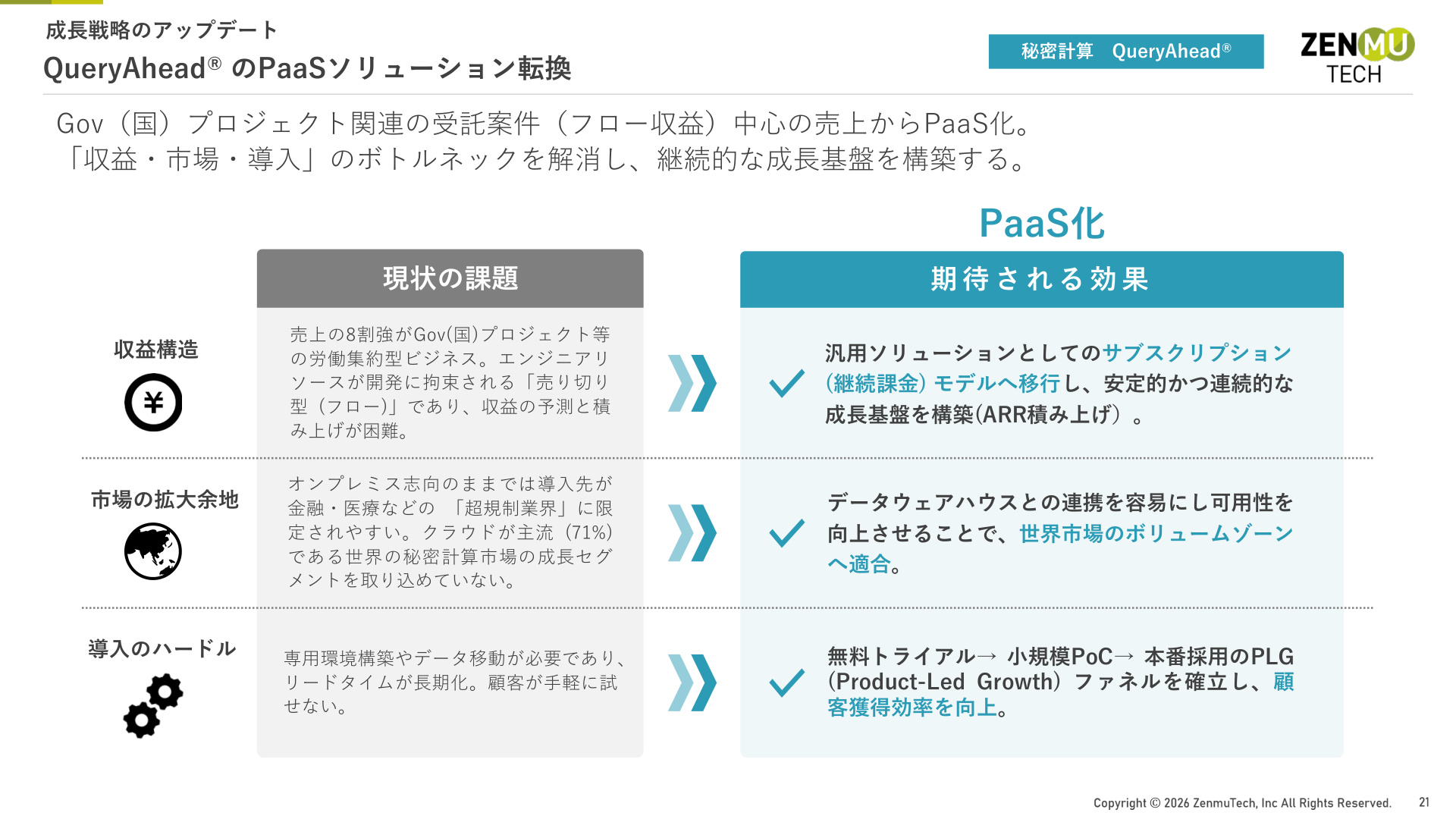
[Analysis of Slide 21: Transforming Future Profitability]
This slide clearly outlines the growth strategy that will dramatically transform ZenmuTech's future profitability . The company is shifting from a government-centric project-based business to a cloud-based PaaS-type recurring revenue model (QueryAhead Hub) . By transitioning to PaaS, integration with data warehouses becomes easier, enabling access to global volume zones beyond the financial and medical sectors, which were previously confined to on-premise environments. Furthermore, by building a Product-Led Growth (PLG) funnel that guides users from free trials and PoCs to full-scale adoption, the company aims to drastically improve customer acquisition efficiency and ARR (Annual Recurring Revenue).
Regarding the development roadmap, the company completed its technical foundation in H2 FY2026 by achieving native code implementation, which accelerated the basic processing speed of secret computing by over 100 times compared to previous versions.
5. Business Topics and Expansion of Alliances
In Q2, the company announced numerous achievements in implementing advanced technologies and strengthening sales partnerships.
- Full-scale Implementation in Medical DX : The "Secret Sharing Proxy," a technology co-developed with HAIP, was adopted for the "Digital Trust Grid" medical DX platform developed by AIHOBS, balancing high data confidentiality with usability.
- Municipal DX and Disaster Communication : Development began on applying secret sharing technology to the "NerveNet" regional decentralized network, in collaboration with the National Institute of Information and Communications Technology (NICT) and Nashua Solutions.
- Patent Application in Generative AI : Co-developed a "Secret Sharing x RAG (Retrieval-Augmented Generation)" solution with Aegis Application and Technica AI to enable secure AI utilization, and filed for a patent. This solution eliminates the need for key management and provides resistance to data poisoning.
- Expansion of Endpoint Security Sales : Signed a three-party business alliance with Mintwave and TMI Privacy & Security Consulting to promote customer adoption that balances legal compliance with security.
- Strengthening PETs (Privacy-Enhancing Technologies) Research : Appointed Associate Professor Takao Murakami of the Institute of Statistical Mathematics as an advisor to accelerate R&D on "output privacy" technology, which prevents the inference of original data from analysis results.
6. Full-Year Forecast and Mid-to-Long-Term Goal: "triple 30 Plan"
Full-Year Earnings Forecast (FY2026)
Despite the H1 shortfall, the full-year forecast remains consistent with the initial plan.
- Revenue : 1,080 million JPY (+26.8% YoY)
- Operating Profit : 161 million JPY (+12.6% YoY, Operating Margin: 14.9%)
- Net Profit : 302 million JPY (+93.7% YoY)
Operating losses are expected to continue through Q3 due to ongoing front-loaded investments in hiring and marketing. However, the company expects to achieve full-year profitability in one stroke in Q4, as large-scale deals materialize and the effects of subscription accumulation bear fruit .
Mid-Term Growth Goal: "triple 30 Plan"
For the fiscal year ending December 2030, the company has set the following quantitative growth targets:
- Revenue CAGR (Compound Annual Growth Rate) : 30%
- Operating Profit Margin : 30%
- Long-term Goal : Grow into a company with 10 billion JPY in revenue.
By combining the stable revenue base provided by ZVD in the short term (with the company's current share of the 8 million+ domestic VDI users at only about 1%, there is significant room for expansion) with the mid-to-long-term PaaS deployment, overseas expansion, and M&A of ZENMU Engine and QueryAhead® , the company aims to evolve into a high-growth, high-profit enterprise.
Conclusion
While ZenmuTech's H1 FY2026 results show pressure on profits, the reality is driven by a Q4-weighted revenue structure and aggressive front-loaded investment for growth . With the flagship ZVD steadily increasing contract numbers to expand stock revenue, and technical development in secret computing PaaS and Generative AI (RAG) aligning with the needs of the era, the company is in a phase where progress in its growth strategy warrants close attention.
This content is not intended as investment advice or a recommendation. Any opinions expressed are solely the personal views of each article.