


JINUSHI Co., Ltd. (3252) Q2 FY2026 Earnings Analysis: 92% Sales Completion Rate Signals High Certainty for ¥8.0 Billion Net Profit Target; Acquisition Contracts Surge 73.3% YoY

StockClub
Published: Aug 13, 2026, 10:16 AM
Sentiment Analysis
JINUSHI Co., Ltd. (Securities Code: 3252) reported Q2 FY2026 earnings with net sales of ¥34,592 million and an operating profit of ¥4,416 million. While the interim figures for sales and net profit appear lower year-on-year, this is in line with the company's business model, which features a "planned concentration of sales profits in the fourth quarter (Q4)."
This report provides an in-depth analysis of the company's steady progress, the significant expansion in acquisitions—a leading indicator of growth—the robust business structure resilient to rising interest rates and inflation, and the enhancement of shareholder returns.
1. Q2 FY2026 Earnings Summary and Progress Toward Full-Year Targets
For the first half of the fiscal year, consolidated results were: net sales of ¥34,592 million (down 13.1% YoY) , operating profit of ¥4,416 million (up 8.9% YoY) , ordinary profit of ¥3,258 million (up 2.6% YoY) , and net profit attributable to owners of the parent of ¥2,092 million (down 24.7% YoY) . Gross profit reached ¥7,256 million, an increase of 11.3% compared to the same period last year.
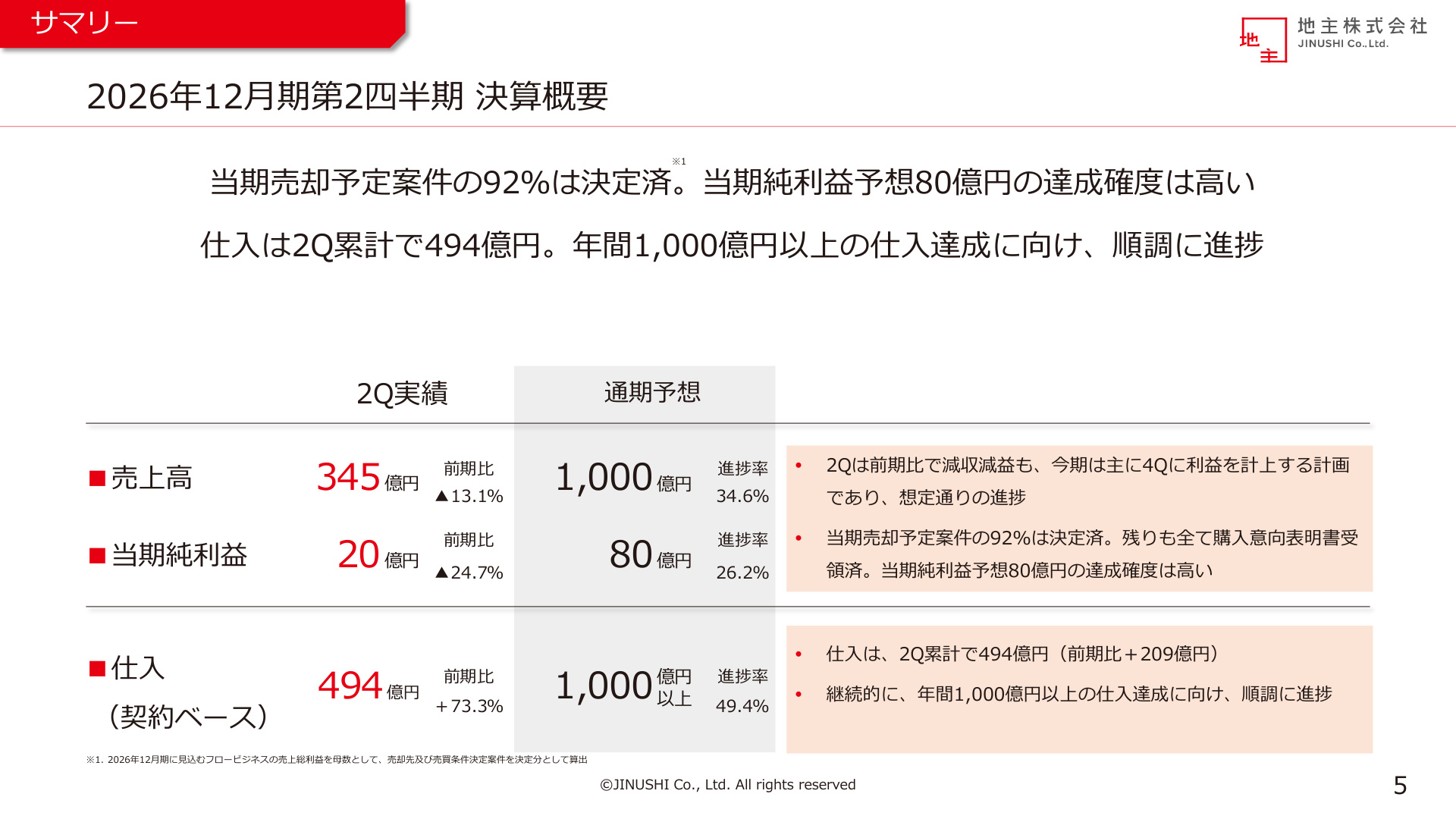
Background and Commentary on the "Earnings Summary" Slide
The slide above illustrates the most critical aspects for investors: the overall earnings picture and the probability of achieving full-year targets .
- 92% of Planned Sales Secured : While the progress rate for net profit attributable to owners of the parent stands at 26.2% at the Q2 stage against the full-year target of ¥8.0 billion, 92% of the properties planned for sale this fiscal year (based on flow business gross profit) have already had their buyers and terms finalized . Letters of intent have been received for the remaining 8%.
- Q4-Concentrated Revenue Structure : The company strategically adjusts the timing of profit recognition to maximize annual earnings and optimize financial conditions. This year’s plan focuses profits in Q4; the interim progress rate is consistent with historical patterns, indicating a very high probability of achieving the full-year plan.
- Track Record : The company has exceeded its initial earnings forecasts for five consecutive years (averaging +15.3% above initial guidance), demonstrating a conservative, disciplined approach to planning and execution.
2. Segment Performance: Rapid Expansion of the Stock Business
The company’s business consists of two pillars: the "Flow Business" (real estate sales profit) , involving the short-term acquisition and sale of land, and the "Stock Business," comprising rental income during the holding period and asset management fees from JINUSHI REIT.
■ Flow Business (Real Estate Investment)
Q2 cumulative flow business sales were ¥30,815 million (down 18.5% YoY), with a gross profit of ¥4,027 million (down 16.1% YoY). As noted, this is due to the shift in profit recognition toward the latter half of the year (specifically Q4), and the company expects full-year sales profits to exceed those of the previous year.
■ Stock Business (Asset Management & Real Estate Leasing)
Conversely, the stock business is showing remarkable growth. Q2 cumulative sales reached ¥3,407 million (up 71.3% YoY) , and gross profit surged to ¥3,009 million (up 75.7% YoY) . This growth is driven by increased rental income from land holdings following accelerated acquisitions, as well as the steady accumulation of asset management fees as JINUSHI REIT expands its asset scale.
Notably, the SG&A coverage ratio (Stock Gross Profit ÷ SG&A expenses) is improving. Having risen steadily from 53.7% in FY2022, it is projected to reach approximately 90% in FY2026 . A structure is emerging where stable stock revenue covers the majority of fixed SG&A expenses, dramatically enhancing the stability of the management foundation.
3. Resilience Against Macroeconomic Shifts (Rising Interest Rates and Inflation)
While "rising interest rates" and "soaring material and construction costs" are concerns in the real estate industry, the "JINUSHI Business" model possesses unique strengths that turn these headwinds into tailwinds.
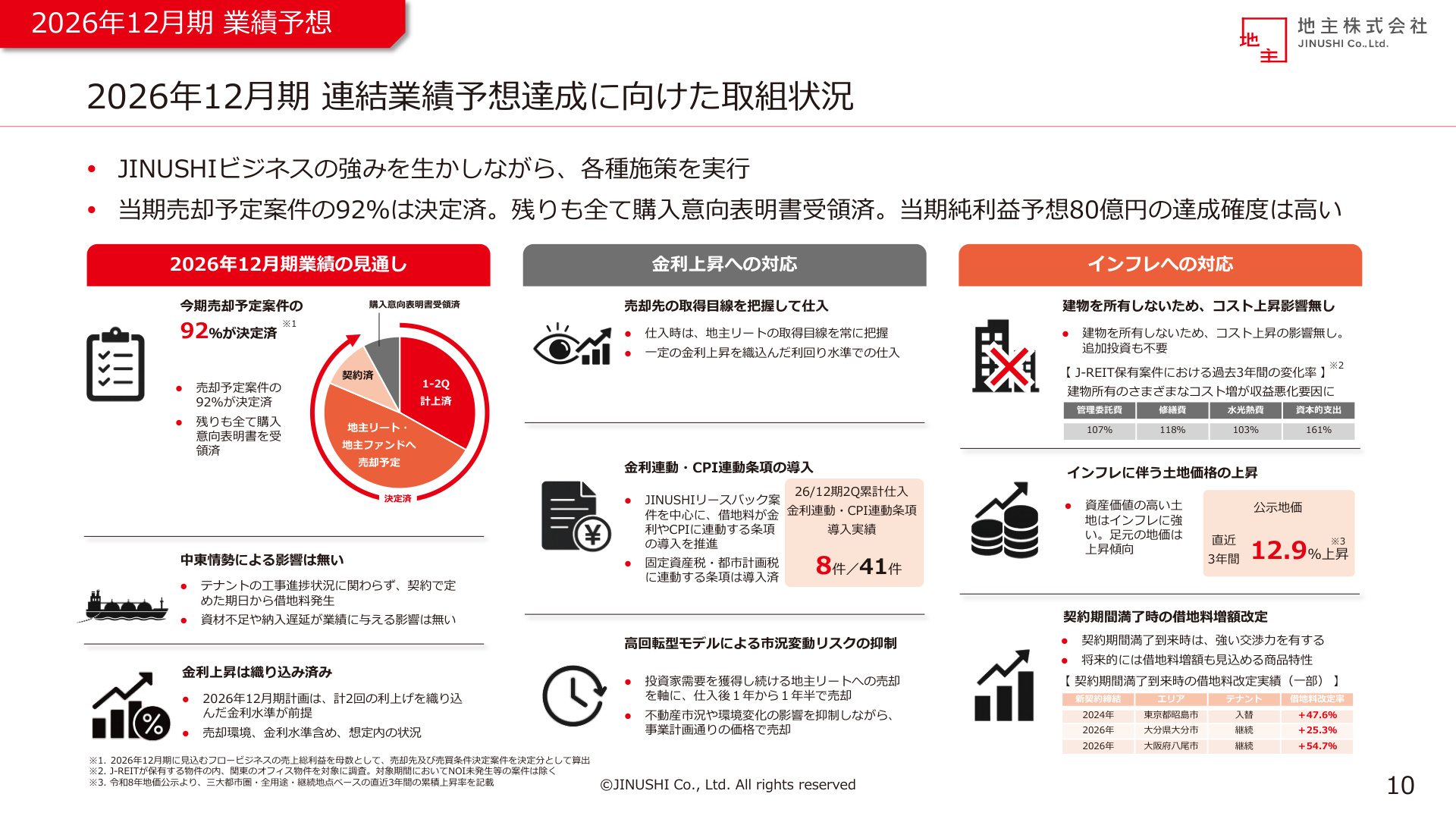
Background and Commentary on the "Initiatives to Achieve Consolidated Earnings Forecasts" Slide
This slide comprehensively outlines the company's risk management measures and competitive advantages against macroeconomic shifts (interest rates, inflation, geopolitical risks, etc.).
- Incorporating and Responding to Interest Rate Hikes : The company formulates acquisition and business plans based on interest rate levels that already account for two Bank of Japan rate hikes. Furthermore, because acquisitions are calculated based on the required yields of buyers like JINUSHI REIT, the company can secure reliable spreads even in a rising rate environment. Additionally, the company is introducing "interest rate-linked and CPI-linked clauses" in contracts (8 cases introduced in H1), creating a mechanism to share interest rate risk with tenants.
- Eliminating Inflation and Construction Cost Risks : The greatest strength lies in the fact that "the tenant constructs the building, and the company owns only the land (underlying land)." Because the company does not own the buildings, it is completely unaffected by the recent sharp increases in construction materials and labor costs. Conversely, it benefits from asset value appreciation due to rising land prices (official land prices have risen 12.9% over the last three years), making the business model highly inflation-resistant.
- Mitigating Market Risk via High-Turnover Model : By setting the period from acquisition to sale at approximately 1 to 1.5 years, the company minimizes exposure to long-term real estate market fluctuations.
4. Leading Indicator of Growth: Surge in Acquisitions and Diverse Approaches
The company is showing powerful momentum in "acquisitions," the source of future profits. Cumulative Q2 acquisitions on a contract basis reached ¥49.4 billion (up ¥20.9 billion, +73.3% YoY) , putting the company on a very steady pace to achieve its full-year target of "¥100 billion or more annually."
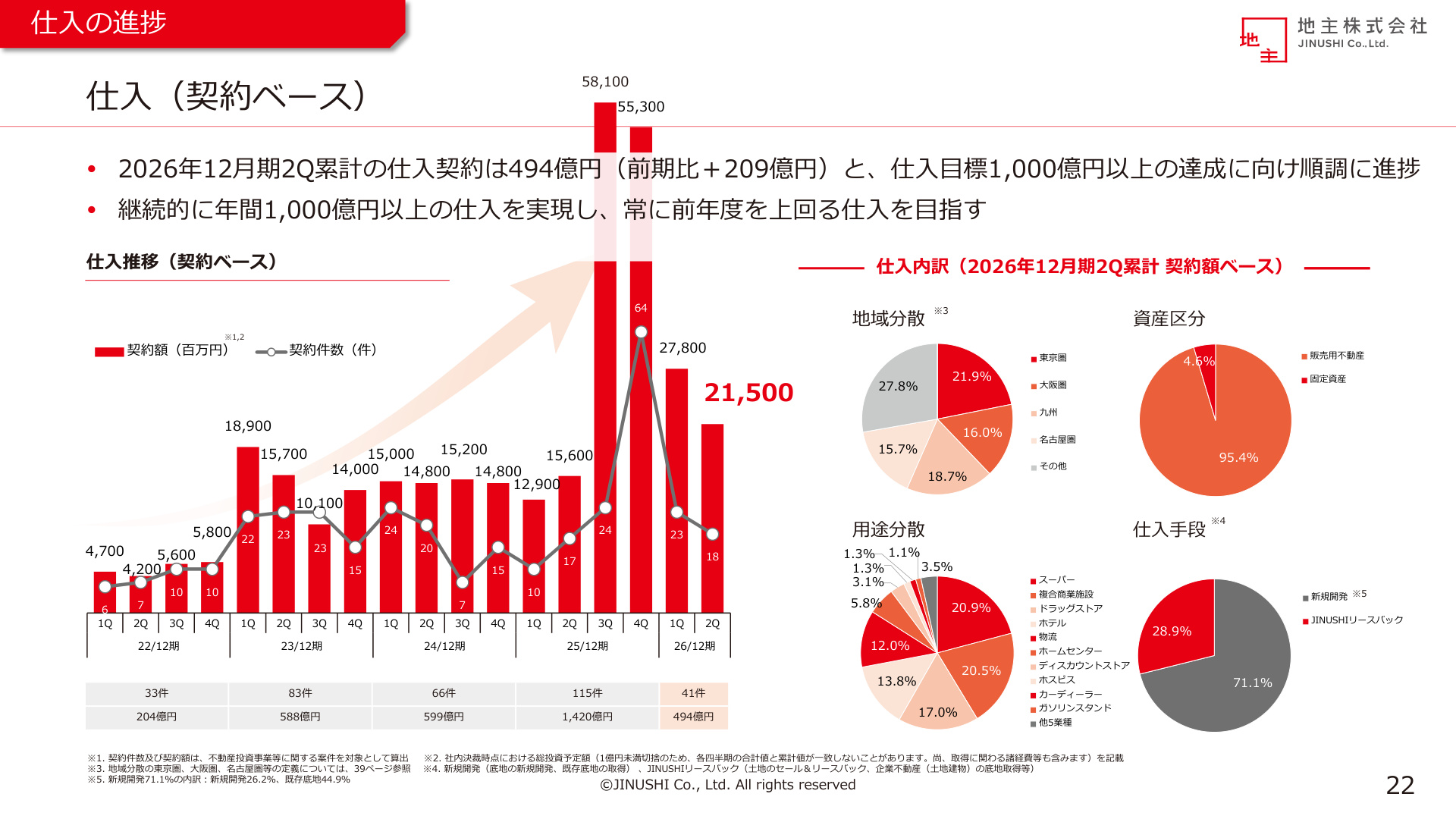
Background and Commentary on the "Acquisitions (Contract Basis) and Breakdown" Slide
The slide above provides core data for understanding the company's future growth potential and risk diversification.
- Explosive Growth in Acquisition Contracts : Contracts for ¥49.4 billion (41 properties) were completed in H1, a significant leap from ¥28.5 billion (15 properties) in the same period last year, supporting the mid-to-long-term goal of "consistently acquiring over ¥100 billion annually."
- Evolution of Acquisition Methods (Growth of JINUSHI Leaseback) : A breakdown of acquisition methods shows that while "new development" accounts for 28.9%, "JINUSHI Leaseback" accounts for 71.1% . The company is flooded with proposals from listed companies looking to improve capital efficiency and review their CRE (Corporate Real Estate) strategies, significantly expanding the company's deal-sourcing channels.
- Thorough Diversification of Region and Use : Acquisitions are well-balanced nationwide: Tokyo area (21.9%), Osaka area (16.0%), Kyushu (15.7%), Nagoya area (18.7%), and others (27.8%). By use, the portfolio is diversified into stable, life-essential, and social infrastructure-related sectors, including supermarkets (20.9%), commercial complexes (20.5%), drugstores (17.0%), hospices (13.8%), logistics (12.0%), and hotels (5.8%), reducing the risk of a downturn in any single industry.
5. Shareholder Return Policy: Commitment to Progressive Dividends
The company maintains a "progressive dividend" policy, continuing to increase dividends in line with earnings growth.
- FY2026 Dividend Forecast : Compared to the annual dividend of ¥110 in the previous fiscal year (¥100 ordinary + ¥10 commemorative), the company plans to increase the dividend to ¥130 annually (¥65 interim, ¥65 year-end) , an increase of ¥20.
- Dividend Payout Ratio : Against a projected EPS of ¥386.62, the company anticipates a payout ratio of 33.6% , clearly demonstrating its commitment to returning profits to shareholders while maintaining financial health.
6. Conclusion and Outlook
JINUSHI's (3252) Q2 FY2026 earnings can be summarized as extremely solid and progressing exactly as planned, based on the following points:
- Certainty of Profit Achievement : With a 92% sales completion rate, there is high certainty of achieving the ¥8.0 billion net profit target.
- Boost from Stock Revenue : Stock gross profit surged 75.7% YoY, with the SG&A coverage ratio approaching 90%.
- Strong Acquisition Momentum : Achieved ¥49.4 billion in contracts (up 73.3% YoY), securing a solid foundation for future growth.
- Structural Advantage in Macro Environment : The "land-specialized model" avoids construction cost risks, while the introduction of interest rate and inflation-linked clauses allows for adaptation to change.
- Enhanced Shareholder Returns : A planned dividend increase to ¥130 per year and adherence to the progressive dividend policy.
Social factors (TSE requests for improved capital efficiency, corporate real estate reviews, and avoidance of building ownership risks due to rising costs) are acting as powerful tailwinds for the "JINUSHI Business." It is evident that the company is on a steady growth trajectory toward the "¥10 billion or more in net profit" target set in its Mid-Term Management Plan (2026-2028).
This content is not intended as investment advice or a recommendation. Any opinions expressed are solely the personal views of each article.