


Skylark Holdings Q2 FY2026 Earnings Analysis: Driving Revenue and Profit Growth Through Multi-Brand Synergy, DX, and M&A

StockClub
Published: Aug 13, 2026, 10:14 AM
Sentiment Analysis
Skylark Holdings (Ticker: 3197) reported significant year-on-year growth in both revenue and profit for the second quarter of the fiscal year ending December 2026 . This performance was driven by strong existing-store traffic, increased average customer spend, successful new store openings and format conversions, and the steady progress of cost-reduction projects. Consequently, the company has announced an upward revision to its full-year earnings and dividend forecasts .
This report provides a detailed analysis based on 10 key topics extracted from the earnings presentation, covering performance highlights, the structural drivers of profit growth, the company's responsiveness to the consumer environment, and its mid-to-long-term growth strategy.
1. Q2 FY2026 Earnings Summary: Key Performance Indicators
Key financial results for the first half of FY2026 are as follows:
- Revenue : ¥242.5 billion (+9.7% YoY, +¥21.5 billion)
- Gross Profit : ¥161.4 billion (+9.3% YoY, +¥13.8 billion)
- Operating Profit (Business Profit) : ¥17.0 billion (+13.4% YoY, +¥2.0 billion)
- Operating Profit (IFRS) : ¥16.9 billion (+20.9% YoY, +¥2.9 billion)
- Net Profit : ¥10.2 billion (+29.2% YoY, +¥2.3 billion)
- ROE (Trailing 12 Months) : 10.2% (+1.2pt from 9.0% in the previous year)
Domestic existing-store sales remained robust at 106.5% of the previous year (customer traffic at 101.6%, average spend at 104.8%), maintaining an ideal momentum where both traffic and spend are driving revenue growth.
2. Business Profit Analysis: A Structure for Absorbing Inflation
The business profit variance analysis illustrates how the company grew profits despite a challenging external environment characterized by soaring raw material and labor costs.
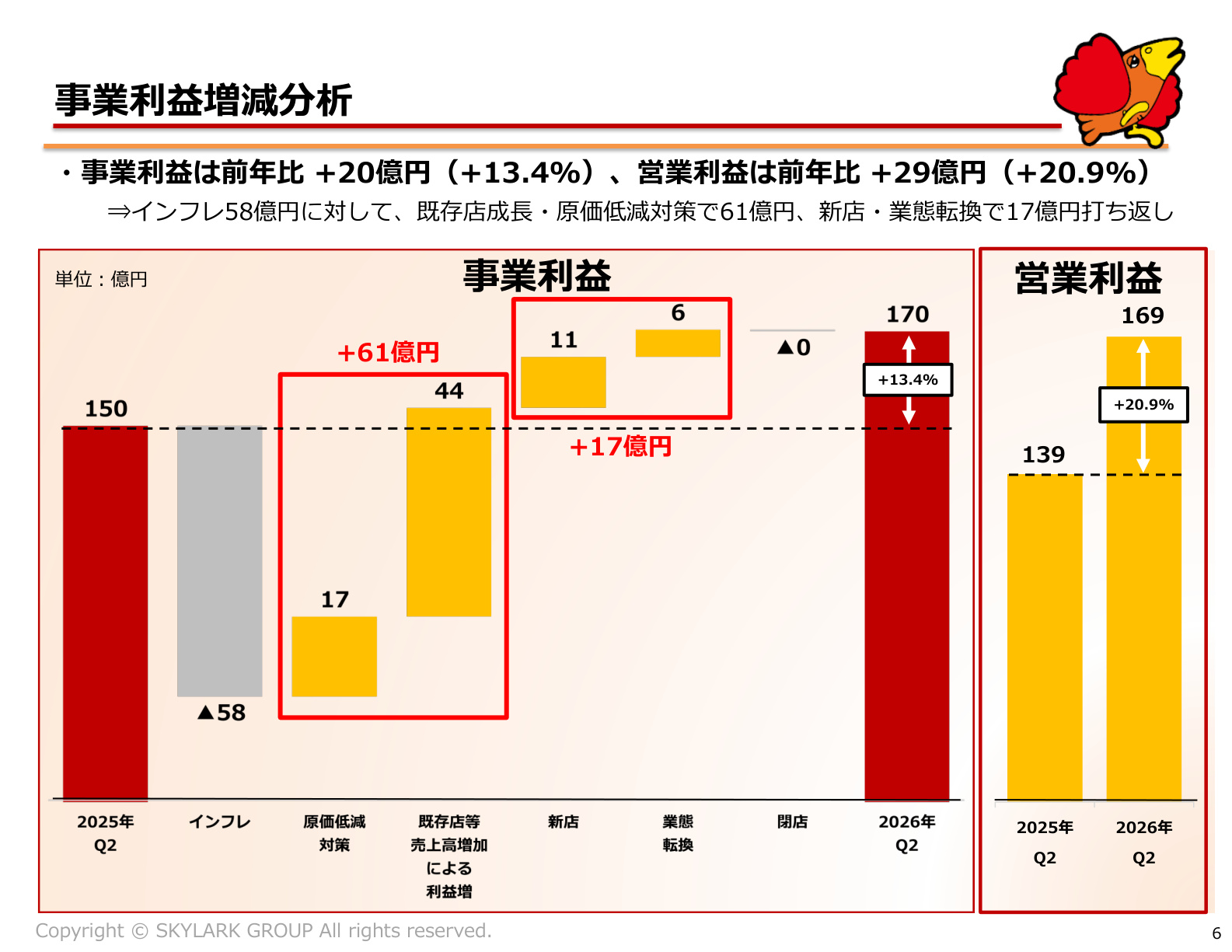
[Slide Analysis: Profit Growth Mechanism]
The slide above shows the progression from ¥15.0 billion in business profit in Q2 2025 to ¥17.0 billion in Q2 2026 (+13.4%).
- Inflationary Cost Increase (-¥5.8 billion) : Rising prices for food ingredients and labor were the primary factors impacting profit.
- Cost Reduction Measures (+¥1.7 billion) : Significant cost savings were achieved through procurement reforms, logistics efficiency, and reviews of recipes and ingredients.
- Existing-Store Sales Growth (+¥4.4 billion) : Increases in customer traffic and average spend powerfully offset the impact of inflation (a combined positive effect of +¥6.1 billion from points 1-3).
- New Store/Format Conversion Effect (+¥1.7 billion) : New openings and conversions to growth formats contributed steadily to profit.
As a result, the company has established a structure that effectively counters the estimated ¥14.5 billion annual inflationary impact through a dual approach of "top-line expansion" and "internal cost-reduction efforts."
3. Upward Revision of Full-Year Guidance and Dividends
Following strong progress in the first half, the company has upwardly revised its consolidated earnings and dividend forecasts for the fiscal year ending December 2026 .
Revisions to Full-Year Earnings Forecast (vs. Initial Guidance)
- Revenue : ¥500.0 billion (up ¥10.0 billion from the initial ¥490.0 billion)
- Business Profit : ¥37.0 billion (up ¥1.0 billion from the initial ¥36.0 billion)
- Operating Profit : ¥35.0 billion (up ¥1.5 billion from the initial ¥33.5 billion)
- Net Profit : ¥20.5 billion (up ¥1.0 billion from the initial ¥19.5 billion)
- Earnings Per Share (EPS) : ¥90.14 (up from the initial ¥85.71)
Revisions to Dividend Forecast
- Year-end Dividend Forecast : ¥17.00 (up ¥1.00 from the previous forecast of ¥16.00)
- Annual Dividend Forecast : ¥27.00 (including the ¥10.00 interim dividend, an increase of ¥5.00 compared to the previous year's ¥22.00)
Building on solid performance, the company is clearly strengthening its commitment to shareholder returns.
4. Updating Inflation Assumptions and Cost-Reduction Projects
The company has revised its annual inflation impact estimate for 2026 from ¥13.0 billion to ¥14.5 billion . The breakdown is as follows:
- Food Costs : ¥7.1 billion (due to high egg prices, rising chicken costs, etc.)
- Labor Costs : ¥5.2 billion (due to wage hikes and minimum wage revisions)
- Other : ¥2.2 billion (energy, logistics, etc.)
To counter this, the "Cost Reduction Project" focuses on price negotiations through relaxed procurement standards, expansion of in-house production and automation, promotion of ingredient modules, and thorough reduction of food waste at stores. In the first half, the company achieved ¥1.7 billion in savings against a target of ¥2.4 billion , serving as a key pillar for full-year cost control.
5. Market Strategy: A Precise Approach to "Consumer Polarization"
In the current dining-out market, there is a clear "polarization" between value-driven demand based on frugality and high-value demand seeking special experiences and quality.
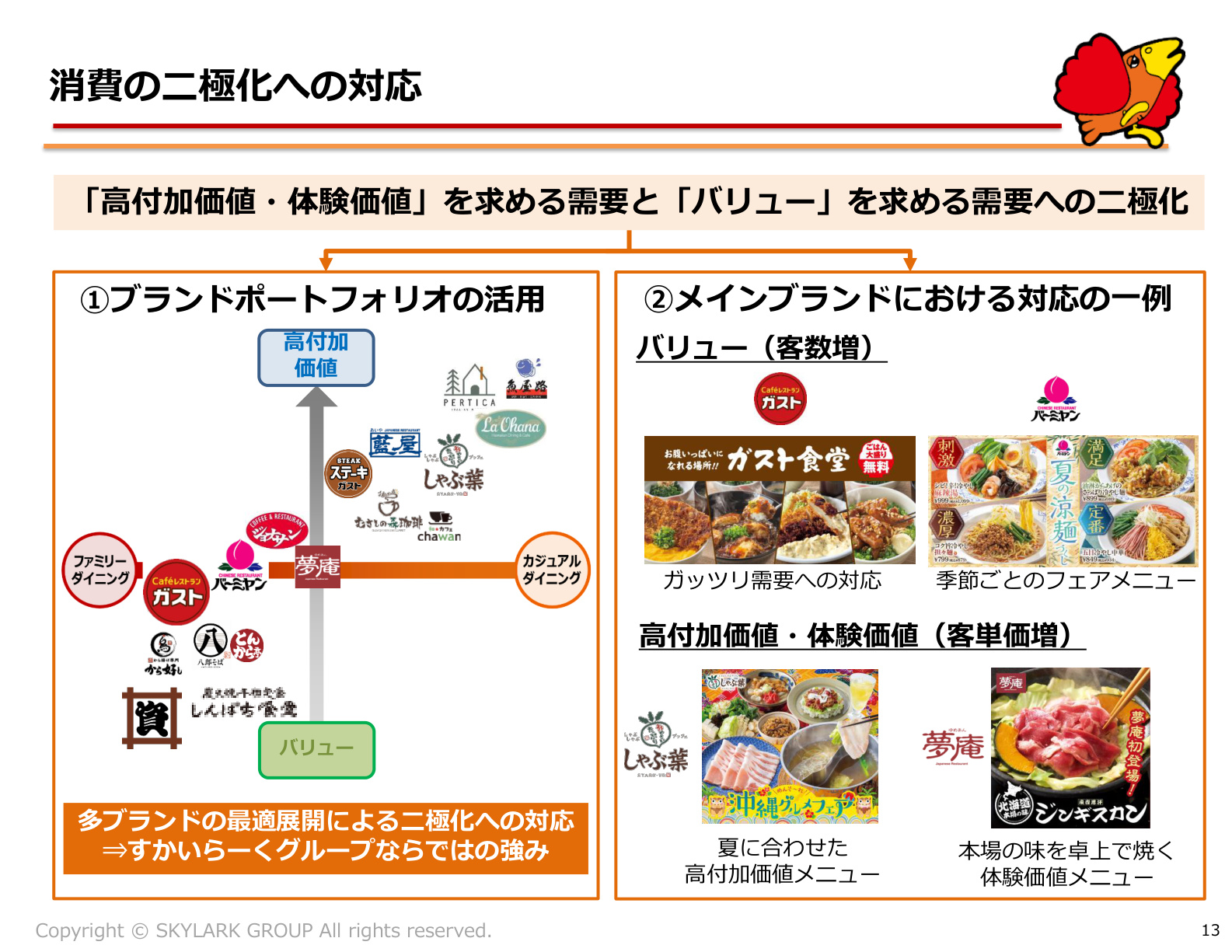
[Slide Analysis: Strengths of the Multi-Brand Portfolio]
This slide outlines how the Skylark Group leverages its diverse brand portfolio to respond to shifting consumer behavior.
- Pursuit of High Value and Experiential Value (Increasing Average Spend) :
- By offering "experiences only available in-store," such as seasonal/local fairs at "Syabu-Yo" (e.g., Okinawa gourmet fair) and tabletop Genghis Khan at "Yumean," the company has successfully raised average customer spend.
- Capturing Value Demand (Increasing Traffic) :
- By deploying menu items that provide satisfaction and fullness at affordable prices, such as "Gusto Shokudo" (free large rice portions) at the flagship "Gusto" brand and authentic cold noodle fairs at "Bamiyan," the company maintains and improves visit frequency across a wide customer base.
The ability to optimally place the right format according to location and target demographic is a unique strength of the company.
6. Leveraging Digital/AI and Maximizing the Membership Base (Approx. 16 Million Members)
The company utilizes its official app, which boasts a membership base of approximately 16 million , as a powerful customer acquisition platform.
- AI-Driven Personalization :
- The company delivers coupons tailored to individual consumption trends and uses AI menu recommendations on ordering tablets (suggesting add-on purchases) to increase average spend.
- Membership Impact :
- App members show 1.57x higher visit frequency and 108% higher average check compared to non-members. A virtuous cycle of membership growth, supported by acquisition campaigns and media exposure, is driving performance.
7. Non-Linear Growth Through M&A: "Sukesan Udon" and "Shinpachi Shokudo"
In addition to organic growth, the company is accelerating its expansion strategy through M&A of highly competitive brands.
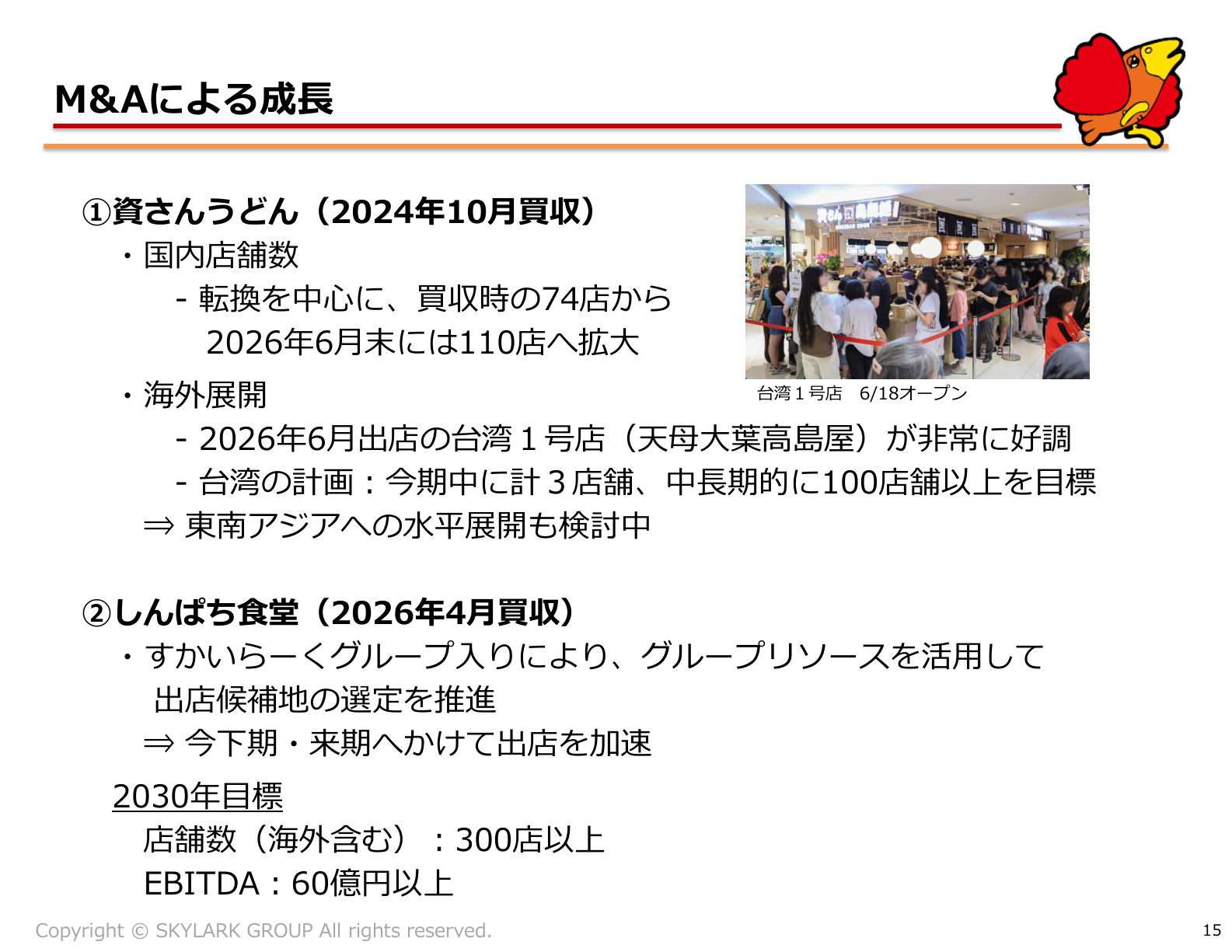
[Slide Analysis: Synergies and Growth Strategy via Group Integration]
This slide shows the progress and future vision of two key brands recently brought under the umbrella.
- Sukesan Udon (Acquired October 2024) :
- Expanded from 74 stores at the time of acquisition to 110 stores by the end of June 2026 , primarily through existing store conversions.
- Overseas Expansion : The first store in Taiwan (Tianmu Dayeh Takashimaya), opened in June 2026, is performing exceptionally well. The company plans to open 3 stores in Taiwan this fiscal year, building a foothold for future expansion into Southeast Asia.
- Shinpachi Shokudo (Acquired April 2026) :
- Leveraging Skylark Group's location-selection expertise and resources to accelerate openings from the second half onward.
- 2030 Goal : Aiming for over 300 stores and over ¥6.0 billion in EBITDA , positioning it as a new pillar of earnings.
Both brands possess strong product appeal, and by combining them with the company's nationwide deployment capabilities, significant synergies are being realized.
8. "Store-Centric Management" and Boosting On-Site Motivation
Based on the philosophy that "people are the driving force behind value creation," the company promotes "store-centric management" that does not rely solely on cost-cutting .
- Investment in the Frontline and Evaluation System Changes :
- Revised manager evaluation systems and incentives, introduced crew point systems, and enhanced training.
- Verification of Effects : According to earnings materials, stores with a higher number of "complimentary messages" show higher year-on-year traffic (+3.2% for stores with 7 or more messages) , directly linking to improvements in revenue and business profit margins.
- DX on the Frontline : By introducing cleanup time (CU time) management, scheduling apps, and self-checkout registers, the company aims to balance operational efficiency with improved customer satisfaction.
9. Store Development, Expansion Strategy, and Growth Potential
The total number of group stores reached 3,214 (as of the end of June 2026). In the first half of 2026, the company completed 21 new store openings, 26 format conversions, and 113 store renovations.
Diversification of store formats is progressing. The ratio of openings in highly concentrated commercial areas, along private railway lines in major cities, in front of local city stations, and in shopping centers has increased significantly compared to the traditional roadside-centric model (78.1% in 2019). The potential for new domestic openings for existing brands is estimated at 1,504 stores , leaving significant room for long-term growth.
10. Financial Position and Progress in ESG/Sustainability
Financial and Cash Flow Status
- Operating Cash Flow : ¥34.5 billion (+¥3.3 billion YoY), indicating improved core earning power.
- Free Cash Flow : Secured ¥8.4 billion (maintaining cash on hand while executing aggressive store investments and M&A).
- Financial Soundness : Proceeding with the lengthening of interest-bearing debt, maintaining a stable net D/E ratio of 0.55x and an equity ratio of 35.7% .
ESG Initiatives and External Evaluation
- Decarbonization : Through the introduction of "Virtual PPA" utilizing biomass power generation, the number of stores achieving net-zero CO2 emissions has expanded to 13 .
- External Certification : Received the highest rating of 5.0 in the "FTSE Russell ESG Rating" and was continuously selected for the GPIF-adopted index. The company was also selected as a "Supplier Engagement Leader" by the environmental NGO CDP for the second consecutive year, earning high praise for its ESG management.
Conclusion
In the second quarter of the fiscal year ending December 2026, Skylark Holdings effectively addressed inflationary cost pressures through "existing-store sales growth," "cost-reduction projects," and "appropriate pricing/value settings," achieving double-digit profit growth and an upward revision.
Furthermore, with the utilization of customer data via apps and AI, improved store productivity through DX, and M&A strategies and overseas expansion represented by "Sukesan Udon" and "Shinpachi Shokudo," this earnings report demonstrates a high level of balance between short-term profit improvement and the construction of a mid-to-long-term growth foundation.
This content is not intended as investment advice or a recommendation. Any opinions expressed are solely the personal views of each article.