


Oisix Q1 FY2027 Earnings Deep Dive: A Sustainable Growth Story Driven by Portfolio Restructuring and B2B Profitability

StockClub
Published: Aug 13, 2026, 10:13 AM
Sentiment Analysis

Oisix Inc. (Securities Code: 3182) reported its financial results for the first quarter (1Q) of the fiscal year ending March 2027. Despite a temporary decline in revenue due to the divestiture of non-core businesses in the previous year, the company achieved significant underlying growth in both revenue and profit , fueled by improved profitability in its core segments and a dramatic expansion in its B2B business. This report provides a comprehensive analysis of the 1Q earnings highlights, segment-specific performance, shifts in financial position, and the upward revision of full-year forecasts alongside mid-to-long-term strategies.
1. Earnings Highlights: 81% Surge in Operating Profit Excluding Divestiture Impact
For 1Q FY2027, consolidated results were as follows: Net Sales of 60,682 million yen (down 8.6% YoY) , EBITDA of 3,374 million yen (up 0.5% YoY) , Operating Profit of 2,271 million yen (up 23.6% YoY) , and Net Income Attributable to Owners of the Parent of 1,289 million yen (up 71.7% YoY) . Progress against full-year forecasts is tracking at approximately 25% across all key metrics, indicating a solid start to the fiscal year.
While the headline revenue shows a decline, this is a structural result of the divestiture of the vehicle and other businesses conducted in the previous fiscal year (which accounted for a 7.3 billion yen reduction in sales and a 600 million yen reduction in operating profit in 1Q). When adjusted for this divestiture, total company sales increased by 3% YoY , and operating profit surged by 81% YoY , demonstrating a substantial strengthening of the company's underlying earning power.
2. Segment Performance Analysis: B2B Profitability Leap and High-Efficiency Management
To better understand the earnings structure, we examine the detailed breakdown by segment and the segment profit/loss under the new reporting standards.
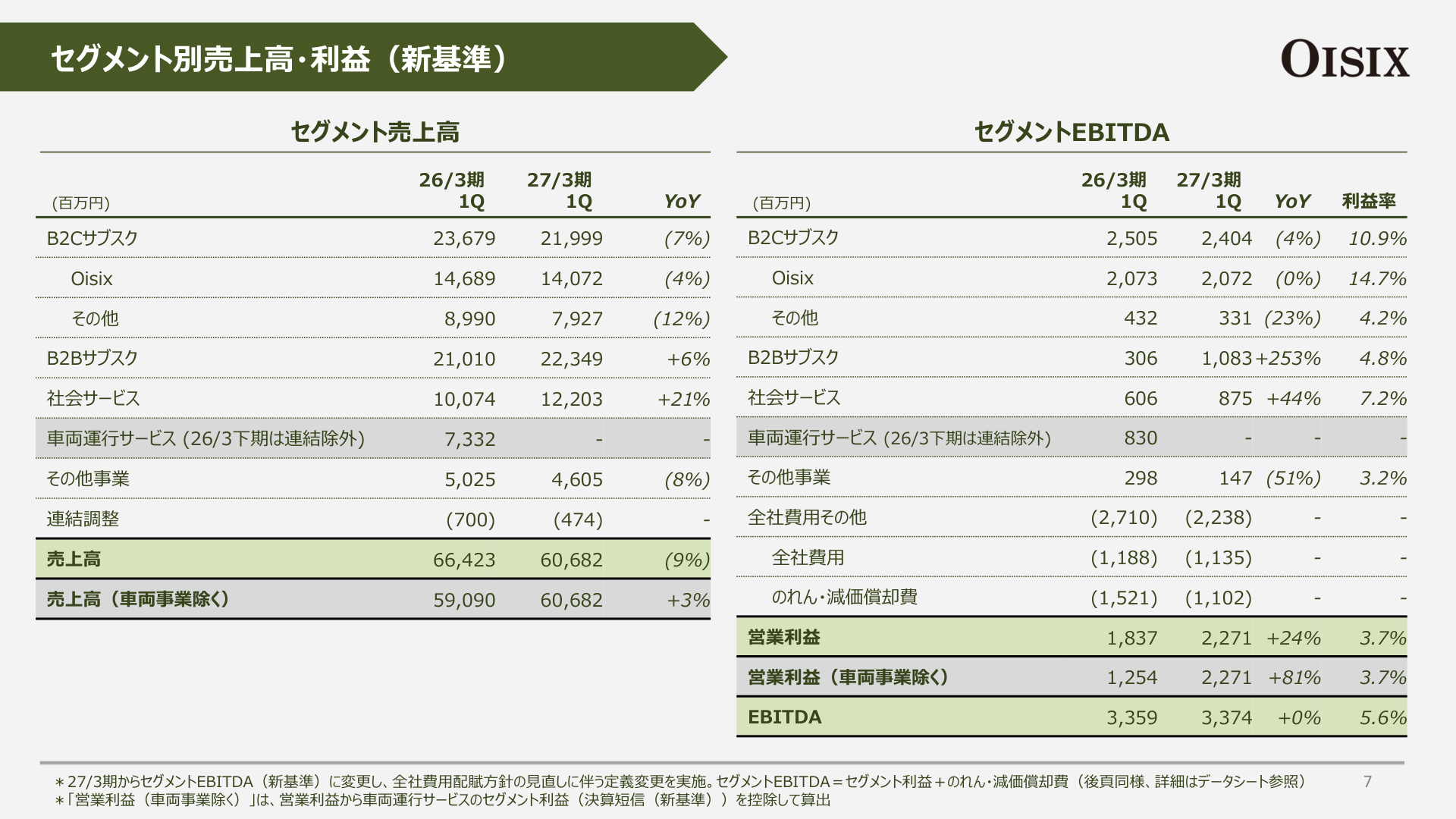
[Significance and Context of the Slide Above]
This slide is critical as it clearly distinguishes between headline figures—which include the divested "Vehicle Operation Service"—and the underlying growth trajectory excluding it. Notably, while total sales decreased by 9%, the underlying performance (excluding the vehicle business) shows a 3% increase in sales and an 81% increase in operating profit (expanding from 1,254 million yen to 2,271 million yen) , visually confirming the success of the company's portfolio restructuring.
-
B2C Subscription Business : Sales were 21,999 million yen (down 7% YoY), but segment EBITDA saw only a marginal decline to 2,404 million yen (down 4% YoY), maintaining a high EBITDA margin of 10.9% . The flagship "Oisix" brand is undergoing structural profitability improvements through optimized product allocation (reviewing sales frequency and cost of goods) and the curbing of unprofitable orders.
-
B2B Subscription Business : Sales reached 22,349 million yen (up 6% YoY), and segment EBITDA achieved a remarkable breakthrough of 1,083 million yen ( up 253% YoY, approximately 3.5x ). In addition to an increase in new contracts, primarily in school lunches, the standardization of on-site operations and price revisions have fully absorbed the impact of rising food and labor costs.
-
Social Service Business : Sales were 12,203 million yen (up 21% YoY), and segment EBITDA was 875 million yen (up 44% YoY), showing strong growth in both top-line and profit.
3. Deep Dive into the B2B Growth Engine and the "Genki Gohan" Rollout
The B2B business is currently the primary driver of Oisix's transformation in profit structure. Below, we track its growth trajectory and strategic details.
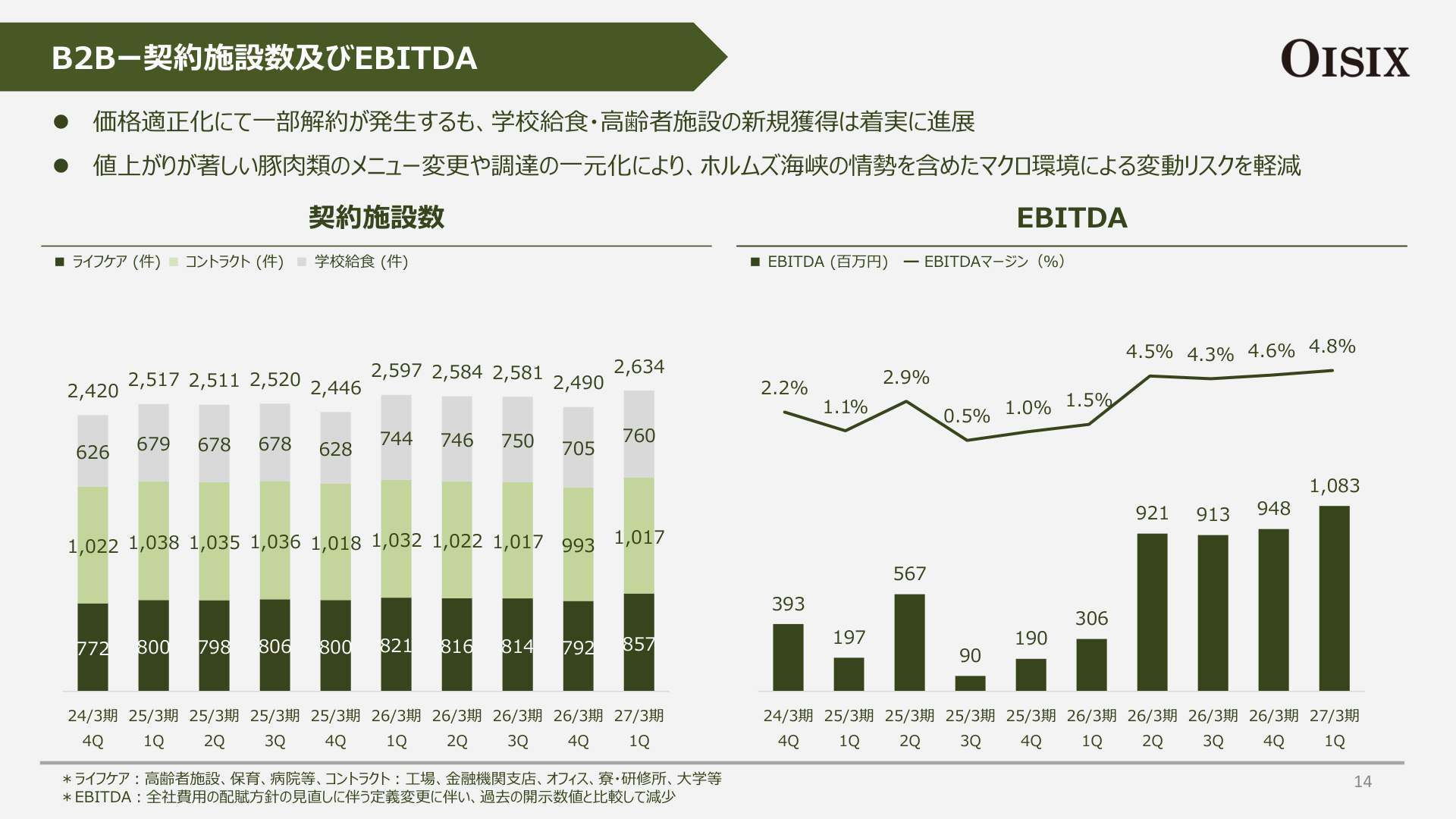
[Significance and Context of the Slide Above]
This slide illustrates the long-term time-series trends of two key B2B metrics: "Number of Contracted Facilities" and "EBITDA Margin." The EBITDA margin, which previously languished in the 1.0%–2.0% range, has surged to 4.8% . Combined with the steady increase in contracted facilities (2,634), this serves as evidence that the B2B business has firmly established itself as the company's "second pillar of profit."
■ Operational Standardization and AI-Driven Cost Control
In the B2B sector, the company has implemented 10-day cycle planning and actual performance alert management for food and labor costs, creating a system to identify and optimize trends at individual locations. Furthermore, starting in 3Q, the company plans to release an AI-based shift scheduling function that calculates optimal labor requirements based on meal count data, accelerating operational efficiency.
■ Full-Scale Launch of "Genki Gohan" for Elderly Care Facilities
"Genki Gohan," a fully prepared meal service for elderly care facilities, began its full-scale rollout in April 2026. In sampling and feedback surveys across approximately 1,500 facilities, 95% of facilities provided high ratings . Furthermore, 10% of facilities are "actively considering switching next fiscal year," and 40% are "considering a switch," forming a strong pipeline ahead of the November peak season for contract renewals.
4. B2C Customer Experience Enhancement and Unit Price Improvement
In the B2C segment, while the number of members remains steady at around 340,000–350,000, the company is focusing on increasing ARPU (Average Revenue Per User) and purchase frequency through UI/UX renewal and product diversification.
- Strengthening Deli Oisix : The production capacity for "Deli Oisix" (ready-to-heat meals) has been expanded by 1.4x , and the company has launched the "Deli Oisix 4-days Plan" with extended shelf life.
- Addressing Time-Saving Needs : The company is boosting purchase frequency among child-rearing households by introducing premium time-saving side dishes like the "Tasu-dake Series" and the "Super Easy Kit 3-Step" to minimize cooking effort and stress.
5. Strengthening Financial Position and Improving Capital Efficiency (ROE/ROIC)
Financially, the company has significantly improved its safety and capital efficiency through the reduction of interest-bearing debt and improved profitability.
- Interest-bearing debt : Reduced by 10.9% from 24,877 million yen at the end of FY26/3 to 22,154 million yen.
- Net Debt / EBITDA Ratio : Dropped significantly from 0.28x at the end of the previous year to 0.04x , reaching a very healthy state nearly devoid of net debt.
- ROE (Return on Equity) : Increased to 17.9% (from 16.4% at the end of FY26/3).
- ROIC (Return on Invested Capital) : Increased to 13.8% (from 12.4% at the end of FY26/3).
The combination of asset-conscious management and debt reduction has enhanced the company's ability to generate cash.
6. Upward Revision of Full-Year Forecasts, Dividends, and Capital Allocation
Concurrent with the earnings announcement, the company revised its full-year forecasts to reflect the results of its structural organizational restructuring.
■ Lower Tax Burden and EPS Upward Revision
Following the transition of the B2B business into a wholly-owned subsidiary in September 2025 and subsequent group-wide organizational restructuring (integration and mergers of major subsidiaries), the corporate tax burden is expected to decrease structurally. Consequently, while maintaining the initial full-year forecasts for sales (252,000 million yen) and operating profit (8,700 million yen), the company has upwardly revised its Earnings Per Share (EPS) forecast from 132.4 yen to 150.0 yen .
■ Dividend Increase Announcement
In line with the EPS revision, the company has raised its full-year dividend forecast to 30 yen per share (a 10 yen increase from the previous year's 20 yen).
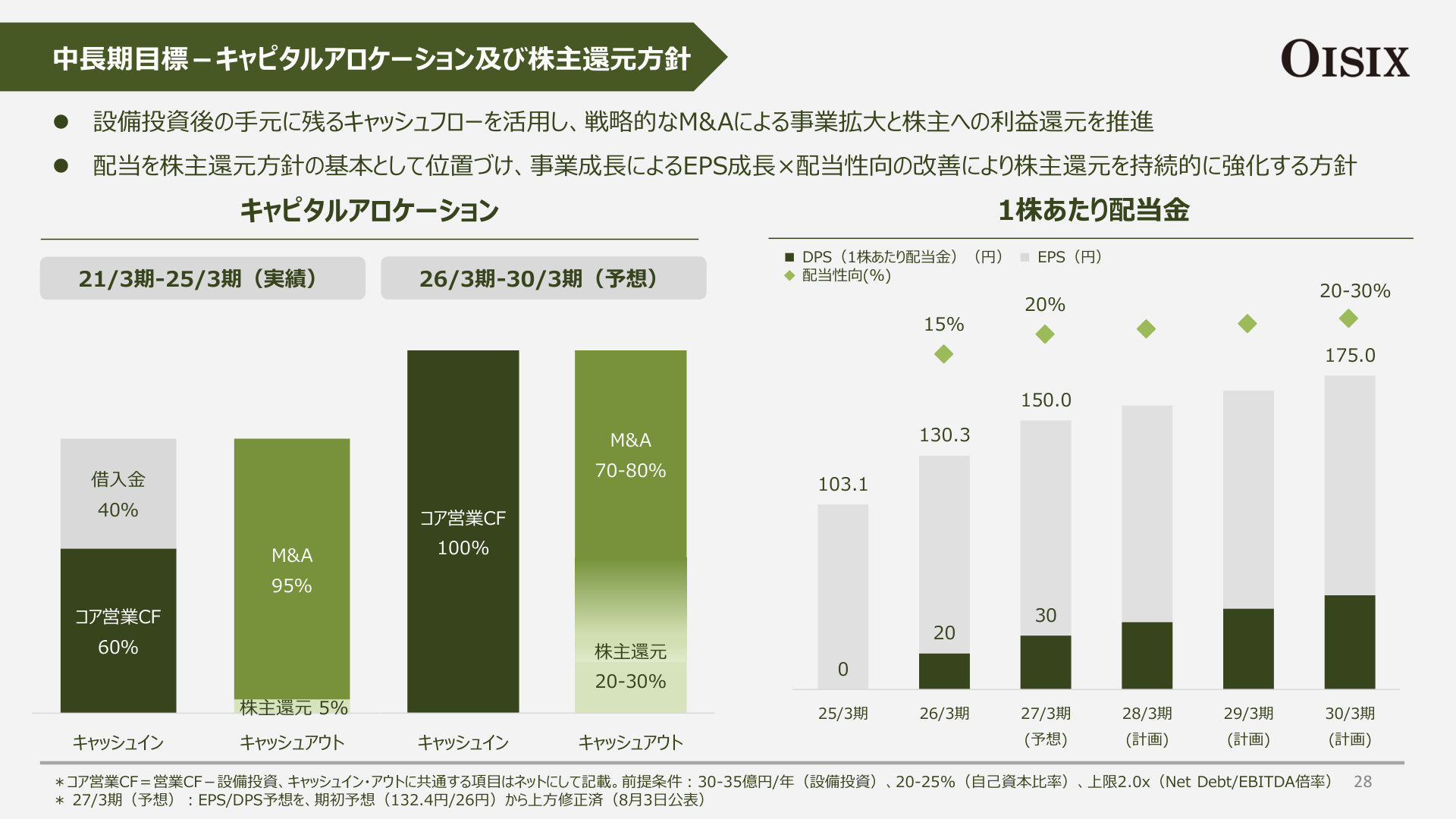
[Significance and Context of the Slide Above]
This slide systematically summarizes the company's mid-to-long-term capital allocation plan and dividend policy. It outlines a basic policy of allocating 100% of core operating cash flow to growth investments (70-80% for M&A) and shareholder returns (20-30%), clearly signaling the intent to gradually raise the dividend payout ratio toward a 20-30% target .
7. Mid-to-Long-Term Growth Story (2030 Targets)
Following its corporate name change to "Oisix" (July 2026), the company is accelerating the concentration of management resources on its core businesses. The following targets have been set for the fiscal year ending March 2030:
- Net Sales : 325 billion yen (CAGR of 5% vs. FY25/3 / 7% CAGR excluding vehicle business)
- EBITDA : 19 billion yen (CAGR of 8% vs. FY25/3 / 13% CAGR excluding vehicle business)
- EPS : 175.0 yen (CAGR of 11% vs. FY25/3)
The core of the future growth story lies in organic top-line growth in the B2B business (expansion of contracted facilities) and expansion of EBITDA margins , as well as the promotion of roll-up M&A in the food distribution industry. Having completed the divestiture of non-essential businesses (vehicle business) and the strengthening of core operations, the company has transitioned into a phase of sustainable corporate value enhancement focused on profitability and capital efficiency.
This content is not intended as investment advice or a recommendation. Any opinions expressed are solely the personal views of each article.